



Community hub
Recent from talks
Knowledge base stats:
Talk channels stats:
Members stats:
Hino Contessa
The Hino Contessa is an automobile which was produced by Hino Motors from 1961 to 1967.
The Contessa was developed largely from the 1947–1961 Renault 4CV powertrain under license to Hino Motors. Offered in both coupe and sedan bodystyles, it replaced the Hino Renault, which was the Renault 4CV manufactured by Hino for Japan. It was adapted into a small pickup truck called the Hino Briska, but used a front engine and rear drive powertrain, while the Contessa used a rear engine and rear drive setup. The PC series coupé was designed by Giovanni Michelotti, while the second generation was longer and wider in both coupé and sedan bodystyles.
Unlike many cars found internationally of this time period, using rear drive and rear engined powertrains, the Contessa was water-cooled rather than air-cooled. The name contessa is Italian for a countess.
47,299 of the PC-series Contessa were built, between April 1961 and the second quarter of 1964. With an 893 cc version of the Renault-based GP engine, max power is 35 PS (26 kW; 35 hp) which provides a top speed of 110 km/h (68 mph). The first Contessa originally received a three-speed column mounted shifter, later a four-speed manual became optional, utilizing an electromagnetic clutch apparatus called Shinko-Hinomatic. The gear change came in for a certain amount of criticism, a result of its long and cumbersome linkage from the steering column to the rear-mounted transmission.
As Hino had a business relationship with Renault at the time, and the powertrain was largely adapted from an existing Renault product, there are clear similarities to the Renault Dauphine. The drivetrain and suspension were carried over from the Hino Renault 4CV (series PA). The main improvement over the 4CV was that the Contessa 900 was a full five-seater, making it a much stronger competitor. The engine was installed longitudinally, meaning the radiator was against the outer edge of the engine bay, whereas the Renault installed the radiator against the firewall, and the Hino engine sat in a north-south orientation with the transmission attached inside the engine bay next to the Contessa's firewall. The engine was slanted to the left, and utilized a crossflow cylinder head. The rear suspension used swing axles.
The first Contessa was never intended for export, although foreign language brochures were printed up for the Michelotti-designed Contessa 900 Sprint Coupé. Aside from the stylish bodywork, the 100 kg lighter Sprint (650 kg or 1,430 lb) also benefitted from an Officine Nardi-tuned engine (and matching steering wheel) with Weber carburetors and 45 PS (33 kW; 44 hp). The Sprint was introduced at both the 10th Tokyo Auto Show, and the Turin Motor Show in 1962, and followed at the New York Auto Show in 1963. Top speed was claimed to be 140 km/h (87 mph). So that there would be no doubts about its provenance, the scuff plates at the bottom of the door apertures read "Hino-Michelotti". The Sprint had a floor-mounted shifter.
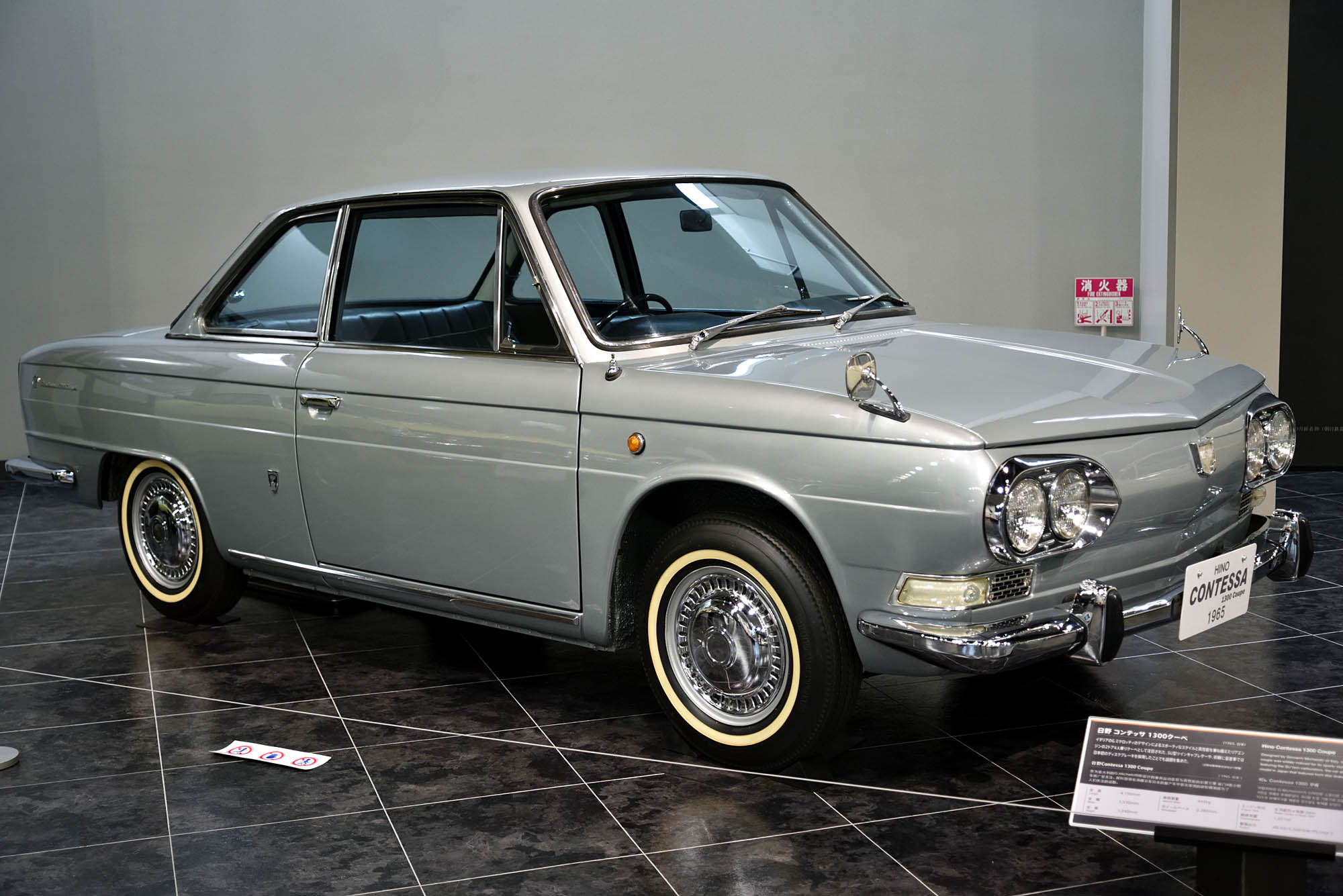
The second generation Contessa debuted in September 1964, with exterior design by Giovanni Michelotti on the Contessa Coupe, (who had sold a very similar design to Triumph for their 1300). While considerably longer and heavier, the PD Contessa also had a much more powerful 1,251 cc four-cylinder engine with five main bearings ("GR100", 55 PS or 40 kW or 54 hp). With a four-speed manual transmission, top speed is 130 km/h (81 mph). A handsome coupé version was presented in April 1965; the coupé benefitted from an upgraded engine with twin carburetors and slightly higher compression and 65 PS (48 kW; 64 hp) from November of the same year. With chassis code PD300/400 (versus PD100/200 for the regular sedan), this sporting version was marketed as the "1300S". There was also an LPG-powered version in Standard or Deluxe trim; in this specification the engine produces 52 PS (38 kW) at 5000 rpm.
100 and 300-series are right-hand drive, while 200 and 400-series are left-hand drive. The use of twin headlights does contribute to a mild similarity to the Renault 8, and the second generation Chevrolet Corvair, and the lack of a front grille because the Contessa, Renault and the Corvair are both rear engined and rear cooled (air for the Corvair, water for the Contessa and Renault). Early Standard versions did not receive bumper horns and were fitted with single front headlamps with blanks where the second set would have gone. Later on, the Standard (of which very few survive) received the same headlamps and bumpers as the De Luxe, albeit with painted rather than chromed bumpers.
Hub AI
Hino Contessa AI simulator
(@Hino Contessa_simulator)
Hino Contessa
The Hino Contessa is an automobile which was produced by Hino Motors from 1961 to 1967.
The Contessa was developed largely from the 1947–1961 Renault 4CV powertrain under license to Hino Motors. Offered in both coupe and sedan bodystyles, it replaced the Hino Renault, which was the Renault 4CV manufactured by Hino for Japan. It was adapted into a small pickup truck called the Hino Briska, but used a front engine and rear drive powertrain, while the Contessa used a rear engine and rear drive setup. The PC series coupé was designed by Giovanni Michelotti, while the second generation was longer and wider in both coupé and sedan bodystyles.
Unlike many cars found internationally of this time period, using rear drive and rear engined powertrains, the Contessa was water-cooled rather than air-cooled. The name contessa is Italian for a countess.
47,299 of the PC-series Contessa were built, between April 1961 and the second quarter of 1964. With an 893 cc version of the Renault-based GP engine, max power is 35 PS (26 kW; 35 hp) which provides a top speed of 110 km/h (68 mph). The first Contessa originally received a three-speed column mounted shifter, later a four-speed manual became optional, utilizing an electromagnetic clutch apparatus called Shinko-Hinomatic. The gear change came in for a certain amount of criticism, a result of its long and cumbersome linkage from the steering column to the rear-mounted transmission.
As Hino had a business relationship with Renault at the time, and the powertrain was largely adapted from an existing Renault product, there are clear similarities to the Renault Dauphine. The drivetrain and suspension were carried over from the Hino Renault 4CV (series PA). The main improvement over the 4CV was that the Contessa 900 was a full five-seater, making it a much stronger competitor. The engine was installed longitudinally, meaning the radiator was against the outer edge of the engine bay, whereas the Renault installed the radiator against the firewall, and the Hino engine sat in a north-south orientation with the transmission attached inside the engine bay next to the Contessa's firewall. The engine was slanted to the left, and utilized a crossflow cylinder head. The rear suspension used swing axles.
The first Contessa was never intended for export, although foreign language brochures were printed up for the Michelotti-designed Contessa 900 Sprint Coupé. Aside from the stylish bodywork, the 100 kg lighter Sprint (650 kg or 1,430 lb) also benefitted from an Officine Nardi-tuned engine (and matching steering wheel) with Weber carburetors and 45 PS (33 kW; 44 hp). The Sprint was introduced at both the 10th Tokyo Auto Show, and the Turin Motor Show in 1962, and followed at the New York Auto Show in 1963. Top speed was claimed to be 140 km/h (87 mph). So that there would be no doubts about its provenance, the scuff plates at the bottom of the door apertures read "Hino-Michelotti". The Sprint had a floor-mounted shifter.
The second generation Contessa debuted in September 1964, with exterior design by Giovanni Michelotti on the Contessa Coupe, (who had sold a very similar design to Triumph for their 1300). While considerably longer and heavier, the PD Contessa also had a much more powerful 1,251 cc four-cylinder engine with five main bearings ("GR100", 55 PS or 40 kW or 54 hp). With a four-speed manual transmission, top speed is 130 km/h (81 mph). A handsome coupé version was presented in April 1965; the coupé benefitted from an upgraded engine with twin carburetors and slightly higher compression and 65 PS (48 kW; 64 hp) from November of the same year. With chassis code PD300/400 (versus PD100/200 for the regular sedan), this sporting version was marketed as the "1300S". There was also an LPG-powered version in Standard or Deluxe trim; in this specification the engine produces 52 PS (38 kW) at 5000 rpm.
100 and 300-series are right-hand drive, while 200 and 400-series are left-hand drive. The use of twin headlights does contribute to a mild similarity to the Renault 8, and the second generation Chevrolet Corvair, and the lack of a front grille because the Contessa, Renault and the Corvair are both rear engined and rear cooled (air for the Corvair, water for the Contessa and Renault). Early Standard versions did not receive bumper horns and were fitted with single front headlamps with blanks where the second set would have gone. Later on, the Standard (of which very few survive) received the same headlamps and bumpers as the De Luxe, albeit with painted rather than chromed bumpers.