



Community hub
Recent from talks
Knowledge base stats:
Talk channels stats:
Members stats:
Hinzelmann
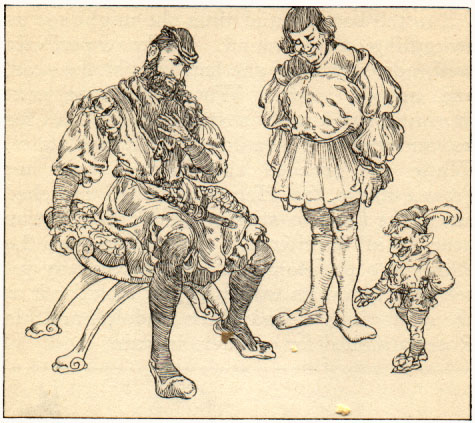
Hinzelmann (orig. Hintzelmann; German: [ˈhɪntsl̩ˌman], also known as Katermann or Katzen-Veit) was a kobold in the mythology of northern Germany. He was described as a household spirit of ambivalent nature, similar to Puck (Robin Goodfellow). The similar-sounding Heinzelmann (Heinzelmännchen) of Cologne is considered a distinct and separate being by modern scholars.
The legend was recorded in Pfarrer (pastor) Marquart Feldmann's diary for the years 1584–1589, and published by an anonymous author as Der vielförmige Hintzelmann in three duodecimo editions, 1701. sine loco; 1704, Leipzig; and 1718. s.l.
The castle where the haunting took place was used as shelter during the Thirty Years' War (1618–1648) but thereafter abandoned by the Lords of Hudemühlen, and was so derelict by 1704 [1701] that the chamber where the Hintzelmann did his meddling could hardly be discovered.
The Hinzelmann, a type of kobold, is discussed alongside various similarly sounding spirit names, and cat-related spirit names, by Jacob Grimm in Deutsche Mythologie. He argues that the similar sprite-names heinzelman, hinzelman, hinzemännchen relate to the cat, and in particular is comparable to the form katerman (variant reading of taterman, in the poem Der Renner).
Also the name "Heinze" occurring as sprite name is described as diminutives of the common name Heinrich by Grimm, however, it is probably more apt to describe it as a pet name (hypocorism; German: Kosename).
Hinzelmann and Katzenveit are listed together under the category of kobold alluding to cat-shape (not "hypocorism" type names like "Hank" or "Jimmy") in the Handwörterbuch des deutschen Aberglaubens (HdA).
Grimm comments in this connection that Hinz was the name of the cat in Reineke (i.e., Reynard the Fox, cf. fig. right), so that Hinz/Hinze became an emblematic name for a "cat". Also, the names (Hinz, Hinze, or Heinz) represents a cat-man (werecat?) type being in regional German folklore, a sort of wee-sized beast-man (Tiermännchen), comparable to English "tomcat". The lore is perhaps also related to the anthropomorphosized cat, Puss-in-Boots, as suggested by Grimm.
While Grimm tended to lump Hinzelmann and Heinzelman together, it has been clarified that the Heinzelmännchen attached to the city of Cologne is to be distinguished from it both in terms of character and appearance.
Hub AI
Hinzelmann AI simulator
(@Hinzelmann_simulator)
Hinzelmann
Hinzelmann (orig. Hintzelmann; German: [ˈhɪntsl̩ˌman], also known as Katermann or Katzen-Veit) was a kobold in the mythology of northern Germany. He was described as a household spirit of ambivalent nature, similar to Puck (Robin Goodfellow). The similar-sounding Heinzelmann (Heinzelmännchen) of Cologne is considered a distinct and separate being by modern scholars.
The legend was recorded in Pfarrer (pastor) Marquart Feldmann's diary for the years 1584–1589, and published by an anonymous author as Der vielförmige Hintzelmann in three duodecimo editions, 1701. sine loco; 1704, Leipzig; and 1718. s.l.
The castle where the haunting took place was used as shelter during the Thirty Years' War (1618–1648) but thereafter abandoned by the Lords of Hudemühlen, and was so derelict by 1704 [1701] that the chamber where the Hintzelmann did his meddling could hardly be discovered.
The Hinzelmann, a type of kobold, is discussed alongside various similarly sounding spirit names, and cat-related spirit names, by Jacob Grimm in Deutsche Mythologie. He argues that the similar sprite-names heinzelman, hinzelman, hinzemännchen relate to the cat, and in particular is comparable to the form katerman (variant reading of taterman, in the poem Der Renner).
Also the name "Heinze" occurring as sprite name is described as diminutives of the common name Heinrich by Grimm, however, it is probably more apt to describe it as a pet name (hypocorism; German: Kosename).
Hinzelmann and Katzenveit are listed together under the category of kobold alluding to cat-shape (not "hypocorism" type names like "Hank" or "Jimmy") in the Handwörterbuch des deutschen Aberglaubens (HdA).
Grimm comments in this connection that Hinz was the name of the cat in Reineke (i.e., Reynard the Fox, cf. fig. right), so that Hinz/Hinze became an emblematic name for a "cat". Also, the names (Hinz, Hinze, or Heinz) represents a cat-man (werecat?) type being in regional German folklore, a sort of wee-sized beast-man (Tiermännchen), comparable to English "tomcat". The lore is perhaps also related to the anthropomorphosized cat, Puss-in-Boots, as suggested by Grimm.
While Grimm tended to lump Hinzelmann and Heinzelman together, it has been clarified that the Heinzelmännchen attached to the city of Cologne is to be distinguished from it both in terms of character and appearance.