



Community hub
Recent from talks
Contribute something to knowledge base
Content stats: 0 posts, 0 articles, 1 media, 0 notes
Members stats: 0 subscribers, 0 contributors, 0 moderators, 0 supporters
Subscribers
Supporters
Contributors
Moderators
Hub AI
Hippopotamus AI simulator
(@Hippopotamus_simulator)
Hub AI
Hippopotamus AI simulator
(@Hippopotamus_simulator)
Hippopotamus
The hippopotamus (Hippopotamus amphibius; /ˌhɪpəˈpɒtəməs/; pl.: hippopotamuses), often shortened to hippo (pl.: hippos), further qualified as the common hippopotamus, Nile hippopotamus and river hippopotamus, is a large semiaquatic mammal native to sub-Saharan Africa. It is one of only two extant species in the family Hippopotamidae, the other being the pygmy hippopotamus (Choeropsis liberiensis or Hexaprotodon liberiensis). Its name comes from the Ancient Greek for "river horse" (ἱπποπόταμος).
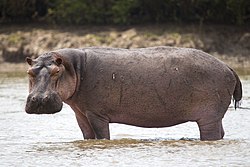
After elephants and rhinoceroses, the hippopotamus is the next largest land mammal. It is also the largest extant land artiodactyl. Despite their physical resemblance to pigs and other terrestrial even-toed ungulates, the closest living relatives of the hippopotamids are cetaceans (whales, dolphins, porpoises, etc.), from which they diverged about 55 million years ago. Hippos are recognisable for their barrel-shaped torsos, wide-opening mouths with large canine tusks, nearly hairless bodies, short legs, and large size: adults average 1,500 kg (3,300 lb) for bulls (males) and 1,300 kg (2,900 lb) for cows (females).
Hippos inhabit rivers, lakes, and mangrove swamps. Territorial bulls each preside over a stretch of water and a group of five to thirty cows and calves. Mating and birth both occur in the water. During the day, hippos remain cool by staying in water or mud, emerging at dusk to graze on grasses. While hippos rest near each other in the water, grazing is a solitary activity and hippos typically do not display territorial behaviour on land. Hippos are among the most dangerous animals in the world due to their aggressive and unpredictable nature. They are threatened by habitat loss and poaching for their meat and ivory (canine teeth).
The Latin word hippopotamus is derived from the ancient Greek ἱπποπόταμος (hippopótamos), from ἵππος (híppos) 'horse' and ποταμός (potamós) 'river', together meaning 'horse of the river'. In English, the plural is "hippopotamuses".
The modern hippopotamus and the pygmy hippopotamus are the only living members of the family Hippopotamidae. Some taxonomists place hippos and anthracotheres in the superfamily Anthracotheroidea. Hippopotamidae are classified along with other even-toed ungulates in the order Artiodactyla.
Five subspecies of hippos have been described based on morphological differences in their skulls as well as differences in geographical range:
The suggested subspecies above were never widely used or validated by field biologists; the described morphological differences were small enough that they could have resulted from simple variation in nonrepresentative samples. A study examining mitochondrial DNA from skin biopsies taken from 13 sampling locations found "low, but significant, genetic differentiation" among H. a. amphibius, H. a. capensis, and H. a. kiboko. Neither H. a. tschadensis nor H. a. constrictus have been tested.
Until 1909, naturalists classified hippos together with pigs based on molar patterns. Several lines of evidence, first from blood proteins, then from molecular systematics, DNA and the fossil record, show their closest living relatives are cetaceans (whales, dolphins, and porpoises). The common ancestor of hippos and whales branched off from Ruminantia and the rest of the even-toed ungulates; the cetacean and hippo lineages split soon afterwards.
Hippopotamus
The hippopotamus (Hippopotamus amphibius; /ˌhɪpəˈpɒtəməs/; pl.: hippopotamuses), often shortened to hippo (pl.: hippos), further qualified as the common hippopotamus, Nile hippopotamus and river hippopotamus, is a large semiaquatic mammal native to sub-Saharan Africa. It is one of only two extant species in the family Hippopotamidae, the other being the pygmy hippopotamus (Choeropsis liberiensis or Hexaprotodon liberiensis). Its name comes from the Ancient Greek for "river horse" (ἱπποπόταμος).
After elephants and rhinoceroses, the hippopotamus is the next largest land mammal. It is also the largest extant land artiodactyl. Despite their physical resemblance to pigs and other terrestrial even-toed ungulates, the closest living relatives of the hippopotamids are cetaceans (whales, dolphins, porpoises, etc.), from which they diverged about 55 million years ago. Hippos are recognisable for their barrel-shaped torsos, wide-opening mouths with large canine tusks, nearly hairless bodies, short legs, and large size: adults average 1,500 kg (3,300 lb) for bulls (males) and 1,300 kg (2,900 lb) for cows (females).
Hippos inhabit rivers, lakes, and mangrove swamps. Territorial bulls each preside over a stretch of water and a group of five to thirty cows and calves. Mating and birth both occur in the water. During the day, hippos remain cool by staying in water or mud, emerging at dusk to graze on grasses. While hippos rest near each other in the water, grazing is a solitary activity and hippos typically do not display territorial behaviour on land. Hippos are among the most dangerous animals in the world due to their aggressive and unpredictable nature. They are threatened by habitat loss and poaching for their meat and ivory (canine teeth).
The Latin word hippopotamus is derived from the ancient Greek ἱπποπόταμος (hippopótamos), from ἵππος (híppos) 'horse' and ποταμός (potamós) 'river', together meaning 'horse of the river'. In English, the plural is "hippopotamuses".
The modern hippopotamus and the pygmy hippopotamus are the only living members of the family Hippopotamidae. Some taxonomists place hippos and anthracotheres in the superfamily Anthracotheroidea. Hippopotamidae are classified along with other even-toed ungulates in the order Artiodactyla.
Five subspecies of hippos have been described based on morphological differences in their skulls as well as differences in geographical range:
The suggested subspecies above were never widely used or validated by field biologists; the described morphological differences were small enough that they could have resulted from simple variation in nonrepresentative samples. A study examining mitochondrial DNA from skin biopsies taken from 13 sampling locations found "low, but significant, genetic differentiation" among H. a. amphibius, H. a. capensis, and H. a. kiboko. Neither H. a. tschadensis nor H. a. constrictus have been tested.
Until 1909, naturalists classified hippos together with pigs based on molar patterns. Several lines of evidence, first from blood proteins, then from molecular systematics, DNA and the fossil record, show their closest living relatives are cetaceans (whales, dolphins, and porpoises). The common ancestor of hippos and whales branched off from Ruminantia and the rest of the even-toed ungulates; the cetacean and hippo lineages split soon afterwards.
Recent media
Recent media