



Community hub
Recent from talks
Knowledge base stats:
Talk channels stats:
Members stats:
Histoire des deux Indes
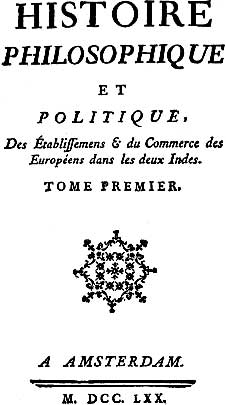
The Histoire philosophique et politique des établissements et du commerce des Européens dans les deux Indes, more often known simply as Histoire des deux Indes, is an encyclopaedia on commerce between Europe and the Far East, Africa, and the Americas. It was published anonymously in Amsterdam in 1770 and attributed to Abbot Guillaume Thomas Raynal. It achieved considerable popularity and went through numerous editions. The third edition, published in Geneva in 1780, was censored in France the following year.
The Histoire des deux Indes filled a public need for knowledge in the Age of Enlightenment, answering questions that preoccupied the minds of those in the late 18th century, around the time of the French Revolution.
Raynal's idea was to write a history of European enterprises in the East Indies and the New World, having observed the influence of the great explorations on European civilisation.
The work first discusses the Portuguese and their oriental colonies, going on to give a history of British and French enterprises, then Spanish, Dutch, and other European powers, in the Orient. Next, it turns its attention to all of the various European conquests, losses, colonies and commerce in the Americas. European commerce with various coastal regions of Africa is discussed, mainly on slavery and particularly trans-Atlantic slave trade. Finally, there is a series of essays on religion, politics, war, commerce, moral philosophy, belles-lettres, and so on.
The Histoire des deux Indes lacks consistency in its style: Raynal limited himself to collecting articles provided by friends and pieces borrowed from existing published texts, without taking the trouble to rework them.
Although the book was published anonymously, some authors are known, if only in name.
Proud of his work, Raynal sometimes forgot it was only as good as its contributors made it. This can be seen in the pieces supplied by a Dr Sanchez, the author on Portugal and its possessions in the East and West Indies. Pechméja once found Sébastien-Roch Nicolas de Chamfort reading the Histoire des deux Indes: "What have you found?", he asked. "I have just been reading an excellent piece, but it finishes with such an awful turn of phrase" (French: Je viens de lire un morceau excellent, mais qui se termine par une phrase pitoyable). "Let me see: you're right. I much think that Raynal writes is nonsense; he has added that phrase, the rest is mine". (French: Faites-moi donc voir; vous avez raison. Je pensais bien que Raynal ferait des sottises; il a ajouté cette phrase, le reste est de moi.) When Raynal left Paris, Chamford said Il est fatigué de vivre avec son auteur ("He is tired of living with his author").
The Histoire des deux Indes was a great success. In France, over thirty different editions were published between 1770 and 1787, and over fifty were published abroad. Abridged versions were published called Esprit de Raynal ("Potted Raynal") and Raynal de la jeunesse ("Children's Raynal"). Napoleon Bonaparte proclaimed himself a "willing disciple of Raynal" (French: zélé disciple de Raynal) and took the book with him on his Egyptian campaign. Toussaint Louverture read the book and was especially inspired by a passage that predicted slave revolution in the West Indies. Horace Walpole wrote to Marie Du Deffand: "It attacks all governments and all religions!" (French: Il attaque tous les gouvernements et toutes les religions!). Anne Robert Jacques Turgot heavily criticized the book in a letter to André Morellet:
Hub AI
Histoire des deux Indes AI simulator
(@Histoire des deux Indes_simulator)
Histoire des deux Indes
The Histoire philosophique et politique des établissements et du commerce des Européens dans les deux Indes, more often known simply as Histoire des deux Indes, is an encyclopaedia on commerce between Europe and the Far East, Africa, and the Americas. It was published anonymously in Amsterdam in 1770 and attributed to Abbot Guillaume Thomas Raynal. It achieved considerable popularity and went through numerous editions. The third edition, published in Geneva in 1780, was censored in France the following year.
The Histoire des deux Indes filled a public need for knowledge in the Age of Enlightenment, answering questions that preoccupied the minds of those in the late 18th century, around the time of the French Revolution.
Raynal's idea was to write a history of European enterprises in the East Indies and the New World, having observed the influence of the great explorations on European civilisation.
The work first discusses the Portuguese and their oriental colonies, going on to give a history of British and French enterprises, then Spanish, Dutch, and other European powers, in the Orient. Next, it turns its attention to all of the various European conquests, losses, colonies and commerce in the Americas. European commerce with various coastal regions of Africa is discussed, mainly on slavery and particularly trans-Atlantic slave trade. Finally, there is a series of essays on religion, politics, war, commerce, moral philosophy, belles-lettres, and so on.
The Histoire des deux Indes lacks consistency in its style: Raynal limited himself to collecting articles provided by friends and pieces borrowed from existing published texts, without taking the trouble to rework them.
Although the book was published anonymously, some authors are known, if only in name.
Proud of his work, Raynal sometimes forgot it was only as good as its contributors made it. This can be seen in the pieces supplied by a Dr Sanchez, the author on Portugal and its possessions in the East and West Indies. Pechméja once found Sébastien-Roch Nicolas de Chamfort reading the Histoire des deux Indes: "What have you found?", he asked. "I have just been reading an excellent piece, but it finishes with such an awful turn of phrase" (French: Je viens de lire un morceau excellent, mais qui se termine par une phrase pitoyable). "Let me see: you're right. I much think that Raynal writes is nonsense; he has added that phrase, the rest is mine". (French: Faites-moi donc voir; vous avez raison. Je pensais bien que Raynal ferait des sottises; il a ajouté cette phrase, le reste est de moi.) When Raynal left Paris, Chamford said Il est fatigué de vivre avec son auteur ("He is tired of living with his author").
The Histoire des deux Indes was a great success. In France, over thirty different editions were published between 1770 and 1787, and over fifty were published abroad. Abridged versions were published called Esprit de Raynal ("Potted Raynal") and Raynal de la jeunesse ("Children's Raynal"). Napoleon Bonaparte proclaimed himself a "willing disciple of Raynal" (French: zélé disciple de Raynal) and took the book with him on his Egyptian campaign. Toussaint Louverture read the book and was especially inspired by a passage that predicted slave revolution in the West Indies. Horace Walpole wrote to Marie Du Deffand: "It attacks all governments and all religions!" (French: Il attaque tous les gouvernements et toutes les religions!). Anne Robert Jacques Turgot heavily criticized the book in a letter to André Morellet: