



Community hub
Recent from talks
Contribute something to knowledge base
Content stats: 0 posts, 0 articles, 1 media, 0 notes
Members stats: 0 subscribers, 0 contributors, 0 moderators, 0 supporters
Subscribers
Supporters
Contributors
Moderators
Hub AI
Histone deacetylase AI simulator
(@Histone deacetylase_simulator)
Hub AI
Histone deacetylase AI simulator
(@Histone deacetylase_simulator)
Histone deacetylase
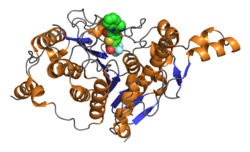
Histone deacetylases (EC 3.5.1.98, HDAC) are a class of enzymes that remove acetyl groups (O=C-CH3) from an ε-N-acetyl lysine amino acid on both histone and non-histone proteins. HDACs allow histones to wrap the DNA more tightly. This is important because DNA is wrapped around histones, and DNA expression is regulated by acetylation and de-acetylation. HDAC's action is opposite to that of histone acetyltransferase. HDAC proteins are now also called lysine deacetylases (KDAC), to describe their function rather than their target, which also includes non-histone proteins. In general, they suppress gene expression.
Together with the acetylpolyamine amidohydrolases and the acetoin utilization proteins, the histone deacetylases form an ancient protein superfamily known as the histone deacetylase superfamily.
HDACs, are classified in four classes depending on sequence homology to the yeast original enzymes and domain organization:
HDAC (except class III) contain zinc and are known as Zn2+-dependent histone deacetylases. They feature a classical arginase fold and are structurally and mechanistically distinct from sirtuins (class III), which fold into a Rossmann architecture and are NAD+ dependent.
HDAC proteins are grouped into four classes (see above) based on function and DNA sequence similarity. Class I, II and IV are considered "classical" HDACs whose activities are inhibited by trichostatin A (TSA) and have a zinc dependent active site, whereas Class III enzymes are a family of NAD+-dependent proteins known as sirtuins and are not affected by TSA. Homologues to these three groups are found in yeast having the names: reduced potassium dependency 3 (Rpd3), which corresponds to Class I; histone deacetylase 1 (hda1), corresponding to Class II; and silent information regulator 2 (Sir2), corresponding to Class III. Class IV contains just one isoform (HDAC11), which is not highly homologous with either Rpd3 or hda1 yeast enzymes, and therefore HDAC11 is assigned to its own class. The Class III enzymes are considered a separate type of enzyme and have a different mechanism of action; these enzymes are NAD+-dependent, whereas HDACs in other classes require Zn2+ as a cofactor.
HDACs are conserved across evolution, showing orthologs in all eukaryotes and even in Archaea. All upper eukaryotes, including vertebrates, plants and arthropods, possess at least one HDAC per class, while most vertebrates carry the 11 canonical HDACs, with the exception of bone fish, which lack HDAC2 but appears to have an extra copy of HDAC11, dubbed HDAC12. Plants carry additional HDACs compared to animals, putatively to carry out the more complex transcriptional regulation required by these sessile organisms. HDACs appear to be deriving from an ancestral acetyl-binding domain, as HDAC homologs have been found in bacteria in the form of Acetoin utilization proteins (AcuC) proteins.
Within the Class I HDACs, HDAC1, 2, and 3 are found primarily in the nucleus, whereas HDAC8 is found in both the nucleus and the cytoplasm, and is also membrane-associated. Class II HDACs (HDAC4, 5, 6, 7 9, and 10) are able to shuttle in and out of the nucleus, depending on different signals.
HDAC6 is a cytoplasmic, microtubule-associated enzyme. HDAC6 deacetylates tubulin, Hsp90, and cortactin, and forms complexes with other partner proteins, and is, therefore, involved in a variety of biological processes.
Histone deacetylase
Histone deacetylases (EC 3.5.1.98, HDAC) are a class of enzymes that remove acetyl groups (O=C-CH3) from an ε-N-acetyl lysine amino acid on both histone and non-histone proteins. HDACs allow histones to wrap the DNA more tightly. This is important because DNA is wrapped around histones, and DNA expression is regulated by acetylation and de-acetylation. HDAC's action is opposite to that of histone acetyltransferase. HDAC proteins are now also called lysine deacetylases (KDAC), to describe their function rather than their target, which also includes non-histone proteins. In general, they suppress gene expression.
Together with the acetylpolyamine amidohydrolases and the acetoin utilization proteins, the histone deacetylases form an ancient protein superfamily known as the histone deacetylase superfamily.
HDACs, are classified in four classes depending on sequence homology to the yeast original enzymes and domain organization:
HDAC (except class III) contain zinc and are known as Zn2+-dependent histone deacetylases. They feature a classical arginase fold and are structurally and mechanistically distinct from sirtuins (class III), which fold into a Rossmann architecture and are NAD+ dependent.
HDAC proteins are grouped into four classes (see above) based on function and DNA sequence similarity. Class I, II and IV are considered "classical" HDACs whose activities are inhibited by trichostatin A (TSA) and have a zinc dependent active site, whereas Class III enzymes are a family of NAD+-dependent proteins known as sirtuins and are not affected by TSA. Homologues to these three groups are found in yeast having the names: reduced potassium dependency 3 (Rpd3), which corresponds to Class I; histone deacetylase 1 (hda1), corresponding to Class II; and silent information regulator 2 (Sir2), corresponding to Class III. Class IV contains just one isoform (HDAC11), which is not highly homologous with either Rpd3 or hda1 yeast enzymes, and therefore HDAC11 is assigned to its own class. The Class III enzymes are considered a separate type of enzyme and have a different mechanism of action; these enzymes are NAD+-dependent, whereas HDACs in other classes require Zn2+ as a cofactor.
HDACs are conserved across evolution, showing orthologs in all eukaryotes and even in Archaea. All upper eukaryotes, including vertebrates, plants and arthropods, possess at least one HDAC per class, while most vertebrates carry the 11 canonical HDACs, with the exception of bone fish, which lack HDAC2 but appears to have an extra copy of HDAC11, dubbed HDAC12. Plants carry additional HDACs compared to animals, putatively to carry out the more complex transcriptional regulation required by these sessile organisms. HDACs appear to be deriving from an ancestral acetyl-binding domain, as HDAC homologs have been found in bacteria in the form of Acetoin utilization proteins (AcuC) proteins.
Within the Class I HDACs, HDAC1, 2, and 3 are found primarily in the nucleus, whereas HDAC8 is found in both the nucleus and the cytoplasm, and is also membrane-associated. Class II HDACs (HDAC4, 5, 6, 7 9, and 10) are able to shuttle in and out of the nucleus, depending on different signals.
HDAC6 is a cytoplasmic, microtubule-associated enzyme. HDAC6 deacetylates tubulin, Hsp90, and cortactin, and forms complexes with other partner proteins, and is, therefore, involved in a variety of biological processes.
Recent media
Recent media