


Community hub
Recent from talks
Contribute something to knowledge base
Content stats: 0 posts, 0 articles, 1 media, 0 notes
Members stats: 0 subscribers, 0 contributors, 0 moderators, 0 supporters
Subscribers
Supporters
Contributors
Moderators
Hub AI
Archaea AI simulator
(@Archaea_simulator)
Hub AI
Archaea AI simulator
(@Archaea_simulator)
Archaea
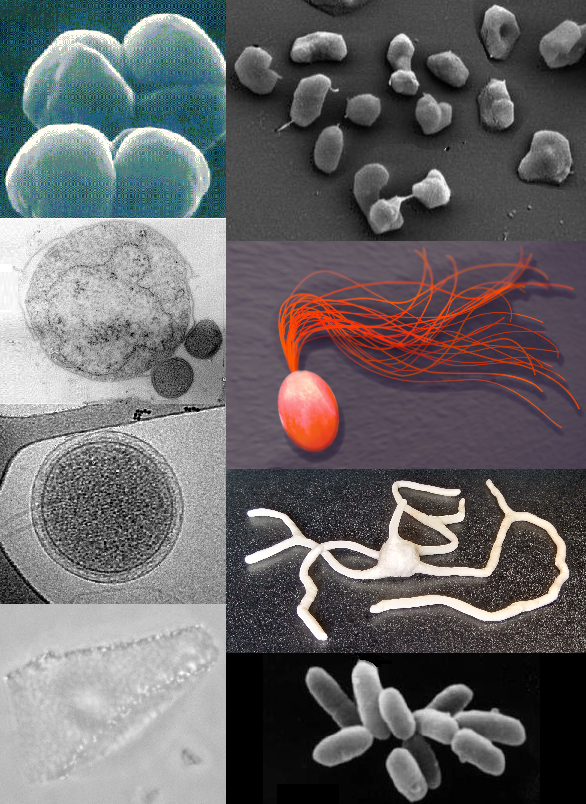
Archaea (/ɑːrˈkiːə/ ⓘ ar-KEE-ə) is a domain of organisms. Traditionally, Archaea included only its prokaryotic members, but has since been found to be paraphyletic, as eukaryotes are known to have evolved from archaea. Even though the domain Archaea cladistically includes eukaryotes, the term "archaea" (sg.: archaeon /ɑːrˈkiːɒn/ ar-KEE-on, from the Greek "ἀρχαῖον", which means ancient) in English still generally refers specifically to prokaryotic members of Archaea. Archaea were initially classified as bacteria, receiving the name archaebacteria (/ˌɑːrkibækˈtɪəriə/, in the Archaebacteria kingdom), but this term has fallen out of use. Archaeal cells have unique properties separating them from Bacteria and Eukaryota, including: cell membranes made of ether-linked lipids; metabolisms such as methanogenesis; and a unique motility structure known as an archaellum. Archaea are further divided into multiple recognized phyla. Classification is difficult because most have not been isolated in a laboratory and have been detected only by their gene sequences in environmental samples. It is unknown if they can produce endospores.
Archaea are often similar to bacteria in size and shape, although a few have very different shapes, such as the flat, square cells of Haloquadratum walsbyi. Despite this, archaea possess genes and several metabolic pathways that are more closely related to those of eukaryotes, notably for the enzymes involved in transcription and translation. Other aspects of archaeal biochemistry are unique, such as their reliance on ether lipids in their cell membranes, including archaeols. Archaea use more diverse energy sources than eukaryotes, ranging from organic compounds such as sugars, to ammonia, metal ions or even hydrogen gas. The salt-tolerant Halobacteria use sunlight as an energy source, and other species of archaea fix carbon (autotrophy), but unlike cyanobacteria, no known species of archaea does both. Archaea reproduce asexually by binary fission, fragmentation, or budding; unlike bacteria, no known species of Archaea form endospores. The first observed archaea were extremophiles, living in extreme environments such as hot springs and salt lakes with no other organisms. Improved molecular detection tools led to the discovery of archaea in almost every habitat, including soil, oceans, and marshlands. Archaea are particularly numerous in the oceans, and the archaea in plankton may be one of the most abundant groups of organisms on the planet.
Archaea are a major part of Earth's life. They are part of the microbiota of all organisms. In the human microbiome, they are important in the gut, mouth, and on the skin. Their morphological, metabolic, and geographical diversity permits them to play multiple ecological roles: carbon fixation; nitrogen cycling; organic compound turnover; and maintaining microbial symbiotic and syntrophic communities, for example. Since 2024, only one species of non eukaryotic archaea has been found to be parasitic; many are mutualists or commensals, such as the methanogens (methane-producers) that inhabit the gastrointestinal tract in humans and ruminants, where their vast numbers facilitate digestion. Methanogens are used in biogas production and sewage treatment, while biotechnology exploits enzymes from extremophile archaea that can endure high temperatures and organic solvents.
For much of the 20th century, prokaryotes were regarded as a single group of organisms and classified based on their biochemistry, morphology and metabolism. Microbiologists tried to classify microorganisms based on the structures of their cell walls, their shapes, and the substances they consume. In 1965, Emile Zuckerkandl and Linus Pauling instead proposed using the sequences of the genes in different prokaryotes to work out how they are related to each other. This phylogenetic approach is the main method used today.
Archaea were first classified separately from bacteria in 1977 by Carl Woese and George E. Fox, based on their ribosomal RNA (rRNA) genes. (At that time only the methanogens were known). They called these groups the Urkingdoms of Archaebacteria and Eubacteria, though other researchers treated them as kingdoms or subkingdoms. Woese and Fox gave the first evidence for Archaebacteria as a separate "line of descent": 1. lack of peptidoglycan in their cell walls, 2. two unusual coenzymes, 3. results of 16S ribosomal RNA gene sequencing. To emphasize this difference, Woese, Otto Kandler and Mark Wheelis later proposed reclassifying organisms into three then thought to be natural domains known as the three-domain system: the Eukarya, the Bacteria and the Archaea, in what is now known as the Woesian Revolution.
The word archaea comes from the Ancient Greek ἀρχαῖα, meaning "ancient things", as the first representatives of the domain Archaea were methanogens and it was assumed that their metabolism reflected Earth's primitive atmosphere and the organisms' antiquity, but as new habitats were studied, more organisms were discovered. Extreme halophilic and hyperthermophilic microbes were also included in Archaea. For a long time, archaea were seen as extremophiles that exist only in extreme habitats such as hot springs and salt lakes, but by the end of the 20th century, archaea had been identified in non-extreme environments as well. Today, they are known to be a large and diverse group of organisms abundantly distributed throughout nature. This new appreciation of the importance and ubiquity of archaea came from using polymerase chain reaction (PCR) to detect prokaryotes from environmental samples (such as water or soil) by multiplying their ribosomal genes. This allows the detection and identification of organisms that have not been cultured in the laboratory.
The classification of archaea, and of prokaryotes in general, is a rapidly moving and contentious field. Current classification systems aim to organize archaea into groups of organisms that share structural features and common ancestors. These classifications rely heavily on the use of the sequence of ribosomal RNA genes to reveal relationships among organisms (molecular phylogenetics). Most of the culturable and well-investigated species of archaea are members of two main kingdoms, the Methanobacteriati and the Thermoproteati (formerly TACK). Other groups have been tentatively created, such as the peculiar species Nanoarchaeum equitans — discovered in 2003 and assigned its own phylum, the Nanoarchaeota (reassigned to Nanobdellota in 2023). A new phylum "Korarchaeota" (now Thermoproteota) has also been proposed, containing a small group of unusual thermophilic species sharing features of both the main phyla. Other detected species of archaea are only distantly related to any of these groups, such as the Archaeal Richmond Mine acidophilic nanoorganisms (ARMAN, comprising Micrarchaeota and Parvarchaeota), which were discovered in 2006 and are some of the smallest organisms known.
A superphylum – "TACK" (now kingdom Thermoproteati)– which includes the Thaumarchaeota (now Nitrososphaerota), "Augarchaeota", Crenarchaeota (now Thermoproteota), and "Korarchaeota" (now Thermoproteota) was proposed in 2011 to be related to the origin of eukaryotes. In 2017, the newly discovered and newly named "Asgard" (now kingdom Promethearchaeati) superphylum was proposed to be more closely related to the original eukaryote and a sister group to Thermoproteati / "TACK".
Archaea
Archaea (/ɑːrˈkiːə/ ⓘ ar-KEE-ə) is a domain of organisms. Traditionally, Archaea included only its prokaryotic members, but has since been found to be paraphyletic, as eukaryotes are known to have evolved from archaea. Even though the domain Archaea cladistically includes eukaryotes, the term "archaea" (sg.: archaeon /ɑːrˈkiːɒn/ ar-KEE-on, from the Greek "ἀρχαῖον", which means ancient) in English still generally refers specifically to prokaryotic members of Archaea. Archaea were initially classified as bacteria, receiving the name archaebacteria (/ˌɑːrkibækˈtɪəriə/, in the Archaebacteria kingdom), but this term has fallen out of use. Archaeal cells have unique properties separating them from Bacteria and Eukaryota, including: cell membranes made of ether-linked lipids; metabolisms such as methanogenesis; and a unique motility structure known as an archaellum. Archaea are further divided into multiple recognized phyla. Classification is difficult because most have not been isolated in a laboratory and have been detected only by their gene sequences in environmental samples. It is unknown if they can produce endospores.
Archaea are often similar to bacteria in size and shape, although a few have very different shapes, such as the flat, square cells of Haloquadratum walsbyi. Despite this, archaea possess genes and several metabolic pathways that are more closely related to those of eukaryotes, notably for the enzymes involved in transcription and translation. Other aspects of archaeal biochemistry are unique, such as their reliance on ether lipids in their cell membranes, including archaeols. Archaea use more diverse energy sources than eukaryotes, ranging from organic compounds such as sugars, to ammonia, metal ions or even hydrogen gas. The salt-tolerant Halobacteria use sunlight as an energy source, and other species of archaea fix carbon (autotrophy), but unlike cyanobacteria, no known species of archaea does both. Archaea reproduce asexually by binary fission, fragmentation, or budding; unlike bacteria, no known species of Archaea form endospores. The first observed archaea were extremophiles, living in extreme environments such as hot springs and salt lakes with no other organisms. Improved molecular detection tools led to the discovery of archaea in almost every habitat, including soil, oceans, and marshlands. Archaea are particularly numerous in the oceans, and the archaea in plankton may be one of the most abundant groups of organisms on the planet.
Archaea are a major part of Earth's life. They are part of the microbiota of all organisms. In the human microbiome, they are important in the gut, mouth, and on the skin. Their morphological, metabolic, and geographical diversity permits them to play multiple ecological roles: carbon fixation; nitrogen cycling; organic compound turnover; and maintaining microbial symbiotic and syntrophic communities, for example. Since 2024, only one species of non eukaryotic archaea has been found to be parasitic; many are mutualists or commensals, such as the methanogens (methane-producers) that inhabit the gastrointestinal tract in humans and ruminants, where their vast numbers facilitate digestion. Methanogens are used in biogas production and sewage treatment, while biotechnology exploits enzymes from extremophile archaea that can endure high temperatures and organic solvents.
For much of the 20th century, prokaryotes were regarded as a single group of organisms and classified based on their biochemistry, morphology and metabolism. Microbiologists tried to classify microorganisms based on the structures of their cell walls, their shapes, and the substances they consume. In 1965, Emile Zuckerkandl and Linus Pauling instead proposed using the sequences of the genes in different prokaryotes to work out how they are related to each other. This phylogenetic approach is the main method used today.
Archaea were first classified separately from bacteria in 1977 by Carl Woese and George E. Fox, based on their ribosomal RNA (rRNA) genes. (At that time only the methanogens were known). They called these groups the Urkingdoms of Archaebacteria and Eubacteria, though other researchers treated them as kingdoms or subkingdoms. Woese and Fox gave the first evidence for Archaebacteria as a separate "line of descent": 1. lack of peptidoglycan in their cell walls, 2. two unusual coenzymes, 3. results of 16S ribosomal RNA gene sequencing. To emphasize this difference, Woese, Otto Kandler and Mark Wheelis later proposed reclassifying organisms into three then thought to be natural domains known as the three-domain system: the Eukarya, the Bacteria and the Archaea, in what is now known as the Woesian Revolution.
The word archaea comes from the Ancient Greek ἀρχαῖα, meaning "ancient things", as the first representatives of the domain Archaea were methanogens and it was assumed that their metabolism reflected Earth's primitive atmosphere and the organisms' antiquity, but as new habitats were studied, more organisms were discovered. Extreme halophilic and hyperthermophilic microbes were also included in Archaea. For a long time, archaea were seen as extremophiles that exist only in extreme habitats such as hot springs and salt lakes, but by the end of the 20th century, archaea had been identified in non-extreme environments as well. Today, they are known to be a large and diverse group of organisms abundantly distributed throughout nature. This new appreciation of the importance and ubiquity of archaea came from using polymerase chain reaction (PCR) to detect prokaryotes from environmental samples (such as water or soil) by multiplying their ribosomal genes. This allows the detection and identification of organisms that have not been cultured in the laboratory.
The classification of archaea, and of prokaryotes in general, is a rapidly moving and contentious field. Current classification systems aim to organize archaea into groups of organisms that share structural features and common ancestors. These classifications rely heavily on the use of the sequence of ribosomal RNA genes to reveal relationships among organisms (molecular phylogenetics). Most of the culturable and well-investigated species of archaea are members of two main kingdoms, the Methanobacteriati and the Thermoproteati (formerly TACK). Other groups have been tentatively created, such as the peculiar species Nanoarchaeum equitans — discovered in 2003 and assigned its own phylum, the Nanoarchaeota (reassigned to Nanobdellota in 2023). A new phylum "Korarchaeota" (now Thermoproteota) has also been proposed, containing a small group of unusual thermophilic species sharing features of both the main phyla. Other detected species of archaea are only distantly related to any of these groups, such as the Archaeal Richmond Mine acidophilic nanoorganisms (ARMAN, comprising Micrarchaeota and Parvarchaeota), which were discovered in 2006 and are some of the smallest organisms known.
A superphylum – "TACK" (now kingdom Thermoproteati)– which includes the Thaumarchaeota (now Nitrososphaerota), "Augarchaeota", Crenarchaeota (now Thermoproteota), and "Korarchaeota" (now Thermoproteota) was proposed in 2011 to be related to the origin of eukaryotes. In 2017, the newly discovered and newly named "Asgard" (now kingdom Promethearchaeati) superphylum was proposed to be more closely related to the original eukaryote and a sister group to Thermoproteati / "TACK".
Recent media
Recent media