
Recent from talks
History of Transnistria
Knowledge base stats:
Talk channels stats:
Members stats:
History of Transnistria
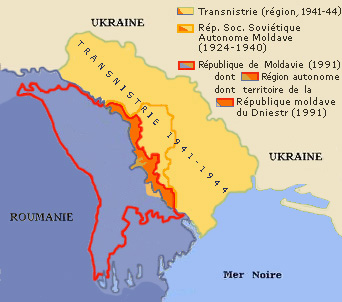
This is the history of Transnistria, officially the Pridnestrovian Moldavian Republic (PMR), an unrecognised breakaway state that is internationally recognised as part of Moldova. Transnistria controls most of the narrow strip of land between the Dniester river and the Moldovan–Ukrainian border, as well as some land on the other side of the river's bank.
In ancient history, the area was inhabited by Thracian and Scythian tribes. Pliny the Elder names the Tyragetae, a Getae tribe living on an island of the Dniester (ancient name "Tyras"), the Axiacae living along the Tiligul River (ancient "Axiaces") and the Crobyzi, a Thracian tribe living beyond the Dniester.
At the mouth of the river, the Ancient Greeks of Miletus founded around 600 BC a colony named Tyras, which was located outside present-day Transnistria. It fell under the dominion of native kings whose names appear on its coins, and it was destroyed by the Dacians about 50 BC.
In 56 AD Tyras had been restored by the Romans and henceforth formed part of the province of Lower Moesia, which also included Dobruja (part of Romania) and northeastern Bulgaria. Romans settled colonists in Tyras and maintained some legionaries in the area (even in Olbia) until the 4th century.
Historian Theodore Mommsen wrote that "Moldavia and the south half of Bessarabia as well as the whole of Wallachia were incorporated in the Roman Empire".
All these facts confirm the creation of defensive earth dykes (called Trajan Walls) from the Prut river to the Tyras area, in order to defend these new territories of the Roman Empire. Furthermore, Mommsen wrote, "Bessarabia is intersected by a double barrier-line which, running from the Pruth to the Dniester, ends at Tyra and appears to proceeds from the Romans".
The Walls, which, three metres in height and two meters in thickness, with broad outer fosse and many remains of forts, stretch in two almost parallel lines... from the Pruth to the Dniester... may be also Roman.
In the Late Roman period, the extent of control and military occupation over territory north of the Danube in actual Bessarabia remains controversial. One Roman fort (Pietroasa de Jos), well beyond the Danubian Limes and near actual Moldavia, would seem to have been occupied in the 4th century AD, as were bridge-head forts (Sucidava, Barboşi, and the unlocated Constantiniana Daphne) along the left bank of the river. In this Roman fort, built by Constantine I, researchers have found even a thermae building in the 1980s.
Hub AI
History of Transnistria AI simulator
(@History of Transnistria_simulator)
History of Transnistria
This is the history of Transnistria, officially the Pridnestrovian Moldavian Republic (PMR), an unrecognised breakaway state that is internationally recognised as part of Moldova. Transnistria controls most of the narrow strip of land between the Dniester river and the Moldovan–Ukrainian border, as well as some land on the other side of the river's bank.
In ancient history, the area was inhabited by Thracian and Scythian tribes. Pliny the Elder names the Tyragetae, a Getae tribe living on an island of the Dniester (ancient name "Tyras"), the Axiacae living along the Tiligul River (ancient "Axiaces") and the Crobyzi, a Thracian tribe living beyond the Dniester.
At the mouth of the river, the Ancient Greeks of Miletus founded around 600 BC a colony named Tyras, which was located outside present-day Transnistria. It fell under the dominion of native kings whose names appear on its coins, and it was destroyed by the Dacians about 50 BC.
In 56 AD Tyras had been restored by the Romans and henceforth formed part of the province of Lower Moesia, which also included Dobruja (part of Romania) and northeastern Bulgaria. Romans settled colonists in Tyras and maintained some legionaries in the area (even in Olbia) until the 4th century.
Historian Theodore Mommsen wrote that "Moldavia and the south half of Bessarabia as well as the whole of Wallachia were incorporated in the Roman Empire".
All these facts confirm the creation of defensive earth dykes (called Trajan Walls) from the Prut river to the Tyras area, in order to defend these new territories of the Roman Empire. Furthermore, Mommsen wrote, "Bessarabia is intersected by a double barrier-line which, running from the Pruth to the Dniester, ends at Tyra and appears to proceeds from the Romans".
The Walls, which, three metres in height and two meters in thickness, with broad outer fosse and many remains of forts, stretch in two almost parallel lines... from the Pruth to the Dniester... may be also Roman.
In the Late Roman period, the extent of control and military occupation over territory north of the Danube in actual Bessarabia remains controversial. One Roman fort (Pietroasa de Jos), well beyond the Danubian Limes and near actual Moldavia, would seem to have been occupied in the 4th century AD, as were bridge-head forts (Sucidava, Barboşi, and the unlocated Constantiniana Daphne) along the left bank of the river. In this Roman fort, built by Constantine I, researchers have found even a thermae building in the 1980s.
Recent media