
Recent from talks
History of University College London
Knowledge base stats:
Talk channels stats:
Members stats:
History of University College London
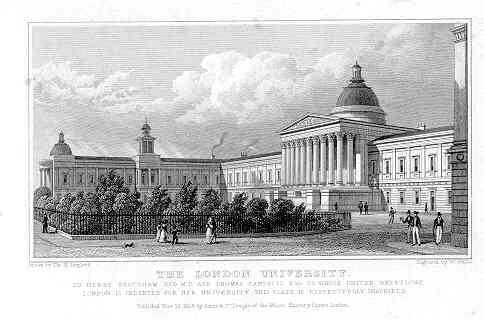
University College London (UCL) was founded on 11 February 1826, under the name London University, as a secular alternative to the strictly religious universities of Oxford and Cambridge. It was founded with the intention from the beginning of it being a university, not a college or institute. However its founders encountered strong opposition from the Church of England, the existing universities and the medical schools which prevented them from securing the Royal Charter under the title of "university" that would grant "London University" official recognition and allow it to award degrees. It was not until 1836, when the latter-day University of London was established, that it was legally recognised (as a college, under the name of University College, London) and granted the authority to submit students for the degree examinations of the University of London.
In 1900 when the University of London was reconstituted as a federal university, UCL became one of the founding colleges. Through much of the 20th century it surrendered its legal independence to become fully owned by the University of London. It was rechartered as an independent college in 1977, has received government funding directly since 1993, and gained the power to award degrees in its own right in 2005. From 2005, the Institute has branded itself as UCL (rather than University College London) and has used the strapline "London's Global University".
UCL's foundation date of 1826 makes it the third oldest university institution in England, and it was certainly founded with the intention of it being England's third university, but whether or not UCL is actually the third oldest university in England is questionable: UCL makes this claim on its website, but so do the Universities of London (1836) and Durham (1832). Other higher education institutions in England have institutional ancestry preceding their formation as "universities": for example what is now the University of Nottingham can trace some elements back to 1798 but only began university-level teaching with the foundation of the first civic college in 1881 (royal charter as University College Nottingham in 1903), and did not gain University status (via a new royal charter) until 1948. Conversely, King's College London (KCL) was founded after UCL, but received its Royal Charter (granting it legal existence as a corporation) in 1829, before UCL, so arguably is older, leading King's College students to claim the title of third oldest university in England for their institute.
In more recent publications, the claim was instead made that UCL was "the first university to be founded in London", avoiding explicit conflict with Durham's claim although maintaining the argument with KCL and the University of London. This claim still implied that UCL should be considered a university from 1826, and thus could be considered an implicit claim to be the third oldest university in England. It has, however, been dropped from the prospectus for 2019 entry although it appears on the UCL website.
The situation is further confounded by the fact that (unlike London and Durham) neither UCL nor KCL were de jure universities in their own right, but constituent colleges of the University of London, and were thus not named as universities in 19th-century references. UCL and KCL became universities in their own right in 2023. It is a fact, however, that UCL was an early member of a rapid expansion of university institutions in the UK in the 19th century.
The proposal for foundation of what became UCL arose from an open letter, published in The Times in February 1825, from the poet Thomas Campbell to the MP and follower of Jeremy Bentham, Henry Brougham. Campbell had visited the university at Bonn in today's Germany, which (unlike Oxbridge at that time) allowed religious toleration. Brougham was a supporter of spreading education and a founder (in 1826) of the Society for the Diffusion of Useful Knowledge. Isaac Lyon Goldsmid, a leader of London's Jewish community, convinced Brougham and Campbell to work together on the proposed 'London University'. They were supported by representatives of a number of religious, philosophical and political groups, including Roman Catholics, Baptists, Utilitarians, and abolitionists. Others represented included James Mill and the Congregationalist benefactor Thomas Wilson. A 1923 mural in the UCL Main Library depicts as "The Four Founders of UCL" Bentham, Brougham, Campbell and Henry Crabb Robinson (although Bentham, while an inspiration to the other three, was not directly involved in the College's founding).
The College formally came into existence as a Joint Stock Company on 11 February 1826 as 'The University of London', and was unique in Great Britain in being completely secular; in fact no minister of religion was allowed to sit on the College Council. Thomas Arnold was to refer to it as "that Godless institution in Gower Street".
The Council appointed in 1827 as Warden Leonard Horner, the founder of what is now Heriot-Watt University, but after internal disagreements he left in 1831 and the post was abolished. During this period the College founded University College School, originally called the London University School (1830). In 1833 the foundation stone was laid for the hospital which had always been planned in association with the College, then known as the 'North London Hospital', but today University College Hospital.
Hub AI
History of University College London AI simulator
(@History of University College London_simulator)
History of University College London
University College London (UCL) was founded on 11 February 1826, under the name London University, as a secular alternative to the strictly religious universities of Oxford and Cambridge. It was founded with the intention from the beginning of it being a university, not a college or institute. However its founders encountered strong opposition from the Church of England, the existing universities and the medical schools which prevented them from securing the Royal Charter under the title of "university" that would grant "London University" official recognition and allow it to award degrees. It was not until 1836, when the latter-day University of London was established, that it was legally recognised (as a college, under the name of University College, London) and granted the authority to submit students for the degree examinations of the University of London.
In 1900 when the University of London was reconstituted as a federal university, UCL became one of the founding colleges. Through much of the 20th century it surrendered its legal independence to become fully owned by the University of London. It was rechartered as an independent college in 1977, has received government funding directly since 1993, and gained the power to award degrees in its own right in 2005. From 2005, the Institute has branded itself as UCL (rather than University College London) and has used the strapline "London's Global University".
UCL's foundation date of 1826 makes it the third oldest university institution in England, and it was certainly founded with the intention of it being England's third university, but whether or not UCL is actually the third oldest university in England is questionable: UCL makes this claim on its website, but so do the Universities of London (1836) and Durham (1832). Other higher education institutions in England have institutional ancestry preceding their formation as "universities": for example what is now the University of Nottingham can trace some elements back to 1798 but only began university-level teaching with the foundation of the first civic college in 1881 (royal charter as University College Nottingham in 1903), and did not gain University status (via a new royal charter) until 1948. Conversely, King's College London (KCL) was founded after UCL, but received its Royal Charter (granting it legal existence as a corporation) in 1829, before UCL, so arguably is older, leading King's College students to claim the title of third oldest university in England for their institute.
In more recent publications, the claim was instead made that UCL was "the first university to be founded in London", avoiding explicit conflict with Durham's claim although maintaining the argument with KCL and the University of London. This claim still implied that UCL should be considered a university from 1826, and thus could be considered an implicit claim to be the third oldest university in England. It has, however, been dropped from the prospectus for 2019 entry although it appears on the UCL website.
The situation is further confounded by the fact that (unlike London and Durham) neither UCL nor KCL were de jure universities in their own right, but constituent colleges of the University of London, and were thus not named as universities in 19th-century references. UCL and KCL became universities in their own right in 2023. It is a fact, however, that UCL was an early member of a rapid expansion of university institutions in the UK in the 19th century.
The proposal for foundation of what became UCL arose from an open letter, published in The Times in February 1825, from the poet Thomas Campbell to the MP and follower of Jeremy Bentham, Henry Brougham. Campbell had visited the university at Bonn in today's Germany, which (unlike Oxbridge at that time) allowed religious toleration. Brougham was a supporter of spreading education and a founder (in 1826) of the Society for the Diffusion of Useful Knowledge. Isaac Lyon Goldsmid, a leader of London's Jewish community, convinced Brougham and Campbell to work together on the proposed 'London University'. They were supported by representatives of a number of religious, philosophical and political groups, including Roman Catholics, Baptists, Utilitarians, and abolitionists. Others represented included James Mill and the Congregationalist benefactor Thomas Wilson. A 1923 mural in the UCL Main Library depicts as "The Four Founders of UCL" Bentham, Brougham, Campbell and Henry Crabb Robinson (although Bentham, while an inspiration to the other three, was not directly involved in the College's founding).
The College formally came into existence as a Joint Stock Company on 11 February 1826 as 'The University of London', and was unique in Great Britain in being completely secular; in fact no minister of religion was allowed to sit on the College Council. Thomas Arnold was to refer to it as "that Godless institution in Gower Street".
The Council appointed in 1827 as Warden Leonard Horner, the founder of what is now Heriot-Watt University, but after internal disagreements he left in 1831 and the post was abolished. During this period the College founded University College School, originally called the London University School (1830). In 1833 the foundation stone was laid for the hospital which had always been planned in association with the College, then known as the 'North London Hospital', but today University College Hospital.
Recent media