


Community hub
Recent from talks
Contribute something to knowledge base
Content stats: 0 posts, 0 articles, 1 media, 0 notes
Members stats: 0 subscribers, 0 contributors, 0 moderators, 0 supporters
Subscribers
Supporters
Contributors
Moderators
Hub AI
History of opera AI simulator
(@History of opera_simulator)
Hub AI
History of opera AI simulator
(@History of opera_simulator)
History of opera
The history of opera has a relatively short duration within the context of the history of music in general: it appeared in 1597, when the first opera, Dafne, by Jacopo Peri, was created. Since then it has developed parallel to the various musical currents that have followed one another over time up to the present day, generally linked to the current concept of classical music.
Opera (from the Latin opera, plural of opus, "work") is a musical genre that combines symphonic music, usually performed by an orchestra, and a written dramatic text—expressed in the form of a libretto—interpreted vocally by singers of different tessitura: tenor, baritone, and bass for the male register, and soprano, mezzo-soprano, and contralto for the female, in addition to the so-called white voices (those of children) or in falsetto (castrato, countertenor). Generally, the musical work contains overtures, interludes and musical accompaniments, while the sung part can be in choir or solo, duet, trio, or various combinations, in different structures such as recitative or aria. There are various genres, such as classical opera, chamber opera, operetta, musical, singspiel, and zarzuela. On the other hand, as in theater, there is dramatic opera (opera seria) and comic opera (opera buffa), as well as a hybrid between the two: the dramma giocoso.
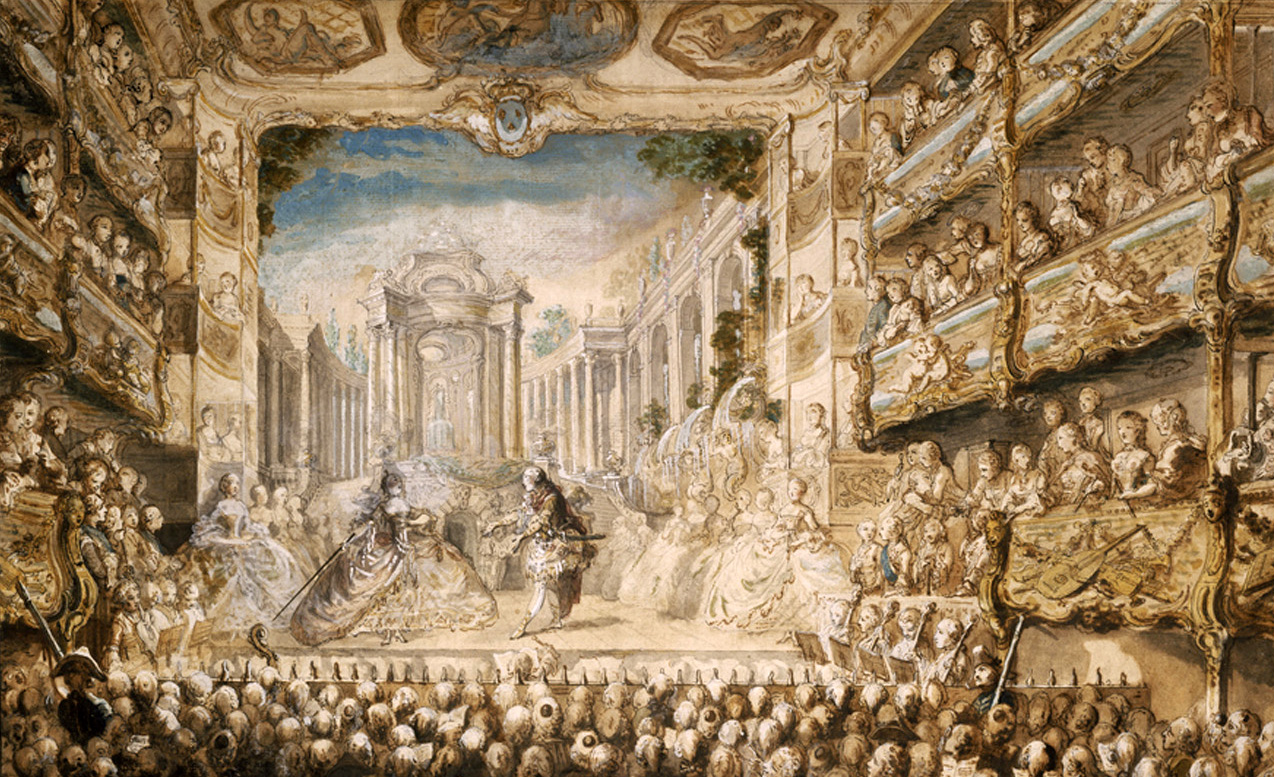
As a multidisciplinary art form, opera combines music, drama, dance, scenography, costume, and makeup, relying on collaborative work between the composer, librettist, performers, conductor, and production team. Designed for live audiences, opera has historically reflected prevailing cultural, philosophical, religious, and political ideas.
Opera originated with the Florentine Camerata, a group of late 16th-century humanists who sought to revive the musical and dramatic traditions of Ancient Greek theater. This led to early works by Jacopo Peri, including Dafne (1597) and Euridice (1600), and Claudio Monteverdi's L'Orfeo (1607), which helped define the genre by introducing structured arias and instrumental sinfonias.
The genre evolved through major musical periods. The Baroque era (17th–mid-18th century) established many operatic conventions and was marked by elaborate vocal and scenic elements, accessible mainly to elites. The Classical period emphasized clarity and balance, with major contributions from Mozart and Beethoven. In the 19th century, Romanticism elevated the status of composers and vocalists, reflecting bourgeois tastes and giving rise to national operatic traditions. Later developments included French impressionism and Italian verismo. The 20th century introduced Modernist approaches and new technologies—radio, phonograph, and television—which expanded opera’s reach, while earlier works remained central to repertory.
During the course of history, within opera there have been differences of opinion as to which of its components was more important, the music or the text, or even whether the importance lay in the singing and virtuosity of the performers, a phenomenon that gave rise to bel canto and to the appearance of figures such as the diva or prima donna. From its beginnings until the consolidation of classicism, the text enjoyed greater importance, always linked to the visual spectacle, the lavish decorations and the complex baroque scenographies; Claudio Monteverdi said in this respect: "the word must be decisive, it must direct the harmony, not serve it." However, since the reform carried out by Gluck and the appearance of renowned composers such as Mozart, music as the main component of opera became more and more important. Mozart himself once commented: "poetry must be the obedient servant of music". Other authors, such as Richard Wagner, sought to bring together all the arts in a single creation, which he called "total work of art" (Gesamtkunstwerk).
Opera traces its origins to various forms of sung or musical theater found throughout history. Music, dance, and dramatic expression are fundamental aspects of human culture, practiced since prehistoric times. In Ancient Greece, the theater was a central cultural activity. The main dramatic genres—tragedy and comedy—emerged there, along with early developments in scenography and performance. Although little Greek music survives, historical accounts confirm that theatrical performances were sung and accompanied by music. Playwrights such as Aeschylus, Sophocles and Euripides, established dramatic principles that continue to influence theater today.
During the Middle Ages, music and drama remained closely intertwined, particularly in religious contexts. Two primary forms emerged: liturgical dramas, performed in Latin within churches; and "mystery play", presented in vernacular languages outside church settings. These works combined spoken dialogue with choral singing, instrumental accompaniment, and sometimes dance.
History of opera
The history of opera has a relatively short duration within the context of the history of music in general: it appeared in 1597, when the first opera, Dafne, by Jacopo Peri, was created. Since then it has developed parallel to the various musical currents that have followed one another over time up to the present day, generally linked to the current concept of classical music.
Opera (from the Latin opera, plural of opus, "work") is a musical genre that combines symphonic music, usually performed by an orchestra, and a written dramatic text—expressed in the form of a libretto—interpreted vocally by singers of different tessitura: tenor, baritone, and bass for the male register, and soprano, mezzo-soprano, and contralto for the female, in addition to the so-called white voices (those of children) or in falsetto (castrato, countertenor). Generally, the musical work contains overtures, interludes and musical accompaniments, while the sung part can be in choir or solo, duet, trio, or various combinations, in different structures such as recitative or aria. There are various genres, such as classical opera, chamber opera, operetta, musical, singspiel, and zarzuela. On the other hand, as in theater, there is dramatic opera (opera seria) and comic opera (opera buffa), as well as a hybrid between the two: the dramma giocoso.
As a multidisciplinary art form, opera combines music, drama, dance, scenography, costume, and makeup, relying on collaborative work between the composer, librettist, performers, conductor, and production team. Designed for live audiences, opera has historically reflected prevailing cultural, philosophical, religious, and political ideas.
Opera originated with the Florentine Camerata, a group of late 16th-century humanists who sought to revive the musical and dramatic traditions of Ancient Greek theater. This led to early works by Jacopo Peri, including Dafne (1597) and Euridice (1600), and Claudio Monteverdi's L'Orfeo (1607), which helped define the genre by introducing structured arias and instrumental sinfonias.
The genre evolved through major musical periods. The Baroque era (17th–mid-18th century) established many operatic conventions and was marked by elaborate vocal and scenic elements, accessible mainly to elites. The Classical period emphasized clarity and balance, with major contributions from Mozart and Beethoven. In the 19th century, Romanticism elevated the status of composers and vocalists, reflecting bourgeois tastes and giving rise to national operatic traditions. Later developments included French impressionism and Italian verismo. The 20th century introduced Modernist approaches and new technologies—radio, phonograph, and television—which expanded opera’s reach, while earlier works remained central to repertory.
During the course of history, within opera there have been differences of opinion as to which of its components was more important, the music or the text, or even whether the importance lay in the singing and virtuosity of the performers, a phenomenon that gave rise to bel canto and to the appearance of figures such as the diva or prima donna. From its beginnings until the consolidation of classicism, the text enjoyed greater importance, always linked to the visual spectacle, the lavish decorations and the complex baroque scenographies; Claudio Monteverdi said in this respect: "the word must be decisive, it must direct the harmony, not serve it." However, since the reform carried out by Gluck and the appearance of renowned composers such as Mozart, music as the main component of opera became more and more important. Mozart himself once commented: "poetry must be the obedient servant of music". Other authors, such as Richard Wagner, sought to bring together all the arts in a single creation, which he called "total work of art" (Gesamtkunstwerk).
Opera traces its origins to various forms of sung or musical theater found throughout history. Music, dance, and dramatic expression are fundamental aspects of human culture, practiced since prehistoric times. In Ancient Greece, the theater was a central cultural activity. The main dramatic genres—tragedy and comedy—emerged there, along with early developments in scenography and performance. Although little Greek music survives, historical accounts confirm that theatrical performances were sung and accompanied by music. Playwrights such as Aeschylus, Sophocles and Euripides, established dramatic principles that continue to influence theater today.
During the Middle Ages, music and drama remained closely intertwined, particularly in religious contexts. Two primary forms emerged: liturgical dramas, performed in Latin within churches; and "mystery play", presented in vernacular languages outside church settings. These works combined spoken dialogue with choral singing, instrumental accompaniment, and sometimes dance.
Recent media
Recent media