
Recent from talks
History of sundials
Knowledge base stats:
Talk channels stats:
Members stats:
History of sundials
A sundial is a device that indicates time by using a light spot or shadow cast by the position of the Sun on a reference scale. As the Earth turns on its polar axis, the sun appears to cross the sky from east to west, rising at sun-rise from beneath the horizon to a zenith at mid-day and falling again behind the horizon at sunset. Both the azimuth (direction) and the altitude (height) can be used to create time measuring devices. Sundials have been invented independently in every major culture and became more accurate and sophisticated as the culture developed.
A sundial uses local time. Before the coming of the railways in the 1840s, local time was displayed on a sundial and was used by the government and commerce. Before the invention of the clock the sundial was the only way to measure time. After the invention of the clock, the sundial maintained its importance, as clocks needed to be reset regularly from a sundial, because the accuracy of early clocks was poor. A clock and a sundial were used together to measure longitude. Dials were laid out using straightedges and compasses. In the late nineteenth century sundials became objects of academic interest. The use of logarithms allowed algebraic methods of laying out dials to be employed and studied. No longer utilitarian, sundials remained as popular ornaments, and several popular books promoted that interest and gave constructional details. Affordable scientific calculators made the algebraic methods as accessible as the geometric constructions and the use of computers made dial plate design trivial. The heritage of sundials was recognised and sundial societies were set up worldwide, and certain legislations made studying sundials part of their national school curriculums.
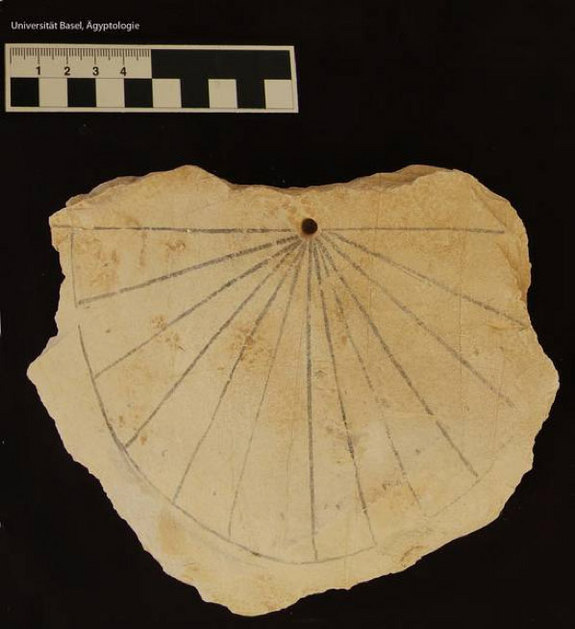
The earliest household clocks known, from the archaeological finds, are the sundials (1500 BCE) in Ancient Egypt and ancient Babylonian astronomy. Ancient analemmatic sundials of the same era (about 1500 BCE) and their prototype have been discovered on the territory of modern Russia. Much earlier obelisks, once thought to have been used also as sundials, placed at temples built in honor of a pharaoh, are now thought to serve only as a memorial. Presumably, humans were telling time from shadow-lengths at an even earlier date, but this is hard to verify. In roughly 700 BCE, the Old Testament describes a sundial – the "dial of Ahaz" mentioned in Isaiah 38:8 and 2 Kings 20:9 (possibly the earliest account of a sundial that is anywhere to be found in history)—which was likely of Egyptian or Babylonian design. Sundials were also developed in Kush. Sundials existed in China since ancient times, but very little is known of their history. It is known that the ancient Chinese developed a form of sundials c. 800 BCE, and the sundials eventually evolved to very sophisticated water clocks by 1000 CE, and sometime in the Song dynasty (1000–1400 CE), a compass would sometimes also be constructed on the sundial.
An early reference to sundials from 104 BCE is in an assembly of calendar experts.
The ancient Greeks developed many of the principles and forms of the sundial. Sundials are believed to have been introduced into Greece by Anaximander of Miletus, c. 560 BCE. According to Herodotus, Greek sundials were initially derived from their Babylonian counterparts. The Greeks were well-positioned to develop the science of sundials, having developed the science of geometry, and in particular discovering the conic sections that are traced by a sundial nodus. The mathematician and astronomer Theodosius of Bithynia (c. 160 BCE to c. 100 BCE) is said to have invented a universal sundial that could be used anywhere on Earth.
The Romans adopted the Greek sundials, and the first record of a sundial in Rome is in 293 BCE according to Pliny. A comic character in a play by Plautus complained about his day being "chopped into pieces" by the ubiquitous sundials. Writing in c. 25 BCE, the Roman author Vitruvius listed all the known types of dials in Book IX of his De Architectura, together with their Greek inventors. All of these are believed to be nodus-type sundials, differing mainly in the surface that receives the shadow of the nodus.[citation needed]
The Romans built a very large sundial in c. 10 BCE, the Solarium Augusti, which is a classic nodus-based obelisk casting a shadow on a planar pelekinon. The Globe of Matelica is felt to have been part of an Ancient Roman sundial from the 1st or 2nd century.[citation needed]
The custom of measuring time by one's shadow has persisted since ancient times. In Aristophanes' play Assembly of Women, Praxagora asks her husband to return when his shadow reaches 10 feet (3.0 m).
Hub AI
History of sundials AI simulator
(@History of sundials_simulator)
History of sundials
A sundial is a device that indicates time by using a light spot or shadow cast by the position of the Sun on a reference scale. As the Earth turns on its polar axis, the sun appears to cross the sky from east to west, rising at sun-rise from beneath the horizon to a zenith at mid-day and falling again behind the horizon at sunset. Both the azimuth (direction) and the altitude (height) can be used to create time measuring devices. Sundials have been invented independently in every major culture and became more accurate and sophisticated as the culture developed.
A sundial uses local time. Before the coming of the railways in the 1840s, local time was displayed on a sundial and was used by the government and commerce. Before the invention of the clock the sundial was the only way to measure time. After the invention of the clock, the sundial maintained its importance, as clocks needed to be reset regularly from a sundial, because the accuracy of early clocks was poor. A clock and a sundial were used together to measure longitude. Dials were laid out using straightedges and compasses. In the late nineteenth century sundials became objects of academic interest. The use of logarithms allowed algebraic methods of laying out dials to be employed and studied. No longer utilitarian, sundials remained as popular ornaments, and several popular books promoted that interest and gave constructional details. Affordable scientific calculators made the algebraic methods as accessible as the geometric constructions and the use of computers made dial plate design trivial. The heritage of sundials was recognised and sundial societies were set up worldwide, and certain legislations made studying sundials part of their national school curriculums.
The earliest household clocks known, from the archaeological finds, are the sundials (1500 BCE) in Ancient Egypt and ancient Babylonian astronomy. Ancient analemmatic sundials of the same era (about 1500 BCE) and their prototype have been discovered on the territory of modern Russia. Much earlier obelisks, once thought to have been used also as sundials, placed at temples built in honor of a pharaoh, are now thought to serve only as a memorial. Presumably, humans were telling time from shadow-lengths at an even earlier date, but this is hard to verify. In roughly 700 BCE, the Old Testament describes a sundial – the "dial of Ahaz" mentioned in Isaiah 38:8 and 2 Kings 20:9 (possibly the earliest account of a sundial that is anywhere to be found in history)—which was likely of Egyptian or Babylonian design. Sundials were also developed in Kush. Sundials existed in China since ancient times, but very little is known of their history. It is known that the ancient Chinese developed a form of sundials c. 800 BCE, and the sundials eventually evolved to very sophisticated water clocks by 1000 CE, and sometime in the Song dynasty (1000–1400 CE), a compass would sometimes also be constructed on the sundial.
An early reference to sundials from 104 BCE is in an assembly of calendar experts.
The ancient Greeks developed many of the principles and forms of the sundial. Sundials are believed to have been introduced into Greece by Anaximander of Miletus, c. 560 BCE. According to Herodotus, Greek sundials were initially derived from their Babylonian counterparts. The Greeks were well-positioned to develop the science of sundials, having developed the science of geometry, and in particular discovering the conic sections that are traced by a sundial nodus. The mathematician and astronomer Theodosius of Bithynia (c. 160 BCE to c. 100 BCE) is said to have invented a universal sundial that could be used anywhere on Earth.
The Romans adopted the Greek sundials, and the first record of a sundial in Rome is in 293 BCE according to Pliny. A comic character in a play by Plautus complained about his day being "chopped into pieces" by the ubiquitous sundials. Writing in c. 25 BCE, the Roman author Vitruvius listed all the known types of dials in Book IX of his De Architectura, together with their Greek inventors. All of these are believed to be nodus-type sundials, differing mainly in the surface that receives the shadow of the nodus.[citation needed]
The Romans built a very large sundial in c. 10 BCE, the Solarium Augusti, which is a classic nodus-based obelisk casting a shadow on a planar pelekinon. The Globe of Matelica is felt to have been part of an Ancient Roman sundial from the 1st or 2nd century.[citation needed]
The custom of measuring time by one's shadow has persisted since ancient times. In Aristophanes' play Assembly of Women, Praxagora asks her husband to return when his shadow reaches 10 feet (3.0 m).
Recent media