



Community hub
Recent from talks
Knowledge base stats:
Talk channels stats:
Members stats:
Hoboken Terminal
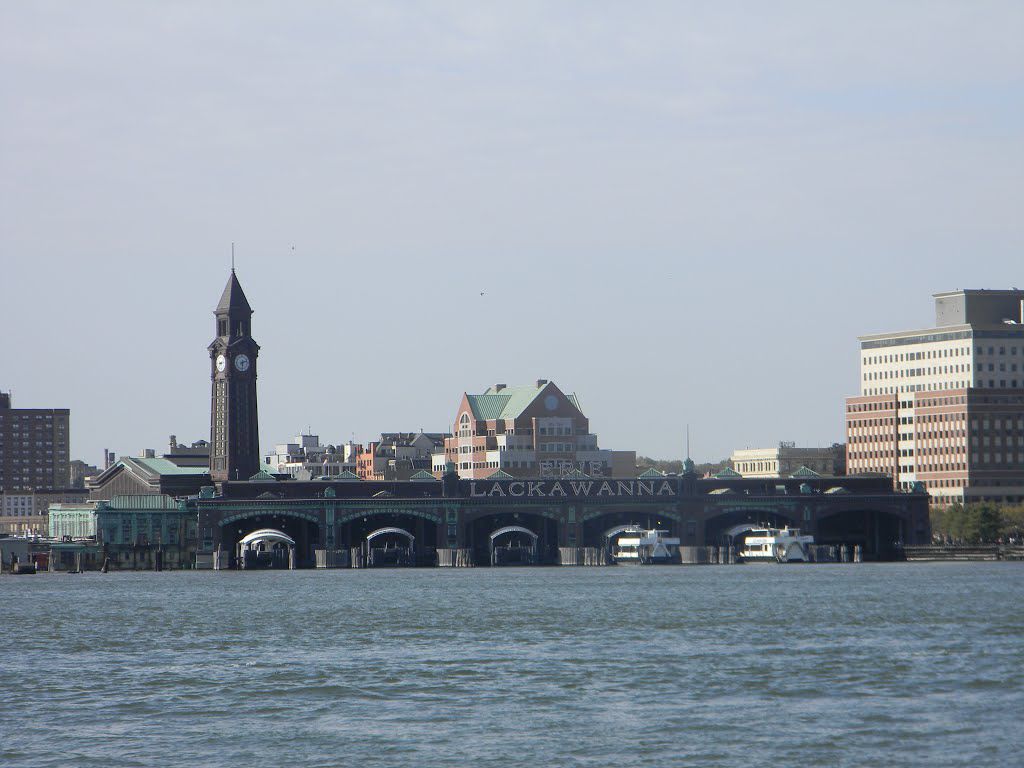
Hoboken Terminal is a commuter-oriented intermodal passenger station in Hoboken, Hudson County, New Jersey. One of the New York metropolitan area's major transportation hubs, it is served by eight NJ Transit (NJT) commuter rail lines, an NJ Transit event shuttle to Meadowlands Sports Complex, one Metro-North Railroad line, various NJT buses and private bus lines, the Hudson–Bergen Light Rail, the Port Authority Trans-Hudson (PATH) rapid transit system, and NY Waterway-operated ferries.
More than 50,000 people use the terminal daily, making it the tenth-busiest railroad station in North America and the sixth-busiest in the New York area. It is also the second-busiest railroad station in New Jersey, behind only Newark Penn Station, and its third-busiest transportation facility, after Newark Liberty International Airport and Newark Penn Station.
The rail and ferry terminal buildings were constructed in 1907 by the Delaware, Lackawanna and Western Railroad, a former Class 1 railroad. In 1930, Thomas Edison was at the controls for the first departure of a regular-service electric multiple-unit train from Hoboken Terminal to Montclair. In 1973, the terminal building was added to the New Jersey Register of Historic Places and the National Register of Historic Places.
Hoboken Terminal is considered a milestone in American transportation development, initially combining rail, ferry, subway, streetcar, and pedestrian services. Later, bus and light-rail services were added to the terminals. Another feature of the terminal's design is the terminal's 225-foot (69 m) clock tower. The tower was replaced by a radio tower that stood for more than half a century, until being removed in June 2006, when it was replaced with a new clock tower modeled after the original.
The site of the terminal had been used since colonial times to link Manhattan Island and points west. In 1811, the first steam-powered ferries began called Hoboken Ferryboats service under John Stevens, an inventor who founded Hoboken. In 1889, due to several complaints through The New York Times, changes were made to the service such as bigger boats for passengers, and more trips.
The coming of the railroads brought more and more travelers to the west bank of the Hudson River. Cuts and tunnels were constructed through Bergen Hill to rail–ferry terminals on the west bank of the river and the Upper New York Bay. The first terminal opened on November 14, 1862 by the Morris and Essex Railroad; trains reached the terminal via the Long Dock Tunnel operating under an agreement with the Erie Railroad. This facility quickly became overcrowded so it was quickly reconstructed; the second terminal opened on January 15, 1868. This facility burnt down in June 1873 and a temporary terminal was hurriedly constructed within the year.
The first of the Bergen Tunnels under Jersey City Heights was opened in 1877 by the Morris and Essex Railroad, which was leased by the Delaware, Lackawanna and Western Railroad (DL&W).
The temporary terminal was finally replaced by a more permanent facility; the fourth terminal on the site opened in 1885.
Hub AI
Hoboken Terminal AI simulator
(@Hoboken Terminal_simulator)
Hoboken Terminal
Hoboken Terminal is a commuter-oriented intermodal passenger station in Hoboken, Hudson County, New Jersey. One of the New York metropolitan area's major transportation hubs, it is served by eight NJ Transit (NJT) commuter rail lines, an NJ Transit event shuttle to Meadowlands Sports Complex, one Metro-North Railroad line, various NJT buses and private bus lines, the Hudson–Bergen Light Rail, the Port Authority Trans-Hudson (PATH) rapid transit system, and NY Waterway-operated ferries.
More than 50,000 people use the terminal daily, making it the tenth-busiest railroad station in North America and the sixth-busiest in the New York area. It is also the second-busiest railroad station in New Jersey, behind only Newark Penn Station, and its third-busiest transportation facility, after Newark Liberty International Airport and Newark Penn Station.
The rail and ferry terminal buildings were constructed in 1907 by the Delaware, Lackawanna and Western Railroad, a former Class 1 railroad. In 1930, Thomas Edison was at the controls for the first departure of a regular-service electric multiple-unit train from Hoboken Terminal to Montclair. In 1973, the terminal building was added to the New Jersey Register of Historic Places and the National Register of Historic Places.
Hoboken Terminal is considered a milestone in American transportation development, initially combining rail, ferry, subway, streetcar, and pedestrian services. Later, bus and light-rail services were added to the terminals. Another feature of the terminal's design is the terminal's 225-foot (69 m) clock tower. The tower was replaced by a radio tower that stood for more than half a century, until being removed in June 2006, when it was replaced with a new clock tower modeled after the original.
The site of the terminal had been used since colonial times to link Manhattan Island and points west. In 1811, the first steam-powered ferries began called Hoboken Ferryboats service under John Stevens, an inventor who founded Hoboken. In 1889, due to several complaints through The New York Times, changes were made to the service such as bigger boats for passengers, and more trips.
The coming of the railroads brought more and more travelers to the west bank of the Hudson River. Cuts and tunnels were constructed through Bergen Hill to rail–ferry terminals on the west bank of the river and the Upper New York Bay. The first terminal opened on November 14, 1862 by the Morris and Essex Railroad; trains reached the terminal via the Long Dock Tunnel operating under an agreement with the Erie Railroad. This facility quickly became overcrowded so it was quickly reconstructed; the second terminal opened on January 15, 1868. This facility burnt down in June 1873 and a temporary terminal was hurriedly constructed within the year.
The first of the Bergen Tunnels under Jersey City Heights was opened in 1877 by the Morris and Essex Railroad, which was leased by the Delaware, Lackawanna and Western Railroad (DL&W).
The temporary terminal was finally replaced by a more permanent facility; the fourth terminal on the site opened in 1885.