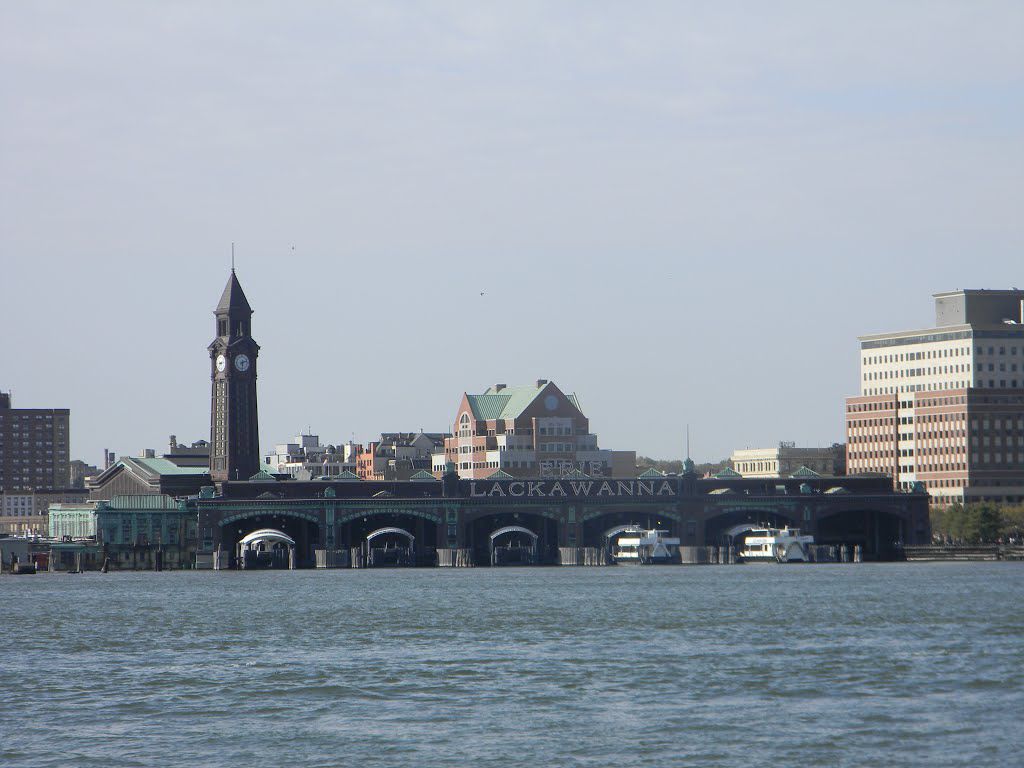
Hoboken Terminal
Hoboken Terminal
Main page
2122828

Hoboken Terminal

logo
Community Hub0 subscribers
Read side by side
from Wikipedia

Hoboken Terminal is a commuter-oriented intermodal passenger station in Hoboken, Hudson County, New Jersey. One of the New York metropolitan area's major transportation hubs, it is served by eight NJ Transit (NJT) commuter rail lines, an NJ Transit event shuttle to Meadowlands Sports Complex, one Metro-North Railroad line, various NJT buses and private bus lines, the Hudson–Bergen Light Rail, the Port Authority Trans-Hudson (PATH) rapid transit system, and NY Waterway-operated ferries.

Key Information

More than 50,000 people use the terminal daily, making it the tenth-busiest railroad station in North America and the sixth-busiest in the New York area. It is also the second-busiest railroad station in New Jersey, behind only Newark Penn Station, and its third-busiest transportation facility, after Newark Liberty International Airport and Newark Penn Station.

The rail and ferry terminal buildings were constructed in 1907 by the Delaware, Lackawanna and Western Railroad, a former Class 1 railroad. In 1930, Thomas Edison was at the controls for the first departure of a regular-service electric multiple-unit train from Hoboken Terminal to Montclair. In 1973, the terminal building was added to the New Jersey Register of Historic Places and the National Register of Historic Places.

Hoboken Terminal is considered a milestone in American transportation development, initially combining rail, ferry, subway, streetcar, and pedestrian services. Later, bus and light-rail services were added to the terminals. Another feature of the terminal's design is the terminal's 225-foot (69 m) clock tower. The tower was replaced by a radio tower that stood for more than half a century, until being removed in June 2006,[7] when it was replaced with a new clock tower modeled after the original.

History

[edit]

19th century

[edit]

The site of the terminal had been used since colonial times to link Manhattan Island and points west.[8] In 1811, the first steam-powered ferries began called Hoboken Ferryboats service under John Stevens, an inventor who founded Hoboken.[9] In 1889, due to several complaints through The New York Times, changes were made to the service such as bigger boats for passengers, and more trips.[10]

The coming of the railroads brought more and more travelers to the west bank of the Hudson River. Cuts and tunnels were constructed through Bergen Hill to rail–ferry terminals on the west bank of the river and the Upper New York Bay. The first terminal opened on November 14, 1862 by the Morris and Essex Railroad; trains reached the terminal via the Long Dock Tunnel operating under an agreement with the Erie Railroad.[11] This facility quickly became overcrowded so it was quickly reconstructed; the second terminal opened on January 15, 1868. This facility burnt down in June 1873 and a temporary terminal was hurriedly constructed within the year.

The first of the Bergen Tunnels under Jersey City Heights was opened in 1877 by the Morris and Essex Railroad, which was leased by the Delaware, Lackawanna and Western Railroad (DL&W).[12]

The temporary terminal was finally replaced by a more permanent facility; the fourth terminal on the site opened in 1885.[11]

20th century

[edit]
Map of the five train-to-ferry transfer points along the west shore of the Hudson River circa 1900

The facility that was in the place of the Hoboken Terminal caught fire and burned down in 1905 after the Hopatcong, a ferry docked at the terminal, caught fire at midnight, which spread to the original facility. The Delaware, Lackawanna and Western Railroad decided to build another large terminal since they had more than enough funds. The new facility was planned by William Truesdale, who worked to modernize the DL&W railroad.[13][14] The rail and ferry terminal buildings were constructed in 1907 by the Delaware, Lackawanna and Western Railroad.[15][16]

The following year, the railroad opened the second parallel tunnel. Both tunnels are still used by NJ Transit.[17] The tubes of the Hudson and Manhattan Railroad, forerunner of PATH, were extended to Hoboken Terminal upon its opening. The first revenue train on the new line ran from the terminal on February 26, 1908.[18]

Hoboken Terminal under construction, 1907

In 1914, George A. Cullen, the Passenger Traffic Manager for the Delaware, Lackawanna and Western Railroad, stated that Hoboken Terminal handled more than 17 million railroad passengers and 18 million additional ferry passengers.[19]

In 1919, the train shed was raised using jacks as it had experienced irregular settlement in the 13 years it had been in service.[20]

In 1930, Thomas Edison was at the controls for the first departure of a regular-service electric multiple unit train from Hoboken Terminal to Montclair. One of the first installations of central air-conditioning in a public space was at the station, as was the first non-experimental use of mobile phones.[21][22]

In 1942, the clock tower of the terminal was removed to reclaim the copper to use in World War II. After the war, Hoboken suffered another blow when automobile and air travel rose to prominence at the expense of the railroads. Amtrak started operating in 1971, and by then intercity services by the then merged Erie and DL&W railroads stopped operating out of Hoboken. The final train between Hoboken and Chicago departed the night of January 5, 1970, and arrived on January 6 in Chicago's Dearborn Station.[13]

Despite the difficulties of the railroad industry, which culminated in bankruptcy for many railroads through the 1970s, the terminal has always been an essential link for New York-bound commuters, which saved it from the threat of demolition. The popular disapproval of the razing of the nearby Pennsylvania Station in 1963,[23] (and its replacement by Madison Square Garden and a new Penn Station below ground level)[24] may have also helped Hoboken Terminal's survival.[13]

Numerous streetcar lines (eventually owned and operated by the Public Service Railway), including the Hoboken Inclined Cable Railway, originated and terminated at the station until bustitution was completed on August 7, 1949.[17]

At the peak of intercity rail service, five passenger terminals were operated by competing railroad companies along the Hudson Waterfront. Of the five, Hoboken Terminal is the only one still in active use. Those at Weehawken (New York Central), Pavonia (Erie Railroad), and Exchange Place (Pennsylvania Railroad) were demolished in the 1960s, while the one in Jersey City (Central Railroad of New Jersey) was partially restored and is now part of Liberty State Park.[25]

In October 1956, four years before its merger with the DL&W to form the Erie Lackawanna Railway, the Erie Railroad began to shift its trains from Pavonia Terminal to Hoboken. The final Erie trains to be moved to Hoboken, in 1959, were from the Northern Branch. In October 1965, on former Erie routes, there were five trains each weekday to Wanaque/Midvale on the Greenwood Lake branch, three to Nyack on the Northern Branch, three to Waldwick via the Newark Branch, two to Essex Fells on its Caldwell Branch, two to Carlton Hill on the former Erie Main Line, and one to Newton on the Sussex Branch.[26][27] All those trains were dropped in 1966.[28]

An Erie Lackawanna commuter train arriving at Hoboken in November 1978

Ferry service from the terminal to lower Manhattan ended on November 22, 1967,[29] due to declining ridership and revenues.[30] It resumed in 1989 on the south side of the terminal and moved back to the restored ferry slips inside the historic terminal on December 7, 2011.[31][32]

In 1973, the terminal building was added to the New Jersey Register of Historic Places[15] and the National Register of Historic Places.[33] The PATH station's platforms were lengthened in 1987 to allow the station to accommodate eight-car trains.[34]

In 1990, the New Jersey Historic Preservation Bond Program gave a grant of $400,000 towards repairs and restoration of the Terminal. In 1991, another grant of $300,000 was given. The money was used towards repairing the ferry terminal's roof and clerestory.[35]

In 1999, the New Jersey Devils' proposed to build an arena atop the Hoboken Terminal, which would be on the Hudson waterfront. The proposal never went through.[36]

21st century

[edit]

On August 14, 2003, amid the Northeast blackout of 2003, PATH and NJ Transit Rail Operations were unable to operate anywhere, including Hoboken Terminal. Commuters from New Jersey used the NY Waterway ferry to Hoboken Terminal as an alternative, and passengers said it was so packed it caused concern.[37] Operations of PATH and NJ Transit trains resumed the morning of August 15 with the use of diesel trains.[38]

Access to the Region's Core (ARC) was a proposed commuter-rail project to add new rail tunnels under the Hudson River, but the plan was canceled in 2010. In 2013, the New Jersey General Assembly passed a resolution supporting the extension of New York City Number 7 subway into Secaucus as a cheaper alternative to the proposed ARC tunnel.[39][40] The plans never went through despite the idea being revived as possibly being a part of, or along with, the Gateway Project, which also proposes new tunnels, and bridges over the Hudson River.[41][42]

A renovation that lasted from 2005 to 2009 demolished and rebuilt walls to resemble their original appearance; the terminal's clock tower was rebuilt as well along with the original neon-lit Lackawanna sign.[43][13]

The station was badly damaged during Hurricane Sandy on October 29, 2012. A 5-foot (1.5 m) storm surge inundated the facility; the water rose as high as 8 feet (2.4 m) in the PATH tunnels. Daytime PATH service to midtown Manhattan was restored on December 19. The waiting room reopened in January 2013, while extensive repairs were still in progress.[44][45] Pre-Sandy service patterns were gradually restored by March 1, 2013.[46][47][48]

As of 2017, the station was the ninth-busiest railway station in North America.[49][50]

On October 5, 2022, officials broke ground on Hoboken Connect, a projected five-year project to renovate the Terminal and its immediate vicinity. The plans call for erecting a 20-story commercial building at 5 and 23 Hudson Place and a 27-story, 389-unit residential building on Observer Highway.[51] Planned improvements to Warrington Plaza include movable seats and modular structures for public use. The ferry terminal will be renovated to add retail space and bicycle storage on the ground floor, while commercial space on its second floor will be constructed to house either transport functions, or tenants such as markets, eateries, or areas for arts and culture.[52] In March 2024, the NJ Transit board awarded a $211 million contract to Schiavone Construction for the construction of six tracks and three platforms, as well as a $2 million contract to Voestalpine Railway Systems Nortrak for trackwork.[53] NJ Transit and LCOR agreed to a ground lease for the Hoboken Connect site in March 2024,[54][55] and work began that May.[56][57]

In October 2024, the PANYNJ announced that the PATH station at Hoboken Terminal would be closed for most of February 2025 so the tracks, platforms, and four staircases could be replaced.[58][59] The PATH station was closed from February 1 to February 25;[60][61] the project cost $31 million.[62]

In April 2025, NJ Transit announced that an interim bus terminal would be built to allow rehabilitation of the existing bus terminal.[63] The interim bus terminal commenced operations on August 9, 2025.[64]

In July 2025, the City of Hoboken announced that LCOR would begin significant construction on Warrington Plaza and Hudson Place as part of the ongoing Hoboken Connect Project.[65][66]

In August 2025, the PANYNJ announced that the PATH station at Hoboken Terminal would shut down for 5 days between August 28 and September 2 for emergency repairs to the interlocking system.[67]

Hudson Place was officially opened to the public on June 16, 2026 with a ribbon cutting ceremony.[68]

Accidents

[edit]
  • In December 1985, an NJ Transit train crashed into the concrete bumper at Hoboken Terminal, injuring 54. The 1985 crash was said to have been caused by a lubricant that had been applied to the tracks to test train wheels.[69]
  • In May 2011, a PATH train crashed into a bumper block at Hoboken Terminal, injuring 34 people;[70][71] the Port Authority said the train came in too fast.[72]
  • On the morning of September 29, 2016, an NJ Transit train crashed through a stopblock and into the concourse of the station, killing one person and injuring more than 110 people.[73][74] Tracks 10 through 17 were reopened on October 10, 2016, with most remaining tracks reopened a week later. The pedestrian concourse reopened on May 14, 2017. Track 6 reopened for service in June 2017 and Track 5 reopened for service sometime around September 2018.[75] The planning for permanent repairs to the concourse roof and supports were ongoing during this time. Permanent repairs and renovations began in March 2019[76] and were completed by the end of 2019.[77][78]
  • On July 12, 2025, a PATH train derailed at the interlocking.[79] The Port Authority said that the likely cause of the derailment was a guard rail on the then recently installed interlocking.[80]
  • On August 10, 2025, a man was electrocuted on the PATH platforms after attempting to retrieve a cell phone that had fallen on the track.[81]

Design

[edit]

Hoboken Terminal is considered a milestone in American transportation development, initially combining rail, ferry, subway, streetcar, and pedestrian services, in one of the most innovatively designed and engineered structures in the nation, with bus and light-rail service added in the ensuing decades. The terminal was also one of the first stations in the world to employ the Bush-type train shed, designed by and named for Lincoln Bush of the DL&W, which quickly became ubiquitous in station design.[21] The terminal building was designed by architect Kenneth M. Murchison in the Beaux-Arts style.[15][16] The structure is made of concrete, copper, stone, steel, and wrought iron. The complex has 14 tracks for NJ Transit trains, which are located entirely above the water.[82]: 2  Track 1 was significantly shortened in the 1960s for a new entrance to the PATH station.[83]

The station is unusual for a New York City area commuter railroad terminal in that it still has low-level platforms, requiring passengers to use stairs on the train to board and alight. The Long Slip Fill and Rail Enhancement project is anticipated to add three high-level accessible-accessible platforms to the south side of the terminal. The project will modify the Long Slip, which is a 2,000-foot (610 m) former barge canal adjacent to the Hoboken Terminal Yard. This is to eliminate it as a conduit for flood water.[84]

The terminal's 225-foot (69 m) clock tower was designed by architect Kenneth Murchison and originally built with the terminal.[82]: 2  Its copper cladding was intended to provide a dramatic decorative effect. By the post-World War II period, this patina had been lost to wind erosion and was removed in about 1950 following a storm. The tower was replaced by a radio tower that stood for more than half a century, until being removed in June 2006, when it was replaced with a new clock tower modeled after the original, down to the same copper cladding, albeit with a more modern steel and aluminum infrastructure. The second tower includes a clock with 12-foot (3.7 m) diameter faces and 4-foot-high (1.2 m) copper letters, which spell out "LACKAWANNA", whose fiber optic technology allows them to be lit from dusk to midnight.[85]

The large main waiting room features floral and Greek Revival motifs in tiled stained glass by Louis Comfort Tiffany set atop bands of pale cement.[86] The terminal exterior extends to over four stories and has a copper-clad façade with ornate detailing. It is said the copper used for it is leftover from the Statue of Liberty.[13] Its single-story base is constructed of rusticated Indiana limestone. A grand double stair with decorative cast-iron railings within the main waiting room provides an entrance to the upper-level ferry concourse.[87]

Hoboken Terminal's design
Hoboken Terminal's exterior depicting its neon-lit Lackawanna sign
Hoboken Terminal's waiting room
Hoboken Terminal's clock tower

Services

[edit]

Commuter rail

[edit]

Hoboken Terminal is the terminus and namesake for NJ Transit's Hoboken Division, which consists of commuter rail lines in northern New Jersey.[88]

Access to other NJ Transit rail lines is available at Newark Penn Station (which also serves Amtrak), Secaucus Junction, or Newark Broad Street.[89][90][91]

Rapid transit

[edit]
Underground platforms at PATH Hoboken station

PATH trains provide 24-hour service from a three-track underground terminal located north of the surface platforms.[92] The following routes are offered daily between 6 a.m. to 11 p.m. weekdays and 10 a.m. to 9 p.m. weekends:

During late nights between 11 p.m. to 6 a.m. weekdays and 9 p.m. to 10 a.m. weekends, one route is offered:

Entrances are from the main concourse or street, below the Hudson Place bus station with both an elevator and stairs. Traveling to Newark Penn Station always requires a transfer, as does daytime service to Journal Square Transportation Center.[93]

Light rail

[edit]
HBLR platform at tracks H1 and H2

Hoboken Terminal is the terminus for two of the three Hudson-Bergen Light Rail routes, which are:

  •   Hoboken–Tonnelle (weekdays only) between Hoboken Terminal and Tonnelle Avenue
  •   8th Street–Hoboken, between 8th Street in Bayonne and Hoboken Terminal

Light rail platforms are located south of Track 18 and the terminal building.[94]

Ferry

[edit]
First floor of the ferry building at Hoboken Terminal

Ferry service is operated by NY Waterway to Brookfield Place Terminal daily, as well as Pier 11/Wall Street and West Midtown Ferry Terminal on weekdays.[95] The ferry concourse has five slips, numbered 1–5. Slips 1 and 5 are generally used for ferries heading to West Midtown, Slip 2 is generally used for Wall Street ferries, and Slip 3 is generally used for Brookfield Place ferries.[96]

Bus service

[edit]

Ten routes operated by New Jersey Transit Bus Operations serve Hoboken. Buses previously used the covered "Hoboken Bus Terminal";[96] however, that was shut down for reconstruction and rehabilitation. Operations were transferred to a temporary terminal until operations moved to the current facility on December 8, 2025.[97] The operations are as follows:

Lane Route Terminus Source
1 None (drop off only) N/A [98]
2 126 Port Authority Bus Terminal [99]
3
4 87 Jersey City [100]
5 85 American Dream Meadowlands [101]
6 89 Nungessers [102]
7 63, 64, 68 Lakewood or Old Bridge Lincoln Harbor [103][104]
8 22, 23 Nungessers [105][106]

Former named trains

[edit]
Name Operators Destination Year begun Year discontinued
Atlantic Express and Pacific Express Erie Railroad, then Erie-Lackawanna Chicago, Illinois 1885, but started departing from Hoboken in 1956 1965
Chicago Limited Lackawanna Railroad DLW terminal in Buffalo, New York, continuing as an express New York Central train to Chicago, the westbound counterpart to the Lackawanna Limited 1917 1941
Erie Limited Erie Railroad, then Erie-Lackawanna Chicago, Illinois Began in 1929, but started departing from Hoboken in 1956 1963
Lake Cities Erie Railroad, then Erie-Lackawanna Chicago, Illinois Began in 1939, but started departing from Hoboken in 1956 1970
Lackawanna Limited Lackawanna Railroad Buffalo, until 1941 continuing to Chicago 1901 1949
Merchants Express Lackawanna Railroad Scranton 1937 1959
New York Mail Lackawanna Railroad, then Erie-Lackawanna via Nickel Plate Road Buffalo, continuing to Chicago 1937 1968
New Yorker/Westerner Lackawanna Railroad, then Erie-Lackawanna via Nickel Plate Road Buffalo, continuing to Chicago 1936 1963
Owl Lackawanna Railroad, then Erie-Lackawanna via Nickel Plate Road Buffalo, continuing to St. Louis 1919 1968
Phoebe Snow Lackawanna Railroad, then Erie-Lackawanna DL&W Terminal, Buffalo 1949 1966
Pocono Express Lackawanna Railroad Buffalo 1936 1965[107]
Scrantonian Lackawanna Railroad Scranton 1942 1952
Twilight Lackawanna Railroad Buffalo 1950 1965[107]

Environs and access

[edit]
Hoboken Terminal viewed from the northeast, with Jersey City skyline in the background

Though the passenger facilities are located within Hoboken, large parts of the infrastructure that supports them are located in Jersey City. The Hoboken/Jersey City line cuts across the rail yard at a northwest diagonal from the river to the intersection of Grove Street and Newark Street. It is at this corner that Observer Highway begins running parallel to the tracks and creating a de facto border for Hoboken.[108] Motor vehicle access to the station is extremely limited. At the eastern end of Observer Highway, buses are permitted to enter their terminal. Other vehicles are required to do a dog-leg turn onto Hudson Place. This 0.05-mile-long (0.080 km) street (designated CR 736) is the only one with motor vehicle traffic adjacent to the station.[109] In 2009, pedestrian access to the terminal from the south was made possible with the opening of a new segment of the Hudson River Waterfront Walkway.[110]

In media

[edit]

References

[edit]
[edit]
Revisions and contributorsEdit on WikipediaRead on Wikipedia
from Grokipedia
Hoboken Terminal is a historic multi-modal transportation hub located at the foot of Hudson Place in Hoboken, New Jersey, along the Hudson River waterfront. Originally constructed in 1907 by the Delaware, Lackawanna and Western Railroad as its primary passenger terminal, it serves as the western terminus for several New Jersey Transit commuter rail lines, including the Main, Bergen County, Morris & Essex, Montclair-Boonton, and North Jersey Coast lines.[1][2] The complex also accommodates Port Authority Trans-Hudson (PATH) subway service to Manhattan, local and regional NJ Transit bus routes, and NY Waterway ferry services to destinations such as Brookfield Place, Pier 11/Wall Street, and Midtown West 39th Street.[3][4][5] Designed in the Beaux-Arts style by architect Kenneth M. Murchison, the terminal's architecture represents a milestone in early 20th-century American transportation engineering, featuring the first Bush-type train shed—a innovative iron-and-glass structure that covered multiple tracks while allowing natural light and ventilation.[2] The facility integrated rail platforms, ferry slips, and pedestrian concourses in a unified complex, facilitating seamless transfers for passengers traveling between New Jersey and New York City during an era when ferries were the primary Hudson River crossing before the widespread use of tunnels and bridges.[2] Its grand waiting hall, with ornate detailing and expansive views of the Manhattan skyline, underscores its role as a "palace of transportation" that handled millions of commuters and immigrants in its early years.[2] Today, Hoboken Terminal remains a critical component of the New York metropolitan area's transit network, handling over 50,000 daily passengers and supporting economic vitality in Hudson County through efficient intermodal connections.[1] Ongoing renovations, including ADA-compliant upgrades to platforms and stairways, structural repairs funded by federal grants, and restoration of historic elements like the ferry terminal roof, ensure its continued functionality and preservation.[6][7][2] As one of the few surviving grand railroad terminals from the pre-automobile age, it exemplifies the evolution of urban mobility while adapting to modern demands for sustainable, high-capacity public transit.[2]

History

Origins and construction

The Delaware, Lackawanna and Western Railroad (DL&W), chartered in 1853 and operational by the mid-19th century, recognized the need for expanded waterfront facilities in Hoboken, New Jersey, to handle surging passenger traffic to New York City. Hoboken's strategic position as a bustling port and primary entry point for European immigrants—a major port of entry with millions passing through Hoboken and nearby ports like Ellis Island between 1892 and 1924—drove the DL&W's focus on integrating rail services with ferry connections across the Hudson River, as direct rail access to Manhattan was impossible without tunnels.[8][9] The railroad's coal-hauling operations from Pennsylvania further underscored Hoboken's role, but growing commuter demands from suburban and industrial routes necessitated a modern, unified terminal to replace fragmented facilities.[10] By the early 1900s, the DL&W had consolidated control over Hoboken's rail and ferry infrastructure, acquiring the terminal and ferry operations of the Morris and Essex Railway, which it had leased since 1868. Initial ferry services dated back to the Hoboken Ferry Company, a DL&W subsidiary established in the 19th century, but these were hampered by outdated structures. A pivotal fire on August 7, 1905, destroyed the existing ferryhouse shortly after this acquisition, accelerating the decision to construct a comprehensive replacement that would seamlessly combine rail, ferry, and streetcar services.[11][10] Planning emphasized efficiency amid rising traffic, with the new design incorporating double-level ferry slips to separate passenger and vehicular flows, addressing congestion at the waterfront.[11] Architect Kenneth M. Murchison, known for his work on major rail projects, led the design in the Beaux-Arts style, drawing influences from classical grandeur to symbolize the railroad's prominence. Chief engineer Lincoln Bush oversaw the rail components, including a cantilevered train shed of steel, glass, and concrete that covered 15 tracks in a multi-level yard configuration.[10][12] Construction commenced immediately after the 1905 fire and progressed rapidly, leveraging the DL&W's financial strength from record profits in preceding years.[10] Engineering challenges included building over water on a steel and concrete foundation to support the expansive layout, while integrating angled track approaches from the south to maximize space in the constrained waterfront site.[10][11] The terminal officially opened on February 25, 1907, with a ceremony marking the integration of DL&W commuter rail lines, ferry slips for Manhattan routes, and streetcar connections, serving as a model for intermodal transportation hubs.[13] This unified facility immediately alleviated bottlenecks, handling thousands of daily passengers and solidifying Hoboken's status as a vital gateway.[11]

Early operations and expansions

Upon its opening in 1907, Hoboken Terminal quickly became a vital hub for trans-Hudson travel, serving as the endpoint for Delaware, Lackawanna & Western (DL&W) Railroad commuter trains and facilitating transfers to ferries bound for Manhattan, with over 35,000 daily passengers in the initial years.[14] By the 1910s, daily operations expanded to include integration with the Hudson & Manhattan Railroad (H&M, predecessor to PATH), which began revenue service from the terminal to 19th Street in Manhattan on February 26, 1908, and extended to Christopher Street and 23rd Street later that year.[15] This connectivity enhanced the terminal's role in regional commuting, with H&M extensions in 1910 reaching Exchange Place and 33rd Street, and full service to Newark commencing in 1911, allowing seamless subway access alongside existing rail and streetcar lines.[15] Streetcar integration was bolstered by the pre-existing North Hudson Elevated line, operational since 1886 from the terminal's second floor to Union City, providing local distribution for arriving passengers.[16] In the 1920s, passenger volumes surged amid suburban growth, reaching system-wide peaks for H&M of 113 million annually in 1927, reflecting the terminal's centrality in handling increased trans-Hudson flows before widespread automobile adoption.[15] Expansions during this period included additional track capacity at the terminal to accommodate growing DL&W services, supporting more frequent suburban runs to destinations like Montclair and Gladstone.[17] The decade's rapid ridership growth prompted major technological upgrades, culminating in the DL&W's electrification project from 1929 to 1931, which converted 160 miles of track from steam to electric locomotives using a 3,000-volt DC overhead catenary system.[17] Inventor Thomas Edison, a consultant on the initiative, piloted the inaugural electric multiple-unit train from Hoboken Terminal to Montclair on September 3, 1930, marking a shift to cleaner, more efficient operations that extended service to Dover and reduced travel times.[18][17] During World War II, the terminal saw heightened activity as a key node in military logistics, with increased rail transport of troops and supplies to nearby Hoboken piers for embarkation to Europe, alongside diligent infrastructure maintenance to sustain wartime demands.[19] The facility's multi-modal setup, including electrified tracks and PATH connections, supported the surge in personnel movement, though resource strains led to measures like removing the clock tower's copper in 1942 for war efforts. By the 1930s and into the war years, daily usage at the terminal approached or exceeded 100,000 passengers, underscoring its peak as a bustling gateway before post-war shifts.[14]

Mid-20th century decline

Following World War II, the rise of automobiles and expanded highway networks significantly reduced demand for rail travel, contributing to a broader decline in passenger services at Hoboken Terminal. The Delaware, Lackawanna & Western Railroad (DL&W), which operated the terminal, faced mounting financial pressures as commuters increasingly opted for personal vehicles and buses, leading to decreased ridership across its network. This shift exacerbated the terminal's challenges, as intercity and local rail volumes dropped sharply, mirroring the national trend where railroads struggled to compete with postwar transportation innovations.[20] Compounding these issues, ferry operations at the terminal ceased on November 22, 1967, when the Erie Lackawanna Railroad discontinued service due to persistent deficits and low patronage, ending a 145-year tradition of Hudson River crossings. The decision reflected the overall erosion of multimodal connectivity at the facility, as ferries had long complemented rail services for New York-bound passengers. Ownership transitions further strained operations: the DL&W merged with the Erie Railroad on October 17, 1960, to form the Erie Lackawanna Railway amid declining revenues and the need for consolidation. By 1976, the failing Erie Lackawanna's commuter services were absorbed into Conrail, the federally created Consolidated Rail Corporation, which took over operations from multiple bankrupt northeastern railroads on April 1 of that year.[21][22][23] Service reductions accelerated in the 1970s, with all intercity trains departing Hoboken Terminal ending by early 1971; the final long-distance run, the Lake Cities to Chicago, left on January 5, 1970. Attention shifted to surviving commuter lines under Conrail's management, but chronic underfunding limited improvements. The New Jersey Public Transportation Act of 1979 established NJ Transit, which began overseeing and subsidizing these commuter services, marking a pivot toward state-supported local rail despite ongoing financial woes.[10][24] Physical deterioration became evident during the 1960s and 1970s, as deferred maintenance plagued the aging structure, with portions falling into serious disrepair following the ferry closure and reduced traffic. Reports from the era highlight neglected infrastructure, including heating systems requiring temporary fixes in the late 1960s, and broader issues like weathering that affected the terminal's once-grand facade. Temporary closures for essential repairs occurred sporadically, underscoring the lack of investment under successive owners. This neglect aligned with Hoboken's economic downturn, as the city's industrial base—once bolstered by shipping and manufacturing—eroded through deindustrialization and job losses in the mid-20th century, turning waterfront areas into underutilized zones and further diminishing terminal usage.[25][26]

Late 20th and 21st century revival

Following the establishment of NJ Transit Rail Operations on January 1, 1983, the agency assumed full control of commuter rail services at Hoboken Terminal from Conrail, initiating a period of sustained investments to reverse years of neglect.[24] This takeover enabled targeted funding for infrastructure upgrades, including major renovations throughout the 1990s that integrated the Port Authority Trans-Hudson (PATH) rapid transit system into the terminal complex, following a brief suspension due to flooding in the early 1990s.[27] These efforts enhanced the terminal's role as a multimodal hub, combining rail, light rail, and ferry services while preserving its historic character. The terminal's historical importance was formally recognized in 1973 when it was added to the National Register of Historic Places as the Erie-Lackawanna Railroad Terminal at Hoboken, underscoring its Beaux-Arts architecture and significance in early 20th-century transportation development.[28] It also received designation on the New Jersey Register of Historic Places that year, providing protections that guided subsequent restorations. In 2006, NJ Transit began rebuilding the iconic clock tower, removing a mid-20th-century radio antenna structure and replicating the original 1907 design to a height of 225 feet, with completion in 2008 as part of broader terminal enhancements.[29] Superstorm Sandy struck on October 29, 2012, causing severe flooding at the terminal with a storm surge reaching up to 8 feet, inundating tracks, platforms, electrical systems, and the nearby PATH tunnels with corrosive saltwater. Repairs exceeded $100 million for NJ Transit facilities alone, including replacement of damaged equipment and resiliency measures like elevated substations, with full commuter rail and PATH service restored by early 2013.[30] These post-storm investments laid the groundwork for long-term flood protections integrated into later projects. The Hoboken Connect initiative, launched in 2022 as a comprehensive $900 million redevelopment led by NJ Transit and developer LCOR, aims to restore the historic terminal while adding modern mixed-use elements to create a vibrant community hub.[31] Key milestones include a $211 million construction contract awarded in March 2024 for core infrastructure work, with site preparation and building foundations starting in May 2024 for a 20-story commercial tower and a 27-story residential building offering 345 apartments.[32] Groundbreaking for Hudson Place and Warrington Plaza upgrades occurred on July 2, 2025, focusing on pedestrian improvements and plaza enhancements.[33] The PATH station closed from January 30 to February 25, 2025, for $31 million in track, platform, and accessibility upgrades under the broader $430 million PATH Forward program.[34] To support bus operations during construction, an interim terminal along Hudson Place opened on August 9, 2025, expected to operate through early 2026.[35] In October 2025, NJ Transit initiated a request for qualifications to secure a marquee tenant for the restored ferry terminal building, the latest phase of the project. As of November 2025, the Hoboken Connect project continues on schedule, with the RFQ for the ferry terminal tenant process underway.[36] Future plans target substantial completion by 2027-2028, with full activation by 2029, incorporating enhanced community spaces, retail areas, and resiliency features to solidify the terminal's position as a resilient transportation and social anchor.[31]

Accidents and incidents

During the 1980s and 1990s, Hoboken Terminal experienced several minor incidents primarily involving track switches and signal failures, which often resulted in delays rather than major casualties. A notable example occurred on December 30, 1985, when an NJ Transit commuter train failed to stop and crashed into a concrete bumper at the end of the track during morning rush hour, traveling at approximately 10 mph; this incident injured 54 passengers and crew members with mostly minor fractures, cuts, and bruises, attributed to a possible brake or signal malfunction.[37][38] Such events highlighted the aging infrastructure at the terminal during this period, contributing to operational disruptions but prompting limited immediate safety overhauls. Superstorm Sandy in October 2012 caused significant safety challenges at Hoboken Terminal due to severe flooding from Hudson River storm surge, reaching up to 8 feet, submerging platforms and tracks. The terminal was evacuated in advance as part of broader Hoboken orders for low-lying areas, with NJ Transit and PATH services suspended; no direct injuries were reported at the site, but the flooding led to structural damage, power outages, and a complete shutdown of PATH operations for seven weeks until partial resumption on December 19, 2012, with full weekday service restored on January 30, 2013.[39][40][41] Safety responses included post-storm assessments that informed flood mitigation upgrades, emphasizing evacuation protocols to prevent access during high-water events.[42] The most severe incident in recent history was the September 29, 2016, NJ Transit crash, when Train 1614 on the Pascack Valley Line overrode a bumping post on Track 5 and collided with a station wall and canopy during rush hour, killing one person (Fabian de Kroon, struck by falling debris) and injuring 114 others, with 67 requiring hospitalization for injuries ranging from concussions to fractures. The National Transportation Safety Board (NTSB) investigation determined the primary causes as human error by the engineer, who accelerated to 21 mph instead of braking due to undiagnosed obstructive sleep apnea, compounded by the absence of Positive Train Control (PTC) technology; signals and brakes functioned as designed.[43][44] In response, NJ Transit implemented mandatory health screenings for engineers, accelerated PTC installation across its network (completed by 2018), and faced federal fines exceeding $500,000 for prior safety violations, leading to broader reforms in crew monitoring and infrastructure inspections.[45][46] On July 12, 2025, a PATH train experienced a derailment at Hoboken Terminal when the last car derailed due to a malfunctioning track switch during ongoing rehabilitation work, blocking tracks and causing widespread delays and overcrowding on the 33rd Street line for over two weeks. No injuries occurred among the approximately 200 passengers on board, but the incident prompted immediate suspension of service, emergency repairs, and a full station closure over Labor Day weekend (August 28 to September 2, 2025) for track and switch replacements as part of a $31 million upgrade project.[47][48] The Port Authority of New York and New Jersey responded by enhancing switch inspections and issuing service advisories, with no further derailments reported by late 2025.[49] From 2000 to 2025, NJ Transit reported over 300 safety incidents system-wide involving its commuter rail at terminals like Hoboken, including approximately 50 end-of-track overruns or signal-related delays specific to the facility, according to Federal Railroad Administration (FRA) data; these contributed to an accident rate of about 2.7 per million train-miles for NJ Transit, higher than the national average, though Hoboken-specific fatalities remained limited to the 2016 event.[50] PATH operations at the terminal saw fewer major incidents, with the 2025 derailment marking the first in over a decade, per Port Authority records emphasizing improved track maintenance post-Sandy.[51]

Architecture and design

Architectural style and layout

Hoboken Terminal exemplifies the Beaux-Arts architectural style, characterized by symmetry, grandeur, and classical elements that evoke the monumental rail terminals of the early 20th century, such as New York City's Pennsylvania Station. Designed by architect Kenneth M. Murchison and constructed in 1907 by the Delaware, Lackawanna & Western Railroad, the terminal integrates rail, ferry, and pedestrian facilities in a unified complex, marking a milestone in American transportation development through its innovative engineering.[2][52] The site's layout spans the Hudson River waterfront, featuring a long, low ferry house with pavilion-like bays and a multi-pitched roofline adjacent to a high, cubic railroad terminal volume, anchored by a prominent clock tower at their intersection. The east elevation of the ferry house includes six elliptical arched openings for access, while the west elevation comprises five bays, with an elegant restaurant at the south end overlooking the river. The rail component incorporates a train shed—the first use of the Bush-type design by engineer Lincoln Bush—covering 17 stub-end tracks, supported by a yard and six ferry slips built over water on a steel and concrete foundation to accommodate seamless multimodal transfers.[53][2][54] Materials emphasize durability and aesthetic refinement, with a reinforced concrete structure entirely sheathed in ornamental copper for the exterior, including moldings and motifs that conform to classical Beaux-Arts traditions through hard-edged, linear ornamentation. Metallic elements were selected over traditional masonry or terra cotta after material investigations to ensure resilience against environmental stresses.[53] The terminal was engineered for high-volume operations, handling over 35,000 daily passengers by 1907, primarily commuters transferring from trains to ferries bound for Manhattan, with the design separating pedestrian flows from rail and watercraft movements via multi-level organization and robust foundations capable of withstanding pile settlement and ferry boat impacts. By 1914, annual usage exceeded 35 million passengers, underscoring its capacity for integrated urban transit demands.[14][55][53]

Interior features and artwork

The main waiting room of Hoboken Terminal serves as a central hub for passengers, characterized by its grand Beaux-Arts interior design. This spacious area features oak paneling, marble floors, and wooden benches, creating an elegant atmosphere that has been preserved since the terminal's opening in 1907. The room's high ceiling, reaching 55 feet, enhances its airy feel and allows natural light to filter through a 40-by-50-foot stained-glass laylight framed by ornate plasterwork.[56] A standout artistic element is the Tiffany stained-glass skylight, crafted by Louis Comfort Tiffany and installed in 1907 as part of the terminal's original construction. This opalescent skylight, with its intricate designs, illuminates the space and reflects the era's emphasis on decorative arts in public architecture. Complementing this are other interior details, such as a prominent grand clock on the wall and a double staircase leading to an upper-level concourse, which add to the room's historical charm and functionality for connecting rail and ferry services.[56][57][58] The terminal's amenities have evolved from its early 20th-century design to meet modern needs while retaining core features like ticket counters and restrooms. Original elements included staffed ticket offices and basic facilities for passengers, with concessions such as cafes and shops added over time to provide food and retail options within the building. Restrooms are available on-site, managed by NJ Transit.[1][59][3] Accessibility improvements have been integrated progressively, particularly following the Americans with Disabilities Act of 1990, with elevators and ramps installed to facilitate movement between levels, platforms, and connected services like PATH. Recent resiliency projects have further enhanced these features, including new ADA-accessible high-level boarding platforms to improve safe and equitable access for all users.[3][60]

Exterior elements and clock tower

The exterior of Hoboken Terminal exemplifies Beaux-Arts neoclassical architecture, characterized by a rusticated limestone base, large arched openings on the ground level for ferry access, and upper stories featuring tall, narrow arched windows framed by Corinthian pilasters and elaborate moldings.[58] The facade includes sculpted keystones above the arches and copper accents on brackets and fittings, with the inscription "Hoboken Terminal" prominently displayed above the main entrance.[58] These elements contribute to the structure's grandeur as a waterfront landmark, blending functionality with ornate detailing typical of early 20th-century transportation hubs.[61] The terminal's waterfront features include the original six ferry slips, constructed in 1907 to accommodate Delaware, Lackawanna and Western Railroad ferries to Manhattan; these berths were restored and reopened in 2011 for modern operations by NY Waterway, enabling simultaneous docking of multiple vessels.[62] This revival maintains the site's role as a key Hudson River crossing point, supporting commuter ferry services to destinations like Midtown and Downtown Manhattan. As of 2025, renovations to the ferry terminal building are underway, restoring and repurposing approximately 36,000 square feet of second-floor space while preserving historic features.[63][59] Rising prominently from the terminal is the 225-foot clock tower, a defining exterior element rebuilt in 2008 as a faithful replica of the 1907 original designed by architect Kenneth M. Murchison.[64] The original tower, equipped with a four-faced clock from the Self Winding Clock Company and a 2,500-pound bell, was dismantled in the early 1950s after sustaining storm damage that rendered it structurally unsound.[65] In its place stood a communications radio tower for over 50 years until its removal in 2006; the reconstruction, costing approximately $6 million and funded jointly by New Jersey Transit and state sources, features four 12-foot-diameter illuminated dials and copper cladding to match the historic aesthetic.[66][67] The project was recognized by the American Institute of Architects for its preservation of architectural integrity.[66] Modern enhancements to the exterior include LED lighting on the clock tower and facade for improved nighttime visibility, as well as restored signage evoking the original "Lackawanna" lettering.[68] These additions ensure the terminal remains a functional beacon while respecting its heritage.[68] The terminal's exterior elements, including the facade and clock tower, were instrumental in its designation as a National Historic Landmark in 1973, highlighting their role in representing early 20th-century intermodal transportation design and the Delaware, Lackawanna and Western Railroad's engineering legacy. Preservation efforts, such as the 2000s renovations, have focused on maintaining these features' authenticity amid ongoing use.[64]

Transportation services

Commuter rail

Hoboken Terminal serves as the primary western terminus for eight New Jersey Transit (NJT) commuter rail routes, including the Main Line, Bergen County Line, Pascack Valley Line, Morris & Essex Line (encompassing Morristown, Gladstone, and Montclair-Boonton branches), North Jersey Coast Line, Raritan Valley Line, and the event-only Meadowlands Rail Line. These routes connect the terminal to destinations across northern New Jersey, New York City via connections, and points west and south, supporting regional commuting patterns. In fiscal year 2024, the NJT Hoboken Division handled 21.9 million total passenger trips.[1][69] The terminal also accommodates Metro-North Railroad service on the Port Jervis Line, with through trains from Port Jervis, New York, to Hoboken established in 2011 following Metro-North's assumption of operations west of Suffern from NJT, enhancing direct connectivity without mid-route changes. The station's layout includes 17 tracks accessed via nine island platforms and one side platform, with tracks 1 through 15 dedicated primarily to NJT operations; this configuration supports efficient dwell times of 10 to 15 minutes per train for boarding, alighting, and cleaning, enabling streamlined turnaround procedures during peak periods to maintain schedule adherence.[70][1] Ticketing at the terminal integrates seamlessly with the NJT Mobile App, allowing passengers to purchase, activate, and display digital tickets via MyTix for all rail services, reducing lines at the on-site ticket windows that operate from 6:00 a.m. to 11:00 p.m. weekdays. During peak hours (typically 6-9 a.m. and 4-7 p.m.), combined NJT frequencies from the terminal reach every 10 to 15 minutes across major lines, with real-time departure information available through the NJT app and station displays to aid transfers.[71] Ridership on NJT commuter rail at Hoboken Terminal experienced significant disruption from Hurricane Sandy in 2012, which flooded the facility and halted operations for months, but has since recovered steadily through infrastructure resiliency upgrades and post-pandemic demand rebound. The broader NJT system saw a 3% overall ridership increase to 382,332 average daily riders in FY2025.[72][73]

PATH rapid transit

The Port Authority Trans-Hudson (PATH) system has operated at Hoboken Terminal since the network's completion in 1911, serving as its western terminus for rapid transit service connecting New Jersey to Manhattan.[15] The station handled 5,365,820 passengers in fiscal year 2024, reflecting its role as a key gateway for commuters traveling to New York City.[74] PATH provides high-frequency urban rail service, distinguishing it from regional commuter options by emphasizing quick, subway-style connections across the Hudson River. The Hoboken PATH station features three tracks served by three platforms in an underground configuration north of the main terminal, including two island platforms that facilitate efficient boarding for arriving and departing trains.[27] Trains from this terminus connect directly to the 33rd Street station in Midtown Manhattan via the dedicated Hoboken–33rd Street route, spanning approximately 3.5 miles through the Uptown Hudson Tubes.[27] Service runs 24 hours a day, with frequencies of every 5 to 10 minutes during peak periods to accommodate high demand, and less frequent intervals off-peak.[75] In early 2025, the station underwent a significant $54 million rehabilitation project, closing from January 30 to February 25 to enable accelerated upgrades.[76] This work included platform restorations to concrete, renewal of track infrastructure for improved drainage and longevity, enhancements to signaling systems, and the installation of new ADA-compliant stairways and elevators.[6] These improvements also addressed platform extensions to better handle modern train lengths and passenger volumes.[3] The station integrates seamlessly with NJ Transit commuter rail via a direct elevated walkway and renovated stairways from PATH Platform C, allowing for straightforward transfers without exiting the terminal.[3]

Hudson-Bergen Light Rail

The Hudson-Bergen Light Rail (HBLR) operates at Hoboken Terminal as the southern terminus of its 8th Street-Hoboken branch, providing essential connections within Hudson County since the branch's opening on September 29, 2002.[77] This northern segment links Hoboken to destinations including Weehawken, where service to Port Imperial stations began on September 7, 2004, and Bayonne, with the 22nd Street extension opening on November 15, 2003.[78][79] The system enhances regional mobility by facilitating seamless transfers to NJ Transit commuter rail and PATH services at the terminal, enabling riders to reach New York City without additional fares in some cases.[80] The Hoboken Terminal light rail station features a street-level side platform located at the foot of Hudson Place, approximately two blocks beyond Observer Highway, integrated into the waterfront promenade adjacent to the main terminal complex.[81] Access to the platform is via pedestrian pathways from the terminal's concourse, with fencing separating the waiting area from the adjacent walkway; no benches are provided, emphasizing efficient flow for intermodal transfers.[82] The HBLR fleet consists of 52 low-floor, air-conditioned vehicles manufactured by Kinki Sharyo, numbered in the 2000 series, designed for level boarding from the platform.[83] Some vehicles have been extended to four modules since 2013, increasing seating capacity by 50% to accommodate growing demand.[84] Service operates daily from approximately 5 a.m. to 1 a.m., with weekday frequencies of every 5 to 15 minutes during peak hours and 10 to 20 minutes off-peak, extending to every 15 to 30 minutes on weekends.[85] This schedule supports integration with NJ Transit commuter rail timetables, allowing coordinated transfers for commuters heading to Secaucus Junction or Manhattan. The station contributes to the system's overall ridership, which averaged nearly 48,000 daily trips as of 2013 and 24,912 average weekday trips in FY2024, playing a key role in local mobility by connecting Hoboken residents to employment centers in Jersey City, Bayonne, and Weehawken.[86][72] Ongoing expansions in the 2020s include the HBLR Route 440 Extension Project south of Bayonne's 8th Street station, where NJ Transit broke ground in March 2025 on a $220 million, one-mile segment featuring a new station west of Route 440 to serve waterfront developments.[87] This initiative, projected to add 4,000 daily passenger trips, aims to extend service toward planned economic hubs along the Hackensack River.[88]

Ferry services

Ferry services at Hoboken Terminal are operated by NY Waterway, which revived commuter ferry operations to Manhattan in 1989 following a period of decline in cross-Hudson water transit. The services provide routes from the terminal to key Manhattan destinations, including daily sailings to Brookfield Place/Battery Park City in Downtown, and weekday trips to Midtown West 39th Street and Pier 11/Wall Street.[4] Schedules feature high-frequency service during peak commuter hours, with departures every 10 minutes to Brookfield Place on weekdays, alongside expanded evening and weekend options to accommodate demand.[89] The terminal's ferry facilities include five active slips out of the original six, restored through phased rehabilitation projects completed in the mid-2000s to support modern operations.[90] NY Waterway deploys Incat Crowther-designed catamaran vessels, such as the 350-passenger Molly Pitcher, which offer spacious interiors, ADA accessibility, and capacity for up to 400 including crew on select routes.[91] Fares are set at $7.50 for one-way adult tickets to Downtown, with reduced rates for children under 12 (free with paying adult) and seniors/disabled passengers at $7.00; ticketing integrates with NJ Transit systems, allowing cross-honored passes and bundled 10-trip options for rail, light rail, and ferry use.[92] Service frequency increases during peak summer periods to handle seasonal tourism.[93] In the 2010s and beyond, NY Waterway has prioritized environmental upgrades, retrofitting vessels like the Hoboken with low-emission engines that reduce NOx emissions by 80% and fuel use by 25%, alongside trials of renewable diesel fuel starting in 2024.[94][95] Plans for diesel-electric hybrid propulsion on key routes, including Hoboken to Brookfield Place, are slated for implementation by 2029.[96] As part of the Hoboken Connect redevelopment, NJ Transit initiated a search in October 2025 for a marquee tenant to occupy the newly renovated historic ferry building, enhancing multimodal connectivity at the site.[63]

Bus services

NJ Transit operates several bus routes from Hoboken Terminal, providing essential local, express, and commuter services to destinations across Hudson County, Bergen County, and into New York City. Key routes include the 126, which connects to the Port Authority Bus Terminal in Manhattan; the 22 and 23 serving North Bergen and Union City; the 85 linking Jersey City; the 87 between Jersey City and Hoboken; the 89 to North Bergen; and additional lines such as the 63, 64, and 68 offering express service from Ocean County areas. These routes collectively serve thousands of passengers daily, facilitating connections for commuters traveling to work, shopping, and other regional activities.[97][98][99] Schedules for these services run frequently, with local routes operating all day, seven days a week, and express options during peak hours to accommodate rush-hour demand. Real-time tracking and trip planning are available through the NJ Transit Mobile app, allowing passengers to monitor arrivals and delays.[99] Bus operations traditionally utilize bays in the adjacent Warrington Plaza, a historic public space that supports efficient loading and unloading. As part of the broader Hoboken Connect revitalization project, construction on upgrades to Warrington Plaza and Hudson Place began in July 2025, incorporating improved bus loading zones, weather-protected shelters, enhanced lighting, pedestrian pathways, and flood-resistant designs to better serve passengers and integrate with the terminal's multimodal functions.[33] To support ongoing renovations, an interim bus terminal opened on August 9, 2025, along Hudson Place between River Street and Clinton Street, featuring eight dedicated bays for key routes including the 126, 89, 87, 85, 63/64/68, and 22/23. This temporary facility includes pedestrian access improvements and will remain in operation through early 2026, ensuring continuity of service during the rehabilitation of the permanent terminal.[35][100][101] All NJ Transit buses serving Hoboken Terminal are equipped for accessibility, featuring ramps or lifts at the front door, a kneeling mechanism to lower the entry step, and securement areas with tie-downs for wheelchairs and mobility devices. Many routes utilize low-floor buses to further ease boarding, and operator assistance is available upon request. For riders unable to use fixed-route services, NJ Transit's Access Link paratransit program provides door-to-door transportation within a three-quarter-mile radius of bus routes.[102][103]

Former named trains

Hoboken Terminal served as the eastern terminus for several premium long-distance passenger trains operated by the Delaware, Lackawanna and Western Railroad (DL&W), which emphasized luxury and direct connections to western destinations. These services, prominent from the early 20th century through the mid-1960s, catered to business travelers and tourists with high-end accommodations, reflecting the terminal's role as a gateway for upscale rail travel between New York and the Midwest.[10] The Lackawanna Limited, introduced in the late 19th century, was one of the DL&W's earliest flagship trains departing from Hoboken Terminal. It operated on a premier route to Buffalo, New York, with through connections to Chicago via the New York Central Railroad, providing a key link for passengers heading westward. Amenities included Pullman sleeping cars for overnight comfort and dedicated dining cars offering multi-course meals prepared onboard. By the 1930s, the train featured air-conditioned cars, a novelty that enhanced its appeal during summer travel seasons. Schedules typically departed Hoboken in the evening, arriving in Buffalo the next morning, with extensions allowing full journeys to the Midwest in under 24 hours.[104][105] In 1949, the Lackawanna Limited was succeeded by the streamlined Phoebe Snow, the DL&W's post-World War II icon, which revived the name of a celebrated early-20th-century service tied to the railroad's "Road of Anthracite" advertising campaign. This daylight train ran from Hoboken Terminal to Buffalo, covering 425 miles in about 8.5 hours, with sleeping, dining, and lounge cars designed for efficiency and elegance. Passengers enjoyed tavern-observation cars with panoramic views, full-service dining featuring regional cuisine, and reclining-seat coaches built by Pullman-Standard. The Phoebe Snow connected seamlessly to Chicago-bound trains at Buffalo, serving routes to Midwest hubs like Detroit and St. Louis. Timetables from the 1950s, such as the July 1954 edition, highlight departures around 9:15 a.m. from Hoboken, underscoring the train's role in daily business commuting. Archival photographs from the 1920s through 1950s depict the train's sleek EMD E-units pulling stainless-steel consists into the terminal's grand concourse, capturing the era's glamour.[106][107][108] Another notable service was the New Yorker, which operated from Hoboken to Buffalo starting in the 1910s and continued into the 1950s as a companion to the Phoebe Snow. It provided similar premium amenities, including sleeping and dining facilities, and facilitated express connections to Chicago, emphasizing speed for transcontinental travel. Like its counterparts, it departed from the terminal's platforms designed to accommodate large consists and ferry transfers to Manhattan.[10][109] These named trains declined sharply after World War II due to increased automobile use, highway expansion, and competition from airlines, leading to service cuts by the DL&W and its successor, the Erie Lackawanna Railroad. The Phoebe Snow made its final runs on November 27-28, 1966, just before the broader collapse of private intercity rail passenger service. The end of these operations by 1970, ahead of Amtrak's formation in 1971, marked the shift away from luxury long-distance trains at Hoboken Terminal. Their legacy endures in the station's architecture, originally engineered in 1907 to support such opulent services with spacious platforms and ferry integration, influencing its preservation as a historic transport hub.[110][111][10]

Access and environs

Pedestrian and station access

Hoboken Terminal offers multiple pedestrian entry points designed to facilitate seamless access to its various transportation modes. The primary entrance is situated at 1 Hudson Place, leading directly into the main concourse and ticket office, where passengers can access commuter rail platforms, bus bays, and ferry slips.[1] The Port Authority Trans-Hudson (PATH) station is integrated beneath the terminal's bus plaza, connected via an elevator at Hudson Place and rebuilt stairways from Platform C to the NJ Transit concourse, enabling efficient transfers for riders arriving from Manhattan.[1][3] The adjacent Hudson-Bergen Light Rail station is accessible via a covered pedestrian bridge with a tensile-supported copper canopy, providing sheltered passage from the terminal building to the light rail platforms south of the main structure.[112] Signage and wayfinding within the terminal include multilingual maps and digital displays, with updates implemented in the 2010s to enhance navigation amid the facility's multi-modal layout.[113] These features guide the daily flow of over 50,000 users.[57] Security is maintained by the New Jersey Transit Police, who patrol the terminal and conduct bag checks during peak hours to ensure passenger safety.[114] Bicycle access is supported through racks located near the Hudson Place entrance and along adjacent streets, with direct connectivity to the Hudson River Waterfront Walkway for waterfront paths.[115][116]

Surrounding neighborhood and developments

Hoboken Terminal is situated in the southwest corner of Hoboken, New Jersey, directly adjacent to the Hudson River waterfront at the foot of Hudson Place. This positioning places it within a densely urban environment characterized by its proximity to the river, which provides striking panoramic views of the Manhattan skyline across the water. The terminal's location enhances its role as a gateway between Hoboken's residential and commercial districts and the broader New York metropolitan area, fostering a seamless blend of transit infrastructure and scenic waterfront access.[1][117] The surrounding neighborhood features a mix of historic and modern landmarks that reflect Hoboken's evolving urban fabric. Elysian Park, a small green space preserving remnants of the historic Elysian Fields—site of early baseball games—lies approximately 0.5 miles north along Hudson Street. Further north, about 0.8 miles away, the Hoboken Historical Museum occupies a renovated 19th-century industrial building at 1301 Hudson Street, showcasing local artifacts and exhibits on the city's maritime and cultural heritage. The area is also dotted with residential high-rises, such as those along the waterfront, which have proliferated since the late 20th century and contribute to the neighborhood's high-density, vibrant residential character.[118][119] Since the 1990s, the terminal has played a central role in Hoboken's gentrification, transforming the once-industrial southwest waterfront into a thriving mixed-use district that attracts young professionals and tourists alike. This revitalization, spurred by improved transit connectivity and proximity to Manhattan, has boosted the local economy through increased tourism—drawing visitors for waterfront walks, dining, and events—and the creation of jobs in retail, hospitality, and real estate sectors. The terminal's integration into the neighborhood has amplified these effects, supporting Hoboken's shift from a working-class port town to a desirable commuter enclave with a population density exceeding 40,000 per square mile.[120][121] Ongoing developments under the Hoboken Connect project are further enhancing the surrounding area with new residential and commercial structures. Approved in 2022, the initiative includes a 389-unit residential building with 20% affordable housing, a 20-story office tower, and a 635,000-square-foot office component, all designed to integrate with the historic terminal while adding public amenities like upgraded plazas. Groundbreaking occurred in July 2025, with interim bus operations along Hudson Place beginning August 9, 2025, and continuing into early 2026; the Lackawanna Ferry Terminal restoration is the latest phase, with an RFP for an anchor tenant issued in October 2025. Completion is anticipated by 2029, aiming to add vitality to the neighborhood through sustainable design and flood-resilient infrastructure. The plaza areas around the terminal, including Hudson Place and Warrington Plaza, host community events such as farmers' markets featuring local produce and vendors, as well as seasonal festivals that promote social gatherings and economic activity.[122][123][33][35][124][125]

Parking and auxiliary facilities

The Hoboken Terminal area offers multiple parking options for commuters and visitors, primarily through nearby municipal garages managed by the City of Hoboken. These include four public garages providing a combined capacity exceeding 1,700 spaces, such as Garage B at Second and Hudson Streets and Garage D at 215 Hudson Street, which are within a short walking distance of the terminal. Daily parking rates in these facilities typically range from $6 for overnight stays (6 p.m.-8 a.m.) to $26-$36 maximum for full-day commuter use (depending on weekday vs. weekend), with monthly permits available for residents and frequent users at around $210 to $250 as of 2025. NJ Transit does not operate its own parking but advises users to confirm availability and rates directly with local operators, as spaces fill quickly during peak hours.[126] Bicycle and scooter parking facilities have been expanded in the 2020s to support multimodal access, with secure racks installed along Hudson Place adjacent to the terminal. In 2024, the City of Hoboken added 13 new racks providing 26 additional spaces, contributing to a total of 96 new bike parking spots near the terminal to address growing demand. NJ Transit provides free bike racks at the station as part of its system-wide policy covering over 90% of its New Jersey train stations, allowing secure storage for bicycles and compatible personal electric vehicles like e-scooters during travel. Bicycles may be locked to these racks for up to seven days in designated areas. Auxiliary services within the terminal include retail concessions and convenience amenities to support passengers. A food court features various fast-food outlets, newsstands, a liquor store, and restaurants in the main concourse, subject to ongoing renovations as of 2025. Vending machines and ATMs are available in waiting areas, while lost and found services are handled through NJ Transit's customer service offices at the terminal or via their centralized system accessible online or by phone.[127] The adjacent Hoboken Rail Yard serves as an NJ Transit maintenance facility for train storage, inspections, and light repairs, enhancing operational efficiency for commuter rail services. This yard includes structures for equipment storage and basic maintenance tasks, with ongoing resiliency upgrades to protect against flooding and ensure rapid return of trains to service. Recent projects, such as a new service and inspection facility, incorporate parts storage and light maintenance capabilities to support the terminal's high-volume operations. Sustainability efforts include the installation of electric vehicle (EV) charging stations in the vicinity, aligning with Hoboken's broader Climate Action Plan. In 2023, the city added 25 public charging stations citywide through a partnership with Volta, including Level 2 and DC fast chargers near key locations like parks and streets proximate to the terminal. These stations, operated at no cost to the city, provide free or low-cost charging to promote electric vehicle adoption among terminal users.[128]

Cultural significance

Hoboken Terminal has served as a prominent filming location in numerous films, often standing in for grand urban train stations due to its Beaux-Arts architecture and waterfront setting. In the 2003 independent film The Station Agent, directed by Tom McCarthy, the terminal's platforms and waiting areas feature prominently as the protagonist, a man with dwarfism, walks to and from the station. Similarly, the 2009 film Julie & Julia, directed by Nora Ephron and starring Meryl Streep and Amy Adams, utilized the terminal's exterior and interiors to depict commuter life in the New York metropolitan area. Other notable cinematic appearances include On the Waterfront (1954), where the terminal's Hudson River views captured the gritty industrial era; Once Upon a Time in America (1984), employing its historic ferries and tracks for period authenticity; and The Curse of the Jade Scorpion (2001), a Woody Allen comedy that filmed comedic chase sequences on the platforms.[129][130][131] The terminal has also appeared in several television productions, leveraging its distinctive clock tower and multi-modal facilities for dramatic effect. Episodes of Law & Order: Special Victims Unit, such as the 2002 installment "Guilt," filmed arrest scenes at the station, using its platforms to represent a bustling New York-area transit hub. HBO's The Sopranos (1999–2007) incorporated New Jersey Transit properties in various episodes, including background shots of commuters and ferries to evoke New Jersey's proximity to Manhattan, contributing to the series' portrayal of mob life in the region. These appearances highlight the terminal's versatility as a stand-in for anonymous yet iconic American rail infrastructure.[132][133] References to Hoboken Terminal in literature are less frequent but appear in works set against the city's industrial and commuter backdrop. Christian Bauman's 2005 novel In Hoboken is set in the city, exploring themes of transience and urban life for the protagonist, a musician navigating post-9/11 existence in the Hudson County enclave. Nonfiction accounts, such as Theodore W. Scull's Hoboken's Lackawanna Terminal (1987), detail its architectural and operational history, influencing subsequent fictional depictions of the area.[134][135] In music and video productions, the terminal's ornate waiting room and riverfront have provided atmospheric settings. Eric Clapton's 1996 music video for "Change the World," from the album Phenomenon, features the guitarist performing amid the station's grand interiors, blending live footage with clips from the film. Rod Stewart's 1990 video for "Downtown Train," a cover of Tom Waits' song, was partially shot in the terminal's waiting area, despite the track's New York focus, to capture a nostalgic commuter vibe. Local artists have drawn inspiration from the clock tower in murals and photography exhibits, further embedding the structure in Hoboken's cultural fabric.[57] Media exposure has contributed to a surge in tourism at Hoboken Terminal, positioning it as a draw for film enthusiasts and history buffs. In 2024, Hoboken attracted 2.9 million unique visitors, a 30% increase from 2021, partly fueled by guided tours of The Sopranos locations and other cinematic sites, including the terminal. This visibility has enhanced the station's role as a gateway to the city's revitalized waterfront, blending transit functionality with cultural allure. As of 2025, ongoing projects like Hoboken Connect continue to improve public access, potentially boosting cultural tourism further.[136][137][138]

Historic designations and preservation efforts

Hoboken Terminal was added to the National Register of Historic Places on July 24, 1973, recognizing its architectural and historical significance as a Beaux-Arts style transportation hub built in 1907 by the Delaware, Lackawanna and Western Railroad. It was simultaneously listed on the New Jersey Register of Historic Places, highlighting its role in the region's rail and ferry history.[139] These designations have guided subsequent restoration projects to ensure compliance with preservation standards, underscoring the terminal's status as a key example of early 20th-century intermodal infrastructure in the United States.[2] Preservation efforts intensified in the 1990s with state grants, including a $400,000 allocation from the New Jersey Historic Preservation Bond Program in 1990 for repairs and restoration.[7] By the early 2000s, major initiatives included a $115 million renovation completed in 2007, which encompassed the reconstruction of the original clock tower after dismantling a replacement radio tower in 2006.[140] This was followed by a $120 million project in 2011 focused on the ferry terminal, funded through a combination of state, federal, and Port Authority resources, divided into phases for structural repairs, roof restoration, and exterior cladding.[141] Overall, federal and state investments exceeding $100 million since the 1990s have supported these works, with additional planning like the 1999 Hoboken Terminal & Yard Preservation Plan emphasizing the site's unique features.[142] The Hoboken Historical Museum has contributed to preservation through educational programs, such as guided walking tours that feature the terminal's architecture and history, fostering public awareness and appreciation of its cultural importance.[143] NJ Transit has also hosted events like the 2025 "Meet Our Rail Fleet" program at the terminal, promoting its railroad heritage.[144] These initiatives highlight the terminal's milestone role as an early intermodal hub connecting rail, ferry, and pedestrian services. Ongoing challenges in preservation include balancing modernization with heritage protection, as seen in the 2025 phases of the Hoboken Connect project, a $176 million state-funded redevelopment that restores the terminal and surrounding plazas while addressing Hurricane Sandy damage.[138] Construction has disrupted commuters and required adaptive strategies for the aging structure, such as navigating the absence of original drawings, yet the project adheres to historic preservation guidelines to maintain architectural integrity.[123][145]

References

User Avatar
No comments yet.