



Community hub
Recent from talks
Contribute something to knowledge base
Content stats: 0 posts, 0 articles, 1 media, 0 notes
Members stats: 0 subscribers, 0 contributors, 0 moderators, 0 supporters
Subscribers
Supporters
Contributors
Moderators
Hub AI
Homologous chromosome AI simulator
(@Homologous chromosome_simulator)
Hub AI
Homologous chromosome AI simulator
(@Homologous chromosome_simulator)
Homologous chromosome
Homologous chromosomes or homologs are a set of one maternal and one paternal chromosome that pair up with each other inside a cell during meiosis. Homologs have the same genes in the same loci, where they provide points along each chromosome that enable a pair of chromosomes to align correctly with each other before separating during meiosis. This is the basis for Mendelian inheritance, which characterizes inheritance patterns of genetic material from an organism to its offspring parent developmental cell at the given time and area.
Chromosomes are linear arrangements of condensed deoxyribonucleic acid (DNA) and histone proteins, which form a complex called chromatin. Homologous chromosomes are made up of chromosome pairs of approximately the same length, centromere position, and staining pattern, for genes with the same corresponding loci. One homologous chromosome is inherited from the organism's mother; the other is inherited from the organism's father. After meiosis occurs within the daughter cells, they have the correct number of genes which are a mix of the two parents' genes. In diploid (2n) organisms, the genome is composed of one set of each homologous chromosome pair, as compared to tetraploid organisms which may have two sets of each homologous chromosome pair. The alleles on the homologous chromosomes may be different, resulting in different phenotypes of the same genes. This mixing of maternal and paternal traits is enhanced by crossing over during meiosis, wherein lengths of chromosomal arms and the DNA they contain within a homologous chromosome pair are exchanged with one another.
Early in the 1900s, William Bateson and Reginald Punnett were studying genetic inheritance and they noted that some combinations of alleles appeared more frequently than others. That data and information was further explored by Thomas Morgan. Using test cross experiments, he revealed that, for a single parent, the alleles of genes near to one another along the length of the chromosome move together. Using this logic he concluded that the two genes he was studying were located on homologous chromosomes. Later on during the 1930s, Harriet Creighton and Barbara McClintock were studying meiosis in corn cells and examining gene loci on corn chromosomes. Creighton and McClintock discovered that the new allele combinations present in the offspring and the event of crossing over were directly related. This proved interchromosomal genetic recombination.
Homologous chromosomes are pairs of chromosomes in a diploid organism that have similar genes, although not necessarily identical. There are two main properties of homologous chromosomes: 1) the length of chromosomal arms and 2) the placement of the centromere.
The actual length of the arm, in accordance with the gene locations, is critically important for proper alignment. Centromere placement on the chromosome can be characterized by four main arrangements, either metacentric, submetacentric, acrocentric, or telocentric. Both of these properties (i.e., the length of chromosomal arms, and the placement of the chromosomal centromere) are the main factors for creating structural homology between chromosomes. Therefore, when two chromosomes containing the relatively same structure exist (e.g., maternal chromosome 15 and paternal chromosome 15), they are able to pair together via the process of synapsis to form homologous chromosomes.
Since homologous chromosomes are not identical and do not originate from the same organism, they are different from sister chromatids. Sister chromatids result after DNA replication has occurred, and thus are identical, side-by-side duplicates of each other.
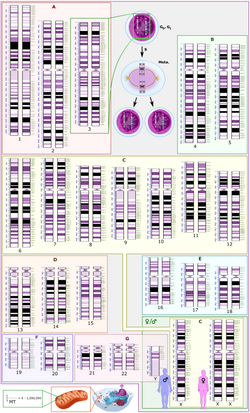
Humans have a total of 46 chromosomes, but there are only 22 pairs of homologous autosomal chromosomes. The additional 23rd pair is the sex chromosomes, X and Y. Note that the pair of sex chromosomes may or may not be homologous, depending on the sex of the individual. For instance, females contain XX, thus have a homologous pair of sex chromosomes. This means that females have 23 pairs of homologous chromosomes in total (i.e., 22 pairs of non-sex chromosomes (autosomes), 1 pair of sex chromosomes). Conversely, males contain XY, which means that they have a non-homologous pair of sex chromosomes as their 23rd pair of chromosomes.[citation needed]
In humans, the 22 pairs of homologous autosomal chromosomes contain the same genes but code for different traits in their allelic forms, as one was inherited from the mother and one from the father.
Homologous chromosome
Homologous chromosomes or homologs are a set of one maternal and one paternal chromosome that pair up with each other inside a cell during meiosis. Homologs have the same genes in the same loci, where they provide points along each chromosome that enable a pair of chromosomes to align correctly with each other before separating during meiosis. This is the basis for Mendelian inheritance, which characterizes inheritance patterns of genetic material from an organism to its offspring parent developmental cell at the given time and area.
Chromosomes are linear arrangements of condensed deoxyribonucleic acid (DNA) and histone proteins, which form a complex called chromatin. Homologous chromosomes are made up of chromosome pairs of approximately the same length, centromere position, and staining pattern, for genes with the same corresponding loci. One homologous chromosome is inherited from the organism's mother; the other is inherited from the organism's father. After meiosis occurs within the daughter cells, they have the correct number of genes which are a mix of the two parents' genes. In diploid (2n) organisms, the genome is composed of one set of each homologous chromosome pair, as compared to tetraploid organisms which may have two sets of each homologous chromosome pair. The alleles on the homologous chromosomes may be different, resulting in different phenotypes of the same genes. This mixing of maternal and paternal traits is enhanced by crossing over during meiosis, wherein lengths of chromosomal arms and the DNA they contain within a homologous chromosome pair are exchanged with one another.
Early in the 1900s, William Bateson and Reginald Punnett were studying genetic inheritance and they noted that some combinations of alleles appeared more frequently than others. That data and information was further explored by Thomas Morgan. Using test cross experiments, he revealed that, for a single parent, the alleles of genes near to one another along the length of the chromosome move together. Using this logic he concluded that the two genes he was studying were located on homologous chromosomes. Later on during the 1930s, Harriet Creighton and Barbara McClintock were studying meiosis in corn cells and examining gene loci on corn chromosomes. Creighton and McClintock discovered that the new allele combinations present in the offspring and the event of crossing over were directly related. This proved interchromosomal genetic recombination.
Homologous chromosomes are pairs of chromosomes in a diploid organism that have similar genes, although not necessarily identical. There are two main properties of homologous chromosomes: 1) the length of chromosomal arms and 2) the placement of the centromere.
The actual length of the arm, in accordance with the gene locations, is critically important for proper alignment. Centromere placement on the chromosome can be characterized by four main arrangements, either metacentric, submetacentric, acrocentric, or telocentric. Both of these properties (i.e., the length of chromosomal arms, and the placement of the chromosomal centromere) are the main factors for creating structural homology between chromosomes. Therefore, when two chromosomes containing the relatively same structure exist (e.g., maternal chromosome 15 and paternal chromosome 15), they are able to pair together via the process of synapsis to form homologous chromosomes.
Since homologous chromosomes are not identical and do not originate from the same organism, they are different from sister chromatids. Sister chromatids result after DNA replication has occurred, and thus are identical, side-by-side duplicates of each other.
Humans have a total of 46 chromosomes, but there are only 22 pairs of homologous autosomal chromosomes. The additional 23rd pair is the sex chromosomes, X and Y. Note that the pair of sex chromosomes may or may not be homologous, depending on the sex of the individual. For instance, females contain XX, thus have a homologous pair of sex chromosomes. This means that females have 23 pairs of homologous chromosomes in total (i.e., 22 pairs of non-sex chromosomes (autosomes), 1 pair of sex chromosomes). Conversely, males contain XY, which means that they have a non-homologous pair of sex chromosomes as their 23rd pair of chromosomes.[citation needed]
In humans, the 22 pairs of homologous autosomal chromosomes contain the same genes but code for different traits in their allelic forms, as one was inherited from the mother and one from the father.
Recent media
Recent media