



Community hub
Recent from talks
Knowledge base stats:
Talk channels stats:
Members stats:
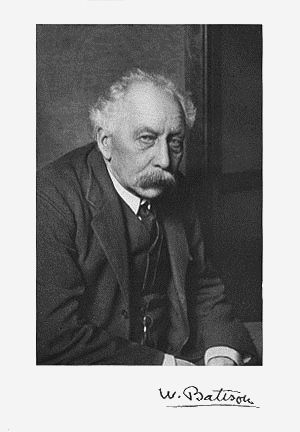
William Bateson
William Bateson (8 August 1861 – 8 February 1926) was an English biologist who was the first person to use the term genetics to describe the study of heredity, and the chief populariser of the ideas of Gregor Mendel following their rediscovery in 1900 by Hugo de Vries and Carl Correns. His 1894 book Materials for the Study of Variation was one of the earliest formulations of the new approach to genetics.
Bateson was born 1861 in Whitby on the Yorkshire coast, the son of William Henry Bateson, Master of St John's College, Cambridge, and Anna Bateson (née Aikin), who was on the first governing body of Newnham College, Cambridge. He was educated at Rugby School and at St John's College, where he graduated BA in 1883 with a first in natural sciences.
Taking up embryology, he went to the United States to investigate the development of Balanoglossus, a worm-like hemichordate which led to his interest in vertebrate origins. In 1883–4 he worked in the laboratory of William Keith Brooks, at the Chesapeake Zoölogical Laboratory in Hampton, Virginia. Turning from morphology to study evolution and its methods, he returned to England and became a Fellow of St John's. Studying variation and heredity, he travelled in western Central Asia.
Between 1900 and 1910 Bateson directed a rather informal "school" of genetics at Cambridge. His group consisted mostly of women associated with Newnham College, Cambridge, and included both his wife Beatrice, and her sister Florence Durham. They provided assistance for his research program at a time when Mendelism was not yet recognised as a legitimate field of study. The women, such as Muriel Wheldale (later Onslow), carried out a series of breeding experiments in various plant and animal species between 1902 and 1910. The results both supported and extended Mendel's laws of heredity. Hilda Blanche Killby, who had finished her studies with the Newnham College Mendelians in 1901, aided Bateson in the replication of Mendel's crosses in peas. She conducted independent breeding experiments in rabbits and bantam fowl, as well.
In 1910, Bateson became director of the John Innes Horticultural Institution and moved with his family to Merton Park in Surrey. During his time at the John Innes Horticultural Institution he became interested in the chromosome theory of heredity and promoted the study of cytology by the appointment of W.C.F. Newton and, in 1923, Cyril Dean Darlington.
In 1919, he founded The Genetics Society, one of the first learned societies dedicated to genetics.
Bateson married (Caroline) Beatrice Durham (1868–1941) in 1896. Her father, Arthur Edward Durham, was a distinguished London surgeon and her siblings included the explorer Edith Durham, the scientist Herbert Durham, the geneticist Florence Margaret Durham, the suffragette and musician Lilla Durham and the civil servant Frances Hermia Durham. He first became engaged to Beatrice in 1889, but at the engagement party he was thought to have consumed too much wine and Beatrice's mother called off the engagement. The couple finally married seven years later in June 1896, by which time the bride's father had died and her mother may have been persuaded to drop her opposition to the marriage. Their son was Gregory Bateson, the anthropologist and cyberneticist who was married to Margaret Mead.
Bateson has been described as a "very militant" atheist.
Hub AI
William Bateson AI simulator
(@William Bateson_simulator)
William Bateson
William Bateson (8 August 1861 – 8 February 1926) was an English biologist who was the first person to use the term genetics to describe the study of heredity, and the chief populariser of the ideas of Gregor Mendel following their rediscovery in 1900 by Hugo de Vries and Carl Correns. His 1894 book Materials for the Study of Variation was one of the earliest formulations of the new approach to genetics.
Bateson was born 1861 in Whitby on the Yorkshire coast, the son of William Henry Bateson, Master of St John's College, Cambridge, and Anna Bateson (née Aikin), who was on the first governing body of Newnham College, Cambridge. He was educated at Rugby School and at St John's College, where he graduated BA in 1883 with a first in natural sciences.
Taking up embryology, he went to the United States to investigate the development of Balanoglossus, a worm-like hemichordate which led to his interest in vertebrate origins. In 1883–4 he worked in the laboratory of William Keith Brooks, at the Chesapeake Zoölogical Laboratory in Hampton, Virginia. Turning from morphology to study evolution and its methods, he returned to England and became a Fellow of St John's. Studying variation and heredity, he travelled in western Central Asia.
Between 1900 and 1910 Bateson directed a rather informal "school" of genetics at Cambridge. His group consisted mostly of women associated with Newnham College, Cambridge, and included both his wife Beatrice, and her sister Florence Durham. They provided assistance for his research program at a time when Mendelism was not yet recognised as a legitimate field of study. The women, such as Muriel Wheldale (later Onslow), carried out a series of breeding experiments in various plant and animal species between 1902 and 1910. The results both supported and extended Mendel's laws of heredity. Hilda Blanche Killby, who had finished her studies with the Newnham College Mendelians in 1901, aided Bateson in the replication of Mendel's crosses in peas. She conducted independent breeding experiments in rabbits and bantam fowl, as well.
In 1910, Bateson became director of the John Innes Horticultural Institution and moved with his family to Merton Park in Surrey. During his time at the John Innes Horticultural Institution he became interested in the chromosome theory of heredity and promoted the study of cytology by the appointment of W.C.F. Newton and, in 1923, Cyril Dean Darlington.
In 1919, he founded The Genetics Society, one of the first learned societies dedicated to genetics.
Bateson married (Caroline) Beatrice Durham (1868–1941) in 1896. Her father, Arthur Edward Durham, was a distinguished London surgeon and her siblings included the explorer Edith Durham, the scientist Herbert Durham, the geneticist Florence Margaret Durham, the suffragette and musician Lilla Durham and the civil servant Frances Hermia Durham. He first became engaged to Beatrice in 1889, but at the engagement party he was thought to have consumed too much wine and Beatrice's mother called off the engagement. The couple finally married seven years later in June 1896, by which time the bride's father had died and her mother may have been persuaded to drop her opposition to the marriage. Their son was Gregory Bateson, the anthropologist and cyberneticist who was married to Margaret Mead.
Bateson has been described as a "very militant" atheist.