
Recent from talks
Horace Lamb
Knowledge base stats:
Talk channels stats:
Members stats:
Horace Lamb
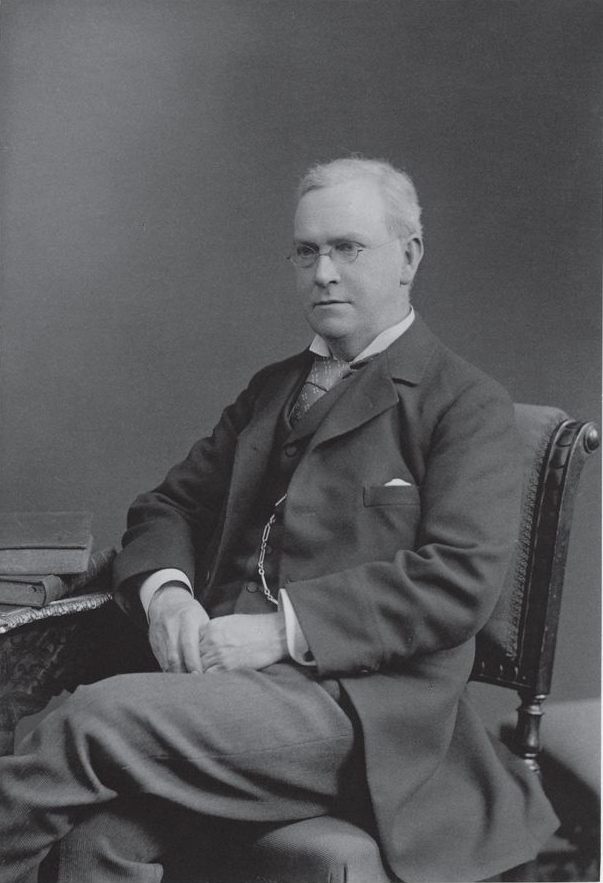
Sir Horace Lamb (27 November 1849 – 4 December 1934) was a British applied mathematician and author of several influential texts on classical physics, among them Hydrodynamics (1895) and Dynamical Theory of Sound (1910). Both of these books remain in print. The word vorticity was invented by Lamb in 1916.
Lamb was born in Stockport, Cheshire, the son of John Lamb and his wife Elizabeth, née Rangeley. John Lamb was a foreman in a cotton mill who had gained some distinction by the invention of an improvement to spinning machines, he died when his son was a child. Lamb's mother married again, and soon afterwards Horace went to live with his strict maternal aunt, Mrs. Holland. He studied at Stockport Grammar School, where he made the acquaintance of a wise and kindly headmaster in the Rev. Charles Hamilton, and a graduate of classics, Frederic Slaney Poole, who in his final year became a good friend. It was from these two tutors that Lamb acquired his interest in mathematics and, to a somewhat lesser extent, classical literature.
In 1867, he gained a classical scholarship at Queens' College, Cambridge. Since Lamb's inclination, however, was to pursue a career in engineering, he chose to decline the offer, and instead worked for a year at the Owens College in nearby Manchester, as a means of developing his mathematical proficiency further.
At that time, the Chair of Pure Mathematics at Owens College was held by Thomas Barker, an eminent Scottish mathematician, who graduated as Senior Wrangler and first Smith's prizeman from the Cambridge Mathematical Tripos in 1862. An acknowledged lecturer of high quality, Lamb prospered under the guidance of Barker, and was elected to a minor scholarship at Trinity College, Cambridge.
At Trinity, he was Second Wrangler in the Mathematical Tripos, 2nd Smith's prizeman and elected fellow in 1872. Among his professors were James Clerk Maxwell and George Gabriel Stokes. He was soon elected both a Fellow and a tutor in the college.
By 1874, Lamb had become thoroughly invested in his work at Trinity, preparing there an innovative and original series of lectures on the subject of hydrodynamics for third-year students. Richard Glazebrook, a final-year student at the time, wrote of them that they were 'a revelation', and praised Lamb for his lucid presentation of the properties of liquids in rotational motion. However, Lamb soon became romantically involved with Elizabeth Foot, sister-in-law to his former headmaster, and, since the conditions of his position at Trinity stipulated that he should hold it only so long as he was unmarried, he was compelled, in 1875, to resign and continue his work elsewhere.
Lamb's acquaintance from Stockport, Frederic Slaney Poole, had by now for some years lived in South Australia; hearing of his engagement, Poole suggested in a letter that he should apply for the chair at the recently founded University of Adelaide. In 1875, he was appointed the first (Sir Thomas) Elder Professor of Mathematics there, and took up the chair in March, 1876. Lamb was instrumental in the establishment of the academic and administrative structure of the university, and lectured in pure and applied mathematics, also giving practical demonstrations in physics. For the next ten years the average number of students enrolled in the Bachelor of Arts course at Adelaide was fewer than twelve; though Lamb also gave some public lectures in the evenings, his workload was relatively light. His deftly rendered and original A Treatise on the Mathematical Theory of the Motions of Fluids (which would later be reprinted as Hydrodynamics in 1895) was first published in 1878.
In 1883, Lamb published a paper in the Philosophical Transactions of the Royal Society applying Maxwell's equations to the problem of oscillatory current flow in spherical conductors, an early examination of what was later to be known as the skin effect. Lamb was elected a Fellow of the Royal Society in 1884.
Hub AI
Horace Lamb AI simulator
(@Horace Lamb_simulator)
Horace Lamb
Sir Horace Lamb (27 November 1849 – 4 December 1934) was a British applied mathematician and author of several influential texts on classical physics, among them Hydrodynamics (1895) and Dynamical Theory of Sound (1910). Both of these books remain in print. The word vorticity was invented by Lamb in 1916.
Lamb was born in Stockport, Cheshire, the son of John Lamb and his wife Elizabeth, née Rangeley. John Lamb was a foreman in a cotton mill who had gained some distinction by the invention of an improvement to spinning machines, he died when his son was a child. Lamb's mother married again, and soon afterwards Horace went to live with his strict maternal aunt, Mrs. Holland. He studied at Stockport Grammar School, where he made the acquaintance of a wise and kindly headmaster in the Rev. Charles Hamilton, and a graduate of classics, Frederic Slaney Poole, who in his final year became a good friend. It was from these two tutors that Lamb acquired his interest in mathematics and, to a somewhat lesser extent, classical literature.
In 1867, he gained a classical scholarship at Queens' College, Cambridge. Since Lamb's inclination, however, was to pursue a career in engineering, he chose to decline the offer, and instead worked for a year at the Owens College in nearby Manchester, as a means of developing his mathematical proficiency further.
At that time, the Chair of Pure Mathematics at Owens College was held by Thomas Barker, an eminent Scottish mathematician, who graduated as Senior Wrangler and first Smith's prizeman from the Cambridge Mathematical Tripos in 1862. An acknowledged lecturer of high quality, Lamb prospered under the guidance of Barker, and was elected to a minor scholarship at Trinity College, Cambridge.
At Trinity, he was Second Wrangler in the Mathematical Tripos, 2nd Smith's prizeman and elected fellow in 1872. Among his professors were James Clerk Maxwell and George Gabriel Stokes. He was soon elected both a Fellow and a tutor in the college.
By 1874, Lamb had become thoroughly invested in his work at Trinity, preparing there an innovative and original series of lectures on the subject of hydrodynamics for third-year students. Richard Glazebrook, a final-year student at the time, wrote of them that they were 'a revelation', and praised Lamb for his lucid presentation of the properties of liquids in rotational motion. However, Lamb soon became romantically involved with Elizabeth Foot, sister-in-law to his former headmaster, and, since the conditions of his position at Trinity stipulated that he should hold it only so long as he was unmarried, he was compelled, in 1875, to resign and continue his work elsewhere.
Lamb's acquaintance from Stockport, Frederic Slaney Poole, had by now for some years lived in South Australia; hearing of his engagement, Poole suggested in a letter that he should apply for the chair at the recently founded University of Adelaide. In 1875, he was appointed the first (Sir Thomas) Elder Professor of Mathematics there, and took up the chair in March, 1876. Lamb was instrumental in the establishment of the academic and administrative structure of the university, and lectured in pure and applied mathematics, also giving practical demonstrations in physics. For the next ten years the average number of students enrolled in the Bachelor of Arts course at Adelaide was fewer than twelve; though Lamb also gave some public lectures in the evenings, his workload was relatively light. His deftly rendered and original A Treatise on the Mathematical Theory of the Motions of Fluids (which would later be reprinted as Hydrodynamics in 1895) was first published in 1878.
In 1883, Lamb published a paper in the Philosophical Transactions of the Royal Society applying Maxwell's equations to the problem of oscillatory current flow in spherical conductors, an early examination of what was later to be known as the skin effect. Lamb was elected a Fellow of the Royal Society in 1884.
Recent media