Hubbry Logo
Mathematical TriposMathematical TriposMain
Open search
Mathematical Tripos
Community hub
Mathematical Tripos
logo
8 pages, 0 posts
0 subscribers
Be the first to start a discussion here.
Mathematical Tripos
Mathematical Tripos
from Wikipedia

Mathematical Tripos
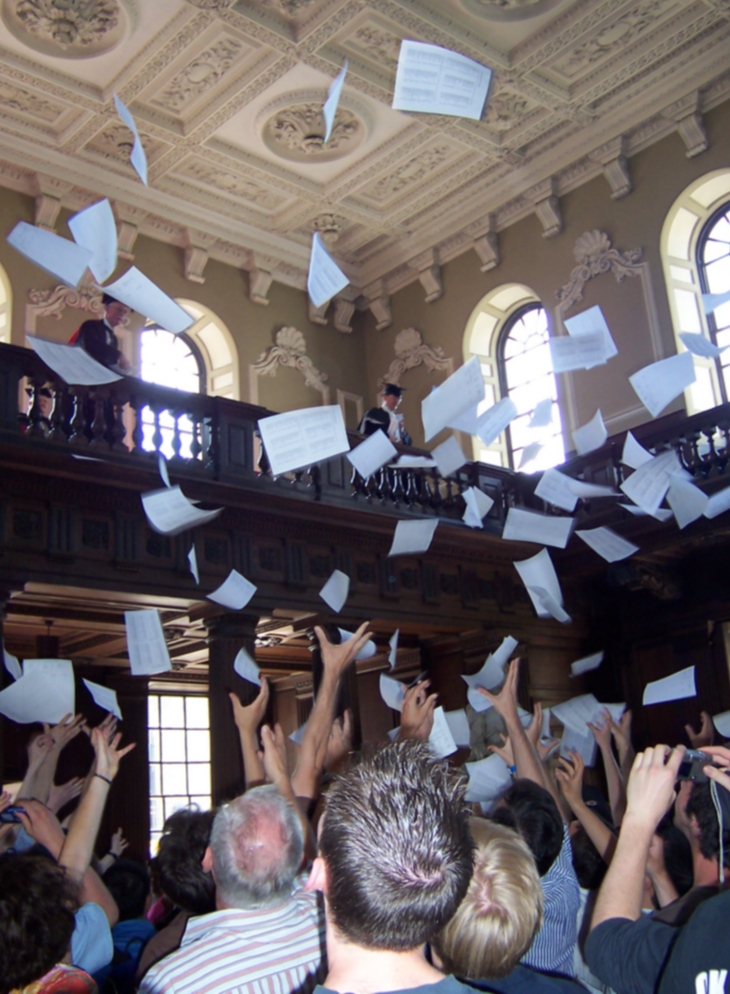
Results for parts II and III of the Mathematical Tripos are read out inside the Senate House, Cambridge, and then, tossed from the balcony.
Type
Skills testedMathematics
Duration3 or 4 years
RegionsUniversity of Cambridge
LanguagesEnglish language
Websitemaths.cam.ac.uk/undergrad

The Mathematical Tripos is the mathematics course that is taught in the Faculty of Mathematics at the University of Cambridge.[1]

Origin

[edit]

In its classical 19th century form, the tripos was a distinctive written examination of undergraduate students of the University of Cambridge. Prior to 1824, the Mathematical Tripos was formally known as the "Senate House Examination".[2] From about 1780 to 1909, the "Old Tripos" was distinguished by a number of features, including the publication of an order of merit of successful candidates, and the difficulty of the mathematical problems set for solution. By way of example, in 1854, the Tripos consisted of 16 papers spread over eight days, totalling 44.5 hours. The total number of questions was 211.[3] It was divided into two parts, with Part I (the first three days) covering more elementary topics.[4]

The actual marks for the exams were never published, but there is reference to an exam in the 1860s where, out of a total possible mark of 17,000, the senior wrangler achieved 7,634, the second wrangler 4,123, the lowest wrangler around 1,500 and the lowest scoring candidate obtaining honours (the wooden spoon) 237; about 100 candidates were awarded honours. The 300-odd candidates below that level did not earn honours and were known as poll men.[5]

The questions for the 1841 examination may be found within Cambridge University Magazine (pages 191–208).[6] Questions from 1876 are reprinted in Lord Rayleigh's collected works.[7]

Wooden Spoon award, 1910

Influence

[edit]

According to the study Masters of Theory: Cambridge and the Rise of Mathematical Physics by Andrew Warwick[8] during this period the style of teaching and study required for the successful preparation of students had a wide influence:

Since Cambridge students did a lot of rote learning called "bookwork", it was noted by Augustus De Morgan and repeated by Andrew Warwick[8]: 152  that authors of Cambridge textbooks skipped known material. In consequence, "non-Cambridge readers ... found the arguments impossible to follow."

From the 1820s to the 1840s, analytic topics such as elliptical integrals were introduced to the curriculum. Under William Whewell, the Tripos' scope changed to one of 'mixed mathematics', with the inclusion of topics from physics such as electricity, heat and magnetism. Students would have to study intensely to perform routine problems rapidly.[4]

Early history

[edit]

The early history is of the gradual replacement during the middle of the eighteenth century of a traditional method of oral examination by written papers, with a simultaneous switch in emphasis from Latin disputation to mathematical questions. That is, all degree candidates were expected to show at least competence in mathematics. A long process of development of coaching—tuition usually outside the official University and college courses—went hand-in-hand with a gradual increase in the difficulty of the most testing questions asked. The standard examination pattern of bookwork (mostly memorised theorems) plus rider (problems to solve, testing comprehension of the bookwork) was introduced.

Wranglers and their coaches

[edit]

The list of wranglers (the candidates awarded a first-class degree) became in time the subject of a great deal of public attention. According to Alexander Macfarlane[9]

To obtain high honours in the Mathematical Tripos, a student must put himself in special training under a mathematician, technically called a coach, who is not one of the regular college instructors, nor one of the University professors, but simply makes a private business of training men to pass that particular examination. Skill consists in the rate at which one can solve and more especially write out the solution of problems. It is excellent training of a kind, but there is not time for studying fundamental principles, still less for making any philosophical investigations. Mathematical insight is something higher than skill in solving problems; consequently the senior wrangler has not always turned out the most distinguished mathematician in after life.

William Hopkins was the first coach distinguished by his students' performances. When he retired in 1849, one of his students, Edward Routh, became the dominant coach. Another coach, William Henry Besant, published a textbook, Elementary Hydrostatics, containing mathematical exercises and solutions such as would benefit students preparing for Tripos. After Routh retired in 1888, Robert Rumsey Webb coached many of the top wranglers. Warwick notes that college teaching improved toward the end of the 19th century:

The expansion of intercollegiate and university lectures at all levels through the 1880s and 1890s meant that, by 1900, it had become unnecessary for coaches either to lecture students or even to provide them with manuscripts covering the mathematical methods they were required to master. The prime job to the coach now was to ensure that students were attending an appropriate range of courses and that they understood what they were being taught. … This curtailment of responsibility made it virtually impossible for a private tutor to dominate undergraduate training the way that Hopkins, Routh, and Webb had done.[8]: 282 

A fellow of Trinity College, Robert Alfred Herman, then was associated with several of the top wranglers as their coach.

When A. R. Forsyth wrote his retrospective in 1935, he recalled Webb, Percival Frost, Herman, and Besant as the best coaches. Other coaches that produced top wranglers include E. W. Hobson, John Hilton Grace, H. F. Baker, Thomas John I'Anson Bromwich, and A. E. H. Love.

Athletics

[edit]

Apart from intellectual preparation, the challenge of Tripos was its duration: "The examinations themselves were intended partly as tests of endurance, taking place on consecutive mornings and afternoons for four and five days together."[8]: 186  Brisk walking was taken up by many candidates to build up their stamina. As the nineteenth century progressed walking turned to athletics and other competitive sports including rowing and swimming. The coaches set the example: Routh had a two-hour constitutional walk daily, while "Besant was a mountaineer, Webb a walker, and Frost was extremely proficient in cricket, tennis, running and swimming."[8]: 200  By 1900, there were twenty-three recognized sports contested at Cambridge.

Women

[edit]

In 1873, Sarah Woodhead became the first woman to take, and to pass, the Mathematical Tripos.[10]

In 1880, Charlotte Angas Scott obtained special permission to take the Mathematical Tripos, as women were not normally allowed to sit for that exam. She came eighth on the Tripos of all students taking them, but due to her sex, the title of "eighth wrangler," a high honour, went officially to a male student.[11] At the ceremony, however, after the seventh wrangler had been announced, all the students in the audience shouted her name. Because she could not attend the award ceremony, Scott celebrated her accomplishment at Girton College where there were cheers and clapping at dinner, a special evening ceremony where the students sang "See the Conquering Hero Comes", received an ode written by a staff member, and was crowned with laurels.[11]

Since 1881 women were allowed to take the Mathematical Tripos,[12] and their exam scores listed, although separately from the men's and thus not included in the rankings. Women obtaining the necessary score also received a special certificate instead of the BA degree with honours.

In 1890, Philippa Fawcett became the first woman to obtain the top score in the Mathematical Tripos,[13][14] but since she could not receive a degree from Cambridge due to being a woman, she could not be the senior wrangler.[12][15] Cambridge did not offer degrees to women until 1948.[15]

No woman became the senior wrangler until Ruth Hendry in 1992.[16]

1909 reforms

[edit]

Reforms were implemented in 1909. The undergraduate course of mathematics at Cambridge still reflects a historically broad approach; and problem-solving skills are tested in examinations, though the setting of excessively taxing questions has been discouraged for many years.

Example questions from 1881, before the reforms, are quoted in A Mathematician's Miscellany:

(b) A sphere spinning in equilibrium on top of a rough horizontal cylinder is slightly disturbed; prove that the track of the point of contact is initially a helix. (c) If the sphere has a centrally symmetrical law of density such as to make the radius of gyration a certain fraction of the radius then, whatever the spin, the track is a helix so long as contact lasts. (Marked at 200; a second part about further details carried another 105.)

The modern tripos

[edit]

As of 2018, the Mathematical Tripos course comprises three undergraduate years (Parts IA, IB and II) which qualify a student for a BA degree, and an optional one year masters course (Part III) which qualifies a student for a Master of Mathematics (MMath) degree (with BA) if they are a Cambridge fourth year student or a Master of Advanced Study (MASt) degree if they come from outside just to do Part III. Assessment is mostly by written examination at the end of each academic year, with some coursework elements in the second, third and fourth years.[17]

During the undergraduate part of the course, students are expected to attend around 12 one-hour lectures per week on average, together with two supervisions. Supervisions are informal sessions in which a small group of students—normally a pair—goes through previously completed example sheets under the guidance of a faculty member, college fellow or graduate student.

During the first year, Part IA, the schedule of courses is quite rigid, providing much of the basic knowledge requisite for mathematics, including algebra, analysis, methods in calculus, and probability. The second year, Part IB, contains no mandatory content but it is recommended that students do particular courses as they are essential prerequisites for further courses. A range of pure courses, such as geometry, complex analysis and a course studying group theory, rings and modules are on offer as well as applied courses on electromagnetism, quantum mechanics and fluid dynamics.[18] In Part II, students are free to choose from a large number of courses over a wide range of mathematical topics; these are separated into more accessible C courses and D courses which are more involved. Some students choose to exchange 25% of the first-year mathematics options in exchange for the Physics option of first-year Natural Sciences Tripos with the possibility of changing to Natural Sciences at the end of the first year.

References

[edit]

Further reading

[edit]
Revisions and contributorsEdit on WikipediaRead on Wikipedia
from Grokipedia
The Mathematical Tripos is the undergraduate honours course in mathematics at the University of Cambridge, comprising examinations in Parts IA, IB, II, and an optional advanced Part III, typically completed over three or four years. Students progress through structured coursework emphasizing pure and applied mathematics, with assessments primarily via annual written examinations consisting of four three-hour papers, supplemented by small-group supervisions and computational projects. Originating in the early eighteenth century as the Senate House Examination—a rigorous oral and later written test primarily in mathematics conducted in Latin—the Tripos formalized the path to a bachelor's degree and evolved into its namesake upon the introduction of the Classical Tripos in 1824. It featured a competitive order-of-merit ranking of successful candidates as "wranglers," with the top performer designated the Senior Wrangler, a system that incentivized intense private coaching by specialists like William Hopkins and Edward John Routh, who trained numerous eminent scientists including George Stokes and James Clerk Maxwell. This emphasis on problem-solving techniques in Newtonian mechanics and related fields propelled Britain's dominance in mathematical physics during the nineteenth century, though the curriculum's conservatism later drew criticism for prioritizing rote analytical skills over innovative theory or experimentation. Significant reforms in 1909, championed by figures such as G.H. Hardy, abolished the merit ordering to reduce undue pressure and refocus on substantive learning, while broadening the syllabus to incorporate modern analysis and diminishing reliance on coaching. The contemporary Tripos maintains its reputation for depth and flexibility, offering diverse electives in areas like probability and geometry, and continues to cultivate leading mathematicians, reflecting its adaptation from a high-stakes ranking mechanism to a comprehensive research-oriented program. Traditions like the "Wooden Spoon"—awarded symbolically to the lowest-ranked wrangler—persisted into the early twentieth century, underscoring the examination's historical intensity.

Historical Origins

Early Foundations and Influences

The Mathematical Tripos originated as part of the University of Cambridge's Bachelor of Arts degree requirements, which traditionally involved oral disputations in the Senate House to demonstrate proficiency in logic, ethics, and rudimentary mathematics as preparation for clerical ordination. By the mid-eighteenth century, these oral examinations began transitioning to written papers, with the first structured written assessments appearing around the 1750s, marking the establishment of the Tripos as a mandatory honors examination for ranking candidates. This shift facilitated broader evaluation of analytical skills beyond rote disputation, aligning with Cambridge's role in training Anglican clergy who required logical rigor for theological discourse. The Tripos's early development was profoundly shaped by Isaac Newton's legacy, as Cambridge mathematicians prioritized Newtonian fluxions and geometry over continental calculus, embedding these in the curriculum to uphold empirical and geometric traditions. This Newtonian focus, evident from the late seventeenth century onward, reinforced mathematics as a tool for natural philosophy, distancing the examination from purely classical or Aristotelian roots while still serving the university's ecclesiastical mission, where mathematical precision was seen as analogous to moral and doctrinal clarity. Initial Tripos questions in the 1750s and 1760s integrated arithmetic, elementary , and with elements of moral philosophy and logic, reflecting the blended intellectual demands of a clerical . By , the examination introduced a formal , classifying successful candidates as wranglers (first class) and establishing competitive rankings that incentivized intensive preparation, with the top performer designated . This system formalized the Tripos's role in distinguishing intellectual merit among undergraduates, setting the stage for its evolution into a rigorous mathematical ordeal.

Development in the 18th and 19th Centuries

During the 18th century, the Mathematical Tripos emerged from the Senate House Examination, an oral assessment in mathematics and natural philosophy conducted in Latin for promising undergraduates seeking academic distinction beyond the ordinary bachelor's degree. By around 1790, the process incorporated printed questions, focusing primarily on Newtonian fluxions, geometry, and basic mechanics, which served as the primary route to honours and reflected Cambridge's adherence to Isaac Newton's legacy amid lingering tensions from the fluxions-calculus controversy. This structure incentivized merit-based selection, positioning the Tripos as a tool for identifying talent in an era when university degrees emphasized classical and theological preparation over specialized science. The early 19th century marked a pivotal expansion, spurred by reformers advocating continental analytical methods to modernize the curriculum. Robert Woodhouse played a key role, publishing The Principles of Analytical Calculation in 1803, which systematically introduced French-style calculus notation and rigor suitable for Tripos questions, challenging the dominance of synthetic geometry and fluxions. This effort laid groundwork for the Analytical Society, founded in 1812 by Charles Babbage, George Peacock, and John Herschel, which accelerated the "analytical revolution" by integrating differential and integral calculus, rigid-body dynamics, and astronomical computations into the syllabus by the 1820s. University reforms, including the 1824 distinction of the Mathematical Tripos from the new Classical Tripos, further entrenched mathematics as the honours gateway, broadening topics to encompass mechanics and optics while heightening competition. By the mid-19th century, the Tripos had intensified into a grueling ordeal, with examinations spanning up to eight days of 5.5-hour papers before 1850, when it remained the sole honours pathway regardless of career intent. Candidates faced problems demanding swift, precise solutions in advanced areas such as heat, light, sound, and lunar theory, fostering skills in applied analysis under severe time constraints. This rigor propelled Cambridge's global mathematical standing, yielding empirical successes like George Gabriel Stokes, who topped the 1841 Tripos and later formulated key equations in fluid dynamics and wave optics, and William Thomson (Lord Kelvin), second in 1845, whose thermodynamic insights stemmed from Tripos-honed analytical prowess. The system's causal link to scientific output—via meritocratic ranking and intensive preparation—underpinned Britain's 19th-century physics advances, though its insularity limited engagement with pure mathematics elsewhere in Europe.

The Classical Era (Pre-1909)

Examination Structure and Content

![Announcement of Mathematical Tripos results][float-right] The Mathematical Tripos examination prior to 1909 formed the capstone of undergraduate mathematical studies at Cambridge, typically taken after three years of residence following a preliminary examination known as the Previous or Little-go. This final assessment comprised multiple written papers testing proficiency across pure and applied mathematics, with candidates required to demonstrate both theoretical understanding and practical problem-solving abilities. In the mid-19th century, the Tripos consisted of 16 papers administered over eight days, with sessions lasting approximately five and a half hours each day. Each paper presented a series of questions demanding rapid computation, geometric constructions and proofs, and solutions to novel problems in areas such as algebra, Euclidean geometry, and mechanics. Applied topics included hydrostatics, dynamics of particles and rigid bodies, optics, astronomy, heat, and electricity, often requiring integration of physical principles with mathematical techniques like those in hydrodynamics. The format emphasized originality and speed, as candidates faced problems not directly replicable from standard texts, fostering analytical ingenuity under time constraints. Results were publicly announced in the Senate House, where classifications were read aloud, ranging from the highest achiever to the lowest successful candidate. This ritual underscored the examination's role as a rigorous filter for mathematical aptitude, with the content evolving to incorporate advanced topics like electromagnetic theory by the late 19th century while retaining a core focus on computational and geometric rigor.

The Wrangler Ranking System

The wrangler ranking system of the classical Mathematical Tripos produced an annual strict order-of-merit list of all candidates who achieved honours, determined by aggregate marks from an intensive eight-day Senate House examination comprising written papers tested in applied and pure mathematics, mechanics, and related sciences. This hierarchy placed the highest-scoring candidate as Senior Wrangler, followed sequentially by Second Wrangler and subsequent ranks down to the lowest honours candidate, derisively known as the recipient of the "Wooden Spoon," who typically scored around 300 marks compared to the Senior Wrangler's over 7,500. The system's meritocratic design incentivized intense preparation, as the published rankings served as a public signal of intellectual prowess, often determining access to patronage networks and fellowships at Cambridge colleges. Attaining the Senior Wrangler position conferred substantial career advantages, including preferential entry into academia, the church, law, actuarial professions, and public service, where high Tripos performance was viewed as a proxy for analytical rigor and reliability. For instance, George Gabriel Stokes, Senior Wrangler in 1841, advanced to the Lucasian Professorship of Mathematics at Cambridge, while Thomas Bond Sprague, Senior Wrangler in 1853, rose to preside over both the Faculty and Institute of Actuaries. Even near-top ranks yielded outsized opportunities; James Clerk Maxwell, Second Wrangler in 1854, became a foundational figure in electromagnetism and thermodynamics. Empirical patterns from 19th-century outcomes demonstrate a strong correlation between upper-echelon rankings and subsequent contributions to British science and mathematics, with top wranglers exhibiting score disparities—such as 7,634 out of 17,000 for one Senior Wrangler versus 5,500–6,000 for mid-tier—that aligned with differentiated capabilities predictive of real-world impact. Notable Senior Wranglers and high placers, including Arthur Cayley in pure mathematics and William Thomson (later Lord Kelvin), Second Wrangler, dominated advancements in physics and engineering, underscoring the system's efficacy in identifying and elevating elite talent despite potential variances in examiners' subjective assessments of problem-solving under timed conditions. This merit hierarchy thus channeled human capital toward fields demanding causal inference and quantitative precision, bolstering Britain's scientific preeminence through verifiable selection mechanisms rather than egalitarian distribution.

Coaching Practices and Preparation

The rigorous and unpredictable nature of the Mathematical Tripos examinations prompted the emergence of private coaching as an adaptive response in the early 19th century, supplementing limited university lecturing with targeted preparation. William Hopkins, who achieved seventh wrangler status in the 1827 Tripos, pioneered this system by tutoring aspiring candidates from the late 1820s onward, selecting and training dozens annually in Tripos-specific problem-solving techniques. Hopkins' methods emphasized deep comprehension over rote memorization, involving intensive drills on mixed mathematics applications, analysis of past papers to anticipate question styles, and supervised exercises incorporating contemporary shortcuts. By his retirement in 1849, he had coached nearly 200 wranglers, including 17 Senior Wranglers such as Arthur Cayley (1842) and George Gabriel Stokes (1841). Successors like Edward Routh continued this tradition, enforcing regimens of extended daily study—often from early morning until late evening, interrupted only for meals and brief exercise to sustain focus—designed to build endurance for the multi-day exams. Coaching fees provided strong economic incentives, scaling with a tutor's proven record of elevating students above rivals in the order of merit; Hopkins' selectivity of top pupils and consistent output of high placers made the profession both selective and remunerative, often yielding incomes surpassing those of university fellows. This market-driven approach reflected the Tripos' emphasis on competitive outperformance, where parental investments in coaching correlated directly with career prospects in church, civil service, or academia.

Extracurricular Elements: Athletics and Social Pressures

The rigorous demands of Tripos preparation in the 19th century often resulted in physical and mental exhaustion among students, with critics like Isaac Todhunter highlighting the risks of "lasting ill health" from prolonged sedentary study and cramming. This intensity prompted adaptations, including the promotion of physical exercise to counteract fatigue and foster endurance, as mathematical training was increasingly viewed through the lens of bodily discipline. By the mid-19th century, sports such as rowing emerged as integral to student life at Cambridge, with university boat clubs established in the 1820s and intercollegiate competitions intensifying thereafter, providing a counterbalance to the Tripos's intellectual grind. Historians note that these activities were not merely recreational but tied to the cultivation of resilience among aspirant wranglers, aligning mathematical prowess with physical vigor in Victorian ideals of manliness. Cricket, similarly widespread among undergraduates, offered seasonal outlets for competition, though rowing's demanding regimen was particularly valorized for mirroring the stamina required in exam marathons. Such extracurricular pursuits offset documented strains, including nervous breakdowns and withdrawal due to overwork, which were recurrent in accounts of Tripos candidates who prioritized rankings over well-being. While precise dropout figures from the era remain elusive, the system's grueling pace—encompassing up to 16 papers over several days—exacerbated vulnerabilities, with athletics serving as a pragmatic hedge against burnout by promoting holistic fortitude. Socially, the Tripos reinforced a hyper-competitive, male-centric ethos, where success signaled not only intellectual merit but masculine fortitude, transcending class barriers through raw ability yet entrenching exclusivity within an all-male domain. This meritocratic facade equalized opportunities for non-aristocratic entrants via mathematical aptitude, but the ambient pressures—intensified by coaching rivalries and public rankings—cultivated a culture of relentless emulation, where failure imperiled social standing and self-perception.

Integration of Women and Early Controversies

Barriers to Female Participation

Women were excluded from formal membership of the University of Cambridge and thus barred from receiving degrees until 1948, which prevented their official participation in honours examinations such as the Mathematical Tripos. This institutional policy stemmed from statutes reserving university privileges for male students, despite the establishment of women's colleges like Girton in 1869, where female students could attend lectures but not matriculate formally. As a result, women pursuing mathematical studies faced structural barriers, including ineligibility for the wrangler rankings and official recognition of Tripos performance, even as they prepared under similar coaching regimens. From the 1870s, limited exceptions allowed women to sit Tripos papers informally through special permissions, often coordinated via women's colleges, paralleling the men's examination without granting equivalent status or certificates of proficiency until 1881 resolutions. In 1880, Charlotte Angas Scott of Girton College received dispensation to attempt the Mathematical Tripos, producing work examiners ranked equivalent to the eighth wrangler among male candidates, marking the first such documented female achievement. Her success, announced anonymously as "a lady" in results lists, empirically tested claims of female incapacity in advanced mathematics but prompted no immediate rule changes, as university governance prioritized tradition over isolated evidence. Resistance to fuller inclusion drew on 19th-century rationales emphasizing separate spheres for men and women, with mathematics viewed as demanding rigorous analytical faculties deemed more naturally aligned with male intellect, per prevailing empirical observations of limited female precedents in the field. Petitions from women's colleges in the 1870s and early 1880s for exam access or titling rights faced repeated defeat in Senate votes, reflecting senate members' concerns over diluting the Tripos's meritocratic prestige and altering gender-based educational norms without broader societal consensus. These barriers persisted despite coaching successes, as women's results, while competitive, lacked the institutional validation to shift policy prior to 1890.

Breakthroughs and Official Recognition

In 1890, Philippa Fawcett of Newnham College achieved the highest score in the Cambridge Mathematical Tripos, outperforming the official Senior Wrangler, Philip Tettenborn, by approximately 13 percent on aggregate marks. Although women were permitted to sit the examinations since 1881, they received no official ranking; Fawcett was thus placed "above the Senior Wrangler" in the published results, a designation that highlighted her superiority without conferring the title or privileges reserved for men. This outcome ignited public and academic debate on female intellectual capacity in mathematics, challenging prevailing Victorian assumptions of innate female inferiority, yet it elicited no immediate reforms to examination policy or university membership. Subsequent decades saw incremental participation by women in the Tripos, with a small but growing number attaining wrangler status—defined as third-class honors or better—despite persistent barriers to formal recognition. By the interwar period, particularly from the 1920s onward, female candidates comprised a rising proportion of examinees from women's colleges like Girton and Newnham, reflecting expanded access to preparatory coaching and resources. Empirical records indicate that these women frequently matched or exceeded male averages in specific papers, as evidenced by unofficial placements and honors lists, thereby accumulating data that undermined earlier dismissals of their competitive viability. The pivotal official recognition arrived in October 1948, when the University of Cambridge voted to award full degrees to women, retroactively validating prior Tripos performances and integrating female graduates into the alumni body. This milestone correlated with observable upticks in female wranglers post-World War II, as degree eligibility removed a key disincentive and aligned incentives with meritocratic outcomes; for instance, the proportion of women achieving high honors began aligning more closely with their enrollment rates, providing quantitative rebuttal to lingering skepticism about parity in mathematical aptitude. Fawcett herself lived to witness this change, having declined a degree offer in 1920 in solidarity with unadmitted peers.

Major Reforms

The 1909 Overhaul

In response to mounting criticisms that the Mathematical Tripos fostered superficial "grinding" through exam tricks and mechanical problem-solving rather than genuine mathematical insight—echoing concerns from earlier Royal Commissions on university examinations—the University of Cambridge implemented major reforms in 1909, largely driven by influential dons including G.H. Hardy. These changes aimed to align the Tripos more closely with emerging European standards emphasizing pure mathematics and theoretical depth, countering the system's historical bias toward applied topics and rote preparation. The most prominent structural alteration eliminated the exhaustive order-of-merit ranking across the entire honors list, which had previously divided candidates into three classes (Wranglers, Senior Optimes, and Junior Optimes) but ordered individuals precisely within and across them, culminating in titles like Senior Wrangler. Instead, candidates were classified into three broad divisions—Class I, Class II, and Class III—with optional subdivisions (such as alpha or beta within classes) for finer distinction, but names within each class listed alphabetically rather than by merit, thereby diminishing the psychological and social pressure of infinitesimal rankings. This shift ended traditions like the public proclamation of the full list in Senate House and the awarding of the Wooden Spoon to the lowest-ranked honors candidate, marking the close of the "Old Tripos" era. Curriculum revisions introduced greater emphasis on abstract and theoretical subjects, reducing reliance on time-pressured tricks that critics like Hardy deemed antithetical to fostering research-oriented mathematicians. While the competitive examination format persisted, the reforms broadened the scope beyond heavy applied mechanics—such as detailed treatments of electromagnetic theory—to prioritize pure analysis, thereby addressing the causal link between outdated coaching practices and Britain's relative lag in advanced mathematics compared to Germany and France. Immediate outcomes included a less hyper-competitive atmosphere, with the top performer still privately acknowledged by examiners but without public fanfare, preserving some meritocratic elements while curbing excesses. The changes did not fully eradicate preparatory coaching but redirected it toward substantive understanding, setting the stage for further evolution without immediately overhauling the Tripos's core rigor.

20th-Century Adjustments and Modernization

In the interwar period, the Mathematical Tripos adapted to incorporate foundational advances in theoretical physics, particularly quantum theory. Lectures on recent developments in spectrum theory were introduced in the Natural Sciences Tripos by Charles Galton Darwin between 1919 and 1922, with parallel integration into the Mathematical Tripos via Ralph H. Fowler's courses from 1922 to 1924. George Birtwistle expanded this with dedicated quantum theory lectures starting in 1924, supported by his textbooks Quantum Theory of the Atom (1926) and The New Quantum Mechanics (1928), leading to Tripos examination questions on Heisenberg's matrix mechanics and Schrödinger's wave mechanics by 1927. Paul Dirac contributed advanced quantum mechanics courses from 1925 onward, embedding these topics firmly in the applied mathematics schedule. Special relativity, building on earlier physics seminars influenced by Einstein's 1905-1911 works, appeared in Dynamics papers for Part II by the early 1920s, aligning the curriculum with continental European developments. Part III, initially a schedule appended to Part II, was established as a distinct postgraduate examination in 1934, offering specialization in emerging areas like quantum field theory and relativistic mechanics post-World War II. This one-year program, enrolling approximately 200 students annually by mid-century, served as an advanced bridge to research, adapting to wartime disruptions and the influx of applied topics from physics. By the 1950s, quantum mechanics had become a standard component, reflecting Cambridge's role in its maturation through figures like Dirac. The 1960s brought structural modernization amid national higher education expansions, with the Faculty of Mathematics reorganized into pure and applied departments in 1960, housed in new facilities to support integrated teaching. These changes facilitated curriculum updates to include post-war mathematical innovations, such as functional analysis and topology, while maintaining exam-centric rigor. Despite shifts away from pre-1909 intensity, the Tripos sustained its empirical effectiveness in talent development, as evidenced by consistent advancement of graduates to leading research positions in mathematics and physics.

Criticisms and Intellectual Debates

G.H. Hardy's Case Against the Tripos

In 1926, G. H. Hardy presented his presidential address to the Mathematical Association, titled "The Case Against the Mathematical Tripos," advocating for the complete abolition of Cambridge's Mathematical Tripos examination system. Hardy, who had himself been a Senior Wrangler in 1896, argued that the Tripos had devolved into a mechanism that prioritized competitive performance over genuine mathematical development, influencing the training of nearly all English professional mathematicians of the era. Central to Hardy's critique was the Tripos's focus on "elaborate futilities," where problems demanded rapid manipulation of techniques rather than profound insight or rigorous proof, thereby rewarding speed, memory, and ingenuity in shortcuts over depth and originality. He contended that this structure stifled creativity by encouraging students to master contrived puzzles suited to timed exams, often at the expense of foundational principles, and fostered habits of superficiality that persisted into professional work. For instance, Hardy noted that Tripos preparation emphasized algebraic dexterity and geometric tricks, which, while impressive in competition, diverted attention from the systematic rigor prevalent in continental analysis. Hardy supported his case with the observed disparity between British and European mathematics: by the early 20th century, Britain lagged significantly in advanced pure mathematics, particularly real and complex analysis, which he attributed directly to the Tripos's unrigorous legacy. He cited the superior output of schools like those in France and Germany, where training emphasized logical depth over examinational prowess, as evidence that the Tripos inculcated methods ill-suited to research. In Hardy's view, this systemic flaw explained why English mathematicians excelled in applied fields but produced fewer contributions to pure theory, underscoring the need to dismantle the Tripos in favor of a curriculum oriented toward independent investigation and scholarly pursuit.

Defenses of Its Meritocratic Rigor and Empirical Successes

The Mathematical Tripos's meritocratic structure, with its anonymous marking and ordinal ranking of candidates as wranglers, has been defended as a reliable mechanism for identifying exceptional talent under pressure, fostering skills transferable to advanced research. High-ranking wranglers frequently demonstrated outsized impact, as seen in Alan Turing's classification as a B* Wrangler (denoting distinction among the top performers) in the 1934 Tripos examinations, after which he formulated the Turing machine model central to theoretical computer science and computability theory. Similarly, Paul Dirac's attainment of first-class honours in the 1923 Tripos preceded his development of the relativistic quantum equation bearing his name, which unified quantum mechanics and special relativity while predicting antimatter. These trajectories illustrate how the system's emphasis on rapid, creative problem-solving under timed conditions equipped participants for foundational innovations, contradicting claims that it stifled originality. Empirical outcomes further substantiate the Tripos's efficacy in producing elite mathematicians, with Cambridge alumni linked to the program accounting for at least 11 Fields Medals by 2018, including recipients like Richard Borcherds and W. Timothy Gowers in 1998 for breakthroughs in algebraic structures and functional analysis, respectively. Subsequent awards to Caucher Birkar (2018) and James Maynard (2022) for advances in algebraic geometry and analytic number theory reinforce this pattern, suggesting the competitive rigor selected individuals resilient to the ambiguities of open-ended research. Defenders highlight that such selection effects—prioritizing raw analytical prowess over rote knowledge—yielded disproportionate contributions relative to program size, as verifiable through alumni publication records and prize distributions. Proponents, drawing on historical precedents, assert that the Tripos's intensity built enduring problem-solving tenacity, enabling sustained productivity beyond academia; for instance, 19th-century Senior Wranglers like William Thomson (later Lord Kelvin) applied honed deductive skills to thermodynamics and engineering feats. This aligns with evaluations of the exam as a benchmark for "rigour, justice and importance" in merit-based assessment, where performance correlated with later versatility across disciplines demanding causal inference and quantitative modeling. The system's empirical track record thus supports its role in causal pathways from intensive training to high-impact outputs, independent of critiques focused on stylistic preferences.

Contemporary Form

Current Curriculum and Part System

The Mathematical Tripos undergraduate course comprises three sequential parts—IA, IB, and II—typically completed over three years to earn a Bachelor of Arts degree, with an optional fourth year constituting Part III at the master's level leading to a Master of Mathematics or Master of Advanced Study. Parts IA and IB provide foundational training in pure and applied mathematics, emphasizing core topics such as algebra, analysis, vector calculus, differential equations, and probability, while incorporating computational elements through projects like CATAM (Computational Applications and Techniques in Applied Mathematics). This structure balances theoretical rigor with practical computation, adapting to modern demands by including programming and numerical methods without diluting foundational proofs. Part II advances to undergraduate-level specialization, offering extensive elective courses across pure mathematics (e.g., number theory, geometry), applied mathematics (e.g., fluid dynamics, quantum mechanics), statistics, logic, and theoretical physics, maintaining a roughly equal emphasis on pure and applied domains. Students select from approximately 20-30 courses annually, fostering depth in chosen areas while requiring breadth through cross-sectional examinations. Recent evolutions include expanded options in data science and machine learning within statistics and applied modules, reflecting interdisciplinary growth since the 1990s, yet preserving the Tripos's commitment to analytical problem-solving over rote application. Part III, pursued by high-achieving graduates, operates as a intensive master's program with up to 80 lecture courses offered each year, spanning advanced pure mathematics, probability, statistics, applied mathematics, theoretical physics, and emerging fields like computational finance and data analysis. Participants typically engage with 12-16 courses, selected for specialization, alongside a required original essay on a research-oriented topic to encourage synthesis and critical evaluation. This modular system retains the Tripos's rigorous, proof-based ethos, integrating contemporary adaptations such as algorithmic methods and statistical modeling while prioritizing causal mathematical reasoning over descriptive tools.

Assessment Methods and Recent Reforms

The Mathematical Tripos assesses students through end-of-year written examinations across Parts IA, IB, and II, with coursework components incorporated in later parts to evaluate applied skills and continuous engagement. Performance is classified into three divisions—I (highest), II, and III—without a comprehensive order-of-merit listing since its abolition in 1909, though internal merit-based ordering may occur within classes for certain parts, and Part III awards distinctions or merits based on aggregate marks thresholds (e.g., distinctions for optimum marks of 72.5 or above in recent years). In April 2025, following a 15-month undergraduate workload review informed by student surveys—where nearly 60% reported inability to complete assigned tasks—the University of Cambridge initiated reconsideration of Tripos rankings and Saturday lectures for the 2025–26 academic year, aiming to mitigate stress while restructuring teaching hours to eliminate weekend sessions. This reform responds to feedback on excessive demands but has sparked debate over balancing accessibility with the Tripos's traditional rigor, as evidenced by faculty concerns that removing rankings could undermine competitive incentives without addressing root workload causes. Despite these adjustments, empirical outcomes affirm the system's efficacy, with graduates demonstrating strong employability through transferable problem-solving abilities highly prized by employers in finance, technology, and research sectors. Data from broader mathematical sciences cohorts show over 89% in employment or further study post-graduation, underscoring sustained value amid reform pressures.

Enduring Impact

Production of Notable Figures

The Mathematical Tripos has produced numerous leading figures in mathematics and physics, particularly among pre-1909 Senior Wranglers, whose rigorous training in analytical methods contributed to groundbreaking discoveries. John William Strutt, 3rd Baron Rayleigh, achieved Senior Wrangler status in 1865 and later received the 1904 Nobel Prize in Physics for discovering argon, demonstrating how Tripos-honed computational and theoretical skills enabled empirical advancements in physical constants and wave theory. Similarly, Arthur Eddington, Senior Wrangler in 1904, applied mathematical rigor from the Tripos to astrophysics, leading expeditions confirming general relativity during the 1919 solar eclipse and advancing stellar structure models. Beyond pure mathematics and physics, Tripos alumni excelled in interdisciplinary fields, leveraging versatile problem-solving abilities. Bertrand Russell, seventh wrangler in 1893, transitioned from Tripos geometry and algebra to foundational work in mathematical logic, co-authoring Principia Mathematica (1910–1913) with Alfred North Whitehead, which formalized mathematics via set theory and influenced 20th-century philosophy. John Maynard Keynes, twelfth wrangler in 1905, utilized probabilistic and analytical tools from the Tripos in economics, authoring The General Theory of Employment, Interest and Money (1936), which shaped macroeconomic policy during the Great Depression through models of aggregate demand. Post-1909 reforms sustained the Tripos's output of high achievers, with alumni overrepresented among Fields Medal recipients relative to the program's scale. Caucher Birkar, who completed the Tripos at Cambridge, received the 2018 Fields Medal for contributions to algebraic geometry, particularly birational classification of varieties, underscoring the enduring applicability of Tripos training in advanced pure mathematics. This pattern reflects empirical success, as Tripos graduates have secured multiple Nobel Prizes in physics and economics, far exceeding expectations for a specialized undergraduate honors program.

Long-Term Influence on Mathematics and Beyond

The Mathematical Tripos significantly shaped British mathematical dominance in the 19th century by prioritizing "mixed mathematics," which blended rigorous analysis with applications to mechanics and physics, fostering problem-solving skills that advanced fields like mathematical physics and engineering. This emphasis, evolving from the Tripos's origins in the late 18th century, positioned Cambridge as a leading center for analytical techniques, with its graduates contributing to innovations in calculus of variations and celestial mechanics that underpinned imperial scientific endeavors. The system's meritocratic structure, ranking students via the "order of merit" since 1824, incentivized intense preparation that yielded a cadre of mathematicians whose methods influenced continental rivals, countering earlier isolations like Newtonian notation preferences. The Tripos's legacy extends to global educational models through its exam-centric rigor, serving as a template for selective, high-pressure assessments in elite programs worldwide, though direct causal links vary by region. In applied domains, its training in computational and physical modeling sustained British contributions to 20th-century developments in relativity and quantum mechanics, even as pure mathematics lagged until post-1909 reforms. Critiques, such as G.H. Hardy's 1940 assertion that the Tripos cultivated "dexterity in manipulation" over theoretical depth, highlight tensions between applied successes and pure math stagnation, yet empirical evidence of Cambridge's output persists: as of 2022, alumni like Fields Medalist James Maynard, trained via the modern Tripos, demonstrate sustained research prowess in number theory. Contemporary debates question whether inclusivity-driven adjustments since the late 20th century have diluted the Tripos's intensity, potentially mirroring broader academic trends prioritizing access over selectivity, but data on medal counts and publication rates affirm its role in producing top-tier talent amid evolving curricula. The system's causal impact lies in embedding causal reasoning and proof-based verification, skills transferable to interdisciplinary fields like economics and computer science, where Cambridge graduates continue to excel without reliance on softened standards.

References

Add your contribution
Related Hubs
User Avatar
No comments yet.