



Community hub
Recent from talks
Knowledge base stats:
Talk channels stats:
Members stats:
Horned lark
The horned lark or shore lark (Eremophila alpestris) is a species of lark in the family Alaudidae found across the northern hemisphere. It is known as "horned lark" in North America and "shore lark" in Europe.
The horned lark was formally described in 1758 by the Swedish naturalist Carl Linnaeus in the tenth edition of his Systema Naturae under the binomial name Alauda alpestris. Linnaeus based his account on the description and illustration by the English naturalist Mark Catesby in his book The Natural History of Carolina, Florida and the Bahama Islands that was published between 1729 and 1732. Linnaeus specified the type locality as North America but this has been restricted to the coastal areas of South Carolina. The horned lark is now placed together with Temminck's lark in the genus Eremophila that was introduced in 1828 by the German naturalist Friedrich Boie. The specific epithet alpestris is Latin meaning "of the high mountains", from Alpes, the Alps. A molecular genetic study of the Alaudidae published in 2023 found that Temminck's lark (Eremophila bilopha) was embedded in a clade containing taxa currently classed as subspecies of the horned lark.
The horned lark is suggested to have diverged from Temminck's lark (E. bilopha) around the Early-Middle Pleistocene, according to genomic divergence estimates. The horned lark is known from around a dozen localities of Late Pleistocene age, including those in Italy, Russia, The United Kingdom and the United States. The earliest known fossil is from the Calabrian of Spain, around 1–0.8 million years old. In 2020, a 46,000 year old frozen specimen was described from the Russian Far East.
A 2014 genetic analysis suggested that the species consists of six clades that in the future may warrant recognition as separate species. A 2020 study also suggested splitting of the species, but into 4 species instead, the Himalayan horned lark E. longirostris, mountain horned lark E. penicillata, common horned lark E. alpestris (sensu stricto), alongside Temminck's lark.
Forty-two subspecies are recognized:
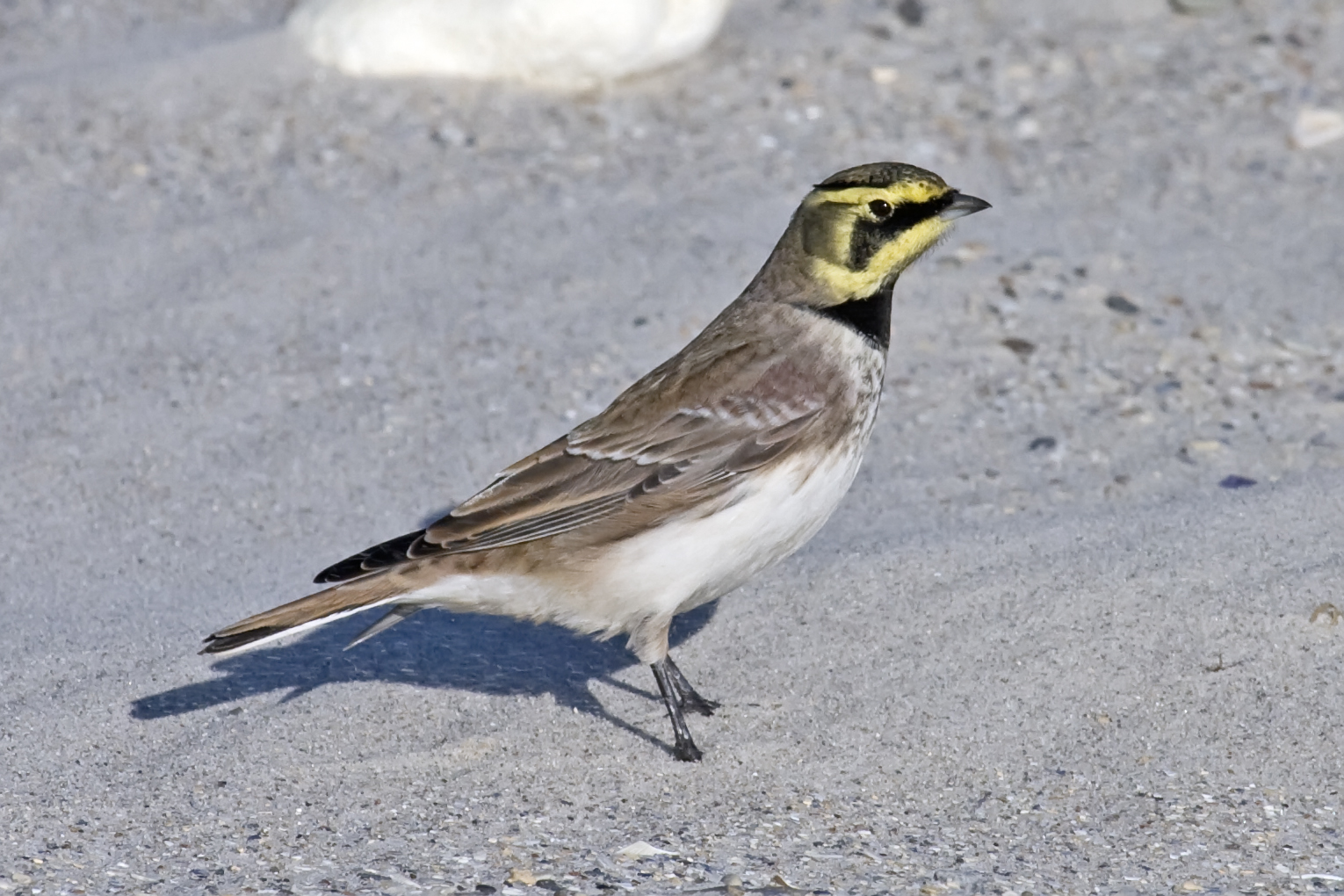
Unlike most other larks, this is a distinctive-looking species on the ground, mainly brown-grey above and pale below, with a striking black and yellow face pattern. Except for the central feathers, the tail is mostly black, contrasting with the paler body; this contrast is especially noticeable when the bird is in flight. The summer male has black "horns",[clarification needed] which give this species its American name. North America has a number of races distinguished by the face pattern and back colour of males, especially in summer. The southern European mountain race E. a. penicillata is greyer above, and the yellow of the face pattern is replaced with white.
Measurements:
Vocalizations are high-pitched, lisping or tinkling, and weak. The song, given in flight as is common among larks, consists of a few chips followed by a warbling, ascending trill.
Hub AI
Horned lark AI simulator
(@Horned lark_simulator)
Horned lark
The horned lark or shore lark (Eremophila alpestris) is a species of lark in the family Alaudidae found across the northern hemisphere. It is known as "horned lark" in North America and "shore lark" in Europe.
The horned lark was formally described in 1758 by the Swedish naturalist Carl Linnaeus in the tenth edition of his Systema Naturae under the binomial name Alauda alpestris. Linnaeus based his account on the description and illustration by the English naturalist Mark Catesby in his book The Natural History of Carolina, Florida and the Bahama Islands that was published between 1729 and 1732. Linnaeus specified the type locality as North America but this has been restricted to the coastal areas of South Carolina. The horned lark is now placed together with Temminck's lark in the genus Eremophila that was introduced in 1828 by the German naturalist Friedrich Boie. The specific epithet alpestris is Latin meaning "of the high mountains", from Alpes, the Alps. A molecular genetic study of the Alaudidae published in 2023 found that Temminck's lark (Eremophila bilopha) was embedded in a clade containing taxa currently classed as subspecies of the horned lark.
The horned lark is suggested to have diverged from Temminck's lark (E. bilopha) around the Early-Middle Pleistocene, according to genomic divergence estimates. The horned lark is known from around a dozen localities of Late Pleistocene age, including those in Italy, Russia, The United Kingdom and the United States. The earliest known fossil is from the Calabrian of Spain, around 1–0.8 million years old. In 2020, a 46,000 year old frozen specimen was described from the Russian Far East.
A 2014 genetic analysis suggested that the species consists of six clades that in the future may warrant recognition as separate species. A 2020 study also suggested splitting of the species, but into 4 species instead, the Himalayan horned lark E. longirostris, mountain horned lark E. penicillata, common horned lark E. alpestris (sensu stricto), alongside Temminck's lark.
Forty-two subspecies are recognized:
Unlike most other larks, this is a distinctive-looking species on the ground, mainly brown-grey above and pale below, with a striking black and yellow face pattern. Except for the central feathers, the tail is mostly black, contrasting with the paler body; this contrast is especially noticeable when the bird is in flight. The summer male has black "horns",[clarification needed] which give this species its American name. North America has a number of races distinguished by the face pattern and back colour of males, especially in summer. The southern European mountain race E. a. penicillata is greyer above, and the yellow of the face pattern is replaced with white.
Measurements:
Vocalizations are high-pitched, lisping or tinkling, and weak. The song, given in flight as is common among larks, consists of a few chips followed by a warbling, ascending trill.