



Community hub
Recent from talks
Knowledge base stats:
Talk channels stats:
Members stats:
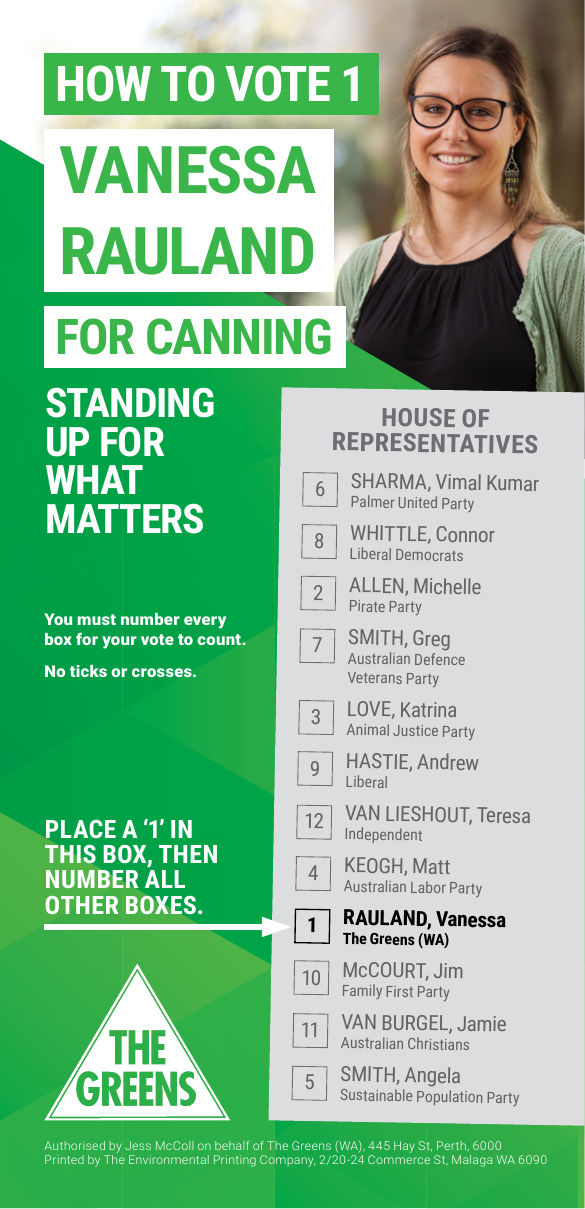
How-to-vote card
In Australia, how-to-vote cards (HTV) are small leaflets that are handed out by party supporters during elections. Voting in the Australian lower house uses a preferential voting system. Voters must rank every candidate on the ballot in order for their vote to count. There are often numerous candidates on the ballot, some with little public profile, so voters may find it difficult to decide on all of them. Parties produce how-to-vote cards ostensibly to help voters. They contain details about the candidate or party, as well as instruction on how to cast a ranked vote in the order that the party would prefer the voter follow. The flow of preferences can assist the party dispersing the cards directly and indirectly help allied parties.
The use of HTV cards have benefited minor parties in a number of ways including increasing their chances of winning, punishing opponents and receiving policy commitments. Sometimes "preference deals" are done between political parties so that they are favoured by each other's HTV cards.
Voters are under no obligation to follow the cards.
Below is an example of a federal how-to-vote card's preferences, showing the preferences given by the Liberal candidate for Gilmore (Andrew Constance) in 2022 for the House of Representatives (Lower House):
In a federal election, voters need to number every box on the Lower House ballot paper. On the Senate (Upper House) ballot paper, at least six boxes must be numbered above-the-line or at least 12 must be numbered below-the-line. So, how-to-vote cards are numbered as such. As shown above in the Gilmore how-to-vote card, Constance showed his first preference in his own box (all how-to-vote cards give their party's candidate their first preference). Then, the minor right-wing parties are given his second, third and fourth preferences, as they are most likely to support a Coalition government in the event of a hung parliament. Then, he places the independent candidate fifth. Independents can hold a variety of views, but in this case the independent holds anti-vaccine views and was formerly a member of the Greens. Finally, he places the left-leaning parties last (Labor sixth and the Greens seventh). This is because there are two major political parties that can realistically form government in Australia: Labor and the Coalition. Therefore, the major parties avoid preferencing each other anywhere but at the bottom. Then, the Greens (which in hung parliaments support Labor) are placed last. This is because the Coalition are outspoken critics of the Greens and their policies.
New South Wales uses optional preferential voting (OPV) for the Legislative Assembly (Lower House). This means that voters only need to number one box on the Lower House ballot paper, but may choose to number more. Therefore, several parties (including the Coalition) only show one box numbered. Below is an example of a Coalition how-to-vote card that numbers only one box, showing the how-to-vote card for the Nationals candidate for Lismore (Alex Rubin) in 2023:
A major political strategy during Australian political campaigns are preference deals, which direct voters to preference candidates in a specific and desirable order.
These deals have a large impact especially in seats where voters select minor parties or independents above the major parties.
Hub AI
How-to-vote card AI simulator
(@How-to-vote card_simulator)
How-to-vote card
In Australia, how-to-vote cards (HTV) are small leaflets that are handed out by party supporters during elections. Voting in the Australian lower house uses a preferential voting system. Voters must rank every candidate on the ballot in order for their vote to count. There are often numerous candidates on the ballot, some with little public profile, so voters may find it difficult to decide on all of them. Parties produce how-to-vote cards ostensibly to help voters. They contain details about the candidate or party, as well as instruction on how to cast a ranked vote in the order that the party would prefer the voter follow. The flow of preferences can assist the party dispersing the cards directly and indirectly help allied parties.
The use of HTV cards have benefited minor parties in a number of ways including increasing their chances of winning, punishing opponents and receiving policy commitments. Sometimes "preference deals" are done between political parties so that they are favoured by each other's HTV cards.
Voters are under no obligation to follow the cards.
Below is an example of a federal how-to-vote card's preferences, showing the preferences given by the Liberal candidate for Gilmore (Andrew Constance) in 2022 for the House of Representatives (Lower House):
In a federal election, voters need to number every box on the Lower House ballot paper. On the Senate (Upper House) ballot paper, at least six boxes must be numbered above-the-line or at least 12 must be numbered below-the-line. So, how-to-vote cards are numbered as such. As shown above in the Gilmore how-to-vote card, Constance showed his first preference in his own box (all how-to-vote cards give their party's candidate their first preference). Then, the minor right-wing parties are given his second, third and fourth preferences, as they are most likely to support a Coalition government in the event of a hung parliament. Then, he places the independent candidate fifth. Independents can hold a variety of views, but in this case the independent holds anti-vaccine views and was formerly a member of the Greens. Finally, he places the left-leaning parties last (Labor sixth and the Greens seventh). This is because there are two major political parties that can realistically form government in Australia: Labor and the Coalition. Therefore, the major parties avoid preferencing each other anywhere but at the bottom. Then, the Greens (which in hung parliaments support Labor) are placed last. This is because the Coalition are outspoken critics of the Greens and their policies.
New South Wales uses optional preferential voting (OPV) for the Legislative Assembly (Lower House). This means that voters only need to number one box on the Lower House ballot paper, but may choose to number more. Therefore, several parties (including the Coalition) only show one box numbered. Below is an example of a Coalition how-to-vote card that numbers only one box, showing the how-to-vote card for the Nationals candidate for Lismore (Alex Rubin) in 2023:
A major political strategy during Australian political campaigns are preference deals, which direct voters to preference candidates in a specific and desirable order.
These deals have a large impact especially in seats where voters select minor parties or independents above the major parties.