Hubbry Logo
Ranked votingRanked votingMain
Open search
Ranked voting
Community hub
Ranked voting
logo
8 pages, 0 posts
0 subscribers
Be the first to start a discussion here.
Ranked voting
Ranked voting
from Wikipedia

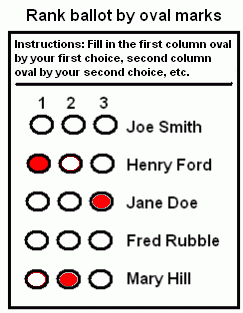
Ovals
Names
Numbers
Various types of ranked voting ballot

Ranked voting is any voting system that uses voters' rankings of candidates to choose a single winner or multiple winners. More formally, a ranked vote system depends only on voters' order of preference of the candidates.

Ranked voting systems vary dramatically in how preferences are tabulated and counted, which gives them very different properties. In instant-runoff voting (IRV) and the single transferable vote system (STV), lower preferences are used as contingencies (back-up preferences) and are only applied when all higher-ranked preferences on a ballot have been eliminated or when the vote has been cast for a candidate who has been elected and surplus votes need to be transferred. Ranked votes of this type do not suffer the problem that a marked lower preference may be used against a voter's higher marked preference.

Some ranked vote systems use ranks as weights; these systems are called positional voting. In the Borda method, the 1st, 2nd, 3rd... candidates on each ballot receive 1, 2, 3... points, and the candidate with the fewest points is elected. Thus intensity of preference is assumed to be at ratios of 1 to 2, 2 to 3, etc.

In the United States and Australia, the terms ranked-choice voting and preferential voting, respectively, almost always[according to whom?] refer to instant-runoff voting; however, because these terms have also been used to mean ranked systems in general, many social choice theorists recommend the use of the term instant-runoff voting in contexts where confusion might arise.

Ranked votes do not incorporate any information about intensity of preferences. Furthermore, common implementations do not account for equality of preference among two or more candidates.

Ranked voting systems of the instant-runoff voting type and the Borda count type are contrasted with rated voting methods, which allow voters to indicate how strongly they support different candidates (e.g. on a scale from 0 to 10).[1] Ranked vote systems produce more information than X voting systems such as first-past-the-post voting. Rated voting systems produce more information than ordinal ballots; as a result, some common results like Arrow's theorem do not directly apply to them.[2]

Some ranked voting systems require the voter rank a set number of candidates. Others, such as optional preferential voting, allow the voter full liberty as to how many candidates they rank. Under STV or IRV, not all rankings are used in any case.[3]

History of ranked voting

[edit]

The earliest known proposals for a ranked voting system can be traced to the works of Ramon Llull in the late 13th century, who developed what would later be known as Copeland's method, which is similar to Condorcet's method. Copeland's method was devised by Ramon Llull in his 1299 treatise Ars Electionis, which was discussed by Nicholas of Cusa in the fifteenth century.[4][5]

A second wave of analysis began when Jean-Charles de Borda published a paper in 1781, advocating for the Borda count, which he called the "order of merit". This methodology drew criticism from the Marquis de Condorcet, who developed his own methods after arguing Borda's approach did not accurately reflect group preferences, because it was vulnerable to spoiler effects and did not always elect the majority-preferred candidate.[4]

Interest in ranked voting continued throughout the 19th century. Carl Andræ formulated a version of the single transferable vote election system, which was adopted by his country, Denmark, in 1855. This used contingent ranked votes to transfer votes of elected candidates, but it did not include transfers of votes from eliminated candidates.[6][7]

In the 1700s, Condorcet considered instant-runoff voting but rejected it as pathological. In 1864, Edward J. Nanson, while noting Condorcet's concerns, said the IRV method is "a perfectly feasible and practicable one for elections on any scale".[8][9]

MIT professor W. R. Ware held a demonstration STV election in 1871 by having 150 MIT students elect four English authors as their favorites. The field of candidates held the names of 35 authors in the first count and eventually concentrated a large proportion of the votes behind just four. Ware went on to surmise how a casual vacancy might be handled and found that countback would produce a winner. This proved that ranked transferable votes could be used to produce a single winner, despite the qualms of Condorcet and others.[10]

Single transferable voting (multi-seat contests using contingent ranked transferable votes) later found common use in cities and to elect legislators in North America, Ireland and other parts of the English-speaking world, with single-winner versions, alternative voting (now known as instant-runoff voting) and contingent voting (also known as supplementary voting) being its companions for single-winner contests of mayors and others.[11]

Theoretical exploration of electoral processes was revived by a 1948 paper from Duncan Black[12] and Kenneth Arrow's investigations into social choice theory, a branch of welfare economics that extends rational choice to include community decision-making processes.[13]

Adoption

[edit]

Plurality voting is the most common voting system, and has been in widespread use since the earliest democracies. As plurality voting has exhibited weaknesses from its start, especially as soon as a third party joins the race, some social scientists began to recommend transferable votes (facilitated by contingent ranked ballots) to reduce the incidence of wasted votes and unrepresentative election results.[14][citation needed]

A form of the single transferable vote system was invented by Carl Andræ in Denmark, where it was used briefly before being abandoned in favour of open list list PR. STV still carried on in Denmark until 1953 for indirect election of the upper house.[citation needed]

At approximately the same time, the single transferable vote system was independently devised by British lawyer Thomas Hare, whose writings soon spread the method throughout the British Empire. Tasmania used STV (called the Hare system) in government elections in the 1890s. STV began permanent and wider adoption throughout Australia beginning in 1907 and the 1910s.[15] The STV system, using contingent ranked votes, has been adopted in Ireland, South Africa, Malta, and approximately 40 cities in the United States and Canada.[16] The single transferable vote system has also been used to elect legislators in Canada, South Africa, India and Nepal.

In the early 2020s, the use of contingent ranked votes saw a comeback in the United States. STV, for a time used only in Cambridge, Massachusetts, was adopted by Portland, Maine, and several other American cities beginning in 2022.[17] Single-winner ranked voting (specifically instant-runoff voting) is used to elect politicians in the states of Maine[18] and Alaska.[19] In November 2016, the voters of Maine narrowly passed Question 5, approving ranked-choice voting (instant-runoff voting) for all elections. This was first put to use in 2018, marking the inaugural use of ranked votes in a statewide election in the United States (when Maine's statewide vote tally was used to determine the two at-large electoral college seats).

In November 2020, Alaska voters passed Measure 2, bringing ranked choice voting (instant-runoff voting) into use from 2022.[20][21] After a series of electoral pathologies in Alaska's 2022 congressional special election, a poll found 54% of Alaskans supported a repeal of the system. This included a third of the voters who had supported Peltola, the ultimate winner in the election. However, a referendum on the issue in 2024 saw a narrow majority in favour of retention of IRV.[22][23]

Some local elections in New Zealand use the multi-winner single transferable vote system.[24] STV is also used to elect local authorities in Scotland[25] and Ireland.[26] Nauru uses a rank-weighted positional method called the Dowdall system.

Equal-ranked ballots

[edit]

In voting with ranked ballots, a tied or equal-rank ballot is one where multiple candidates receive the same rank or rating. In instant runoff and first-preference plurality, such ballots are generally rejected; however, in social choice theory some election systems assume equal-ranked ballots are "split" evenly between all equal-ranked candidates (e.g. in a two-way tie, each candidate receives half a vote). Other election systems, the Borda count and the Condorcet method, can use different rules for handling equal-rank ballots. These rules produce different mathematical properties and behaviors, particularly under strategic voting.

Theoretical foundations of ranked voting

[edit]

Majority-rule

[edit]

Many concepts formulated by the Marquis de Condorcet in the 18th century continue to significantly impact the field. One of these concepts is the Condorcet winner, a candidate who would win against any other candidate in a two-way race. A voting system that always elects this candidate is called a Condorcet method; however, it is possible for an election to have no Condorcet winner, a situation called a Condorcet cycle. Suppose an election with 3 candidates A, B, and C has 3 voters. One votes A > C > B, one votes B > A > C, and one votes C > B > A. In this case, no Condorcet winner exists: A cannot be a Condorcet winner as two-thirds of voters prefer B over A. Similarly, B cannot be the winner as two-thirds prefer C over B, and C cannot win as two-thirds prefer A over C. This forms a rock-paper-scissors style cycle with no Condorcet winner.

Social well-being

[edit]

Voting systems can also be judged on their ability to deliver results that maximize the overall well-being of society, i.e. to choose the best candidate for society as a whole.[27]

Spatial voting models

[edit]

Spatial voting models, initially proposed by Duncan Black and further developed by Anthony Downs, provide a theoretical framework for understanding electoral behavior. In these models, each voter and candidate is positioned within an ideological space that can span multiple dimensions. It is assumed that voters tend to favor candidates who closely align with their ideological position over those more distant. A political spectrum is an example of a one-dimensional spatial model.

A spatial model of voting

The accompanying diagram presents a simple one-dimensional spatial model, illustrating the voting methods discussed in subsequent sections of this article. It is assumed that supporters of candidate A cast their votes in the order of A > B > C, while candidate C's supporters vote in the sequence of C > B > A. Supporters of candidate B are equally divided between listing A or C as their second preference. From the data in the accompanying table, if there are 100 voters, the distribution of ballots will reflect the positioning of voters and candidates along the ideological spectrum.

Spatial models offer significant insights because they provide an intuitive visualization of voter preferences. These models give rise to an influential theorem—the median voter theorem—attributed to Duncan Black. This theorem stipulates that within a broad range of spatial models, including all one-dimensional models and all symmetric models across multiple dimensions, a Condorcet winner is guaranteed to exist. Moreover, this winner is the candidate closest to the median of the voter distribution. Empirical research has generally found that spatial voting models give a highly accurate explanation of most voting behavior.[28]

Other theorems

[edit]

Arrow's impossibility theorem is a generalization of Condorcet's result on the impossibility of majority rule. It demonstrates that every ranked voting algorithm is susceptible to the spoiler effect. Gibbard's theorem provides a closely related corollary, that no voting rule can have a single, always-best strategy that does not depend on other voters' ballots.

Examples

[edit]

Borda count

[edit]

The Borda count is a weighted-rank system that assigns scores to each candidate based on their position in each ballot. If m is the total number of candidates, the candidate ranked first on a ballot receives m − 1 points, the second receives m − 2, and so on, until the last-ranked candidate who receives zero. In the given example, candidate B emerges as the winner with 130 out of a total 300 points. While the Borda count is simple to administer, it does not meet the Condorcet criterion. Also, it is heavily affected by the entry of candidates who have no real chance of winning.

Other positional systems

[edit]

Systems that award points in a similar way but possibly with a different formula are called positional systems. The score vector (m − 1, m − 2, ..., 0) is associated with the Borda count, (1, 1/2, 1/3, ..., 1/m) defines the Dowdall system and (1, 0, ..., 0) equates to first-past-the-post.

Instant-runoff voting

[edit]

Instant-runoff voting, often conflated with ranked-choice voting in general, is a contingent ranked-vote voting method that recursively eliminates the plurality loser of an election until one candidate has the majority of the remaining votes. In the given example, candidate A is declared winner in the third round, having received a majority of votes through the accumulation of first-choice votes and redistributed votes from candidate B. This system embodies the voters' preferences between the final candidates, stopping when a candidate garners the preference of a majority of voters. Instant-runoff voting does not fulfill the Condorcet winner criterion.

Single transferable voting

[edit]

Single transferable voting is a contingent ranked-vote election method that elects multiple members. It elects any candidates who achieve quota, and if necessary recursively eliminates the plurality loser at various stages of the vote count and transfers surplus votes of winners until enough are elected by quota or by still being in the running when the field of candidates is thinned to the number of remaining open seats. Because elected members are elected with the same or about the same number of votes, each party popular enough for representation receives a number of seats appropriate to the vote tallies of its candidates. The transfers reduce waste to about one quota - which in a five-seat district is about 17 percent of valid votes; in districts with more members than five, the waste is smaller. All but one quota of votes approximately are used to actually elect someone in the district so the percentage of effective votes is dependably about 80 to 90 percent of valid votes in the district.[29][30]

Defeat-dropping Condorcet

[edit]

The defeat-dropping Condorcet methods all look for a Condorcet winner, i.e. a candidate who is not defeated by any other candidate in a one-on-one majority vote. If there is no Condorcet winner, they repeatedly drop (set the margin to zero) for the one-on-one matchups that are closest to being tied, until there is a Condorcet winner. How "closest to being tied" is defined depends on the specific rule. For the Minimax Condorcet method, the elections with the smallest margin of victory are dropped, whereas in ranked pairs only elections that create a cycle are eligible to be dropped (with defeats being dropped based on the margin of victory).

How-To-Vote cards

[edit]

In Australian Commonwealth and state elections, voters are handed How-To-Vote cards (HTVC) which recommend how best to support a chosen candidate.[31] In South Australia, the Electoral Commission publishes a combined HTVC for all candidates which saves time and money. This also benefits minor parties and independents who are unable to staff all polling booths.

See also

[edit]

References

[edit]
[edit]
Revisions and contributorsEdit on WikipediaRead on Wikipedia
from Grokipedia
Ranked voting, also termed preferential voting or ranked-choice voting, encompasses electoral systems where voters order by preference rather than selecting a single choice, with tabulation involving the progressive elimination of lowest-polling options and transfer of their votes to subsequent preferences until a secures over 50% support among continuing ballots. This approach aims to reflect broader consensus by mitigating vote-splitting effects inherent in plurality systems, though it operates on subsets of ballots excluding those that exhaust preferences without further rankings. Originating in the mid-19th century, the concept traces to British reformer Thomas Hare, who proposed the (STV) in 1857 as a proportional method for multi-member districts, influencing single-winner variants like (IRV). Early adoption occurred in places such as , , in 1892 for legislative elections, with nationwide use in Australia's since 1918 under the alternative vote system. Empirical analyses indicate that ranked systems can reduce strategic abstention and spoiler candidacies but may introduce complexities, including non-monotonicity where increasing first-preference support can paradoxically lead to defeat. As of 2025, ranked voting is employed for national elections in countries including , (for president and by-elections), and (STV for parliament), while in the United States, it governs federal contests in and , and municipal races in over 50 jurisdictions such as and . Proponents cite evidence of elevated voter satisfaction and decreased , with studies from implementations showing winners often garnering stronger cross-partisan appeal. Critics, however, highlight elevated ballot invalidation risks among less-educated voters and failures to consistently satisfy the Condorcet criterion, where a pairwise winner may lose under ranked tabulation, as observed in certain simulations and real contests.

Definition and Core Principles

Fundamental Mechanics

In ranked voting systems, voters rank candidates by assigning ordinal numbers to indicate preferences, typically marking "1" for the first choice, "2" for the second, and so on, rather than selecting a single candidate as in plurality voting. This structure enables the expression of nuanced voter intent, where a ballot's validity depends on proper sequential numbering without duplicates or skips, though some implementations allow exhausted ballots if preferences run out. The core principle relies on ordinal data—voters' relative orderings—to aggregate support, contrasting with cardinal systems that assign scores or approvals. The fundamental counting mechanic in single-winner ranked systems, such as , begins with tallying first-preference votes; if no achieves a (over 50% of valid votes), the lowest-polling is eliminated, and their votes transfer to the next ranked preference on those ballots. This iterative elimination and redistribution continues until one secures a , ensuring the winner has broader acceptability than under first-past-the-post, where victories can occur with as little as 30-40% support. In multi-winner variants like the , a quota (often : votes / (seats + 1) + 1) determines election thresholds, with surpluses from over-quota candidates redistributed proportionally by transferring fractions of votes based on remaining preferences. These mechanics promote majority rule by simulating sequential runoffs without multiple election rounds, reducing vote-splitting effects observed in plurality systems—for instance, in Australia's House of Representatives elections since 1918, where preferential voting has consistently produced winners with majority support after preferences. However, implementation requires precise rules for handling ties, non-monotonicity risks (where rank improvements can paradoxically harm a candidate), and voter compliance, as incomplete rankings can lead to exhausted ballots comprising up to 5-10% in some jurisdictions. Empirical data from over 100 years of Australian use shows preferential systems yield stable outcomes with higher voter turnout in optional-preference formats, though mandatory full rankings enforce complete preference expression.

Variations in Ballot Design

In ranked voting systems, ballots vary in the degree of completeness required from voters. Full preferential ballots mandate ranking all candidates to ensure the vote remains active throughout , as seen in Australia's elections where failure to number every candidate exhausts the . In contrast, partial or optional preferential ballots permit voters to rank only preferred candidates, with unranked ones treated as indifferent; this design, used in Australia's elections, allows ballots to exhaust if preferences run out during eliminations, potentially discarding up to 5-10% of votes in some contests. Marking methods differ to accommodate paper, optical-scan, or electronic formats. Sequential numbering requires voters to write "1," "2," etc., beside candidates in order of , common in hand-marked ballots for but prone to errors like skipped numbers. Grid or bubble formats, used in optical-scan systems like those in primaries, present candidates in rows with columns for ranks (e.g., fill ovals for 1st through 5th ), facilitating machine readability and limiting ranks to contest size but reducing flexibility for long candidate lists. Some systems accommodate equal preferences, allowing voters to assign identical ranks to express ties, which expands expressiveness but complicates tallying by introducing shared vote fractions or alternative counting rules, as in certain implementations under Meek's method. Most instant-runoff variants prohibit equals to streamline processes, treating overmarking as invalid for that rank. Layouts for multi-contest ballots often separate races with headers or page breaks, while single-contest designs prioritize vertical lists for readability in jurisdictions like . These variations influence voter compliance and error rates, with partial and grid designs generally yielding higher valid ballot rates in tested U.S. implementations.

Historical Development

Origins in the 19th Century

The earliest documented conception of a transferable vote system, foundational to modern ranked voting, emerged in 1821 when British educator Thomas Wright Hill devised a method for electing school monitors. In Hill's unpublished scheme, applied experimentally among pupils, voters expressed multiple preferences, allowing surplus votes beyond the quota for election to transfer to subsequent choices on the ballot, thereby distributing representation more evenly among a group. This approach addressed the inefficiencies of simple plurality voting by incorporating voter rankings to minimize wasted votes, though it remained a private innovation without broader dissemination until later historical accounts. Mid-century developments advanced these ideas toward practical . In 1855, Danish mathematician and politician Carl Georg Andrae proposed an independent system for in Denmark's multi-member districts, formalized in publications the following year. Andrae's method required voters to rank candidates, with seats allocated by transferring surplus votes from over-quota winners to next preferences and redistributing votes from lowest-polling candidates until all positions filled, aiming to reflect diverse voter opinions more accurately than . This innovation responded to observed disproportionalities in Danish assemblies, where majority blocs dominated despite fragmented support. Concurrently in Britain, Thomas Hare published The Machinery of Representation in 1857, outlining a comprehensive (STV) framework for parliamentary elections across a single national district. Hare's proposal mandated ranking all candidates, with iterative counting transferring surpluses fractionally and eliminating trailing contenders to ensure proportional seat allocation matching voter preferences. Intended to counter the "rotten boroughs" and underrepresentation plaguing the UK's first-past-the-post system post-1832 Reform Act, Hare's work emphasized empirical fairness in aggregating ranked ballots to approximate in diverse electorates. These 19th-century proposals collectively laid the groundwork for ranked voting by prioritizing transferable preferences over single marks, though adoption lagged due to administrative complexities and entrenched interests.

Expansion and Adoption in the 20th Century

The adoption of ranked voting systems expanded significantly in the early , particularly through variants like (IRV) for single-winner contests and the (STV) for multi-winner . In , the federal government enacted the Commonwealth Electoral Act 1918, introducing preferential voting—equivalent to IRV—for elections to ensure winners achieved majority support after preference transfers, replacing the first-past-the-post system; this was first applied in the 1919 federal election. , meanwhile, utilized the Hare-Clark system—a localized STV method—for House of Assembly elections from onward, dividing the state into multi-member districts where voters ranked candidates to achieve proportional outcomes based on Hare quotas. These implementations reflected reformist efforts to mitigate vote splitting in multi-candidate races and promote broader voter expression, drawing on theoretical work by proponents like Thomas . Post-World War I, STV saw uptake in British-influenced territories seeking amid movements and colonial reforms. Malta implemented STV for its legislative assembly elections starting in 1921, using multi-member districts with voter rankings to allocate seats proportionally, a that persisted through in 1964. Northern Ireland's Parliament, established under the , employed STV for its initial 1921 election, applying it to 52 single-member districts initially before shifting to multi-member constituencies, with the aim of balancing unionist and nationalist interests through transferable preferences. In the , STV was enshrined in the 1922 constitution for elections, using 5- to 7-member constituencies to foster proportionality in a newly independent multi-party . These adoptions often prioritized empirical goals like reducing wasted votes—evident in Malta's consistent use of 5-member districts yielding seats aligned closely with first-preference shares—and were influenced by advocacy from proportional representation leagues. In the United States, ranked voting proliferated at the municipal level during the Progressive Era and New Deal periods, driven by campaigns against machine politics and for inclusive representation. Over 20 cities adopted STV by the 1930s, including Cincinnati in 1924 for its city council (using 9-member at-large districts) and New York City in 1937 (initially 23-member, reduced to 17), where voters ranked candidates to elect proportionally without primaries fragmenting support. Ashtabula, Ohio, implemented it as early as 1915, one of the first U.S. locales to do so for local governance. These systems aimed to empower minority groups and independents via surplus transfers and eliminations, though implementation varied with district magnitudes typically 5 to 9 seats. While federal and state levels remained wedded to plurality voting, this municipal wave marked ranked voting's broadest North American foothold before mid-century repeals in most cases due to administrative burdens and shifting political priorities.

Contemporary Reforms and Reversals

In the early 21st century, ranked voting systems, particularly instant-runoff voting (also known as ranked-choice voting in the United States), experienced a resurgence primarily at the municipal level in the U.S., driven by efforts to mitigate vote-splitting and encourage broader candidate participation. San Francisco became the largest city to adopt instant-runoff voting for most local offices following a 2002 charter amendment, with implementation beginning in 2004 for board of supervisors elections. Subsequent adoptions included Minneapolis in 2006 (effective 2009), Oakland in 2010, and over 40 other jurisdictions by 2021, often via local ballot measures or ordinances aimed at reducing runoff election costs and increasing voter satisfaction. By October 2024, approximately 50 U.S. jurisdictions, spanning 23 states and Washington, D.C., utilized ranked-choice voting in public elections, affecting nearly 14 million registered voters. Statewide reforms marked a significant escalation, with Maine approving ranked-choice voting via citizen initiative in November 2016 for federal, state, and presidential elections (initially implemented in primaries from 2018 and generals from 2020 after legal challenges). followed with Ballot Measure 2 in November 2020, establishing top-four primaries paired with ranked-choice voting for state, federal, and presidential contests, first used in the special for U.S. House. Internationally, adoptions were limited; shifted to limited preferential voting (allowing up to three preferences) for its national parliament in 2007 to address ethnic bloc voting and instability, replacing first-past-the-post. These reforms were often justified by proponents citing empirical evidence from earlier implementations, such as higher and fewer exhausted ballots in Australian House elections under since 1918, though causal attribution remains debated due to confounding variables like . Reversals and pushback emerged concurrently, reflecting concerns over complexity, transparency, and potential for strategic manipulation. , repealed instant-runoff voting in March 2010 via city council vote after its 2009 mayoral election, where the plurality winner lost under the method amid voter confusion and lawsuits, reverting to first-past-the-post. In , ranked-choice voting was adopted in 2019 for primaries but faced repeal efforts; while upheld for 2021 use, state-level restrictions and litigation highlighted administrative burdens. By 2025, legislative bans proliferated, with 13 states— including (2023), (2024), and others like and —prohibiting ranked-choice voting for state and federal elections, citing unverifiable counts and diminished accountability, as evidenced by failed audits in 's 2022 election. Ballot measures in November 2024 rejected adoption in , , , , , and , while voters retained it narrowly after a recount, underscoring polarized empirical outcomes: studies show mixed effects on turnout (slight increases in some cities) but persistent non-monotonicity risks where rankings can invert plurality winners without majority support.

Specific Ranked Voting Methods

Instant-Runoff Voting (IRV)

Instant-runoff voting (IRV), also termed the alternative vote or ranked-choice voting, constitutes a single-winner in which voters rank in descending order of preference on their ballots. A securing over 50% of first-preference votes is declared the winner. In the absence of such a , the garnering the fewest first-preference votes is eliminated, with those votes reassigned to the next-highest preferences indicated on the respective ballots. This iterative elimination and transfer persists until one attains a of active votes. The tabulation emulates sequential runoff contests sans additional polling days, conserving resources while purportedly reflecting broader voter consensus. Exhausted ballots—those lacking further transferable preferences—do not count toward remaining candidates, potentially diminishing total vote participation in later rounds. For example, suppose 100 voters rank three candidates: A receives 45 first preferences, B 30, and C 25. Eliminating C redistributes its votes; if 20 transfer to B and 5 exhaust, B then holds 50, securing victory with a of continuing votes. IRV traces to the mid-19th century as a single-winner adaptation of the single transferable vote, pioneered by Thomas Hare, with practical implementation in Queensland, Australia, by 1892 and federally in 1918 for House elections to avert vote fragmentation among similar parties. By 2024, national adoption persists in Australia for lower-house contests, Ireland for presidential and Dáil by-elections, and Fiji for parliamentary seats; subnational use includes India's presidential election and several U.S. locales such as New York City mayoral races since 2021, Maine statewide since 2018, and Alaska's 2022 special Senate election. Repeals occurred in Ohio cities like Cincinnati in 1957 and defeats in U.S. ballot measures, including Burlington, Vermont, in 2009 after a 2005 trial yielding a plurality-unsupported winner. Proponents assert IRV curtails spoiler effects and incentivizes positive campaigning by enabling sincere lower preferences, yet empirical analyses reveal limited alterations in winner profiles versus plurality systems and occasional non-monotonic outcomes where augmented first-preference support precipitates defeat. It fails the Condorcet criterion, possibly electing pairwise losers, and complicates verification due to multi-stage counts, with studies documenting higher undervote rates among less-educated voters. Randomized trials, such as in San Francisco, indicate modest turnout gains but no consistent moderation of elected officials' ideologies.

Single Transferable Vote (STV)

The (STV) is a preferential system employed in multi-member electoral districts to allocate seats based on voter rankings of candidates rather than party lists. Voters indicate preferences by numbering candidates (1 for first choice, 2 for second, and so on), allowing votes to transfer from eliminated or surplus candidates to continue expressing voter intent until all seats are filled. This contrasts with single-winner ranked methods like by enabling proportionality across multiple winners in districts typically electing 3 to 7 representatives. To determine election, the Droop quota is calculated as the total valid votes divided by (seats to be filled plus one), then adding one; for instance, with 100,000 votes and 4 seats, the quota is approximately 20,001. First-preference votes are tallied; any surpassing the quota is elected, and their surplus votes—calculated as votes received minus quota—are transferred proportionally to next preferences at a fractional value (e.g., if a has 30,000 votes for a 20,000 quota, each transfers with value 10,000/30,000 or one-third). If no meets the quota, the lowest-polling is eliminated, and their votes transfer at full value to subsequent preferences; this iterates—alternating surpluses and eliminations—until seats are filled. Variations exist in transfer methods, such as inclusive (Gregory) approaches that average values across continuing s to avoid underutilized votes. STV was devised by British lawyer Thomas Hare, who outlined it in his 1857 book The Machinery of Representation following the UK's that year, building on earlier proportional ideas to minimize wasted votes in large constituencies. Independently, Danish mathematician Carl Andrae proposed a similar system around 1855. Initial adoptions included Tasmania's House of Assembly in 1907 and Ireland's in 1921 under its constitution, where it has persisted for national parliamentary elections. Contemporary use includes Malta's since 1947, Northern Ireland's local councils and Stormont Assembly, Scotland's since 2007, and Australia's federal (with modifications). In multi-member districts, STV promotes intra-party competition and independent candidacies by rewarding candidate-specific preferences over strict party loyalty, though its manual counting can extend processes—e.g., Ireland's 2020 required multiple recounts in some constituencies. Political scientists regard STV as theoretically appealing for balancing proportionality and voter choice, yet its implementation remains limited globally due to in large electorates and potential for non-monotonic outcomes where vote changes alter results counterintuitively.

Condorcet Criterion Methods

Condorcet criterion methods comprise a family of ranked-choice voting systems engineered to elect the Condorcet winner—a candidate who garners a of votes against each rival in hypothetical pairwise contests—provided such a winner exists among the ballots. These systems first tabulate pairwise preferences by comparing rankings: for each candidate pair, the one ranked higher on more ballots prevails./02:_Voting_Theory/2.10:Copelands_Method(Pairwise_Comparisons)) The resulting of majorities identifies a Condorcet winner as the node with outgoing edges to all others. Absent a universal winner, cycles in preferences necessitate tie-breaking rules that preserve pairwise strengths to approximate the criterion. Copeland's method, also termed the pairwise comparison score, awards each candidate points equal to their net pairwise victories (wins minus losses or ties). The highest-scoring candidate is elected, directly fulfilling the Condorcet criterion when a clear winner emerges by maximizing head-to-head successes./02:_Voting_Theory/2.10:Copelands_Method(Pairwise_Comparisons)) This method, rooted in aggregating binary contests, favors broadly competitive candidates but can tie in balanced cycles, requiring auxiliary resolution like lotteries or further criteria. The method resolves outcomes by selecting the candidate whose worst pairwise defeat—defined by the largest margin or vote opposition faced—is minimized relative to competitors. Variants measure defeats by raw vote differences or simple majorities lost, ensuring the winner withstands the strongest possible challenge. It satisfies the Condorcet criterion outright and resists strategic entry of weak spoilers by prioritizing resilience in direct matchups. Schulze's method, introduced by Markus Schulze in 1997 and formalized in subsequent analyses, constructs the winner via the strongest paths in the pairwise graph: a candidate prevails if their maximum-strength path (sequence of victories weighted by margins) to every other exceeds rivals' paths in reverse. Employing algorithms akin to Floyd-Warshall for path strengths, it elects the Condorcet winner seamlessly and handles cycles by favoring candidates with robust dominance chains. Empirical studies affirm its monotonicity and independence from irrelevant alternatives under ranked ballots. Ranked pairs, devised by Nicolaus Tideman in , proceeds by all pairwise majorities descending by margin, then iteratively locking the highest uncontradicted victories into a partial order until a complete transitive forms. This builds a stable hierarchy from empirical strengths, guaranteeing the Condorcet winner's top position and mitigating cycle disruptions through margin-based prioritization. Tideman's approach, implemented in tools like Harvard's simulations, underscores its computational viability for moderate electorates. These methods, while theoretically robust against plurality's spoiler effects, see sparse public adoption owing to elevated tally complexity—often O(n^3) for n candidates—versus instant-runoff's linearity, though software like OpaVote facilitates their use in organizational polls. Proponents, including Nobel laureate , advocate them for aligning outcomes with majority pairwise rule, yet real-world cycles (observed in up to 10% of simulated elections) amplify resolution variances across variants.

Positional Voting Systems

Positional voting systems constitute a category of ranked voting methods in which voters order by preference, and each ranking position corresponds to a predetermined score or point value assigned to the in that position on the . The total points accumulated across all determine the winner or winners, with higher aggregate scores prevailing. These systems differ from elimination-based ranked methods like by aggregating preferences through additive scoring rather than sequential exclusion. The most prominent example is the , developed by French mathematician Jean-Charles de Borda in 1770 as a means to select members of the . Under the standard Borda rule, for an election with m candidates, a voter awards m−1 points to their first-ranked choice, m−2 points to the second, and so on, down to 0 points for the last-ranked candidate. Ballots may allow equal rankings or incomplete lists in variants, but the core mechanic sums these positional points; the candidate with the highest total wins. For instance, in a three-candidate race (A, B, C), first place receives 2 points, second 1 point, and third 0 points, such that if 100 voters rank A > B > C unanimously, A garners 200 points, B 100, and C 0. Variants of positional scoring adjust the point distribution to alter emphasis on higher ranks. Linear schemes like the maintain decreasing integers, while others employ non-linear weights, such as the Dowdall system used in Nauru's parliamentary elections since 1971, which assigns 1 point for first place, 1/2 for second, 1/3 for third, and so forth, summing fractional values to favor broad but not necessarily top preferences. This harmonic progression mitigates extreme point disparities from low rankings compared to integer systems. Other configurations include truncated scales (e.g., 3 points for first, 2 for second, 1 for third, 0 otherwise) or exponential decays, each tuning the system's sensitivity to voter ordinal judgments. Adoption of positional systems remains limited in sovereign elections, primarily confined to niche or small-scale applications due to computational demands and vulnerability to tactical strategies like rank exhaustion or (deliberately downranking strong rivals). Nauru's Dowdall method elects all 19 members of its parliament via multi-member districts, where the top vote-getters fill seats based on cumulative scores from ranked ballots. Some Pacific Island legislatures, including and in variants, have experimented with Borda-like scoring for candidate selection, reflecting influences from in post-colonial reforms. Organizational uses persist, such as in academic committees or internal party votes (e.g., Slovenia's presidential elections employ a modified Borda), but large-scale public implementations are rare, with proponents citing fuller preference expression against detractors' concerns over manipulability.

Theoretical Foundations

Condorcet and Majority Rule Criteria

The Condorcet criterion posits that a voting system should elect the Condorcet winner—the candidate who garners a of votes against each opponent in pairwise comparisons—whenever such a winner exists. This standard emerged from the work of Nicolas de Caritat, , who in his 1785 treatise Essai sur l'application de l'analyse à la probabilité des décisions rendues à la pluralité des voix analyzed decisions and electoral outcomes through probabilistic pairwise evaluations, highlighting the potential for a candidate to pairwise dominate others despite aggregate ranking inconsistencies. Condorcet's framework underscored that true preference might manifest in bilateral contests rather than holistic tallies, though he also identified the , where cyclic preferences (e.g., A beats B, B beats C, C beats A) preclude a universal winner, occurring with probability approaching 89% in random voter profiles as modeled in later analyses. In contrast, the criterion demands that a receiving over 50% of first-preference rankings prevail outright, ensuring alignment with explicit top-choice under ranked ballots. This criterion, rooted in straightforward majoritarian logic, is satisfied by and many ranked systems but diverges from Condorcet compliance, as a pairwise-dominant may lack initial support yet reflect broader consensual through transfers or comparisons. Empirical simulations, such as those aggregating synthetic data, reveal that Condorcet winners exist in approximately 70-90% of realistic electorates, depending on voter , making the criterion a stringent test for systems claiming to capture will beyond mere first preferences. Ranked voting methods vary in adherence: (IRV) upholds the majority criterion by exhausting ballots until a threshold is met but routinely violates Condorcet, as seen in cases where early elimination of a strong contender allows a non-pairwise-dominant option to advance (e.g., Burlington, Vermont's 2009 mayoral contest, where IRV elected a losing pairwise to the true Condorcet winner). Conversely, Condorcet-compliant ranked methods—like , which resolves cycles by minimizing the largest pairwise loss, or Schulze's beatpath approach, which traces strongest opposition paths—guarantee selection of the pairwise victor when present but may elect non-monotonic outcomes, where boosting a 's paradoxically causes defeat. These trade-offs highlight a core tension: while majority criterion ensures intuitive first-preference dominance, Condorcet criterion better approximates transitive social preference in multi-candidate fields, though neither fully resolves , which proves no ordinal system satisfies all fairness axioms including .
CriterionDefinitionSatisfied by IRV?Satisfied by Condorcet Methods?
CondorcetElects candidate beating all others pairwise, if existsNo (e.g., eliminates strong contenders prematurely)Yes, by resolving pairwise matrices
MajorityElects candidate with >50% first preferencesYes, via successive eliminations to majorityYes, as Condorcet winner implies majority support in key matchups
Proponents argue Condorcet elevates causal preference revelation over positional artifacts, as pairwise majorities directly probe voter intent without assuming transitivity, yet critics note its computational demands and vulnerability to strategic in ranked inputs. In practice, hybrid systems like total vote runoff iteratively apply Condorcet until resolution, balancing these criteria while mitigating cycles empirically observed in less than 10% of structured voter data.

Social Choice Theory and Arrow's Impossibility

investigates the aggregation of individual preferences into coherent collective outcomes, emphasizing ordinal rankings in voting systems where voters express relative preferences without interpersonal intensity comparisons. This field highlights inherent tensions in designing fair decision mechanisms, as individual preferences may lead to intransitive or cyclical social preferences, such as in Condorcet's paradox where majority pairwise preferences form cycles (A beats B, B beats C, C beats A). Kenneth Arrow formalized these challenges in his 1951 monograph Social Choice and Individual Values, proving an impossibility theorem for social welfare functions that produce a complete, transitive social ranking from individual ordinal rankings. The theorem asserts that no such function exists for three or more alternatives that satisfies four axioms: unrestricted domain (handles any consistent preference profile), (if all individuals prefer alternative X to Y, society ranks X above Y), (social ranking between X and Y depends solely on individual rankings between them, ignoring third options), and non-dictatorship (no single individual's preferences dictate the social ranking for all pairs). In ranked voting contexts, Arrow's result reveals fundamental limits, as these systems use ordinal inputs akin to the theorem's assumptions but often yield only a winner selection rather than a full social ordering. (IRV), for instance, violates : introducing or removing a low-support can reverse the outcome between leading contenders by altering vote transfers, even if individual pairwise remain unchanged. Similarly, (STV) in multi-winner settings aggregates rankings via surpluses and eliminations but cannot guarantee a transitive social without potential cycles or violations across diverse electorates. The theorem implies that ranked systems, while mitigating some plurality flaws like vote splitting, inevitably trade off fairness criteria; empirical simulations confirm frequent violations in realistic preference distributions, underscoring no ordinal method achieves universal consistency. Proponents of range or argue they evade Arrow's strictures by incorporating cardinal utilities, but pure ranked approaches remain bound by ordinal impossibilities.

Spatial Voting and Preference Aggregation

The spatial voting model conceptualizes voter preferences as arising from proximity in an ideological space, where both voters and candidates occupy positions—often along a unidimensional continuum—and individuals rank alternatives based on decreasing utility with distance from their ideal point. This approach, formalized by in his 1957 analysis of democratic competition, assumes rational actors maximize electoral success by converging toward voter distributions, generating ordinal rankings that reflect spatial alignments rather than arbitrary tastes. Under unidimensional spatial conditions, these proximity-derived preferences exhibit the single-peaked property, enabling stable aggregation outcomes via mechanisms like pairwise , which selects the voter's position as the equilibrium under symmetric distributions. Ranked voting systems extend this by incorporating full preference orders to simulate sequential eliminations or transfers, theoretically aligning collective choices more closely with the spatial than plurality methods, which can favor peripheral candidates when voter support fragments. Simulations of (IRV) in such models, with voters uniformly distributed on a [0,1] interval and candidates at fixed positions, demonstrate that vote transfers progressively eliminate outliers, often yielding winners nearer the distribution's center—e.g., deviations from the reduced by up to 20-30% relative to plurality in controlled unidimensional scenarios with three to five candidates. However, spatial analyses reveal limitations in ranked aggregation: IRV does not invariably elect the , as clustered positions or skewed voter densities can trigger early elimination of centrally located options, with monotonicity failures—where boosting a frontrunner's first-preference support causes its defeat—occurring in approximately 10-15% of three- simulations under spatial assumptions. In multidimensional extensions, the absence of single-peakedness introduces cyclical , undermining ranked methods' ability to consistently aggregate to a coherent spatial optimum, as preferences no longer converge predictably and small perturbations yield disparate outcomes. These theoretical insights underscore ranked voting's reliance on spatial structure for effective preference synthesis, yet highlight vulnerabilities to distribution-specific anomalies absent in simpler benchmarks.

Purported Advantages

Mitigation of Vote Splitting and Spoiler Effects

Ranked voting systems, particularly (IRV) and the (STV), purport to mitigate vote splitting by allowing votes to transfer from eliminated candidates to voters' next preferences, consolidating support among similar candidates that might otherwise fragment under plurality rules. In , ideologically aligned candidates can divide their shared voter base, enabling a less preferred opponent to secure a plurality win, as occurred in the 1912 U.S. presidential election where Theodore Roosevelt's Progressive candidacy split Republican votes, contributing to Woodrow Wilson's victory with 41.8% of the popular vote. Under ranked voting, supporters can rank their most preferred first and a compatible alternative second, ensuring that if the first choice is eliminated early due to insufficient first-preference support, the vote contributes to the second choice rather than being discarded, thus reducing the need for pre-election coordination or candidate withdrawals to avoid splitting. The spoiler effect—wherein a minor candidate draws disproportionate votes from a major contender, inverting voter intent—is similarly addressed through ranking, as voters unaffected by the spoiler can place the major candidate higher, while spoiler supporters can rank the major as a , preventing the minor's participation from solely benefiting the opposition. Theoretical analyses under probabilistic voter models, such as the impartial culture, indicate that ranked-choice voting demonstrates lower spoiler susceptibility than across various scenarios, as transfers neutralize the isolating impact of third candidates on pairwise majorities. For instance, in a three-candidate race, plurality may see a spoiler shift the winner by splitting one side's votes, but IRV simulations show the outcome aligning more closely with aggregated post-elimination. Empirical evidence from STV implementations supports reduced spoiler incidence, with analysis of 999 Scottish local elections (2007–2022) yielding a 4.9% spoiler rate under STV, compared to higher rates in plurality-based systems like single non-transferable vote (11.0%). In single-winner IRV contexts, such as Australian federal House elections since 1918, the system has enabled persistent minor-party candidacies—e.g., the Australian Greens averaging 10–12% first preferences without routinely spoiling Labor or Liberal outcomes—owing to transfer mechanics that redistribute votes iteratively until a majority threshold is met. Studies of U.S. IRV adoptions, including San Francisco's mayoral races post-2004, further document fewer instances of vote splitting forcing candidate consolidations, as rankings permit broader intra-party competition without risking external victories. However, these mitigations are not absolute, as strategic ranking or incomplete ballots can still influence transfers, though overall spoiler rates remain lower than in unranked systems.

Promotion of Centrist or Consensus Candidates

Proponents of ranked voting systems, such as (IRV), argue that these methods favor candidates with broad appeal by requiring winners to accumulate support beyond first preferences through transferable votes, thereby elevating consensus-oriented figures over polarizing extremists. In theoretical models of unidimensional spatial voting, IRV demonstrates a moderating effect compared to , electing candidates positioned closer to the voter preference, as extreme candidates are more likely to be eliminated early without sufficient second- or third-choice transfers from opponents. This dynamic aligns with centripetalist incentives observed in preferential systems, where candidates cultivate cross-group support to maximize rankings, as documented in analyses of divided societies using variants like the alternative vote. Empirical instances support this in specific contexts, particularly primaries prone to factional splits. In the 2021 New York City Democratic mayoral primary, IRV elected , a moderate candidate who garnered broad second-choice support across ideological and borough lines, avoiding a win by a more progressive plurality favorite like or an extreme option. Similarly, in Maine's 2020 federal elections under IRV, independent and moderate candidates saw increased vote shares, with Senator retaining her seat amid modest gains for cross-appeal strategies, per analysis of competitive races. These outcomes suggest ranked systems can mitigate primary by rewarding viability through transfers, though such effects are more pronounced in multi-candidate fields with engaged voters ranking fully. However, broader evidence reveals limitations, with ranked voting not reliably producing centrists, especially IRV implementations. Simulations using 2020 Cooperative Election Study data across U.S. states found IRV winners positioned 38% farther from the voter and 43% from the compared to Condorcet-compliant methods, a gap widening in polarized environments due to "center squeeze" where consensus candidates are prematurely eliminated. In Alaska's 2022 U.S. House special election, IRV eliminated centrist Nick Begich—a Condorcet winner who would have prevailed pairwise—allowing Democrat to win via transfers, illustrating failure to select the broadest-appeal candidate. Contextual models further indicate IRV can exacerbate platform polarization when partisan attachments are strong or voter engagement low, as advantaged candidates shift rightward without moderating, per game-theoretic analysis. For multi-winner systems like (STV), proportionality ensures diverse representation including fringes rather than enforcing , diluting consensus effects in single-seat analogies. Overall, while ranked voting theoretically incentivizes broader coalitions, empirical patterns show inconsistent promotion of centrists, often hinging on voter behavior and candidate imbalances rather than systemic guarantees.

Potential for Increased Voter Engagement

Proponents of ranked voting argue that it fosters greater voter engagement by enabling individuals to rank multiple candidates, thereby reducing the perceived risk of a "wasted" vote and encouraging more authentic expression of preferences without fear of inadvertently aiding less-preferred outcomes. This mechanism theoretically diminishes strategic abstention or —where voters limit rankings to one choice—and promotes a of , as ballots contribute across elimination rounds until a is achieved. In systems like (IRV), this can sustain voter influence longer than plurality rules, potentially motivating broader participation among those disillusioned with binary choices. Empirical evidence on turnout remains mixed, with no consistent demonstration of substantial increases in overall participation rates following adoption. However, analyses of U.S. local elections indicate that ranked choice voting mitigates the typical decline in voter turnout between primary and general elections by consolidating the process into a single ballot, reducing drop-off by approximately 24 percentage points relative to plurality systems with separate runoffs. In comparable cities, post-adoption turnout in consolidated RCV elections averaged 31.7%, compared to 16.9% in plurality runoffs, yielding an estimated 8 percentage point uplift attributable to the format's efficiency in avoiding low-turnout second rounds. These effects were observed in jurisdictions such as Minneapolis and San Francisco from 2005 to 2015, though general election turnout showed no significant change (34.1% in RCV cities versus 28.4% in plurality controls). Voter satisfaction surveys in RCV implementations further suggest potential for heightened engagement through perceived fairness and expressiveness. In post-election polls from cities like and , majorities of participants reported finding the ranking process straightforward and preferable to traditional methods, with some indicating increased willingness to support non-major-party candidates due to reduced spoiler concerns. For example, surveys have found that 67% of RCV voters are more likely to select their true favorite first, correlating with self-reported higher satisfaction and lower regret over outcomes. Such feedback, while subject to self-selection in voluntary rankings and potential ballot exhaustion (where incomplete rankings lead to non-counting in later rounds), implies a psychological boost to future participation, though long-term causal impacts require further longitudinal study beyond short-term local data.

Criticisms and Theoretical Flaws

Non-Monotonicity and Reversal Paradoxes

Instant-runoff voting (IRV), a common form of ranked voting, fails the monotonicity criterion, which requires that increasing support for a candidate—by voters raising that candidate in their preference rankings—cannot cause the candidate to lose or rank lower. In IRV, this can occur because additional first-preference votes for a frontrunner may prevent an early elimination but alter transfer patterns in later rounds, potentially pushing the candidate below the threshold for victory. Theoretical models indicate that upward monotonicity failures—where gaining votes causes loss—are more likely in competitive elections where no candidate exceeds 25% first preferences and the plurality loser pairwise defeats the IRV winner. A real-world instance appeared in the 2009 mayoral election under IRV, where simulations showed that if the Progressive candidate gained additional first-preference votes from supporters shifting rankings upward, the candidate would shift from winning to losing due to changed elimination order and vote transfers. Spatial modeling of three-candidate IRV elections estimates monotonicity failure rates from 0.7% to 51% depending on assumptions about voter preferences, with higher prevalence in close races; analysis of 1992–2010 Alternative Vote (IRV equivalent) elections found overall rates of 1–2% but exceeding 50% among the closest contests. However, examinations of over 100 empirical IRV elections reported no observed monotonicity anomalies, suggesting theoretical vulnerabilities may seldom manifest under typical preference distributions. Ranked voting systems like IRV also exhibit reversal paradoxes, including failures of , where a winning separate subgroups of voters loses when those groups are combined into a single electorate. For instance, in a hypothetical two- under IRV, B wins each individually, but upon merger, altered elimination sequencing favors A due to aggregated transfers. IRV further violates , where inverting all voter does not consistently invert the outcome , as transfer dynamics under do not mirror forward elimination. These paradoxes underscore IRV's susceptibility to counterintuitive results, though their practical incidence remains debated, with simulations indicating failures in subsets of profiles akin to monotonicity issues.

Persistence of Strategic Voting Incentives

Despite proponents' claims that ranked voting eliminates the need for strategic behavior by allowing voters to express full preferences without fear of wasting votes, theoretical analyses demonstrate persistent incentives for insincere ranking. In (IRV), sincere voting—ranking candidates in true order of preference—is not a dominant , as voters can sometimes improve outcomes for their preferred candidates by compromising (elevating a less-favored but more viable alternative higher) or burying (intentionally ranking a strong rival lower than warranted to facilitate their elimination). Game-theoretic models indicate that, under precise beliefs about others' sincere voting, a greater proportion of voters stand to gain from strategic deviations in IRV compared to plurality systems, particularly when pivotal scenarios involve multi-stage eliminations. These incentives arise from IRV's sequential elimination process, which creates opportunities for manipulation not present in simpler systems. For instance, a voter whose top choice is unlikely to win outright may strategically demote a frontrunner they dislike to exhaust that candidate's support in later rounds, or inflate rankings for a "lesser evil" to block an undesirable pairwise matchup. Experimental studies confirm that voters adapt tactically in IRV settings, with manipulation rates varying by information availability but rarely approaching zero, even when full rankings are encouraged. Critics argue this undermines IRV's purported advantage, as the complexity of predicting elimination orders amplifies uncertainty and thus strategic gaming, rather than resolving it. Empirical evidence from implementations, such as Australia's preferential voting, reveals ongoing tactical behavior despite official guidance for sincere rankings; voters often adjust based on polling to avoid "donkey voting" pitfalls or to bolster partners. In U.S. jurisdictions adopting ranked-choice voting, post-election analyses have identified patterns consistent with strategic , where rankings cluster unnaturally to disadvantage perceived threats, though detection remains challenging due to unverifiable private preferences. Overall, while ranked systems reduce some plurality-style spoilers, they introduce new strategic equilibria that rational voters exploit, perpetuating insincerity in preference aggregation.

Violation of Basic Fairness Criteria

Ranked voting systems, particularly (IRV), violate several basic fairness criteria in , which are intuitive axioms designed to ensure equitable preference aggregation. These include the (IIA) and the participation criterion, both of which prioritize stable outcomes unaffected by extraneous factors or . The IIA criterion posits that the preference order between any two candidates should remain unchanged if a third, irrelevant candidate is added or removed from the . IRV fails IIA because the sequential elimination process redistributes votes in ways that can reverse the relative standing of non-clone candidates when irrelevant options alter the elimination sequence, potentially electing a different winner despite unchanged pairwise preferences. This violation underscores a core theoretical flaw: outcomes depend on the full field of candidates, not just direct comparisons, leading to instability in multi-candidate races. Similarly, the participation criterion requires that no voter should regret participating, meaning the addition of ballots supporting the eventual winner cannot cause that candidate to lose. IRV violates this by allowing new votes that rank a frontrunner higher to inadvertently boost a competitor through vote transfers during eliminations, resulting in the frontrunner's defeat. Such paradoxes erode the basic fairness expectation that broader support strengthens, rather than undermines, a candidate's position. These failures highlight ranked voting's departure from foundational axioms that demand robustness to minor perturbations in ballots or participation levels, as formalized in analyses of preferential systems. While proponents argue such violations are rare in practice, their theoretical presence challenges the systems' claim to inherent fairness over simpler plurality methods.

Empirical Evidence

Analyses of Election Outcomes and Representativeness

Empirical analyses of (IRV) outcomes indicate that winners often secure support in the final round through preference transfers, contrasting with plurality systems where candidates can prevail with under 50% of first-preference votes. For instance, in the 2022 Alaska U.S. House election, Democrat advanced to 51.5% in the final IRV round after eliminating Republican , reflecting broader second-choice support that would not capture. Similarly, in the 2022 Alaska Senate race, incumbent Republican reached 53.7% final support against challenger Kelly Tshibaka, outcomes interpreted by some observers as favoring more moderate candidates over ideological extremes due to cross-partisan s. These cases suggest IRV can enhance perceived representativeness by electing candidates with consolidated backing beyond initial plurality leaders. However, broader studies of IRV implementations in U.S. municipalities find no systematic shifts in the ideological composition of elected bodies or alignment between policy outcomes and public preferences. An analysis of city council roll-call voting data pre- and post-IRV adoption revealed unchanged legislator ideal points and no narrowing of gaps between fiscal policies and median voter opinion, challenging claims of transformative representativeness gains. In Australia, where IRV has been used for federal lower house elections since 1919, outcomes have perpetuated two-party dominance, with major parties (Labor and Liberal-National Coalition) securing all seats via preference flows, often yielding two-party-preferred majorities exceeding 50% but limiting third-party breakthroughs despite voter rankings. This persistence raises questions about IRV's capacity to diversify representation beyond entrenched coalitions. For multi-winner single transferable vote (STV) systems, analyses from and highlight improved relative to plurality. 's Dáil Éireann elections under STV since 1921 have enabled smaller parties like and the Greens to gain seats through transfers, with 2020 results allocating 33% of seats to non-Fianna Fáil/ parties despite their 55% vote share, fostering a more fragmented yet voter-preference-reflective legislature. STV since 1949 has similarly produced diverse outcomes, as in the 2022 election where minor parties like One Nation and the captured 6 of 40 seats via quotas and surpluses, exceeding their raw vote proportions and arguably enhancing issue-based representation. Yet, STV's representativeness is tempered by intra-party competition and transfer patterns favoring established factions, with no consistent evidence of electing more centrist aggregates compared to single-winner alternatives.

Impacts on Turnout, Polarization, and Candidate Diversity

Empirical analyses of ranked-choice voting (RCV) implementations, primarily instant-runoff voting in U.S. local elections, reveal limited or null effects on voter turnout. A study of San Francisco's adoption of RCV found it associated with lower turnout, attributing this to increased ballot complexity and voter fatigue in ranking multiple candidates. Broader reviews, including examinations of multiple jurisdictions, indicate no consistent turnout boost, as expanded choice does not sufficiently offset cognitive demands or exhaustion rates, which average 5-10% in RCV races compared to under 1% in plurality systems. Claims of mobilization gains, often from advocacy groups, lack robust causal evidence after controlling for election competitiveness and demographics. On polarization, RCV shows no reduction in ideological or racial divides and may exacerbate them in certain contexts. Simulations across polarized electorates demonstrate that instant-runoff variants elect winners more ideologically distant from the voter than plurality or other ranked systems, particularly in high-polarization states. Precinct-level data from and Oakland elections (1995-2015) confirm persistent racially polarized voting under RCV, with gaps like 29% between Asian and White support for candidates unchanged by the system; reductions in divides stem from candidate demographics rather than mechanics. Advocacy assertions of overlook these patterns, as RCV's runoff simulation favors broad but shallow coalitions over majority consensus. Regarding candidate diversity, RCV yields temporary increases in entry but no sustained gains in descriptive representation. Difference-in-differences analyses of 273 U.S. cities over three decades show initial rises of 2.2 mayoral and 1 council candidates post-RCV, driven by low-quality entrants (under 5% vote share), with effects fading in subsequent cycles and no impact on viable competitors. Proportions of or non-white candidates remain unaffected, as complexity deters marginalized entrants without altering recruitment incentives. While some local cases report higher minority wins, these correlate with multi-member districts or STV variants rather than single-winner RCV, and overall evidence indicates barriers for less resourced or minority voters in ranking ballots.

Ballot Exhaustion and Error Rates

In ranked voting systems such as (IRV), ballot exhaustion occurs when a voter's ranked preferences are fully utilized after all listed candidates are eliminated, rendering the inactive in subsequent counting rounds and effectively discarding it from the final determination. This phenomenon arises primarily in jurisdictions permitting partial rankings, where voters may not complete full candidate lists, leading to higher exhaustion compared to mandatory full-ranking systems like Australia's. Empirical analyses of U.S. IRV elections reveal exhaustion rates varying by contest and voter behavior. A study of four elections—San Leandro mayoral (2010), Oakland mayoral (2010), Pierce (2008), and mayoral (2009)—found rates from 9.6% in San Leandro to 27.1% in Oakland, with over 600,000 ballots examined showing winners often lacking a of total original votes due to discarded ballots. Across Bay Area RCV elections from 2004 to 2010, average exhaustion averaged 12%, though proponents argue this equates to fewer disenfranchised voters than traditional runoff systems, where turnout drops averaged 23% between primary and runoff rounds. Critics contend exhaustion undermines support claims, as final-round tallies exclude exhausted ballots, potentially skewing outcomes in multi-candidate races. Voter error rates, encompassing overvotes (ranking the same multiple times), overranks (non-sequential numbering), and skips (gaps in rankings), are elevated in ranked voting relative to plurality systems. A comprehensive across U.S. RCV jurisdictions reported average overvote rates of 0.6% (14 times higher than 0.04% in non-ranked races), overranks at 2.4%, skips at 2.0%, and overall rejected ballots at 0.35% in initial rounds rising to 0.53% in finals—approximately 10 times higher than in non-ranked contests—with a total mismark incidence of 4.8%. Rejection policies vary: 65.8% of overvotes are discarded, while skips may be tolerated as exhaustion unless consecutive, per local rules.
ElectionExhaustion Rate
San Leandro Mayoral (2010)9.6%
Oakland Mayoral (2010)27.1%
Bay Area RCV Average (2004-2010)12%
Demographic patterns indicate higher error and exhaustion prevalence in precincts with greater non-white populations, , or lower levels, as observed in and RCV implementations, raising concerns of despite most mismarked votes still partially counting in early rounds. While some analyses downplay errors as minor given voter adaptation over time, others highlight persistent complexity-driven invalidation exceeding plurality baselines, potentially eroding trust without exhaustive voter .

Controversies and Political Reception

Debates Over Complexity and Transparency

Critics of ranked voting systems, such as (IRV), argue that they impose excessive cognitive demands on voters compared to , increasing the likelihood of errors and reducing participation. A 2024 study published in Social Science Quarterly found that voters experiencing in ranked-choice voting (RCV) elections ranked fewer candidates, expressed lower confidence in the accuracy of counting, and showed diminished support for the relative to non-confused voters. This complexity manifests in higher rates of ballot exhaustion, where ballots are discarded after a voter's ranked preferences are eliminated, effectively disenfranchising those voters; for instance, research in Electoral Studies documented substantial exhaustion in Australian IRV elections, with thousands of votes discarded per contest due to incomplete rankings or elimination without further preferences. Demographic disparities exacerbate these issues, as certain groups—such as racial minorities or those with lower levels—exhibit higher rates and difficulty completing full rankings, according to a CalPERS-commissioned analysis of RCV implementation. Proponents counter that voter mitigates , with surveys indicating most participants in initial RCV elections report understanding the process, though longitudinal data reveals persistent challenges in comprehension and satisfaction. However, from San Francisco's adoption of RCV links the system to lower turnout, attributing declines to the added burden of ranking multiple candidates amid crowded ballots. Transparency concerns arise from the opaque, multi-stage tabulation process, which involves sequential eliminations and vote redistributions that are difficult for non-experts to verify or without specialized software. Unlike plurality systems, where results are immediately tallied by simple counts, ranked voting delays —sometimes for weeks—and obscures causal links between initial votes and final outcomes, fostering distrust; jurisdictions report extended lines at polls and slowed result reporting as direct consequences. These factors contributed to repeals and rejections, including Burlington, Vermont's 2010 abandonment of IRV after a contentious 2009 mayoral marred by exhaustion and perceived unintuitiveness, and statewide measure defeats in seven U.S. states during the November 2024 elections, where voters cited complexity and error risks as key objections. Advocacy groups like FairVote, which promote RCV, often downplay these debates by emphasizing theoretical benefits over empirical pitfalls, but independent analyses highlight methodological flaws in pro-RCV research, such as underreporting error disparities across demographics. Ultimately, while ranked voting aims to capture nuanced preferences, its implementation has empirically demonstrated trade-offs in and verifiability that undermine public confidence in .

Partisan Adoption Patterns and Criticisms

In the United States, adoption of ranked-choice voting (RCV) has exhibited partisan asymmetries, with stronger from Democratic-leaning jurisdictions and organizations, contrasted by widespread Republican-led opposition and legislative bans. Cities such as , , and —predominantly Democratic—have implemented RCV for local elections, often through initiatives supported by progressive reformers aiming to reduce vote-splitting and promote majority support. In contrast, as of March 2025, thirteen states, primarily under Republican control, have enacted bans on RCV for state and federal elections, including (2021), (2023), (2024), and others like , , , and . These bans cite concerns over complexity and voter confusion, with Republican legislators arguing that RCV undermines traditional plurality voting's simplicity and direct accountability. Republican criticisms often frame RCV as a mechanism that disadvantages conservative candidates by exhausting ballots in multi-candidate fields, potentially transferring votes to Democrats via lower preferences, as observed in Alaska's 2022 congressional election where Democrat prevailed over Republicans despite fewer first-choice votes. Groups like the Foundation for Government Accountability describe RCV as a "partisan plot" engineered to disrupt elections favoring one party, pointing to higher ballot exhaustion rates—up to 10-15% in some implementations—that disproportionately affect less urban, Republican-leaning voters. In , a 2025 House bill to ban RCV passed strictly along party lines (57-44 Republican vote), reflecting GOP priorities for election transparency amid fears of delayed certifications and unverifiable rankings. While some Democrats criticize RCV for failing to deliver promised moderation—evident in New York City's 2021 primaries where exhausted ballots reached 15% and outcomes mirrored plurality results—overall Democratic support persists in nonpartisan primaries to consolidate party fields. Voter initiatives underscore this divide: in November 2024, RCV measures failed in seven states (Arizona, Colorado, Idaho, Missouri, Oregon, Virginia, Washington), often in Republican strongholds, while Alaska voters narrowly upheld it despite GOP repeal efforts. Pro-RCV advocates counter that Republican opposition stems from discomfort with systems rewarding broad-appeal candidates over base mobilization, though empirical data from implemented locales shows no consistent partisan skew in winners. Internationally, partisan patterns are less pronounced, as ranked systems like in (adopted federally in 1918) and in Ireland (1920s) emerged from institutional reforms rather than party platforms, with ongoing use across ideological governments without equivalent U.S.-style bans. In the U.S., however, the partisan rift has stalled broader adoption, with Republican statehouses prioritizing reversions to plurality amid 2024-2025 legislative pushes in over a dozen additional states.

Recent Legislative Battles and Voter Rejections

In November 2024, voters in Arizona, Colorado, Idaho, and Missouri rejected ballot measures that would have implemented ranked-choice voting alongside nonpartisan primaries, with the initiatives failing by wide margins in each state. Similar proposals also failed in Nevada and Oregon, marking the rejection of ranked-choice voting adoption efforts in at least six states that year. These defeats represented a significant setback for proponents, as the measures had been backed by substantial funding from reform advocacy groups but encountered voter concerns over added complexity in ballot design and vote counting. Legislatively, Republican-controlled statehouses advanced bans on ranked-choice voting amid debates over its transparency and potential for manipulation. By June 2024, five states had enacted prohibitions, including restrictions on its use in state and local elections to preserve traditional systems. This trend continued into 2025, with Georgia's passing SB 175 on March 4, 2025, to explicitly bar ranked-choice voting statewide, targeting even limited applications for overseas ballots. By March 2025, a total of thirteen states had implemented such bans, often justified by lawmakers citing empirical issues like ballot exhaustion and verification challenges observed in existing implementations. Efforts to repeal or restrict ranked-choice voting in jurisdictions where it was already in use highlighted ongoing partisan divides. In , a November 2024 ballot initiative to the state's top-four primary and ranked-choice system failed by a narrow 50.1% to 49.9% margin, preserving the method despite criticisms from conservative groups. Meanwhile, bills in states like and faced no major challenges after their bans but spurred litigation from advocates, underscoring legislative resistance to expansion. These battles reflect broader skepticism, with surveys post-2024 indicating that while abstract support for voter choice exists, practical implementation faces hurdles in public approval and legislative passage.

Current Implementation and Future Prospects

Active Jurisdictions and Systems in Use

Ranked voting systems, encompassing (IRV) for single-winner contests and (STV) for multi-winner , are implemented in select national legislatures and widespread subnational elections. mandates full preferential voting (IRV) for all seats, requiring voters to rank all candidates since its introduction in 1918, while the employs STV with voter rankings transferred to achieve proportionality across multi-member districts since 1949. utilizes STV for elections in multi-member constituencies, where voters rank candidates and surpluses or eliminations transfer preferences to elect representatives proportionally, a system in continuous use since 1922. applies STV similarly for its unicameral parliament, emphasizing candidate rankings over party lists to fill 65 seats across 13 districts. In , STV governs elections, where state legislative members rank candidates to allocate seats proportionally, and a variant elects the President via an ranking process. Subnationally, adoption is more fragmented, often limited to specific offices or regions. In the United States, applies IRV to federal primaries and generals since 2020 and state primaries since 2018, alongside Alaska's use of IRV in general elections for state executives, legislature, and U.S. House seats following a 2020 ballot measure effective 2022. Over 50 local jurisdictions, including (local offices since 2004) and and mayor since 2009), employ IRV for municipal races. In the , STV elects members to the (108 seats across 18 constituencies since 1998) and local councils in and (since 2007 for Scottish locals). permits STV as an option for local body elections in districts that adopt it via , though most retain first-past-the-post.
JurisdictionLevelSystemKey Details
National (House)IRVFull rankings required; all seats.
National (Senate)STVMulti-member (6-12 per state); proportional.
National (Dáil)STV39 constituencies, 3-5 seats each; full rankings encouraged.
National (Parliament)STV13 districts, 5 seats each; candidate-focused.
National (, President)STVProportional for upper house; electoral college for executive.
()State/FederalIRVPrimaries and generals; overrides runoffs.
()State/FederalIRVGeneral elections post-top-four primary.
()Regional/Assembly/LocalSTVAssembly: 6 seats per constituency; locals similar.
LocalSTV (optional)Adopted in ~30% of territorial authorities.
These implementations vary in requiring exhaustive rankings versus partial preferences, with IRV simulating runoffs by eliminating lowest-ranked candidates iteratively until a threshold is met, and STV allocating quotas while transferring surplus votes proportionally. remains selective, often driven by desires for support or proportionality without party lists, though not universal due to administrative complexities.

Ongoing Challenges and Potential Reforms

One persistent challenge in ranked voting systems, particularly instant-runoff variants, is elevated rates of ballot mismarking compared to . Analysis of approximately 3 million ballots from U.S. jurisdictions including , , , and between 2018 and 2023 found an average overvote rate of 0.6% in ranked-choice races—14 times higher than the 0.04% in non-ranked contests—with 65.8% of such ballots . Overall, 4.8% of ranked ballots exhibited mismarks like overranks (2.4% average) or skips (2.0% average), leading to final-round rejection rates of 0.53%, versus 0.04% in plurality systems. Ballot exhaustion, where votes are discarded after all ranked candidates are eliminated, compounds these issues, with rates typically ranging from 0.5% to 0.6% but reaching 7% in isolated cases like . Such exhaustion has shown disproportionate effects on minority voters; in the 2021 New York City Democratic primary, rates were higher in districts with large Asian and Hispanic populations, while in Alaska's 2022 elections, Alaska Native voters experienced elevated exhaustion absent co-ethnic candidates. These patterns suggest causal links to lower ballot completion among less familiar demographic groups, potentially undermining representativeness despite overall low impact on most outcomes, as discarded ballots seldom exceed narrow victory margins. Verification poses additional hurdles due to the multi-round tabulation process, which complicates traditional audits and exposes systems to software errors or manipulation risks not unique to ranked methods but amplified by complex algorithms. Implementation costs, while showing no statistically significant per-capita increase post-adoption in a study of 14 U.S. cities from 1996–2016 (averaging $3.39 before versus marginal changes after), remain a frequent point of contention amid needs for new equipment, training, and public outreach. Widespread voter rejections, as in seven states during the November 2024 ballot measures (including , , , and ), highlight ongoing resistance tied to perceived opacity. Proposed reforms emphasize voter education to mitigate errors, with indicating it could align discarded distributions more closely with valid ones and reduce exhaustion below 2%. Jurisdictional variations in handling skips—such as ignoring non-consecutive rankings in versus termination in —suggest standardizing lenient rules to preserve more votes without compromising intent. Enhanced risk-limiting audits tailored to ranked tabulations, incorporating full ranking data, offer pathways to bolster security and transparency. Exploring hybrid systems, like combining ranked with approval elements, or proportional variants for multi-winner races, could address exhaustion by incentivizing fuller rankings, though empirical validation remains limited.

References

Add your contribution
Related Hubs
User Avatar
No comments yet.