



Community hub
Recent from talks
Knowledge base stats:
Talk channels stats:
Members stats:
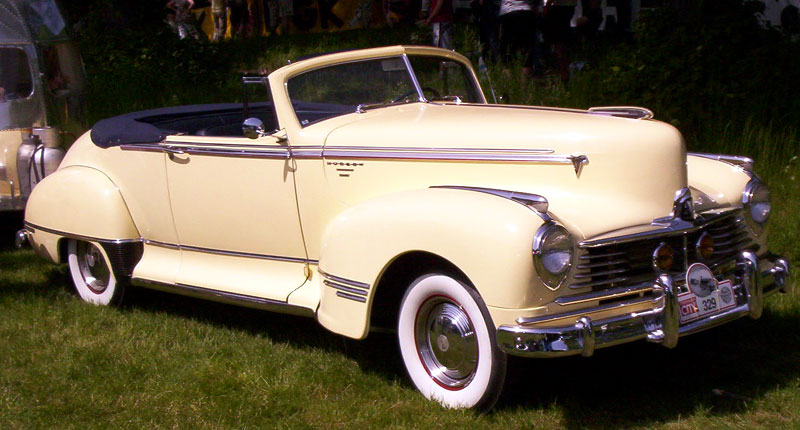
Hudson Commodore
The Hudson Commodore is an automobile that was produced by the Hudson Motor Car Company of Detroit, Michigan between 1941 and 1952. During its time in production, the Commodore was the largest and most luxurious Hudson model.
The Commodore Series 12 and Series 14 were the junior models to the Commodore Custom Series 15 and Series 17. The junior models debuted in Hudson's 1941 model line. Commodore Series 12 featured a I6 engine and the Series 14 models came with a I8, with all built on a 121-inch (3,073 mm) wheelbase, while Commodore Customs utilized on the 121 in (3,073 mm) wheelbase for Series 15 coupes and a 128 in (3,251 mm) version for Series 17 sedans.
The Commodore was powered by Hudson's 202 cu in (3.3 L) I6 producing 102 bhp (76 kW), or by Hudson's 254.4 cu in (4.2 L) I8 that produced 128 bhp (95 kW). Prices listed for the Series 12 coupe started at US$1,028 ($22,502 in 2025 dollars ) to the top level Custom Series 17 Sedan at US$1,537 ($33,644 in 2025 dollars ).
The Commodore series was Hudson's largest model range in its debut year, consisting of sedans, coupes, and convertibles. Hudson used a forward hinged hood that opened from the rear by the windshield with the front end of the hood sliding downward over the grille. Elements of the interior and exterior were styled by Betty Thatcher, "the first woman designer to be employed by a car manufacturer".
For the 1942 model year, the cars received a facelift. This included concealed running boards, modestly enlarged front grilles, and external trim arrangements. Hudson offered an optional "Drive-Master" vacuum-assisted clutch with a servo-operated transmission with three modes: "automatic" shifting and clutching, automated clutching only, or fully manual.
The firm promoted its economy over luxury during the shortened model year that ended in January 1942, as U.S. war production accelerated.
Hudson began postwar automobile production on August 30, 1945. Body styles were trimmed to Sedan, Club Coupe, and Convertible. The designs were based on the 1942 models. There were minor cosmetic changes from the pre-war versions with one exception, the car's grille now had a concave center section.
Hudson automobiles were more fully equipped than competitive makes, and all Hudson models received door armrests, twin air-horns, ashtrays, windshield wipers, stop lights, locking glove box, sealed beam headlights, and deep pile carpeting. Commodore and Commodore Customs added foam rubber seat cushions (Hudson was the first automaker to introduce foam seat cushions), door-step courtesy lights, rear center armrest (sedans), and gold etched lettering on the dashboard panel.
Hub AI
Hudson Commodore AI simulator
(@Hudson Commodore_simulator)
Hudson Commodore
The Hudson Commodore is an automobile that was produced by the Hudson Motor Car Company of Detroit, Michigan between 1941 and 1952. During its time in production, the Commodore was the largest and most luxurious Hudson model.
The Commodore Series 12 and Series 14 were the junior models to the Commodore Custom Series 15 and Series 17. The junior models debuted in Hudson's 1941 model line. Commodore Series 12 featured a I6 engine and the Series 14 models came with a I8, with all built on a 121-inch (3,073 mm) wheelbase, while Commodore Customs utilized on the 121 in (3,073 mm) wheelbase for Series 15 coupes and a 128 in (3,251 mm) version for Series 17 sedans.
The Commodore was powered by Hudson's 202 cu in (3.3 L) I6 producing 102 bhp (76 kW), or by Hudson's 254.4 cu in (4.2 L) I8 that produced 128 bhp (95 kW). Prices listed for the Series 12 coupe started at US$1,028 ($22,502 in 2025 dollars ) to the top level Custom Series 17 Sedan at US$1,537 ($33,644 in 2025 dollars ).
The Commodore series was Hudson's largest model range in its debut year, consisting of sedans, coupes, and convertibles. Hudson used a forward hinged hood that opened from the rear by the windshield with the front end of the hood sliding downward over the grille. Elements of the interior and exterior were styled by Betty Thatcher, "the first woman designer to be employed by a car manufacturer".
For the 1942 model year, the cars received a facelift. This included concealed running boards, modestly enlarged front grilles, and external trim arrangements. Hudson offered an optional "Drive-Master" vacuum-assisted clutch with a servo-operated transmission with three modes: "automatic" shifting and clutching, automated clutching only, or fully manual.
The firm promoted its economy over luxury during the shortened model year that ended in January 1942, as U.S. war production accelerated.
Hudson began postwar automobile production on August 30, 1945. Body styles were trimmed to Sedan, Club Coupe, and Convertible. The designs were based on the 1942 models. There were minor cosmetic changes from the pre-war versions with one exception, the car's grille now had a concave center section.
Hudson automobiles were more fully equipped than competitive makes, and all Hudson models received door armrests, twin air-horns, ashtrays, windshield wipers, stop lights, locking glove box, sealed beam headlights, and deep pile carpeting. Commodore and Commodore Customs added foam rubber seat cushions (Hudson was the first automaker to introduce foam seat cushions), door-step courtesy lights, rear center armrest (sedans), and gold etched lettering on the dashboard panel.