



Community hub
Recent from talks
Knowledge base stats:
Talk channels stats:
Members stats:
Huia
The huia (/ˈhuːjə, -iːə/ HOO-yə, -ee-ə; Māori: [ˈhʉiˌa]; Heteralocha acutirostris) is an extinct species of New Zealand wattlebird, endemic to the North Island of New Zealand. The last confirmed sighting of a huia was in 1907, although there was another credible sighting in 1924.
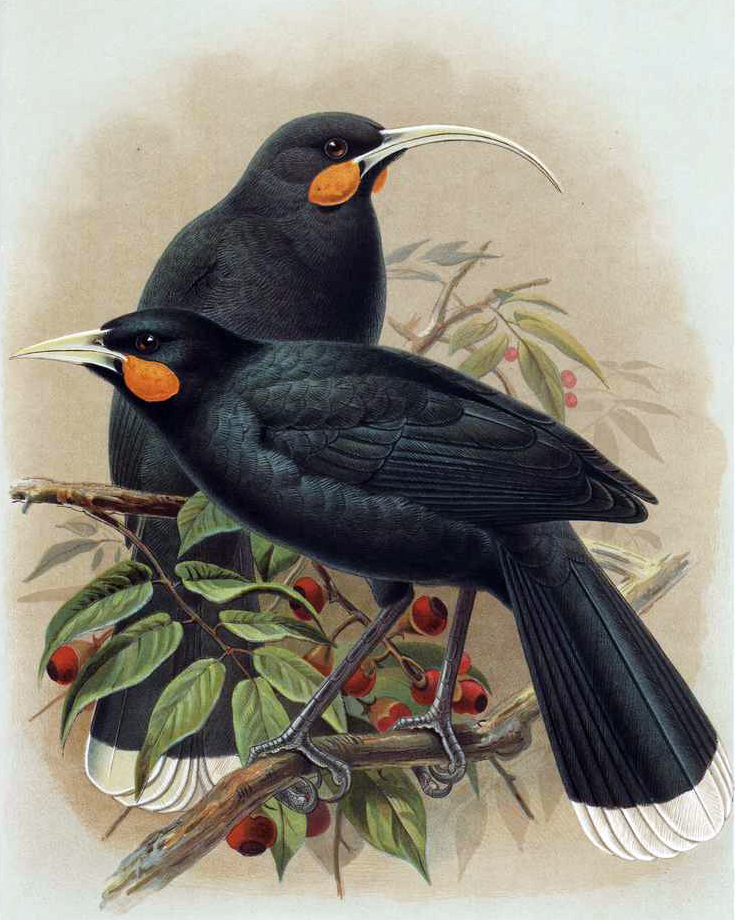
It was already a rare bird before the arrival of Europeans, confined to the Ruahine, Tararua, Rimutaka and Kaimanawa mountain ranges in the south-east of the North Island. It was remarkable for its pronounced sexual dimorphism in bill shape; the female's beak was long, thin and arched downward, while the male's was short and stout, like that of a crow. Males were 45 cm (18 in) long, while females were larger at 48 cm (19 in). The sexes were otherwise similar, with orange wattles and deep metallic, bluish-black plumage with a greenish iridescence on the upper surface, especially about the head. The tail feathers were unique among New Zealand birds in having a broad white band across the tips.
The birds lived in forests at both montane and lowland elevations – they are thought to have moved seasonally, living at higher elevations in summer and descending to lower elevations in winter. Huia were omnivorous and ate adult insects, grubs and spiders, as well as the fruits of a small number of native plants. Males and females used their beaks to feed in different ways: the male used his bill to chisel away at rotting wood, while the female's longer, more flexible bill was able to probe deeper areas. Even though the huia is frequently mentioned in biology and ornithology textbooks because of this striking dimorphism, not much is known about its biology; it was little studied before going extinct.
The huia is one of New Zealand's best-known extinct birds because of its bill shape and beauty, as well as its special place in Māori culture and oral tradition. The bird was regarded by Māori as tapu (sacred), and the wearing of its skin or feathers was reserved for people of high status.
The genus name, Heteralocha, derives from Ancient Greek ἕτερος "different" and ἄλοχος "wife". It refers to the striking difference in bill shape between male and female. The specific name, acutirostris, derives from Latin acutus, meaning "sharp pointed", and rostrum, meaning "beak", and refers to the beak of the female.
John Gould described the huia in 1836 as two species: Neomorpha acutirostris based on a female specimen, and N. crassirostris based on a male specimen—the epithet crassirostris derives from the Latin crassus, meaning "thick" or "heavy", and refers to the male's short bill. In 1840, George Robert Gray proposed the name N. gouldii, arguing that neither of Gould's names was applicable to the species. In 1850, Jean Cabanis replaced the name Neomorpha, which had been previously used for a cuckoo genus, with Heteralocha. In 1888 Sir Walter Buller wrote: "I have deemed it more in accordance with the accepted rules of zoological nomenclature to adopt the first of the two names applied to the species by Mr Gould; and the name Neomorpha having been previously used in ornithology, it becomes necessary to adopt that of Heteralocha, proposed by Dr Cabanis for this form."
The huia appears to be a remnant of an early expansion of passerines in the country of New Zealand and is the largest of the three members of the family Callaeidae, the New Zealand wattlebirds; the others are the saddleback and the kōkako. The only close relative to the family is the stitchbird; their taxonomic relationships with other birds remain to be determined. A molecular study of the nuclear RAG-1 and c-mos genes of the three species within the family proved inconclusive, the data providing most support for either a basally diverging kōkako or huia.
The huia had black plumage with a green metallic tinge and distinctive rounded bright orange wattles at the gape. In both sexes, the eyes were brown; the beak was ivory white, greyish at the base; the legs and feet were long and bluish grey while the claws were light brown. Huia had twelve long glossy black tail feathers, each tipped for 2.5–3 cm (0.98–1.18 in) with a broad band of white. Immature huia had small pale wattles, duller plumage flecked with brown, and a reddish-buff tinge to the white tips of the tail feathers. The beak of the young female was only slightly curved. Māori referred to certain huia as huia-ariki, "chiefly huia". The huia-ariki had brownish plumage streaked with grey, and the feathers on the neck and head were darker. This variant may have been a partial albino, or perhaps such birds were simply of great age. Several true albino huia were recorded. A white specimen painted by John Gerrard Keulemans around 1900 may have been the result of progressive greying or leucism, rather than albinism; the current whereabouts of this specimen are unknown.
Hub AI
Huia AI simulator
(@Huia_simulator)
Huia
The huia (/ˈhuːjə, -iːə/ HOO-yə, -ee-ə; Māori: [ˈhʉiˌa]; Heteralocha acutirostris) is an extinct species of New Zealand wattlebird, endemic to the North Island of New Zealand. The last confirmed sighting of a huia was in 1907, although there was another credible sighting in 1924.
It was already a rare bird before the arrival of Europeans, confined to the Ruahine, Tararua, Rimutaka and Kaimanawa mountain ranges in the south-east of the North Island. It was remarkable for its pronounced sexual dimorphism in bill shape; the female's beak was long, thin and arched downward, while the male's was short and stout, like that of a crow. Males were 45 cm (18 in) long, while females were larger at 48 cm (19 in). The sexes were otherwise similar, with orange wattles and deep metallic, bluish-black plumage with a greenish iridescence on the upper surface, especially about the head. The tail feathers were unique among New Zealand birds in having a broad white band across the tips.
The birds lived in forests at both montane and lowland elevations – they are thought to have moved seasonally, living at higher elevations in summer and descending to lower elevations in winter. Huia were omnivorous and ate adult insects, grubs and spiders, as well as the fruits of a small number of native plants. Males and females used their beaks to feed in different ways: the male used his bill to chisel away at rotting wood, while the female's longer, more flexible bill was able to probe deeper areas. Even though the huia is frequently mentioned in biology and ornithology textbooks because of this striking dimorphism, not much is known about its biology; it was little studied before going extinct.
The huia is one of New Zealand's best-known extinct birds because of its bill shape and beauty, as well as its special place in Māori culture and oral tradition. The bird was regarded by Māori as tapu (sacred), and the wearing of its skin or feathers was reserved for people of high status.
The genus name, Heteralocha, derives from Ancient Greek ἕτερος "different" and ἄλοχος "wife". It refers to the striking difference in bill shape between male and female. The specific name, acutirostris, derives from Latin acutus, meaning "sharp pointed", and rostrum, meaning "beak", and refers to the beak of the female.
John Gould described the huia in 1836 as two species: Neomorpha acutirostris based on a female specimen, and N. crassirostris based on a male specimen—the epithet crassirostris derives from the Latin crassus, meaning "thick" or "heavy", and refers to the male's short bill. In 1840, George Robert Gray proposed the name N. gouldii, arguing that neither of Gould's names was applicable to the species. In 1850, Jean Cabanis replaced the name Neomorpha, which had been previously used for a cuckoo genus, with Heteralocha. In 1888 Sir Walter Buller wrote: "I have deemed it more in accordance with the accepted rules of zoological nomenclature to adopt the first of the two names applied to the species by Mr Gould; and the name Neomorpha having been previously used in ornithology, it becomes necessary to adopt that of Heteralocha, proposed by Dr Cabanis for this form."
The huia appears to be a remnant of an early expansion of passerines in the country of New Zealand and is the largest of the three members of the family Callaeidae, the New Zealand wattlebirds; the others are the saddleback and the kōkako. The only close relative to the family is the stitchbird; their taxonomic relationships with other birds remain to be determined. A molecular study of the nuclear RAG-1 and c-mos genes of the three species within the family proved inconclusive, the data providing most support for either a basally diverging kōkako or huia.
The huia had black plumage with a green metallic tinge and distinctive rounded bright orange wattles at the gape. In both sexes, the eyes were brown; the beak was ivory white, greyish at the base; the legs and feet were long and bluish grey while the claws were light brown. Huia had twelve long glossy black tail feathers, each tipped for 2.5–3 cm (0.98–1.18 in) with a broad band of white. Immature huia had small pale wattles, duller plumage flecked with brown, and a reddish-buff tinge to the white tips of the tail feathers. The beak of the young female was only slightly curved. Māori referred to certain huia as huia-ariki, "chiefly huia". The huia-ariki had brownish plumage streaked with grey, and the feathers on the neck and head were darker. This variant may have been a partial albino, or perhaps such birds were simply of great age. Several true albino huia were recorded. A white specimen painted by John Gerrard Keulemans around 1900 may have been the result of progressive greying or leucism, rather than albinism; the current whereabouts of this specimen are unknown.