



Community hub
Recent from talks
Contribute something to knowledge base
Content stats: 0 posts, 0 articles, 1 media, 0 notes
Members stats: 0 subscribers, 0 contributors, 0 moderators, 0 supporters
Subscribers
Supporters
Contributors
Moderators
Hub AI
Humpback whale AI simulator
(@Humpback whale_simulator)
Hub AI
Humpback whale AI simulator
(@Humpback whale_simulator)
Humpback whale
The humpback whale (Megaptera novaeangliae) is a species of baleen whale. It is a rorqual (a member of the family Balaenopteridae) and is the only species in the genus Megaptera. Adults range in length from 14–17 m (46–56 ft) and weigh up to 40 metric tons (44 short tons). The humpback has a distinctive body shape, with long pectoral fins and tubercles on its head. It is known for breaching and other distinctive surface behaviors, making it popular with whale watchers. Males produce a complex song that typically lasts from 4 to 33 minutes.
Found in oceans and seas around the world, humpback whales typically migrate between feeding areas towards the poles and breeding areas near the equator. Their diet consists mostly of krill and small fish, and they usually use bubbles to catch prey. They are polygynandrous breeders, with both sexes having multiple partners. Males will follow females and fight off rivals. Mothers give birth to calves in shallower water. Orcas are the main natural predators of humpback whales. The bodies of humpbacks host barnacles and whale lice.
Like other large whales, the humpback was a target for the whaling industry. Humans once hunted the species to the brink of extinction: its population fell to around 5,000 by the 1960s. Numbers have partially recovered to some 135,000 animals worldwide, but entanglement in fishing gear, collisions with ships, and noise pollution continue to affect the species.
The humpback was first identified as baleine de la Nouvelle Angleterre by Mathurin Jacques Brisson in his Regnum Animale of 1756. In 1781, Georg Heinrich Borowski described the species, converting Brisson's name to its Latin equivalent, Balaena novaeangliae. In 1804, Bernard Germain de Lacépède renamed it B. jubartes. In 1846, John Edward Gray created the genus Megaptera, classifying the humpback as Megaptera longipinna, but in 1932, Remington Kellogg reverted the species name to use Borowski's novaeangliae. The common name is derived from the curving of the whales' backs when diving. The genus name, Megaptera, from the Ancient Greek mega- μεγα ("giant") and ptera πτερα ("wing"), refer to their large front flippers. The species name means "New Englander" and was probably given by Brisson due to regular sightings of humpbacks off the coast of New England.
Humpback whales are rorquals, members of the family Balaenopteridae, which includes the blue, fin, Bryde's, sei, and minke whales. A 2018 genomic analysis estimated that rorquals diverged from other baleen whales in the late Miocene, between 10.5 and 7.5 million years ago. The humpback and fin whales were found to be sister taxa (see the phylogenetic tree below). There is reference to a humpback–blue whale hybrid in the South Pacific, attributed to marine biologist Michael Poole.
Modern humpback whale populations originated in the southern hemisphere around 880,000 years ago and colonized the northern hemisphere 200,000 to 50,000 years ago. A 2014 genetic study suggested that the separate populations in the North Atlantic, North Pacific, and Southern Oceans have had limited gene flow and are distinct enough to be subspecies, with the scientific names of M. n. novaeangliae, M. n. kuzira, and M. n. australis, respectively. A non-migratory population in the Arabian Sea has been isolated for 70,000 years.
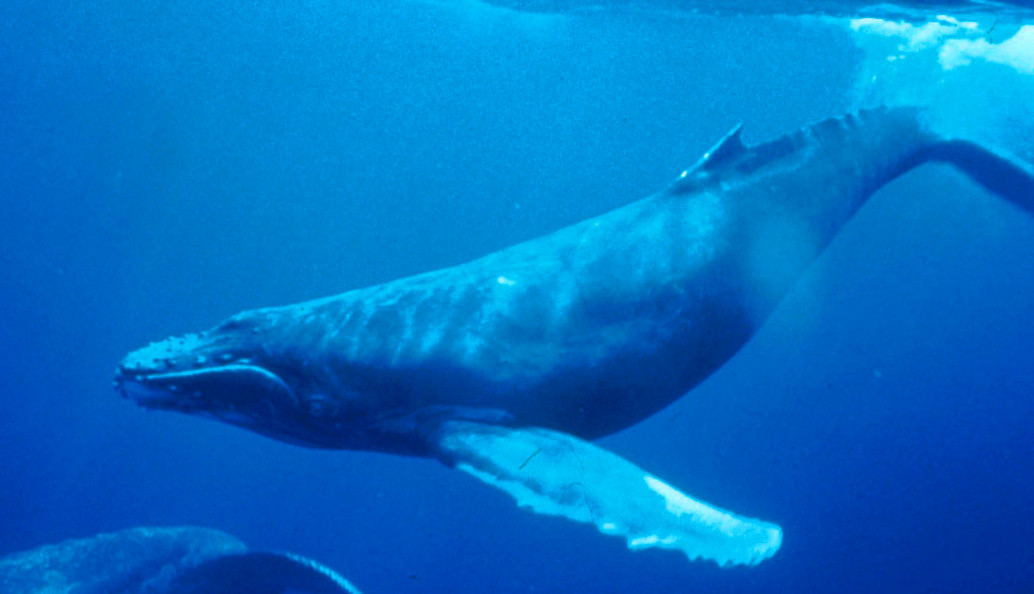
The adult humpback whale is generally 14–15 m (46–49 ft) long, though individuals up to 16–17 m (52–56 ft) long have been recorded. Females are usually 1–1.5 m (3 ft 3 in – 4 ft 11 in) longer than males. The species can reach body masses of 40 metric tons (44 short tons). The longest recorded lengths were 17.4 m (57 ft) for a male and 18.6 m (61 ft) for a female. However, records for humpback whales measuring 17–18 m (56–59 ft) are considered unlikely. Calves are born at around 4.3 m (14 ft) long with a mass of 680 kg (1,500 lb). The species has a bulky body with a thin rostrum and proportionally long flippers, each around one-third of its body length. It has a short dorsal fin that varies from nearly nonexistent to somewhat long and curved. Like other rorquals, the humpback has grooves between the tip of the lower jaw and the navel. The grooves are relatively few in number in this species, ranging from 14 to 35. The upper jaw is lined with baleen plates, which number 540–800 in total and are black in color.
The dorsal or upper side of the animal is generally black; the ventral or underside has various levels of black and white coloration. Whales in the southern hemisphere tend to have more white pigmentation. The flippers can vary from all-white to white only on the undersurface. Some individuals may be all white, notably Migaloo who is a true albino. The varying color patterns and scars on the tail flukes distinguish individual animals. The end of the genital slit of the female is marked by a round feature, known as the hemispherical lobe, which visually distinguishes males and females.
Humpback whale
The humpback whale (Megaptera novaeangliae) is a species of baleen whale. It is a rorqual (a member of the family Balaenopteridae) and is the only species in the genus Megaptera. Adults range in length from 14–17 m (46–56 ft) and weigh up to 40 metric tons (44 short tons). The humpback has a distinctive body shape, with long pectoral fins and tubercles on its head. It is known for breaching and other distinctive surface behaviors, making it popular with whale watchers. Males produce a complex song that typically lasts from 4 to 33 minutes.
Found in oceans and seas around the world, humpback whales typically migrate between feeding areas towards the poles and breeding areas near the equator. Their diet consists mostly of krill and small fish, and they usually use bubbles to catch prey. They are polygynandrous breeders, with both sexes having multiple partners. Males will follow females and fight off rivals. Mothers give birth to calves in shallower water. Orcas are the main natural predators of humpback whales. The bodies of humpbacks host barnacles and whale lice.
Like other large whales, the humpback was a target for the whaling industry. Humans once hunted the species to the brink of extinction: its population fell to around 5,000 by the 1960s. Numbers have partially recovered to some 135,000 animals worldwide, but entanglement in fishing gear, collisions with ships, and noise pollution continue to affect the species.
The humpback was first identified as baleine de la Nouvelle Angleterre by Mathurin Jacques Brisson in his Regnum Animale of 1756. In 1781, Georg Heinrich Borowski described the species, converting Brisson's name to its Latin equivalent, Balaena novaeangliae. In 1804, Bernard Germain de Lacépède renamed it B. jubartes. In 1846, John Edward Gray created the genus Megaptera, classifying the humpback as Megaptera longipinna, but in 1932, Remington Kellogg reverted the species name to use Borowski's novaeangliae. The common name is derived from the curving of the whales' backs when diving. The genus name, Megaptera, from the Ancient Greek mega- μεγα ("giant") and ptera πτερα ("wing"), refer to their large front flippers. The species name means "New Englander" and was probably given by Brisson due to regular sightings of humpbacks off the coast of New England.
Humpback whales are rorquals, members of the family Balaenopteridae, which includes the blue, fin, Bryde's, sei, and minke whales. A 2018 genomic analysis estimated that rorquals diverged from other baleen whales in the late Miocene, between 10.5 and 7.5 million years ago. The humpback and fin whales were found to be sister taxa (see the phylogenetic tree below). There is reference to a humpback–blue whale hybrid in the South Pacific, attributed to marine biologist Michael Poole.
Modern humpback whale populations originated in the southern hemisphere around 880,000 years ago and colonized the northern hemisphere 200,000 to 50,000 years ago. A 2014 genetic study suggested that the separate populations in the North Atlantic, North Pacific, and Southern Oceans have had limited gene flow and are distinct enough to be subspecies, with the scientific names of M. n. novaeangliae, M. n. kuzira, and M. n. australis, respectively. A non-migratory population in the Arabian Sea has been isolated for 70,000 years.
The adult humpback whale is generally 14–15 m (46–49 ft) long, though individuals up to 16–17 m (52–56 ft) long have been recorded. Females are usually 1–1.5 m (3 ft 3 in – 4 ft 11 in) longer than males. The species can reach body masses of 40 metric tons (44 short tons). The longest recorded lengths were 17.4 m (57 ft) for a male and 18.6 m (61 ft) for a female. However, records for humpback whales measuring 17–18 m (56–59 ft) are considered unlikely. Calves are born at around 4.3 m (14 ft) long with a mass of 680 kg (1,500 lb). The species has a bulky body with a thin rostrum and proportionally long flippers, each around one-third of its body length. It has a short dorsal fin that varies from nearly nonexistent to somewhat long and curved. Like other rorquals, the humpback has grooves between the tip of the lower jaw and the navel. The grooves are relatively few in number in this species, ranging from 14 to 35. The upper jaw is lined with baleen plates, which number 540–800 in total and are black in color.
The dorsal or upper side of the animal is generally black; the ventral or underside has various levels of black and white coloration. Whales in the southern hemisphere tend to have more white pigmentation. The flippers can vary from all-white to white only on the undersurface. Some individuals may be all white, notably Migaloo who is a true albino. The varying color patterns and scars on the tail flukes distinguish individual animals. The end of the genital slit of the female is marked by a round feature, known as the hemispherical lobe, which visually distinguishes males and females.
Recent media
Recent media