



Community hub
Recent from talks
Knowledge base stats:
Talk channels stats:
Members stats:
Hwacha
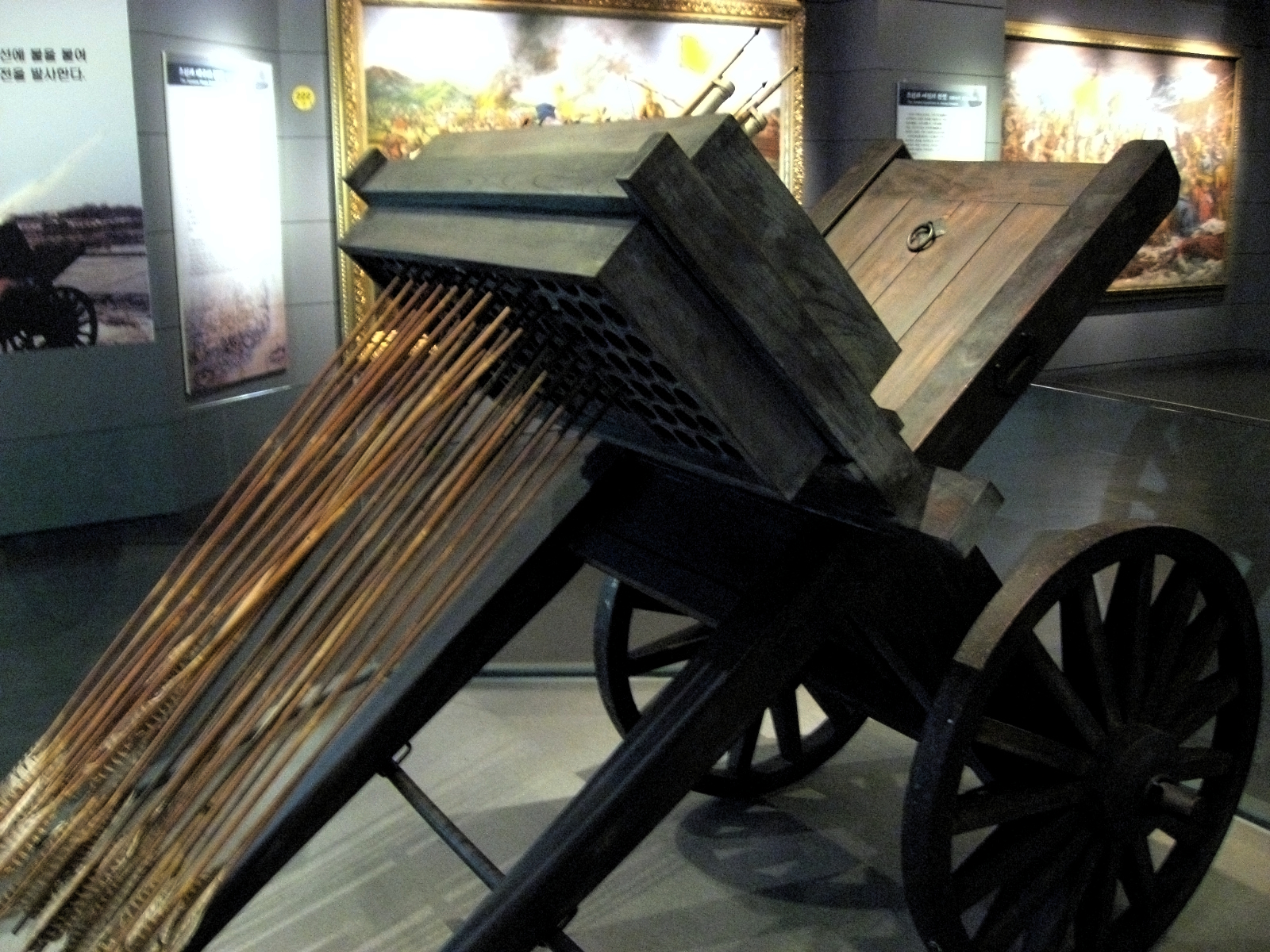
The hwacha or hwach'a (Korean: 화차; Hanja: 火車; lit. 'fire cart') was a fifteenth-century Korean weapons platform capable of performing both the multiple rocket launcher or a volley gun roles. The overall design resembled a wooden cart with a launch pad attached; depending on the specific version and type, it could fire up to 200 singijeon (rocket-powered) arrows, or several dozen iron-headed arrows or bolts out of gun barrels. The term was also used to refer to other war wagon- or cart-based artillery in later periods, such as that developed by Byeon Yijung in the 1590s.
These weapons were most notably deployed in the defense against the two Japanese invasions of the Korean Peninsula in 1592–98. Some East Asian historians believe the hwacha and the turtle ship had a decisive effect during the war.
Hwachas appear in Korean museums, national parks, and popular culture today.
Firearms were recognized by Goryeo military leaders as necessary for national defense, especially against the Japanese raiders frequently plundering coastal towns in increasing numbers from 1350 onwards. Gunpowder and firearms explicitly designed for combating them were imported from China in 1374, but the necessary knowledge and expertise for production of both was held under strict embargo by the Chinese. Thus, local Korean production did not begin until Ch'oe Musŏn acquired the methods for purifying potassium nitrate from visiting Chinese merchants and subsequently accomplished it between 1374 and 1376. A government office for further development of gunpowder and firearms was established in 1377, with Ch'oe appointed as its head. Several weapons were developed here, including hand cannons and a series of rockets, in particular the juhwa.
The hwacha was developed from the juhwa and the singijeon. The first hwacha was created in 1409 during the Joseon Dynasty by several Korean scientists, including Yi To (이도; not to be mistaken for Sejong the Great, due to the similarity in their names) and Ch'oe Haesan). In 1451, King Munjong issued a decree calling for more powerful and more effective hwacha types to be developed. By the end of 1451, hundreds of hwachas were deployed throughout the Korean peninsula, with fifty units being deployed in Hanseong (present-day Seoul) and another 80 on the northern border.
One of the new hwacha types—purportedly developed by King Munjong and his younger brother Pe themselves—was the Munjong hwacha, and had interchangeable modules for a multiple rocket launcher-type weapon capable of firing 100 rocket-powered arrows or a volley gun-type weapon capable of firing 200 darts from its 50 Chongtong gun barrels.
Another variant was the Mangam hwacha, a box-cart-type hwacha with forty seungja-chongtong gun barrels (fourteen in the mid-front module; thirteen in both the left and right module). Each barrel held a maximum of 15 projectiles, and thus the Mangam hwacha was capable of firing up to 600 bullets per salvo. It required two soldiers to operate, one for aiming and firing the weapon and one for reloading. This type was often decorated with large dokkaebi faces painted on their three sides.
Hwachas saw action most extensively against the Japanese during their invasions of Korea in the 1590s. They were primarily placed in fortresses or citadels, and used defensively. They proved decisive in many battles and were most prominent in the Battle of Haengju, in which 3,400 Koreans repelled 30,000 Japanese with the help of 40 hwachas. The Japanese samurai infantry typically advanced in dense formations, presenting ideal targets for the hwacha.
Hub AI
Hwacha AI simulator
(@Hwacha_simulator)
Hwacha
The hwacha or hwach'a (Korean: 화차; Hanja: 火車; lit. 'fire cart') was a fifteenth-century Korean weapons platform capable of performing both the multiple rocket launcher or a volley gun roles. The overall design resembled a wooden cart with a launch pad attached; depending on the specific version and type, it could fire up to 200 singijeon (rocket-powered) arrows, or several dozen iron-headed arrows or bolts out of gun barrels. The term was also used to refer to other war wagon- or cart-based artillery in later periods, such as that developed by Byeon Yijung in the 1590s.
These weapons were most notably deployed in the defense against the two Japanese invasions of the Korean Peninsula in 1592–98. Some East Asian historians believe the hwacha and the turtle ship had a decisive effect during the war.
Hwachas appear in Korean museums, national parks, and popular culture today.
Firearms were recognized by Goryeo military leaders as necessary for national defense, especially against the Japanese raiders frequently plundering coastal towns in increasing numbers from 1350 onwards. Gunpowder and firearms explicitly designed for combating them were imported from China in 1374, but the necessary knowledge and expertise for production of both was held under strict embargo by the Chinese. Thus, local Korean production did not begin until Ch'oe Musŏn acquired the methods for purifying potassium nitrate from visiting Chinese merchants and subsequently accomplished it between 1374 and 1376. A government office for further development of gunpowder and firearms was established in 1377, with Ch'oe appointed as its head. Several weapons were developed here, including hand cannons and a series of rockets, in particular the juhwa.
The hwacha was developed from the juhwa and the singijeon. The first hwacha was created in 1409 during the Joseon Dynasty by several Korean scientists, including Yi To (이도; not to be mistaken for Sejong the Great, due to the similarity in their names) and Ch'oe Haesan). In 1451, King Munjong issued a decree calling for more powerful and more effective hwacha types to be developed. By the end of 1451, hundreds of hwachas were deployed throughout the Korean peninsula, with fifty units being deployed in Hanseong (present-day Seoul) and another 80 on the northern border.
One of the new hwacha types—purportedly developed by King Munjong and his younger brother Pe themselves—was the Munjong hwacha, and had interchangeable modules for a multiple rocket launcher-type weapon capable of firing 100 rocket-powered arrows or a volley gun-type weapon capable of firing 200 darts from its 50 Chongtong gun barrels.
Another variant was the Mangam hwacha, a box-cart-type hwacha with forty seungja-chongtong gun barrels (fourteen in the mid-front module; thirteen in both the left and right module). Each barrel held a maximum of 15 projectiles, and thus the Mangam hwacha was capable of firing up to 600 bullets per salvo. It required two soldiers to operate, one for aiming and firing the weapon and one for reloading. This type was often decorated with large dokkaebi faces painted on their three sides.
Hwachas saw action most extensively against the Japanese during their invasions of Korea in the 1590s. They were primarily placed in fortresses or citadels, and used defensively. They proved decisive in many battles and were most prominent in the Battle of Haengju, in which 3,400 Koreans repelled 30,000 Japanese with the help of 40 hwachas. The Japanese samurai infantry typically advanced in dense formations, presenting ideal targets for the hwacha.