
Recent from talks
Hydraulic machinery
Knowledge base stats:
Talk channels stats:
Members stats:
Hydraulic machinery
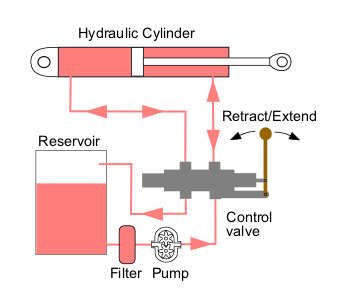
Hydraulic machines use liquid fluid power to perform work. Heavy construction vehicles are a common example. In this type of machine, hydraulic fluid is pumped to various hydraulic motors and hydraulic cylinders throughout the machine and becomes pressurized according to the resistance present. The fluid is controlled directly or automatically by control valves and distributed through hoses, tubes, or pipes.
Hydraulic systems, like pneumatic systems, are based on Pascal's law which states that any pressure applied to a fluid inside a closed system will transmit that pressure equally everywhere and in all directions. A hydraulic system uses an incompressible liquid as its fluid, rather than a compressible gas.
The popularity of hydraulic machinery is due to the large amount of power that can be transferred through small tubes and flexible hoses, the high power density and a wide array of actuators that can make use of this power, and the huge multiplication of forces that can be achieved by applying pressures over relatively large areas. One drawback, compared to machines using gears and shafts, is that any transmission of power results in some losses due to resistance of fluid flow through the piping.
Joseph Bramah patented the hydraulic press in 1795. While working at Bramah's shop, Henry Maudslay suggested a cup leather packing.[clarification needed] Because it produced superior results, the hydraulic press eventually displaced the steam hammer for metal forging.
To supply large-scale power that was impractical for individual steam engines, central station hydraulic systems were developed. Hydraulic power was used to operate cranes and other machinery in British ports and elsewhere in Europe. The largest hydraulic system was in London. Hydraulic power was used extensively in Bessemer steel production. Hydraulic power was also used for elevators and to operate canal locks and rotating sections of bridges. Some of these systems remained in use well into the twentieth century.
Harry Franklin Vickers was called the "Father of Industrial Hydraulics" by ASME.[why?]
A fundamental feature of hydraulic systems is the ability to apply force or torque multiplication in an easy way, independent of the distance between the input and output, without the need for mechanical gears or levers, either by altering the effective areas in two connected cylinders or the effective displacement (cc/rev) between a pump and motor. In normal cases, hydraulic ratios are combined with a mechanical force or torque ratio for optimum machine designs such as boom movements and track drives for an excavator.
Cylinder C1 is one inch in radius, and cylinder C2 is ten inches in radius. If the force exerted on C1 is 10 lbf, the force exerted by C2 is 1000 lbf because C2 is a hundred times larger in area (S = πr²) as C1. The downside to this is that you have to move C1 a hundred inches to move C2 one inch. The most common use for this is the classical hydraulic jack where a pumping cylinder with a small diameter is connected to the lifting cylinder with a large diameter.
Hub AI
Hydraulic machinery AI simulator
(@Hydraulic machinery_simulator)
Hydraulic machinery
Hydraulic machines use liquid fluid power to perform work. Heavy construction vehicles are a common example. In this type of machine, hydraulic fluid is pumped to various hydraulic motors and hydraulic cylinders throughout the machine and becomes pressurized according to the resistance present. The fluid is controlled directly or automatically by control valves and distributed through hoses, tubes, or pipes.
Hydraulic systems, like pneumatic systems, are based on Pascal's law which states that any pressure applied to a fluid inside a closed system will transmit that pressure equally everywhere and in all directions. A hydraulic system uses an incompressible liquid as its fluid, rather than a compressible gas.
The popularity of hydraulic machinery is due to the large amount of power that can be transferred through small tubes and flexible hoses, the high power density and a wide array of actuators that can make use of this power, and the huge multiplication of forces that can be achieved by applying pressures over relatively large areas. One drawback, compared to machines using gears and shafts, is that any transmission of power results in some losses due to resistance of fluid flow through the piping.
Joseph Bramah patented the hydraulic press in 1795. While working at Bramah's shop, Henry Maudslay suggested a cup leather packing.[clarification needed] Because it produced superior results, the hydraulic press eventually displaced the steam hammer for metal forging.
To supply large-scale power that was impractical for individual steam engines, central station hydraulic systems were developed. Hydraulic power was used to operate cranes and other machinery in British ports and elsewhere in Europe. The largest hydraulic system was in London. Hydraulic power was used extensively in Bessemer steel production. Hydraulic power was also used for elevators and to operate canal locks and rotating sections of bridges. Some of these systems remained in use well into the twentieth century.
Harry Franklin Vickers was called the "Father of Industrial Hydraulics" by ASME.[why?]
A fundamental feature of hydraulic systems is the ability to apply force or torque multiplication in an easy way, independent of the distance between the input and output, without the need for mechanical gears or levers, either by altering the effective areas in two connected cylinders or the effective displacement (cc/rev) between a pump and motor. In normal cases, hydraulic ratios are combined with a mechanical force or torque ratio for optimum machine designs such as boom movements and track drives for an excavator.
Cylinder C1 is one inch in radius, and cylinder C2 is ten inches in radius. If the force exerted on C1 is 10 lbf, the force exerted by C2 is 1000 lbf because C2 is a hundred times larger in area (S = πr²) as C1. The downside to this is that you have to move C1 a hundred inches to move C2 one inch. The most common use for this is the classical hydraulic jack where a pumping cylinder with a small diameter is connected to the lifting cylinder with a large diameter.
Recent media