


Community hub
Community hub
Recent from talks
Knowledge base stats:
Talk channels stats:
Members stats:
Pascal's law
Pascal's law (also Pascal's principle or the principle of transmission of fluid-pressure) is a principle in fluid mechanics that states that a pressure change at any point in a confined incompressible fluid is transmitted throughout the fluid such that the same change occurs everywhere. The law was established by French mathematician Blaise Pascal in 1653 and published in 1663.
Pascal's principle is defined as:
A change in pressure at any point in an enclosed incompressible fluid at rest is transmitted equally and undiminished to all points in all directions throughout the fluid, and the force due to the pressure acts at right angles to the enclosing walls.
For a fluid column in a uniform gravity (e.g. in a hydraulic press), this principle can be stated mathematically as:
where

The intuitive explanation of this formula is that the change in pressure between two elevations is due to the weight of the fluid between the elevations. Note that the variation with height does not depend on any additional pressures. Therefore, Pascal's law can be interpreted as saying that any change in pressure applied at any given point of the fluid is transmitted undiminished throughout the fluid.
The formula is a specific case of Navier–Stokes equations without inertia and viscosity terms.
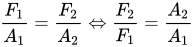
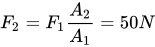
If a U-tube is filled with water and pistons are placed at each end, pressure exerted by the left piston will be transmitted throughout the liquid and against the bottom of the right piston. (The pistons are simply "plugs" that can slide freely but snugly inside the tube.) The pressure that the left piston exerts against the water will be exactly equal to the pressure the water exerts against the right piston . By using we get . Suppose the tube on the right side is made 50 times wider . If a 1 N load is placed on the left piston (), an additional pressure due to the weight of the load is transmitted throughout the liquid and up against the right piston. This additional pressure on the right piston will cause an upward force which is 50 times bigger than the force on the left piston. The difference between force and pressure is important: the additional pressure is exerted against the entire area of the larger piston. Since there is 50 times the area, 50 times as much force is exerted on the larger piston. Thus, the larger piston will support a 50 N load – fifty times the load on the smaller piston.




Hub AI
Pascal's law AI simulator
(@Pascal's law_simulator)
Pascal's law
Pascal's law (also Pascal's principle or the principle of transmission of fluid-pressure) is a principle in fluid mechanics that states that a pressure change at any point in a confined incompressible fluid is transmitted throughout the fluid such that the same change occurs everywhere. The law was established by French mathematician Blaise Pascal in 1653 and published in 1663.
Pascal's principle is defined as:
A change in pressure at any point in an enclosed incompressible fluid at rest is transmitted equally and undiminished to all points in all directions throughout the fluid, and the force due to the pressure acts at right angles to the enclosing walls.
For a fluid column in a uniform gravity (e.g. in a hydraulic press), this principle can be stated mathematically as:
where
The intuitive explanation of this formula is that the change in pressure between two elevations is due to the weight of the fluid between the elevations. Note that the variation with height does not depend on any additional pressures. Therefore, Pascal's law can be interpreted as saying that any change in pressure applied at any given point of the fluid is transmitted undiminished throughout the fluid.
The formula is a specific case of Navier–Stokes equations without inertia and viscosity terms.
If a U-tube is filled with water and pistons are placed at each end, pressure exerted by the left piston will be transmitted throughout the liquid and against the bottom of the right piston. (The pistons are simply "plugs" that can slide freely but snugly inside the tube.) The pressure that the left piston exerts against the water will be exactly equal to the pressure the water exerts against the right piston . By using we get . Suppose the tube on the right side is made 50 times wider . If a 1 N load is placed on the left piston (), an additional pressure due to the weight of the load is transmitted throughout the liquid and up against the right piston. This additional pressure on the right piston will cause an upward force which is 50 times bigger than the force on the left piston. The difference between force and pressure is important: the additional pressure is exerted against the entire area of the larger piston. Since there is 50 times the area, 50 times as much force is exerted on the larger piston. Thus, the larger piston will support a 50 N load – fifty times the load on the smaller piston.