



Community hub
Recent from talks
Contribute something to knowledge base
Content stats: 0 posts, 0 articles, 1 media, 0 notes
Members stats: 0 subscribers, 0 contributors, 0 moderators, 0 supporters
Subscribers
Supporters
Contributors
Moderators
Hub AI
Hydraulic modular trailer AI simulator
(@Hydraulic modular trailer_simulator)
Hub AI
Hydraulic modular trailer AI simulator
(@Hydraulic modular trailer_simulator)
Hydraulic modular trailer
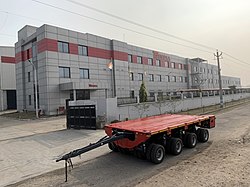
A hydraulic modular trailer (HMT) is a platform trailer unit that features swing axles, hydraulic suspension, independently steerable axles, two or more axle rows, compatibility to join two or more units longitudinally and laterally, and uses a power pack unit (PPU) to steer and adjust height. These trailer units are used to transport oversized loads, which are difficult to disassemble and are overweight. Trailers of this type are manufactured using high-tensile steel, which allows them to support heavy loads. They are operated by one or more ballast tractors that push or pull the trailer using a drawbar or gooseneck connection. This tractor-trailer arrangement is commonly referred to as a heavy hauler.
Typical loads include oil rig modules, bridge sections, buildings, ship sections, and industrial machinery such as generators and turbines. Also, militaries use HMT for tank transportation. There is a limited number of manufacturers who produce these heavy-duty trailers because the market share of oversized loads is very thin when we talk about the overall transportation industry. There are self-powered units of hydraulic modular trailers, which are called Self-propelled modular transporters (SPMTs), which are used when the ballast tractors are unable to be used due to space.
In 1953 H.P. Wynn of Robert Wynn and Sons Ltd a Shaftesbury-based Guinness World Records-winning heavy haulage company collaborated with Cranes Trailers Limited from Dereham to build a lowered, stronger and hydraulically suspended trailer to move large oversize loads. Cranes Trailers Limited came up with a prototype trailer which was named "Trailer 333" but they were not confident about its operation and the loading platform was higher than the expectation.
Later Wynn headed to Willy Scheuerle, a German trailer specialist, to manufacturer a similar trailer with a lower platform height and fully operational hydraulic axles. By 1956 Scheuerle completed the manufacturing of the first hydraulic modular trailer and testing was done at Pfedelbach plant. Next year four-axle, 32-wheeled modules were delivered to Robert Wynn and Sons Ltd.
In 1962, Cranes Trailers Limited developed two four-axle, 32-wheeled modules for Pickfords, a London-based heavy haulage company. With a combined payload capacity of 160 tons on a total of eight axles and 64 wheels, the modules incorporated hydraulic suspensions, and each axle was interlinked with a mechanical steering system at an operational height that varied from 2.9 to 3.11 feet (0.88 to 0.95 m). The modules had drawbar coupling, which could be coupled at either or both ends (coupling at both ends allowed for a push-pull combination).
In 1963, Goldhofer developed modular trailers in Europe for heavy haulers. In the same year, Cometto developed a 300-ton capacity module in a 14-axle, seven-row configuration. Scheuerle also demonstrated its modules at events in 1967, and later King Truck Equipment Ltd. signed an agreement with Scheuerle that gave them exclusive manufacturing rights to produce their trailers in the UK.
In 1971, King Truck Equipment Ltd. demonstrated two custom-built heavy-haul trailers for Pickfords. Each unit could carry up to 150 tons on six axle rows with a total of 48 wheels and was primarily operated with Pickfords' Scammell ballast tractors using a drawbar coupling. The trailers had independent suspension and steering abilities via the Petter twin-cylinder diesel engine used as a PPU.
In the 1970s, manufacturers began developing HMTs in response to the limitations of conventional low loaders. To comply with new regulations and safety requirements, manufacturers recognized the need for additional axles to distribute payload weight, and HMTs emerged as the most effective solution. Manufacturers adopted hydraulic suspension for its efficient design and adjustable characteristics, rather than using mechanical leaf springs or air suspension. High-tensile steel was selected instead of aluminum because trailer weight reduction was not a priority for HMTs, which have their own payload capacity independent of the ballast tractor. The main weakness of both early and modern HMTs has been their tires, a limitation that remains significant. Self-propelled modular transporters (SPMTs) use solid tires for this reason, although solid tires are unsuitable for HMTs since they operate at higher speeds.
Hydraulic modular trailer
A hydraulic modular trailer (HMT) is a platform trailer unit that features swing axles, hydraulic suspension, independently steerable axles, two or more axle rows, compatibility to join two or more units longitudinally and laterally, and uses a power pack unit (PPU) to steer and adjust height. These trailer units are used to transport oversized loads, which are difficult to disassemble and are overweight. Trailers of this type are manufactured using high-tensile steel, which allows them to support heavy loads. They are operated by one or more ballast tractors that push or pull the trailer using a drawbar or gooseneck connection. This tractor-trailer arrangement is commonly referred to as a heavy hauler.
Typical loads include oil rig modules, bridge sections, buildings, ship sections, and industrial machinery such as generators and turbines. Also, militaries use HMT for tank transportation. There is a limited number of manufacturers who produce these heavy-duty trailers because the market share of oversized loads is very thin when we talk about the overall transportation industry. There are self-powered units of hydraulic modular trailers, which are called Self-propelled modular transporters (SPMTs), which are used when the ballast tractors are unable to be used due to space.
In 1953 H.P. Wynn of Robert Wynn and Sons Ltd a Shaftesbury-based Guinness World Records-winning heavy haulage company collaborated with Cranes Trailers Limited from Dereham to build a lowered, stronger and hydraulically suspended trailer to move large oversize loads. Cranes Trailers Limited came up with a prototype trailer which was named "Trailer 333" but they were not confident about its operation and the loading platform was higher than the expectation.
Later Wynn headed to Willy Scheuerle, a German trailer specialist, to manufacturer a similar trailer with a lower platform height and fully operational hydraulic axles. By 1956 Scheuerle completed the manufacturing of the first hydraulic modular trailer and testing was done at Pfedelbach plant. Next year four-axle, 32-wheeled modules were delivered to Robert Wynn and Sons Ltd.
In 1962, Cranes Trailers Limited developed two four-axle, 32-wheeled modules for Pickfords, a London-based heavy haulage company. With a combined payload capacity of 160 tons on a total of eight axles and 64 wheels, the modules incorporated hydraulic suspensions, and each axle was interlinked with a mechanical steering system at an operational height that varied from 2.9 to 3.11 feet (0.88 to 0.95 m). The modules had drawbar coupling, which could be coupled at either or both ends (coupling at both ends allowed for a push-pull combination).
In 1963, Goldhofer developed modular trailers in Europe for heavy haulers. In the same year, Cometto developed a 300-ton capacity module in a 14-axle, seven-row configuration. Scheuerle also demonstrated its modules at events in 1967, and later King Truck Equipment Ltd. signed an agreement with Scheuerle that gave them exclusive manufacturing rights to produce their trailers in the UK.
In 1971, King Truck Equipment Ltd. demonstrated two custom-built heavy-haul trailers for Pickfords. Each unit could carry up to 150 tons on six axle rows with a total of 48 wheels and was primarily operated with Pickfords' Scammell ballast tractors using a drawbar coupling. The trailers had independent suspension and steering abilities via the Petter twin-cylinder diesel engine used as a PPU.
In the 1970s, manufacturers began developing HMTs in response to the limitations of conventional low loaders. To comply with new regulations and safety requirements, manufacturers recognized the need for additional axles to distribute payload weight, and HMTs emerged as the most effective solution. Manufacturers adopted hydraulic suspension for its efficient design and adjustable characteristics, rather than using mechanical leaf springs or air suspension. High-tensile steel was selected instead of aluminum because trailer weight reduction was not a priority for HMTs, which have their own payload capacity independent of the ballast tractor. The main weakness of both early and modern HMTs has been their tires, a limitation that remains significant. Self-propelled modular transporters (SPMTs) use solid tires for this reason, although solid tires are unsuitable for HMTs since they operate at higher speeds.
Recent media
Recent media