
Recent from talks
Leaf spring
Knowledge base stats:
Talk channels stats:
Members stats:
Leaf spring
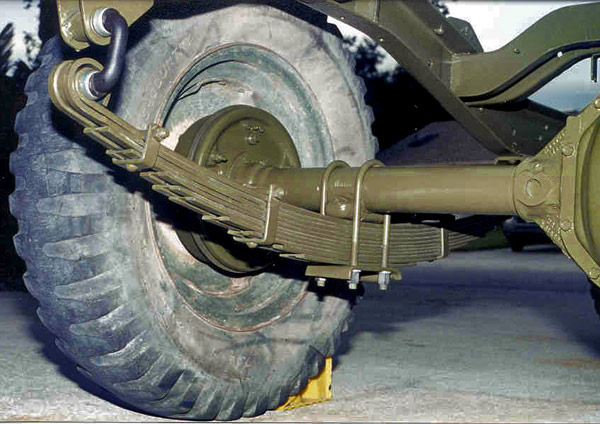
A leaf spring is a simple form of spring commonly used for suspension in wheeled vehicles. Originally called a laminated or carriage spring, and sometimes referred to as a semi-elliptical spring, elliptical spring, or cart spring, it is one of the oldest forms of vehicle suspension. A leaf spring is one or more narrow, arc-shaped, thin plates that are attached to the axle and chassis in a way that allows the leaf spring to flex vertically in response to irregularities in the road surface. Lateral leaf springs are the most commonly used arrangement, running the length of the vehicle and mounted perpendicular to the wheel axle, but numerous examples of transverse leaf springs exist as well.
Leaf springs can serve multiple suspension functions: location, springing, and to some extent damping as well, through interleaf friction. However, this friction is not well controlled, resulting in stiction and irregular suspension motions. For this reason, some manufacturers have used mono-leaf springs.
A leaf spring takes the form of a slender arc-shaped length of spring steel of a rectangular cross-section. In the most common configuration, the centre of the arc provides the location for the axle, while loops formed at either end provide for attaching to the vehicle chassis. For very heavy vehicles, a leaf spring can be made from several leaves stacked on top of each other in several layers, often with progressively shorter leaves. The longest leaf is also known as the main, master, or No. 1 leaf, with leaves numbered in descending order of length. The eyes at the end of the leaf spring are formed into the master leaf. In general, aside from the main leaf, the other leaves are tapered at each end. Sometimes auxiliary or rebound leaves are part of the main spring pack, in which case the auxiliary leaf closest to the main leaf is No. 1, the next closest is No. 2, etc. The leaves are attached to each other through the centre bolt, which is at or near the mid-point along the length of the leaf spring. To ensure that leaves remain aligned laterally, several methods can be used, including notches and grooves between leaves or external clips.
Spring steels were discovered to be most efficient at approximately 1% carbon content. Individual leaf thickness is specified by the Stubbs or Birmingham gauge, with typical thicknesses ranging between 0.203 to 0.375 in (5.2 to 9.5 mm) (6 to 3/8 or 00 gauge). The material and dimensions should be selected such that each leaf is capable of being hardened to have a fully martensitic structure throughout the entire section. Suitable spring steel alloys include 55Si7, 60Si7, 65Si7, 50Cr4V2, and 60Cr4V2.
The two ends of a leaf spring usually are formed into round eyes or eyelets, through which a fastener connects each end of the spring to the vehicle frame or body. Some springs terminated in a concave end, called a spoon end (seldom used now), to carry a swivelling member instead. One eye is usually fixed but allowed to pivot with the motion of the spring, whereas the other eye is fastened to a hinge mechanism that allows that end to pivot and undergo limited movement. A leaf spring can either be attached directly to the frame at both eyes or attached directly at one end, usually the front, with the other end attached through a shackle: a short swinging arm. The shackle takes up the tendency of the leaf spring to elongate when compressed and thus makes the suspension softer. The shackle provides some degree of flexibility to the leaf spring so that it does not fail when subjected to heavy loads. The axle is usually fastened to the middle of the spring by U-bolts.
The leaf spring acts as a linkage to hold the axle in position and thus separate linkages are not necessary. The result is a suspension that is simple and strong. Inter-leaf friction dampens the spring's motion and reduces rebound, which, until shock absorbers were widely adopted, was a very significant advantage over helical springs. However, because the leaf spring is also serving to hold the axle in position, soft springs—i.e. springs with low spring constant—are not suitable. The consequent stiffness, in addition to inter-leaf friction, makes this type of suspension not particularly comfortable for the riders.[citation needed]
There are a variety of leaf springs, usually employing the word "elliptical". "Elliptical" or "full elliptical" leaf springs, patented in 1804 by the British inventor Obadiah Elliott, referred to two circular arcs linked at their tips. This was joined to the frame at the top centre of the upper arc, the bottom centre was joined to the "live" suspension components, such as a solid front axle. Additional suspension components, such as trailing arms, would usually be needed for this design, but not for "semi-elliptical" leaf springs as used in the Hotchkiss drive. That employed the lower arc, hence its name.
"Quarter-elliptic" springs often had the thickest part of the stack of leaves stuck into the rear end of the side pieces of a short ladder frame, with the free end attached to the differential, as in the Austin Seven of the 1920s. As an example of non-elliptic leaf springs, the Ford Model T had multiple leaf springs over its differential that were curved in the shape of a yoke. As a substitute for dampers (shock absorbers), some manufacturers laid non-metallic sheets in between the metal leaves, such as wood.
Hub AI
Leaf spring AI simulator
(@Leaf spring_simulator)
Leaf spring
A leaf spring is a simple form of spring commonly used for suspension in wheeled vehicles. Originally called a laminated or carriage spring, and sometimes referred to as a semi-elliptical spring, elliptical spring, or cart spring, it is one of the oldest forms of vehicle suspension. A leaf spring is one or more narrow, arc-shaped, thin plates that are attached to the axle and chassis in a way that allows the leaf spring to flex vertically in response to irregularities in the road surface. Lateral leaf springs are the most commonly used arrangement, running the length of the vehicle and mounted perpendicular to the wheel axle, but numerous examples of transverse leaf springs exist as well.
Leaf springs can serve multiple suspension functions: location, springing, and to some extent damping as well, through interleaf friction. However, this friction is not well controlled, resulting in stiction and irregular suspension motions. For this reason, some manufacturers have used mono-leaf springs.
A leaf spring takes the form of a slender arc-shaped length of spring steel of a rectangular cross-section. In the most common configuration, the centre of the arc provides the location for the axle, while loops formed at either end provide for attaching to the vehicle chassis. For very heavy vehicles, a leaf spring can be made from several leaves stacked on top of each other in several layers, often with progressively shorter leaves. The longest leaf is also known as the main, master, or No. 1 leaf, with leaves numbered in descending order of length. The eyes at the end of the leaf spring are formed into the master leaf. In general, aside from the main leaf, the other leaves are tapered at each end. Sometimes auxiliary or rebound leaves are part of the main spring pack, in which case the auxiliary leaf closest to the main leaf is No. 1, the next closest is No. 2, etc. The leaves are attached to each other through the centre bolt, which is at or near the mid-point along the length of the leaf spring. To ensure that leaves remain aligned laterally, several methods can be used, including notches and grooves between leaves or external clips.
Spring steels were discovered to be most efficient at approximately 1% carbon content. Individual leaf thickness is specified by the Stubbs or Birmingham gauge, with typical thicknesses ranging between 0.203 to 0.375 in (5.2 to 9.5 mm) (6 to 3/8 or 00 gauge). The material and dimensions should be selected such that each leaf is capable of being hardened to have a fully martensitic structure throughout the entire section. Suitable spring steel alloys include 55Si7, 60Si7, 65Si7, 50Cr4V2, and 60Cr4V2.
The two ends of a leaf spring usually are formed into round eyes or eyelets, through which a fastener connects each end of the spring to the vehicle frame or body. Some springs terminated in a concave end, called a spoon end (seldom used now), to carry a swivelling member instead. One eye is usually fixed but allowed to pivot with the motion of the spring, whereas the other eye is fastened to a hinge mechanism that allows that end to pivot and undergo limited movement. A leaf spring can either be attached directly to the frame at both eyes or attached directly at one end, usually the front, with the other end attached through a shackle: a short swinging arm. The shackle takes up the tendency of the leaf spring to elongate when compressed and thus makes the suspension softer. The shackle provides some degree of flexibility to the leaf spring so that it does not fail when subjected to heavy loads. The axle is usually fastened to the middle of the spring by U-bolts.
The leaf spring acts as a linkage to hold the axle in position and thus separate linkages are not necessary. The result is a suspension that is simple and strong. Inter-leaf friction dampens the spring's motion and reduces rebound, which, until shock absorbers were widely adopted, was a very significant advantage over helical springs. However, because the leaf spring is also serving to hold the axle in position, soft springs—i.e. springs with low spring constant—are not suitable. The consequent stiffness, in addition to inter-leaf friction, makes this type of suspension not particularly comfortable for the riders.[citation needed]
There are a variety of leaf springs, usually employing the word "elliptical". "Elliptical" or "full elliptical" leaf springs, patented in 1804 by the British inventor Obadiah Elliott, referred to two circular arcs linked at their tips. This was joined to the frame at the top centre of the upper arc, the bottom centre was joined to the "live" suspension components, such as a solid front axle. Additional suspension components, such as trailing arms, would usually be needed for this design, but not for "semi-elliptical" leaf springs as used in the Hotchkiss drive. That employed the lower arc, hence its name.
"Quarter-elliptic" springs often had the thickest part of the stack of leaves stuck into the rear end of the side pieces of a short ladder frame, with the free end attached to the differential, as in the Austin Seven of the 1920s. As an example of non-elliptic leaf springs, the Ford Model T had multiple leaf springs over its differential that were curved in the shape of a yoke. As a substitute for dampers (shock absorbers), some manufacturers laid non-metallic sheets in between the metal leaves, such as wood.
Recent media