
Recent from talks
Hyperbolic absolute risk aversion
Knowledge base stats:
Talk channels stats:
Members stats:
Hyperbolic absolute risk aversion
In finance, economics, and decision theory, hyperbolic absolute risk aversion (HARA) refers to a type of risk aversion that is particularly convenient to model mathematically and to obtain empirical predictions from. It refers specifically to a property of von Neumann–Morgenstern utility functions, which are typically functions of final wealth (or some related variable), and which describe a decision-maker's degree of satisfaction with the outcome for wealth. The final outcome for wealth is affected both by random variables and by decisions. Decision-makers are assumed to make their decisions (such as, for example, portfolio allocations) so as to maximize the expected value of the utility function.
Notable special cases of HARA utility functions include the quadratic utility function, the exponential utility function, and the isoelastic utility function.
A utility function is said to exhibit hyperbolic absolute risk aversion if and only if the level of risk tolerance —the reciprocal of absolute risk aversion —is a linear function of wealth W:


where A(W) is defined as –U "(W) / U '(W). A utility function U(W) has this property, and thus is a HARA utility function, if and only if it has the form
with restrictions on wealth and the parameters such that and For a given parametrization, this restriction puts a lower bound on W if and an upper bound on W if . For the limiting case as → 1, L'Hôpital's rule shows that the utility function becomes linear in wealth; and for the limiting case as goes to 0, the utility function becomes logarithmic: .

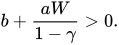



Absolute risk aversion is decreasing if (equivalently T '(W) > 0), which occurs if and only if is finite and less than 1; this is considered the empirically plausible case, since it implies that an investor will put more funds into risky assets the more funds are available to invest. Constant absolute risk aversion occurs as goes to positive or negative infinity, and the particularly implausible case of increasing absolute risk aversion occurs if is greater than one and finite.

Relative risk aversion is defined as R(W)= WA(W); it is increasing if , decreasing if , and constant if . Thus relative risk aversion is increasing if b > 0 (for ), constant if b = 0, and decreasing if b < 0 (for ).


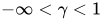
If all investors have HARA utility functions with the same exponent, then in the presence of a risk-free asset a two-fund monetary separation theorem results: every investor holds the available risky assets in the same proportions as do all other investors, and investors differ from each other in their portfolio behavior only with regard to the fraction of their portfolios held in the risk-free asset rather than in the collection of risky assets.
Hub AI
Hyperbolic absolute risk aversion AI simulator
(@Hyperbolic absolute risk aversion_simulator)
Hyperbolic absolute risk aversion
In finance, economics, and decision theory, hyperbolic absolute risk aversion (HARA) refers to a type of risk aversion that is particularly convenient to model mathematically and to obtain empirical predictions from. It refers specifically to a property of von Neumann–Morgenstern utility functions, which are typically functions of final wealth (or some related variable), and which describe a decision-maker's degree of satisfaction with the outcome for wealth. The final outcome for wealth is affected both by random variables and by decisions. Decision-makers are assumed to make their decisions (such as, for example, portfolio allocations) so as to maximize the expected value of the utility function.
Notable special cases of HARA utility functions include the quadratic utility function, the exponential utility function, and the isoelastic utility function.
A utility function is said to exhibit hyperbolic absolute risk aversion if and only if the level of risk tolerance —the reciprocal of absolute risk aversion —is a linear function of wealth W:
where A(W) is defined as –U "(W) / U '(W). A utility function U(W) has this property, and thus is a HARA utility function, if and only if it has the form
with restrictions on wealth and the parameters such that and For a given parametrization, this restriction puts a lower bound on W if and an upper bound on W if . For the limiting case as → 1, L'Hôpital's rule shows that the utility function becomes linear in wealth; and for the limiting case as goes to 0, the utility function becomes logarithmic: .
Absolute risk aversion is decreasing if (equivalently T '(W) > 0), which occurs if and only if is finite and less than 1; this is considered the empirically plausible case, since it implies that an investor will put more funds into risky assets the more funds are available to invest. Constant absolute risk aversion occurs as goes to positive or negative infinity, and the particularly implausible case of increasing absolute risk aversion occurs if is greater than one and finite.
Relative risk aversion is defined as R(W)= WA(W); it is increasing if , decreasing if , and constant if . Thus relative risk aversion is increasing if b > 0 (for ), constant if b = 0, and decreasing if b < 0 (for ).
If all investors have HARA utility functions with the same exponent, then in the presence of a risk-free asset a two-fund monetary separation theorem results: every investor holds the available risky assets in the same proportions as do all other investors, and investors differ from each other in their portfolio behavior only with regard to the fraction of their portfolios held in the risk-free asset rather than in the collection of risky assets.