Hubbry Logo
Exponential utilityExponential utilityMain
Open search
Exponential utility
Community hub
Exponential utility
logo
8 pages, 0 posts
0 subscribers
Be the first to start a discussion here.
Exponential utility
Exponential utility
from Wikipedia
Exponential Utility Function for different risk profiles

In economics and finance, exponential utility is a specific form of the utility function, used in some contexts because of its convenience when risk (sometimes referred to as uncertainty) is present, in which case expected utility is maximized. Formally, exponential utility is given by:
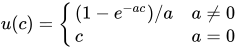
is a variable that the economic decision-maker prefers more of, such as consumption, and is a constant that represents the degree of risk preference ( for risk aversion, for risk-neutrality, or for risk-seeking). In situations where only risk aversion is allowed, the formula is often simplified to .

Note that the additive term 1 in the above function is mathematically irrelevant and is (sometimes) included only for the aesthetic feature that it keeps the range of the function between zero and one over the domain of non-negative values for c. The reason for its irrelevance is that maximizing the expected value of utility gives the same result for the choice variable as does maximizing the expected value of ; since expected values of utility (as opposed to the utility function itself) are interpreted ordinally instead of cardinally, the range and sign of the expected utility values are of no significance.


The exponential utility function is a special case of the hyperbolic absolute risk aversion utility functions.

Risk aversion characteristic

[edit]

Exponential utility implies constant absolute risk aversion (CARA), with coefficient of absolute risk aversion equal to a constant:
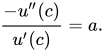
In the standard model of one risky asset and one risk-free asset,[1][2] for example, this feature implies that the optimal holding of the risky asset is independent of the level of initial wealth; thus on the margin any additional wealth would be allocated totally to additional holdings of the risk-free asset. This feature explains why the exponential utility function is considered unrealistic.

Mathematical tractability

[edit]

Though isoelastic utility, exhibiting constant relative risk aversion (CRRA), is considered more plausible (as are other utility functions exhibiting decreasing absolute risk aversion), exponential utility is particularly convenient for many calculations.

Consumption example

[edit]

For example, suppose that consumption c is a function of labor supply x and a random term : c = c(x) + . Then under exponential utility, expected utility is given by:

where E is the expectation operator. With normally distributed noise, i.e.,
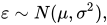
E(u(c)) can be calculated easily using the fact that

Thus

Multi-asset portfolio example

[edit]

Consider the portfolio allocation problem of maximizing expected exponential utility of final wealth W subject to

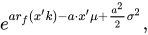
where the prime sign indicates a vector transpose and where is initial wealth, x is a column vector of quantities placed in the n risky assets, r is a random vector of stochastic returns on the n assets, k is a vector of ones (so is the quantity placed in the risk-free asset), and rf is the known scalar return on the risk-free asset. Suppose further that the stochastic vector r is jointly normally distributed. Then expected utility can be written as

where is the mean vector of the vector r and is the variance of final wealth. Maximizing this is equivalent to minimizing

which in turn is equivalent to maximizing
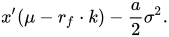
Denoting the covariance matrix of r as V, the variance of final wealth can be written as . Thus we wish to maximize the following with respect to the choice vector x of quantities to be placed in the risky assets:


This is an easy problem in matrix calculus, and its solution is
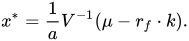
From this it can be seen that (1) the holdings x* of the risky assets are unaffected by initial wealth W0, an unrealistic property, and (2) the holding of each risky asset is smaller the larger is the risk aversion parameter a (as would be intuitively expected). This portfolio example shows the two key features of exponential utility: tractability under joint normality, and lack of realism due to its feature of constant absolute risk aversion.

See also

[edit]

References

[edit]
Revisions and contributorsEdit on WikipediaRead on Wikipedia
from Grokipedia
Exponential utility is a utility function in economics and decision theory that models risk-averse preferences with constant absolute risk aversion (CARA). It is commonly expressed in the form u(x)=eαxu(x) = -e^{-\alpha x}, where xx denotes or payoff and α>0\alpha > 0 is the constant coefficient of absolute risk aversion, ensuring that the intensity of risk aversion does not vary with levels. This functional form, which is strictly increasing and concave, captures how individuals value uncertain outcomes by assigning higher utility to certain gains over probabilistic ones of equal . The key properties of exponential utility stem from its mathematical structure: the first derivative u(x)=αeαx>0u'(x) = \alpha e^{-\alpha x} > 0 confirms monotonicity, while the second derivative u(x)=α2eαx<0u''(x) = -\alpha^2 e^{-\alpha x} < 0 establishes concavity and risk aversion. Absolute risk aversion is defined as A(x)=u(x)u(x)=αA(x) = -\frac{u''(x)}{u'(x)} = \alpha, remaining invariant to wealth, whereas relative risk aversion R(x)=xA(x)=αxR(x) = x A(x) = \alpha x rises linearly with wealth, implying increasing relative risk aversion (IRRA). Unlike power or logarithmic utilities, exponential utility is bounded above by 0 (approaching 0 as xx \to \infty) but unbounded below (approaching -\infty as xx \to -\infty), which resolves infinite expected value paradoxes like the St. Petersburg paradox by yielding finite certainty equivalents. These traits make it analytically convenient, particularly when outcomes follow normal distributions, as certainty equivalents and risk premia admit closed-form expressions. Exponential utility finds extensive applications in financial economics for portfolio optimization, where it simplifies mean-variance analysis under uncertainty; in insurance theory for pricing policies and determining risk premia; and in health economics for evaluating cost-effectiveness of treatments involving probabilistic health outcomes. For example, it underpins models of optimal insurance demand, showing that risk-averse agents fully insure against risks when loading factors are absent. Its single-parameter simplicity facilitates calibration to empirical data on risk attitudes, though critics note that constant absolute risk aversion may not align with observed decreasing relative risk aversion in wealthier populations. The exponential utility function emerged from foundational work on measuring risk aversion, notably formalized by John W. Pratt in his 1964 paper "Risk Aversion in the Small and in the Large," which introduced the Arrow-Pratt measures of absolute and relative risk aversion, with the exponential form exemplifying CARA. Kenneth Arrow further developed these ideas in his 1971 collection Essays in the Theory of Risk-Bearing, applying them to insurance markets and resource allocation under uncertainty. Since then, it has become a benchmark in expected utility theory, influencing subsequent research despite alternatives like hyperbolic absolute risk aversion (HARA) functions offering greater flexibility.

Definition and Formulation

Functional Form

The exponential utility function, a cornerstone of expected utility theory, is commonly expressed in its basic form as u(w)=eαwu(w) = -e^{-\alpha w}, where ww represents wealth and α>0\alpha > 0 is the risk aversion parameter. This formulation ensures the function is strictly increasing, as its first is u(w)=αeαw>0u'(w) = \alpha e^{-\alpha w} > 0. A normalized variant, often used for consumption c0c \geq 0, is u(c)=1eαcαu(c) = \frac{1 - e^{-\alpha c}}{\alpha}. This form is derived from the basic exponential through an —specifically, shifting and scaling to satisfy u(0)=0u(0) = 0 and u(0)=1u'(0) = 1, conditions that align with von Neumann-Morgenstern axioms while preserving ordinal properties. The first is u(c)=eαc>0u'(c) = e^{-\alpha c} > 0, confirming monotonicity, and as α0\alpha \to 0, the function approaches the risk-neutral linear case u(c)=cu(c) = c via . The negative exponential structure guarantees concavity for when α>0\alpha > 0, as the second u(w)=α2eαw<0u''(w) = -\alpha^2 e^{-\alpha w} < 0 implies diminishing marginal utility. For the risk-seeking case with α>0\alpha > 0, a convex variant such as u(w)=eαw1αu(w) = \frac{e^{\alpha w} - 1}{\alpha} yields u(w)>0u''(w) > 0, though this is less commonly applied in standard models.

Parameters and Interpretation

The parameter α\alpha in the exponential utility function serves as the constant absolute risk aversion (CARA) coefficient, which measures the degree of an agent's aversion to absolute changes in wealth and remains invariant across different wealth levels, allowing for a consistent assessment of risk preferences independent of current financial position. This parameterization ensures that the intensity of risk aversion does not diminish or increase with wealth accumulation, distinguishing it from other forms where risk attitudes vary. Boundary cases for α\alpha provide clear interpretations of risk attitudes: when α=0\alpha = 0, the function approaches linear , implying risk neutrality where the agent is indifferent to risk. Positive values α>0\alpha > 0 characterize risk-averse agents who prefer certain outcomes over gambles with equivalent , while negative values α<0\alpha < 0 indicate risk-loving behavior, where the agent favors uncertainty. The parameter α\alpha carries units of inverse wealth (e.g., dollars1^{-1}), reflecting its role in scaling the curvature of the utility function relative to wealth changes and thus determining the overall sensitivity to risk. In practical models, α\alpha is calibrated to match observed behaviors or empirical risk premiums; smaller values indicate lower risk aversion. This parameterization of the exponential utility originated in John W. Pratt's 1964 seminal work on measures of risk aversion, where the form was highlighted for its analytical tractability in deriving consistent risk premiums and facilitating comparisons across utility specifications.

Properties

Risk Aversion Characteristics

The exponential utility function is defined by constant absolute risk aversion (CARA), where the Arrow-Pratt measure of absolute is given by A(w)=u(w)u(w)=αA(w) = -\frac{u''(w)}{u'(w)} = \alpha, with α>0\alpha > 0 denoting the constant coefficient of absolute risk aversion that holds independently of the agent's level ww. This measure, introduced by Pratt, quantifies the local of the utility function relative to its , capturing the agent's aversion to small risks. For the exponential form u(w)=eαwu(w) = -e^{-\alpha w}, the first is u(w)=αeαwu'(w) = \alpha e^{-\alpha w} and the second is u(w)=α2eαwu''(w) = -\alpha^2 e^{-\alpha w}, yielding A(w)=α2eαwαeαw=αA(w) = \frac{\alpha^2 e^{-\alpha w}}{\alpha e^{-\alpha w}} = \alpha, confirming the independence from ww. This CARA property implies that risk-averse agents allocate a fixed amount to risky assets irrespective of their total wealth, as the marginal utility's ensures wealth-independent risk exposure. For instance, in decisions under fair pricing, the optimal coverage equals the , providing full protection without dependence on initial wealth levels. In contrast, the aversion for exponential utility is R(w)=wA(w)=αwR(w) = w \cdot A(w) = \alpha w, which rises linearly with wealth, differing from the constant aversion observed in power functions. Regarding premiums, for a normally distributed risky prospect with μ\mu and variance σ2\sigma^2, the equivalent—the sure amount yielding the same expected as the prospect—is μα2σ2\mu - \frac{\alpha}{2} \sigma^2, where the term α2σ2\frac{\alpha}{2} \sigma^2 represents the that compensates for variance. This approximation arises from the second-order Taylor expansion of expected under normality, highlighting how higher α\alpha amplifies aversion to variance.

Analytic Properties

The exponential utility function, typically formulated as u(w)=eαwu(w) = -e^{-\alpha w} for α>0\alpha > 0 and ww, exhibits monotonicity, as its first u(w)=αeαw>0u'(w) = \alpha e^{-\alpha w} > 0 ensures that higher yields strictly greater utility, aligning with the fundamental preference for more over less in von Neumann-Morgenstern expected utility theory. This property holds universally for α>0\alpha > 0, confirming the function's increasing nature without exceptions. Additionally, the function is strictly concave, with u(w)=α2eαw<0u''(w) = -\alpha^2 e^{-\alpha w} < 0, which satisfies the curvature requirement of the von Neumann-Morgenstern axioms for risk-averse preferences and enables the application of Jensen's inequality in expected calculations. This concavity underpins the function's suitability for modeling aversion to uncertainty. A key analytic advantage is the explicit solvability of the certainty equivalent (CE) for a random wealth w~\tilde{w}, defined by u(CE)=E[u(w~)]u(\text{CE}) = E[u(\tilde{w})], yielding CE=1αlnE[eαw~]\text{CE} = -\frac{1}{\alpha} \ln E[e^{-\alpha \tilde{w}}]; this expression corresponds to the negative inverse of the moment-generating function of αw~-\alpha \tilde{w}, facilitating precise risk assessments. For specific distributions, closed-form solutions enhance tractability: if w~N(μ,σ2)\tilde{w} \sim N(\mu, \sigma^2), then CE=μα2σ2\text{CE} = \mu - \frac{\alpha}{2} \sigma^2, directly incorporating mean and variance for straightforward expected maximization. Similarly, for exponentially distributed w~\tilde{w} with rate λ>α\lambda > \alpha, the expectation simplifies to a , E[eαw~]=λλ+αE[e^{-\alpha \tilde{w}}] = \frac{\lambda}{\lambda + \alpha}, yielding an explicit CE and supporting analytical solutions in reliability or contexts. Due to its constant absolute risk aversion (CARA) property, the exponential utility renders optimal choices independent of initial levels, as portfolio demands or consumption rules separate from starting endowments, thereby simplifying the solution of multi-period dynamic models by reducing dimensionality in Hamilton-Jacobi-Bellman equations. This incommensurability avoids the path-dependence issues common in other forms, enabling recursive structures in problems.

Applications

Consumption and Single-Asset Decisions

In consumption and decisions under , an agent with exponential seeks to maximize the expected E[u(w)], where final w arises from allocating a base amount x to a risky opportunity yielding expected return μ plus a random shock ε ~ Normal(0, σ²), with the remainder earning the r. This setup captures basic choices like adjusting savings or in the face of shocks or simple gambles, where the constant absolute (CARA) property ensures that risk attitudes do not vary with levels. The optimal allocation x* balances the expected excess return μ - r and , yielding x* = (μ - r)/(α σ²), with α denoting the coefficient of absolute ; this adjustment reflects the CARA feature, making the effective risk tolerance fixed in terms. A key application is in decisions, where the agent faces a potential loss and decides on coverage to mitigate the shock. With exponential utility, the agent purchases full insurance when the premium equals the , as the fixed risk tolerance leads to complete hedging of the under fair pricing. For unfair premiums (premium > ), the for coverage d remains independent of initial due to the CARA property, with the optimal coverage solving the first-order condition that equates the benefit in the loss state to the , ensuring partial hedging. This result highlights how exponential utility simplifies by decoupling insurance from fluctuations. Early formalization of these choices under , including the role of constant risk aversion, appears in Arrow's of optimal contracts. For single-asset investment decisions, the agent allocates between a risk-free asset yielding rate r_f and a single risky asset with expected return E and variance σ², assuming normal returns for tractability. The exponential utility implies that the optimal investment is a fixed dollar amount in the risky asset, independent of total wealth, given by investment amount = (E - r_f)/(α σ²); this dollar-fixed allocation arises because the constant absolute risk aversion translates risk exposure into an absolute tolerance level, leading to scale-invariant behavior in absolute terms. Such decisions exemplify how exponential utility facilitates closed-form solutions in mean-variance settings, prioritizing the excess return per unit of risk-adjusted variance.

Multi-Asset Portfolio Allocation

In the single-period multi-asset portfolio allocation problem, an with initial w0w_0 allocates amounts x\mathbf{x} across nn risky assets and a risk-free asset to maximize expected exponential E[u(w0+rp)]\mathbb{E}[u(w_0 + r_p)], where u(w)=exp(αw)u(w) = -\exp(-\alpha w) is the utility function with constant absolute parameter α>0\alpha > 0, and the portfolio return is rp=xTμ+xTV1/2ϵr_p = \mathbf{x}^T \boldsymbol{\mu} + \mathbf{x}^T \mathbf{V}^{1/2} \boldsymbol{\epsilon} with ϵN(0,I)\boldsymbol{\epsilon} \sim \mathcal{N}(\mathbf{0}, \mathbf{I}), μ\boldsymbol{\mu} the vector of expected returns, and V\mathbf{V} the of asset returns. Assuming joint normality of returns, the problem is tractable because the expected reduces to a certainty equivalent involving the portfolio and variance. The optimal allocation is given by x=1αV1(μrf1),\mathbf{x}^* = \frac{1}{\alpha} \mathbf{V}^{-1} (\boldsymbol{\mu} - r_f \mathbf{1}), where rfr_f is the and 1\mathbf{1} is a vector of ones. This solution specifies the absolute dollar amounts invested in each risky asset and is notably independent of the initial w0w_0, a direct consequence of the CARA property, which implies that risk tolerance is constant in absolute terms rather than proportional to . The places the remaining w01Txw_0 - \mathbf{1}^T \mathbf{x}^* in the risk-free asset. This optimal allocation mirrors the mean-variance framework, where V1(μrf1)\mathbf{V}^{-1} (\boldsymbol{\mu} - r_f \mathbf{1}) defines the tangency portfolio proportions that maximize the , scaled by the risk tolerance 1/α1/\alpha. Higher α\alpha reduces exposure to risky assets, emphasizing , while the solution incorporates asset correlations through V\mathbf{V} to achieve diversification. For instance, in a two-asset case with a risk-free bond yielding rfr_f and a single risky with expected excess return μ\mu and variance σ2\sigma^2, the optimal amount invested in the stock simplifies to x=μασ2x^* = \frac{\mu}{\alpha \sigma^2}, with the remainder in the bond; this absolute xx^* remains fixed regardless of w0w_0, so the portfolio weight in the stock x/w0x^*/w_0 declines as wealth grows. Exponential utility extends naturally to dynamic settings, such as Merton's continuous-time portfolio problem, where the maximizes lifetime expected from consumption and terminal wealth under Itô processes for asset prices. For CARA , the optimal policy invests a constant absolute dollar amount in the tangency (market) portfolio at each instant, independent of current wealth, leading to a myopic without intertemporal hedging motives. This property simplifies solving the Hamilton-Jacobi-Bellman , yielding explicit solutions for multi-asset environments with log-normal dynamics.

Comparisons and Limitations

With Other Utility Functions

Exponential utility, characterized by constant absolute risk aversion (CARA), contrasts with power utility functions, which exhibit constant relative risk aversion (CRRA). Under exponential utility, the absolute stakes in risky decisions remain independent of levels, making it suitable for scenarios involving fixed-dollar risks such as or hedging specific exposures. In contrast, power utility scales risks proportionally to , which is more appropriate for proportional risks in long-term or consumption decisions where relative stakes matter. Compared to quadratic utility, exponential utility also facilitates mean-variance optimization but offers a globally defined framework without the limitations of quadratic forms. Quadratic utility implies increasing absolute and becomes undefined beyond a "bliss point" where turns negative, restricting its applicability to limited ranges. Exponential utility maintains constant absolute across all levels, enabling consistent analysis for portfolios with potentially unbounded returns. Logarithmic utility, a special case of power utility with CRRA parameter equal to 1, displays decreasing absolute risk aversion, leading agents to allocate larger absolute amounts to risky assets as wealth grows. This contrasts with exponential utility's CARA property, which avoids wealth effects in decisions like pricing but may overestimate risk tolerance for high-wealth agents by not reducing absolute aversion with affluence. In terms of computational tractability, exponential utility leverages the (MGF) to derive closed-form solutions for expected utility even under non-normal return distributions, such as Gaussian mixtures, simplifying . Power and logarithmic utilities often necessitate or for such cases, reducing analytical convenience. Exponential utility is sometimes employed in hybrid models to approximate the local behavior of more complex functions, such as through Taylor expansions that capture mean-variance preferences near a reference level, bridging to quadratic or power forms for targeted analyses.

Empirical and Theoretical Criticisms

The exponential utility function embodies constant absolute (CARA), meaning an agent's willingness to bear risk remains fixed in absolute monetary terms irrespective of their level. This theoretical feature implies that a would accept the same dollar-denominated gamble as someone with modest means, which is widely regarded as unrealistic since wealthier individuals typically exhibit greater tolerance for absolute risks. Such constant risk tolerance contradicts the decreasing absolute (DARA) hypothesis, originally posited by , which posits that absolute diminishes as rises, aligning better with intuitive economic behavior. Empirical studies, particularly surveys and experiments conducted since the 1970s, consistently demonstrate that absolute decreases with , undermining the CARA assumption central to exponential utility. For instance, field experiments involving over 2,000 participants in choices revealed significant evidence of decreasing absolute , with participants showing higher risk tolerance at elevated levels. Similarly, analyses of financial data confirm that absolute declines and exhibits convexity with respect to total or financial , challenging the wealth-independent risk posture of CARA models. These findings extend to observed behaviors in and , where exponential fails to calibrate accurately to patterns such as scaled-up risky investments by the affluent, as post-1970s surveys indicate attenuates with income rises. In practical applications, exponential utility proves overly sensitive to the choice of the risk aversion parameter α, where minor variations can drastically alter optimal decisions, complicating model robustness in real-world scenarios. It also neglects relative risk considerations prevalent in expanding economies, where decisions hinge more on proportional stakes than fixed dollars, and fares poorly against behavioral evidence of and skewed preferences under non-normal return distributions. These shortcomings stem from the historical shift in risk theory, evolving from the Pratt-Arrow framework of the 1960s-1970s, which emphasized analytical convenience, to modern behavioral critiques influenced by Kahneman and Tversky's , highlighting deviations from like reference dependence and probability weighting. As alternatives, economists often advocate shifting to constant relative risk aversion (CRRA) functions for greater realism in capturing wealth-scaled risk preferences, despite their reduced tractability in certain derivations. Nonetheless, exponential utility persists in theoretical models for its mathematical simplicity, such as in option pricing frameworks or optimization, where closed-form solutions outweigh empirical imperfections.

References

Add your contribution
Related Hubs
User Avatar
No comments yet.