Recent from talks
Nothing was collected or created yet.
Hyperion (moon)
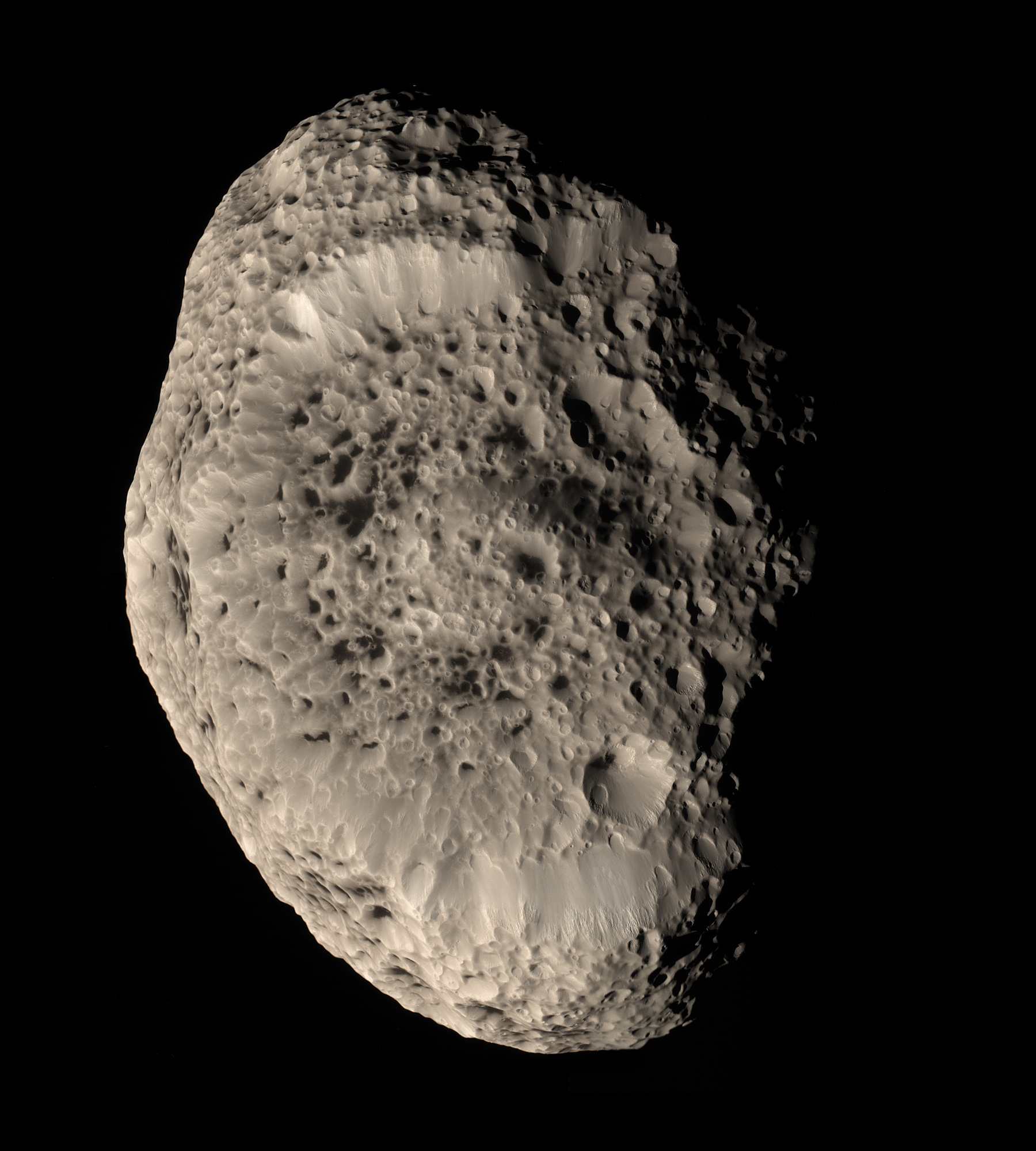
View on WikipediaHyperion in approximately natural color, as photographed by the Cassini spacecraft. Bond-Lassell Dorsum arcs across much of Hyperion's face | |
| Discovery | |
|---|---|
| Discovered by | |
| Discovery date | 16 September 1848 |
| Designations | |
Designation | Saturn VII |
| Pronunciation | /haɪˈpɪəriən/[1][a] |
Named after | Ὑπερίων Hyperīon[a] |
| Adjectives | Hyperionian /ˌhɪpəraɪˈoʊniən/[2][3] |
| Orbital characteristics | |
| 1,481,009 km (920,256 mi)[b] | |
| Eccentricity | 0.1230061[4] |
| 21.276 d | |
| Inclination | 0.43° (to Saturn's equator)[5][6] |
| Satellite of | Saturn |
| Physical characteristics | |
| Dimensions | 360.2 km × 266.0 km × 205.4 km (223.8 mi × 165.3 mi × 127.6 mi)[7] |
| 135.00±4.00 km[8] | |
| Mass | (5.5510±0.0007)×1018 kg[8] |
Mean density | 0.5386±0.0479 g/cm3[8] |
| 0.017–0.021 m/s2 depending on location[7] | |
| 45–99 m/s depending on location.[9] | |
| ~13 d (chaotic)[10] | |
| variable | |
| Albedo | 0.3[11] |
| Temperature | 93 K (−180 C)[12] |
| 14.1[13] | |
Hyperion /haɪˈpɪəriən/ is the eighth-largest moon of Saturn. It is distinguished by its highly irregular shape, chaotic rotation, low density, and its unusual sponge-like appearance. It was the first non-rounded moon to be discovered.
Discovery
[edit]Hyperion was independently discovered by William Cranch Bond and his son George Phillips Bond in the United States, and William Lassell in the United Kingdom in September 1848.
Name
[edit]The moon is named after the Titan Hyperion, the god of watchfulness and observation, and the elder brother of Cronus (the Greek equivalent of the Roman god Saturn). It is also designated Saturn VII. The adjectival form of the name is Hyperionian.
Hyperion's discovery came shortly after John Herschel had suggested names for the seven previously known satellites of Saturn in his 1847 publication Results of Astronomical Observations made at the Cape of Good Hope.[14] William Lassell, who saw Hyperion two days after William Bond, had already endorsed Herschel's naming scheme and suggested the name Hyperion in accordance with it.[15] He also beat Bond to publication.[16]
Physical characteristics
[edit]
Shape
[edit]Hyperion is one of the largest bodies known to be highly irregularly shaped (non-ellipsoidal, and especially not in hydrostatic equilibrium) in the Solar System.[c] The only larger moon known to be irregular in shape is Neptune's moon Proteus. Hyperion has about 15% of the mass of Mimas, the least massive known ellipsoidal body. The largest crater on Hyperion is approximately 121.57 km (75.54 mi) in diameter and 10.2 km (6.3 mi) deep. A possible explanation for the irregular shape is that Hyperion is a fragment of a larger body that was broken up by a large impact in the distant past.[17] A proto-Hyperion could have been 350–1,000 km (220–620 mi) in diameter (which ranges from a little below the size of Mimas to a little below the size of Tethys).[18] Over about 1,000 years, ejecta from a presumed Hyperion breakup would have impacted Titan at low speeds, building up volatiles in the atmosphere of Titan.[18]
Composition
[edit]
Like most of Saturn's moons, Hyperion's low density indicates that it is composed largely of water ice with only a small amount of rock. It is thought that Hyperion may be similar to a loosely accreted pile of rubble in its physical composition. However, unlike most of Saturn's moons, Hyperion has a low albedo (0.2–0.3), indicating that it is covered by at least a thin layer of dark material. This may be material from Phoebe (which is much darker) that got past Iapetus. Hyperion is redder than Phoebe and closely matches the color of the dark material on Iapetus.
Hyperion has a porosity of about 0.46.[9] Although Hyperion is the eighth-largest moon of Saturn, it is only the ninth-most massive. Phoebe has a smaller radius, but it is more massive than Hyperion and thus denser.[7]
Surface features
[edit]Voyager 2 passed through the Saturn system, but photographed Hyperion only from a distance. It discerned individual craters and an enormous ridge, but was not able to make out the texture of Hyperion's surface. Early images from the Cassini orbiter suggested an unusual appearance, but it was not until Cassini's first targeted flyby of Hyperion on 25 September 2005 that Hyperion's oddness was revealed in full.
Hyperion's surface is covered with deep, sharp-edged craters that give it the appearance of a giant sponge. Dark material fills the bottom of each crater. The reddish substance contains long chains of carbon and hydrogen and appears very similar to material found on other Saturnian satellites, most notably Iapetus. Scientists attribute Hyperion's unusual, sponge-like appearance to the fact that it has an unusually low density for such a large object. Its low density makes Hyperion quite porous, with a weak surface gravity. These characteristics mean impactors tend to compress the surface, rather than excavating it, and most material that is blown off the surface never returns.[19]
The latest analyses of data obtained by Cassini during its flybys of Hyperion in 2005 and 2006 show that about 40 percent of it is empty space. It was suggested in July 2007 that this porosity allows craters to remain nearly unchanged over the eons. The new analyses also confirmed that Hyperion is composed mostly of water ice with very little rock.[20]
Static charge
[edit]Hyperion's surface is electrically charged and was the first discovered to be so other than the Moon's surface.[21]
Orbit and rotation
[edit]
Saturn · Hyperion · Titan

The Voyager 2 images and subsequent ground-based photometry indicated that Hyperion's rotation is chaotic, that is, its axis of rotation wobbles so much that its orientation in space is unpredictable. Its Lyapunov time is around 30 days.[22][23][24] Hyperion, together with Pluto's moons Nix and Hydra,[25][26] is among only a few moons in the Solar System known to rotate chaotically, although it is expected to be common in binary asteroids.[27] It is also the only regular planetary natural satellite in the Solar System known to not be tidally locked.
Hyperion is unique among the large moons in that it is very irregularly shaped, has a fairly eccentric orbit, and is near a much larger moon, Titan. These factors combine to restrict the set of conditions under which a stable rotation is possible. The 3:4 orbital resonance between Titan and Hyperion may also make a chaotic rotation more likely. The fact that its rotation is not locked probably accounts for the relative uniformity of Hyperion's surface, in contrast to many of Saturn's other moons, which have contrasting trailing and leading hemispheres.[28]
Exploration
[edit]Hyperion has been imaged several times from moderate distances by the Cassini orbiter. The first close targeted flyby occurred at a distance of 500 km (310 mi) on 26 September 2005.[19] Cassini made another close approach to Hyperion on 25 August 2011 when it passed 25,000 km (16,000 mi) from Hyperion, and third close approach was on 16 September 2011, with closest approach of 58,000 km (36,000 mi).[29] Cassini's last flyby was on 31 May 2015 at a distance of about 34,000 km (21,000 mi).[19]
See also
[edit]Notes
[edit]- ^ a b From the long 'i' in Latin Hyperīon, one might expect the name to be stressed on the 'i' in English, /ˌhɪpəˈraɪən/, and indeed that pronunciation is recommended in Noah Webster (1884) A Practical Dictionary of the English Language, but recent sources universally stress the name of the 'e', as indeed do many older sources, such as Keats' poem.
- ^ Computed from period, using the IAU-MPC NSES μ value.
- ^ There are about ten asteroids and an unknown number of irregular Trans-Neptunian objects larger than Hyperion.
References
[edit]- ^ "Hyperion". Lexico UK English Dictionary. Oxford University Press. Archived from the original on March 22, 2020.
"Hyperion". Merriam-Webster.com Dictionary. Merriam-Webster. - ^ "JPL (ca. 2008) Cassini Equinox Mission: Hyperion". Archived from the original on 2016-04-10. Retrieved 2011-01-30.
- ^ Bill Yenne (1987) The Atlas of the Solar System, p. 144
- ^ Pluto Project pseudo-MPEC for Saturn VII Archived 2006-05-29 at the Wayback Machine
- ^ NASA's Solar System Exploration: Saturn: Moons: Hyperion: Facts & Figures Archived 2004-11-03 at the Wayback Machine
- ^ MIRA's Field Trips to the Stars Internet Education Program: Saturn
- ^ a b c d Thomas, P. C. (July 2010). "Sizes, shapes, and derived properties of the saturnian satellites after the Cassini nominal mission" (PDF). Icarus. 208 (1): 395–401. Bibcode:2010Icar..208..395T. doi:10.1016/j.icarus.2010.01.025. Archived from the original (PDF) on 2011-09-27. Retrieved 2015-09-04.
- ^ a b c Jacobson, Robert. A. (1 November 2022). "The Orbits of the Main Saturnian Satellites, the Saturnian System Gravity Field, and the Orientation of Saturn's Pole*". The Astronomical Journal. 164 (5): 199. Bibcode:2022AJ....164..199J. doi:10.3847/1538-3881/ac90c9. S2CID 252992162.
- ^ a b Thomas, P.C.; Armstrong, J. W.; Asmar, S. W.; Burns, J. A.; Denk, T.; Giese, B.; Helfenstein, P.; Iess, L.; et al. (2007). "Hyperion's Sponge-like Appearance". Nature. 448 (7149): 50–56. Bibcode:2007Natur.448...50T. doi:10.1038/nature05779. PMID 17611535. S2CID 4415537.
- ^ "Hyperion In Depth". NASA. December 2017. Retrieved 2019-02-05.
- ^ D.R. Williams (18 September 2006). "Saturnian Satellite Fact Sheet". NASA. Retrieved 2007-11-04.
- ^ "About Saturn & Its Moons: Moons – Hyperion". Cassini @ JPL/NASA. Archived from the original on 2012-06-04. Retrieved 2011-01-30.
- ^ Observatorio ARVAL (April 15, 2007). "Classic Satellites of the Solar System". Observatorio ARVAL. Archived from the original on September 20, 2011. Retrieved 2011-12-17.
- ^ Lassell, W. (14 January 1848). "Observations of satellites of Saturn". Monthly Notices of the Royal Astronomical Society. 8 (3): 42–43. Bibcode:1848MNRAS...8...42L. doi:10.1093/mnras/8.3.42. Retrieved 2011-12-18.
- ^ W. Lassell (1848). "Discovery of a New Satellite of Saturn". Monthly Notices of the Royal Astronomical Society. 8 (9): 195–197. Bibcode:1848MNRAS...8..195L. doi:10.1093/mnras/8.9.195a.
- ^ Bond, W.C. (1848). "Discovery of a new satellite of Saturn". Monthly Notices of the Royal Astronomical Society. 9 (1): 1–2. Bibcode:1848MNRAS...9....1B. doi:10.1093/mnras/9.1.1.
- ^ R.A.J. Matthews (1992). "The Darkening of Iapetus and the Origin of Hyperion". Quarterly Journal of the Royal Astronomical Society. 33: 253–258. Bibcode:1992QJRAS..33..253M.
- ^ a b Farinella, P.; Marzari, F.; Matteoli, S. (1997). "The Disruption of Hyperion and the Origin of Titan's Atmosphere". Astronomical Journal. 113 (2): 2312–2316. Bibcode:1997AJ....113.2312F. doi:10.1086/118441.
- ^ a b c "Cassini Prepares for Last Up-close Look at Hyperion". Jet Propulsion Laboratory. 28 May 2015. Retrieved 2015-05-29.
- ^ "Key to Giant Space Sponge Revealed". Space.com. 4 July 2007. Retrieved October 26, 2007.
- ^ "Cassini Caught in Hyperion's Particle Beam". www.jpl.nasa.gov. NASA Jet Propulsion Laboratory (JPL). Retrieved 2024-02-19.
- ^ M. Tarnopolski (May 2015). "Nonlinear time-series analysis of Hyperion's lightcurves". Astrophysics and Space Science. 357 (2): 160. arXiv:1412.2423. Bibcode:2015Ap&SS.357..160T. doi:10.1007/s10509-015-2379-3. S2CID 56311141.
- ^ M. Tarnopolski (Feb 2017). "Influence of a second satellite on the rotational dynamics of an oblate moon". Celestial Mechanics and Dynamical Astronomy. 127 (2): 121–138. arXiv:1607.07333. Bibcode:2017CeMDA.127..121T. doi:10.1007/s10569-016-9719-7. S2CID 118512400.
- ^ M. Tarnopolski (Oct 2017). "Rotation of an oblate satellite: Chaos control". Astronomy & Astrophysics. 606: A43. arXiv:1704.02015. Bibcode:2017A&A...606A..43T. doi:10.1051/0004-6361/201731167. S2CID 119360690.
- ^ M. R. Showalter, D. P. Hamilton (Jun 2015). "Resonant interactions and chaotic rotation of Pluto's small moons". Nature. 522 (7554): 45–49. Bibcode:2015Natur.522...45S. doi:10.1038/nature14469. PMID 26040889. S2CID 205243819.
- ^ Kenneth Chang (2015-06-03). "Astronomers Describe Chaotic Dance of Pluto's Moons". New York Times.
- ^ Nadoushan, M. J.; Assadian, N. (2015). "Widespread chaos in rotation of the secondary asteroid in a binary system". Nonlinear Dynamics. 81 (4): 2031. Bibcode:2015NonLD..81.2031J. doi:10.1007/s11071-015-2123-0. S2CID 124747289.
- ^ Wisdom, J.; Peale, S.J.; Mignard, F. (1984). "The chaotic rotation of Hyperion". Icarus. 58 (2): 137–152. Bibcode:1984Icar...58..137W. CiteSeerX 10.1.1.394.2728. doi:10.1016/0019-1035(84)90032-0.
- ^ "Saturn's Odd Pockmarked Moon Revealed in New Photos". Space.com. 30 August 2011. Retrieved 31 August 2011.
External links
[edit]- Cassini mission Hyperion page
- [1] at NASA's Solar System Exploration site
- The Planetary Society: Hyperion
- NASA: Saturn's Hyperion, A Moon With Odd Craters
- Cassini images of Hyperion Archived 2011-08-13 at the Wayback Machine
- Images of Hyperion at JPL's Planetary Photojournal
- Hyperion nomenclature from the USGS planetary nomenclature page
Hyperion (moon)
View on GrokipediaDiscovery and Nomenclature
Discovery
Hyperion was independently discovered on September 16, 1848, by American astronomers William Cranch Bond and his son George Phillips Bond (with George making the initial sighting), using the 15-inch refractor telescope at Harvard College Observatory in Cambridge, Massachusetts.[2][3] Two days later, on September 18, 1848, British astronomer William Lassell made a simultaneous independent discovery using his newly constructed 24-inch aperture reflecting telescope at Starfield Observatory near Liverpool, England.[4][3] Lassell's instrument, one of the most powerful reflectors of the era, allowed him to confirm the faint object trailing behind Saturn's known moons.[5] Confirming the discovery proved difficult due to Hyperion's faint apparent magnitude of approximately 14.1, which made it barely visible even in large telescopes, compounded by the intense glare from Saturn's bright disk and rings.[6][1] The edge-on orientation of Saturn's rings during their 1848 plane-crossing event reduced this glare, enabling the detections under exceptionally favorable conditions.[3] Lassell announced his finding first in a letter published in the Monthly Notices of the Royal Astronomical Society (volume 8, November 1848), followed by the Bonds' report in the same journal (volume 9, May 1849), securing official recognition among astronomers by mid-1849.[7] These publications detailed the observations and positioned Hyperion as Saturn's eighth known satellite, prompting the subsequent naming process.[1]Naming and Designation
The name Hyperion for one of Saturn's moons was proposed in 1847 by British astronomer John Herschel in his publication Results of Astronomical Observations made during the years 1834, 5, 6, 7, 8, at the Cape of Good Hope, as part of a systematic nomenclature scheme for the planet's satellites. Herschel suggested naming them after the Titans and Titanesses from Greek mythology, the siblings and descendants of Cronus (the Greek equivalent of the Roman god Saturn), to create a thematic consistency in astronomical labeling.[8] In Greek mythology, Hyperion was a prominent Titan, son of Uranus (Heaven) and Gaia (Earth), who embodied heavenly light and watchfulness; he wed his sister Theia and fathered the luminaries Helios (sun god), Selene (moon goddess), and Eos (dawn goddess), thereby linking him symbolically to celestial observation and illumination.[9] Following its discovery on September 16, 1848, by William Cranch Bond and his son George Phillips Bond using the Harvard College Observatory's 15-inch refractor telescope, and independently two days later by William Lassell using his 24-inch reflecting telescope in England, the moon received the provisional designation Saturn VII. This numeral reflected its status as the seventh major satellite of Saturn known at the time, slotted between Titan (VI) and Iapetus (VIII) in the early sequence of discoveries.[10] As Saturn's satellite count grew with later observations—reaching over 270 confirmed moons by 2025—the Roman numeral system evolved into a provisional standard for newly found bodies, assigned sequentially upon confirmation by the International Astronomical Union (IAU). However, Hyperion retained its mythological name permanently, as Herschel's Titan-themed convention was formally adopted for all classical Saturnian moons, prioritizing historical and cultural resonance over purely numerical identifiers. The English pronunciation of Hyperion is /haɪˈpɪəriən/, emphasizing its classical roots while adapting to modern phonetic norms in scientific discourse. This approach underscores the broader cultural significance of mythological nomenclature in astronomy, where names evoke ancient narratives to connect contemporary discoveries with humanity's shared heritage, a practice Herschel championed to avoid nationalistic or arbitrary alternatives.[11][12]Orbital Dynamics
Orbital Parameters
Hyperion's orbit around Saturn is characterized by a semi-major axis of 1,481,009 km, positioning it between the orbits of Titan at approximately 1,222,000 km and Iapetus at about 3,561,000 km.[13] This distance corresponds to roughly 24.6 Saturn equatorial radii, given Saturn's equatorial radius of 60,268 km. The moon's orbital eccentricity is 0.123, which causes substantial variations in its distance from Saturn, ranging from a periapsis of about 1,299,000 km to an apoapsis of roughly 1,663,000 km.[13] The orbit has a low inclination of 0.43° relative to Saturn's equatorial plane, indicating a nearly coplanar path with the planet's ring system and other major satellites.[14] Hyperion completes one sidereal orbit every 21.277 days, corresponding to a mean motion of approximately 16.92° per day.[13] This places it outside the main clustered orbits of Saturn's mid-sized moons but still subject to significant gravitational influences. A key feature of Hyperion's orbital dynamics is its 3:4 mean-motion resonance with Titan, where Titan completes four orbits for every three of Hyperion's, helping to maintain long-term stability against chaotic evolution. Additionally, the orbit experiences perturbations from nearby satellites like Titan and Iapetus, as well as from Saturn's oblateness, which induces precession of the periapsis and node over timescales of decades to centuries.[15] These interactions contribute to small oscillations in the orbital elements but preserve overall stability.[16]| Orbital Element | Value | Notes/Source |
|---|---|---|
| Semi-major axis (a) | 1,481,009 km | Places between Titan and Iapetus [17] |
| Eccentricity (e) | 0.123 | Causes distance variation of ~364,000 km [17] |
| Inclination (i) | 0.43° (to equator) | Low inclination relative to Saturn's plane [18] |
| Sidereal period (P) | 21.277 days | Mean motion ~16.92°/day [17] |
| Resonance with Titan | 3:4 mean-motion | Stabilizes orbit [19] |
[18]: https://www.pas.rochester.edu/~dmw/astr111/Lectures/Lect_20.pdf
[19]: https://iopscience.iop.org/article/10.3847/2515-5172/ae109e
Rotational Dynamics
Hyperion's rotation is chaotic, lacking fixed poles or a stable axis, due to its low gravitational binding energy from a porous, low-density structure (approximately 0.54 g/cm³) and perturbations from orbital resonances that amplify external torques on its triaxial shape.[20] This results in tumbling motion where the spin axis wanders through all possible orientations, preventing any long-term synchronous rotation.[21] The moon's irregular form, with principal moments of inertia yielding (B - A)/C ≈ 0.26, further destabilizes its spin under Saturn's gravitational influence.[20] A key driver is the 3:4 mean-motion resonance with Titan, where Titan completes four orbits for every three of Hyperion's, maintaining an orbital eccentricity of about 0.1 and inducing forced librations that counteract tidal locking.[21] This resonance overlaps spin-orbit resonances (such as p=1 and p=3/2), creating a broad chaotic zone in phase space via the Chirikov criterion, with a stability parameter ω₀ ≈ 0.89 that exceeds the critical value for chaos.[20] Consequently, Hyperion experiences unpredictable variations in spin rate and orientation, with no equilibrium state. The Lyapunov time for this chaotic motion is approximately 30 days—on the order of a few orbital periods (21.3 days)—signifying exponential divergence of nearby trajectories and inherent unpredictability beyond short timescales, such as decades for precise orientation forecasts.[21] Spacecraft observations, including Voyager 2 images from 1981 and Cassini flybys in 2005 and 2006, confirmed this tumbling, revealing a highly variable rotation period averaging about 13 days but fluctuating significantly due to the chaos.[1] Mathematically, Hyperion's dynamics are described within the framework of chaotic attractors arising from the restricted three-body problem involving Saturn, Hyperion, and Titan, where numerical integrations of the torque equations show non-zero Lyapunov exponents (λ ≈ 0.1 per orbital period) and dense phase-space structures indicative of strange attractors.[20] Surface-of-section plots reveal a large chaotic sea encompassing spin rates from p=0.5 to p=2 relative to the orbital motion, underscoring the system's sensitivity.[21]Physical Characteristics
Morphology and Dimensions
Hyperion possesses a highly irregular, potato-like shape, characterized by its elongated and asymmetrical form, which deviates significantly from spherical symmetry. Measurements from Cassini spacecraft imaging data indicate principal dimensions along its three axes of approximately 362 × 258 × 204 km, modeled as a triaxial ellipsoid to estimate its volume.[22] This shape yields a mean radius of about 138 km, equivalent in volume to a sphere with a radius of roughly 135 km. The moon's low mass, determined through gravitational perturbations observed during Cassini flybys, is (5.62 ± 0.05) × 10¹⁸ kg. Combined with volume estimates from the triaxial ellipsoid model, this results in a mean density of 0.565 g/cm³ (as of 2024 analysis), which is only slightly more than half that of water ice.[22] The exceptionally low density suggests Hyperion is a porous body, likely a rubble pile composed of loosely aggregated fragments, with porosity estimated at 42 ± 6%, assuming a primary composition of water ice. This high porosity, potentially ranging from 40% to 50% under varying compositional assumptions, implies significant void space within its structure, consistent with it being a remnant fragment from a larger parent body disrupted by impacts.[1] In comparison to other irregular Saturnian moons, such as Phoebe, Hyperion shares a similarly non-spherical, potato-like morphology but exhibits markedly lower density (Phoebe's is approximately 1.64 g/cm³), highlighting differences in internal compaction and porosity.Composition and Internal Structure
Hyperion's composition is dominated by water ice, with minor amounts of non-ice components including silicates and organic materials.[1] The moon's bulk density is exceptionally low at 0.565 g/cm³, which is approximately half that of pure water ice and implies a high porosity of 42 ± 6% assuming a primarily icy makeup, potentially reaching up to 46% if denser rocky inclusions are present. This porosity supports the interpretation of Hyperion as a rubble-pile structure, consisting of loosely aggregated icy fragments held together primarily by gravity rather than cohesive strength. The surface features a dark, reddish coating resembling tholins—complex organic polymers formed by irradiation of simpler hydrocarbons—which is likely exogenous material transported from the outer moon Phoebe through the E ring or related dynamical pathways.[23] Internal models indicate no differentiated rocky core, instead suggesting a homogeneous matrix of water ice permeated by voids that account for the observed low density and irregular shape retention.[24] Spectral reflectance observations spanning 0.3–5 μm, obtained via the Cassini Visual and Infrared Mapping Spectrometer, reveal a relatively flat spectrum characteristic of irradiated organic compounds, with subtle absorptions at 3.29 μm indicating aromatic C-H bonds in the dark material.Surface Features
Hyperion's surface is dominated by a highly irregular, sponge-like topography resulting from extensive impact cratering, where deep and overlapping craters create a pitted, porous appearance reminiscent of a celestial rubble pile. Observations from the Cassini spacecraft reveal that these craters, formed primarily through compression due to the moon's low density and weak gravity, cover much of the surface without significant ejecta blankets, as material often escapes or slumps inward.[1][25][26] The most prominent feature is a large impact basin spanning approximately 120 kilometers in diameter and reaching depths of about 10 kilometers, which exemplifies the moon's capacity to retain such profound depressions. Smaller craters, typically 2 to 10 kilometers across, are abundant and often exhibit bright rims composed of exposed water ice, contrasting with their darker floors. In some regions, lower crater densities suggest episodes of resurfacing or erosion, potentially driven by mass wasting processes like landslides that smooth out older impacts. Fresh craters occasionally display bright ray patterns of ejecta, indicating relatively recent bombardment events.[27][13] Crater floors frequently harbor reddish deposits rich in hydrocarbons—compounds of carbon and hydrogen mixed with frozen water and carbon dioxide—which may derive from internal volatile release or external delivery via interplanetary dust or material from other Saturnian satellites. No evidence of tectonic structures, such as faults or ridges, appears on the surface, underscoring Hyperion's geologically inert nature. The overlying regolith layer is porous and unconsolidated, with dark material accumulations estimated at tens of meters thick, contributing to the moon's overall low albedo.[29][26] Subtle global color variations mark the surface, with darker, redder hues predominating in low-lying areas due to the settling of organic-rich dust, while brighter icy exposures highlight elevated terrains and recent disruptions. These dark materials consist primarily of hydrocarbons similar to those found in comets and meteorites.[30][29]Electrical Properties
The sunlit surfaces of Hyperion exhibit a permanent static charge, marking the first such detection on an airless body beyond Earth's Moon, as observed during the Cassini spacecraft's targeted flyby on September 25, 2005.[31] This charging arises primarily from the interaction of solar ultraviolet (UV) radiation, which generates photoelectrons, and micrometeorite impacts, which produce secondary electrons, in Hyperion's tenuous plasma environment at approximately 9.5 Saturn radii from the planet.[31] Due to the moon's distance from the Sun—about 9.5 AU—the reduced UV flux limits photoelectron emission, allowing ambient plasma electrons to accumulate and result in a strongly negative surface potential of approximately -200 V.[32] This negative potential creates intense electric fields near the surface, estimated to reach strengths sufficient to levitate fine dust particles ranging from 10 to 100 nm in size, analogous to electrostatic lofting observed on the Moon.[31] Cassini's Cassini Plasma Spectrometer (CAPS) instruments detected an upward-directed electron beam during the flyby, confirming the charge buildup and its magnitude through the acceleration of low-energy electrons away from the surface toward the spacecraft.[31] Models based on these measurements indicate that the surface potential varies with solar distance, becoming more negative farther from the Sun due to diminished UV-driven photoelectron currents, with Hyperion's value aligning closely with predictions for bodies at similar heliocentric distances.[31] The electrostatic effects have significant implications for Hyperion's surface evolution, as levitated dust can be transported across the moon, potentially leading to erosion and redistribution that erodes impact craters over time.[32] This mechanism may contribute to the observed low crater retention on Hyperion, where fine regolith particles are mobilized, smoothing features and enhancing the moon's porous, sponge-like appearance.[32] Similar charging phenomena occur on other airless bodies, such as the Moon—where daytime potentials reach +10 V and enable dust levitation—and asteroids like Itokawa, though Hyperion's more extreme negative values reflect its unique orbital and environmental conditions.[31] The porous regolith structure of Hyperion likely aids in retaining these charges by minimizing electron recombination.[31]Exploration and Observations
Early and Voyager Observations
Following its discovery in 1848, ground-based observations of Hyperion were challenging due to the moon's faint magnitude of around 14.5, limiting early efforts to confirm its orbit and basic parameters.[33] Telescopic astrometry in the 20th century, including photographic plates and photoelectric photometry from observatories like the U.S. Naval Observatory, gradually improved ephemerides by refining positional data despite Hyperion's proximity to the brighter Titan, which often caused saturation in exposures. These efforts provided essential orbital constraints but yielded little insight into physical properties owing to the moon's low albedo and chaotic rotation, which complicated light-curve analysis.[34] The first spacecraft observations came during Voyager 1's Saturn encounter in August 1980, with a flyby of Hyperion at a distance of approximately 880,000 km, capturing the initial close-up images that revealed its highly irregular, potato-like shape rather than a spherical form.[35] These images, taken over several days, showed a rough, cratered surface with no evidence of global geological processes, marking Hyperion as distinct from Saturn's more regular icy satellites.[36] Voyager 2's encounter in August 1981, approaching within about 431,000 km on August 25, supplemented these findings with additional imaging and spectral data from its photopolarimeter and infrared interferometer, indicating a predominantly icy composition through subtle absorption features consistent with water ice.[37] Combined analysis of the two missions' 82 images allowed initial estimates of Hyperion's dimensions at roughly 370 km across its longest axis, with an irregular triaxial shape derived from photoclinometry techniques that modeled slopes and shading to infer topography.[36] Rotation estimates from light-curve variations in the low-resolution images suggested a period of about 13 days at the time of Voyager 2's flyby, with the spin axis near the orbital plane, hinting at non-synchronous motion.[38] However, the Voyager images were limited by resolutions as fine as 8–9 km per pixel, insufficient for detailed crater mapping or geological interpretation, leaving much of Hyperion's surface structure unresolved.[39] These early observations laid the groundwork for subsequent missions like Cassini, which achieved far higher resolutions to explore Hyperion's unique characteristics.[36]Cassini Mission Observations
The Cassini spacecraft, orbiting Saturn from 2004 to 2017, conducted multiple close flybys of Hyperion between 2005 and 2015, yielding unprecedented multi-instrument data on the moon's surface, composition, and dynamics. The closest encounter occurred on September 26, 2005, at an altitude of approximately 500 km, enabling detailed remote sensing across visible, infrared, and ultraviolet wavelengths. Subsequent flybys, including those in 2011 and the final distant approach on May 31, 2015, at 34,000 km, supplemented this dataset with additional imaging and spectroscopic observations. These encounters collectively provided the foundation for understanding Hyperion's irregular structure and behavior, far surpassing prior reconnaissance. High-resolution imaging from the Cassini Imaging Science Subsystem (ISS) achieved pixel scales down to 50 m during the 2005 flyby, revealing a profoundly cratered surface with a distinctive sponge-like appearance. Craters exhibit shallow depths relative to their diameters, often filled with dark material, and walls marked by numerous small pits and depressions, indicative of high porosity estimated at around 40% in the outer layers. This porous texture suggests that impacts compress rather than excavate material, preserving a rubble-pile interior with extensive void spaces. Recent analyses of archived Cassini images have produced global mosaics at 50 m/pixel resolution, further highlighting the moon's low-density, fractured regolith and lack of significant tectonic features. The Visual and Infrared Mapping Spectrometer (VIMS) and Ultraviolet Imaging Spectrograph (UVIS) performed compositional mapping during these flybys, confirming that Hyperion's surface is predominantly water ice, with subordinate carbon dioxide ice and dark, complex organic compounds concentrated in crater floors and lowlands. VIMS spectra identified aliphatic and aromatic hydrocarbons, along with phyllosilicates and iron-bearing minerals in trace amounts, while UVIS data supported the dominance of H₂O ice mixed with CO₂ across brighter terrains. These organics, likely exogenous from external sources, contribute to the moon's low albedo of about 0.1 in darker regions. During the 2005 flyby, Cassini's instruments also detected strong electrical charging, including a beam of electrons emanating from the surface, indicating a highly negative surface potential. Multiple imaging sequences across the flybys definitively confirmed Hyperion's chaotic rotation, characterized by irregular tumbling with no stable axis, driven by its non-spherical shape and orbital resonances. Observations tracked the moon's unpredictable orientation, with spin periods varying chaotically over timescales of years, consistent with theoretical models of non-principal axis rotation. This dynamical state precludes synchronous locking with Saturn, resulting in asynchronous tumbling at rates of about 72–75° per day relative to the orbital plane. Archived data from these encounters continue to support ongoing studies of Hyperion's rotational evolution as of 2025.Origin and Evolution
Formation Hypotheses
The primary hypothesis for Hyperion's formation posits it as a surviving remnant from the catastrophic disruption of a larger progenitor satellite approximately 400–500 million years ago, during a late dynamical instability in the Saturnian system associated with Titan's tidal migration.[40] This event likely involved a high-velocity collision, possibly with a comet or another body, shattering the progenitor and leaving Hyperion as an irregular rubble pile unable to reaccrete due to excessive fragment velocities exceeding escape speeds.[41] Dynamical simulations of the Saturn system indicate that orbital instabilities could trigger such massive collisions, leading to fragmentation and the dispersal of debris that contributed to the current irregular satellite population.[42] Recent models suggest this instability was triggered by the breaking of Saturn's past spin-orbit resonance with Neptune, driven by Titan's outward migration, and may also explain the origin of Saturn's rings through the disruption and re-accretion of inner moons.[43] One variant links this disruption to Iapetus, suggesting that ejecta from Hyperion's progenitor impacted and darkened the leading hemisphere of Iapetus through subsequent debris interception. An alternative scenario proposes that Hyperion was captured from the Kuiper Belt or an extended outer solar system disk, akin to other irregular Saturnian moons.[44] This view is supported by its highly irregular shape, low mean density of 0.55 g/cm³ indicating high porosity (37–48%), and spectral similarities to primitive outer Solar System objects, including the retrograde irregular moons like Phoebe.[1][44] However, this hypothesis faces challenges, as the low density of primitive captured bodies typically requires substantial post-capture erosion or processing to explain Hyperion's sponge-like, highly porous structure without invoking internal differentiation.[45] Hyperion's surface darkening is attributed in part to bombardment by exogenous material from Phoebe, whose retrograde orbit populates a vast debris ring that supplies dark, organic-rich dust to co-orbiting outer moons. Spectral matches between this Phoebe-derived material and Hyperion's reddish, low-albedo coating confirm this exogenous contamination, enhancing the moon's overall subdued reflectance.[46] Its chaotic rotation, resulting from low gravitational binding and tidal resonances, likely served as a survival mechanism by preventing tidal locking and stabilizing its orbit post-formation.[47]Dynamical Evolution
Hyperion's dynamical evolution has been profoundly shaped by its 3:4 mean-motion resonance with Titan, which has driven orbital migration and maintained stability against ejection over approximately 400–500 million years.[40] Titan's outward tidal migration, at a rate corresponding to a timescale of about 11 Gyr for its semi-major axis, excites Hyperion's eccentricity to roughly 0.1, preventing close encounters that could destabilize its orbit.[40] This resonance configuration, first modeled in detail in the 1970s, ensures that Hyperion completes three orbits for every four of Titan's, providing a protective barrier amid the Saturnian system's gravitational perturbations. Simulations indicate that the resonance formed around 400–500 million years ago and has persisted since, with Titan's total migration accounting for about 4% change in its semi-major axis over the age of the Solar System. The moon's rotation remains chaotic due to its irregular shape and low density, resulting in weak self-gravity that fails to dampen tumbling effectively over tidal timescales. This chaotic state, characterized by unpredictable variations in spin axis and rate on scales of weeks to months, arises from overlapping spin-orbit resonances and has been confirmed through numerical integrations showing exponential sensitivity to initial conditions. Episodes of temporary stabilization occur when Hyperion is briefly captured in commensurate spin-orbit states, such as 2:1 resonances, though these are short-lived compared to the persistent tumbling driven by its asphericity. The tidal despinning timescale for Hyperion exceeds the age of the solar system, allowing this chaos to endure without evolving to synchronous rotation.[48][49] Surface alterations on Hyperion arise from interactions with the E ring's dust grains and micrometeorite impacts, which deposit material and erode the icy regolith over geological timescales. E ring particles, primarily water ice from Enceladus, accrete onto Hyperion's surface, undergoing subsequent modification by charged particle bombardment in Saturn's magnetosphere, leading to spectral darkening and compositional changes observed in infrared data. Micrometeorite flux contributes to ongoing resurfacing through cratering and sputtering, with rates sufficient to refresh porous features without erasing the overall cratered terrain. These processes have gradually modified Hyperion's appearance since its likely formation from a disruptive collision. Long-term simulations using N-body integrators predict gradual orbital diffusion for Hyperion, with eccentricity variations potentially leading to instability if the Titan resonance weakens. Under current tidal models, Hyperion faces a possible fate of outward scattering or collision with Titan within tens of millions of years, though rapid migration scenarios suggest ejection as more probable. These predictions stem from integrations tracking resonance libration and eccentricity damping over 4.5 Gyr, highlighting the resonance's role in short-term stability amid diffusive perturbations.References
- Nov 3, 2024 · Hyperion is the largest of Saturn's irregular, nonspherical moons. Hyperion's mean radius is 83.9 miles (135 kilometers).
- The 15-inch telescope known as “The Great Refractor” was installed at Cambridge in 1847. For 20 years it was the largest telescope in the United States.Missing: Hyperion | Show results with:Hyperion
- Sep 26, 2005 · G.P. Bond [Bond 1848]. Which means that the very first astronomer who saw Hyperion was George Bond, and not his father William Bond ...
- https://science.[nasa](/page/NASA).gov/photojournal/hyperions-unusual-craters/
