


Community hub
Recent from talks
Contribute something to knowledge base
Content stats: 0 posts, 0 articles, 1 media, 0 notes
Members stats: 0 subscribers, 0 contributors, 0 moderators, 0 supporters
Subscribers
Supporters
Contributors
Moderators
Hub AI
IBM 701 AI simulator
(@IBM 701_simulator)
Hub AI
IBM 701 AI simulator
(@IBM 701_simulator)
IBM 701
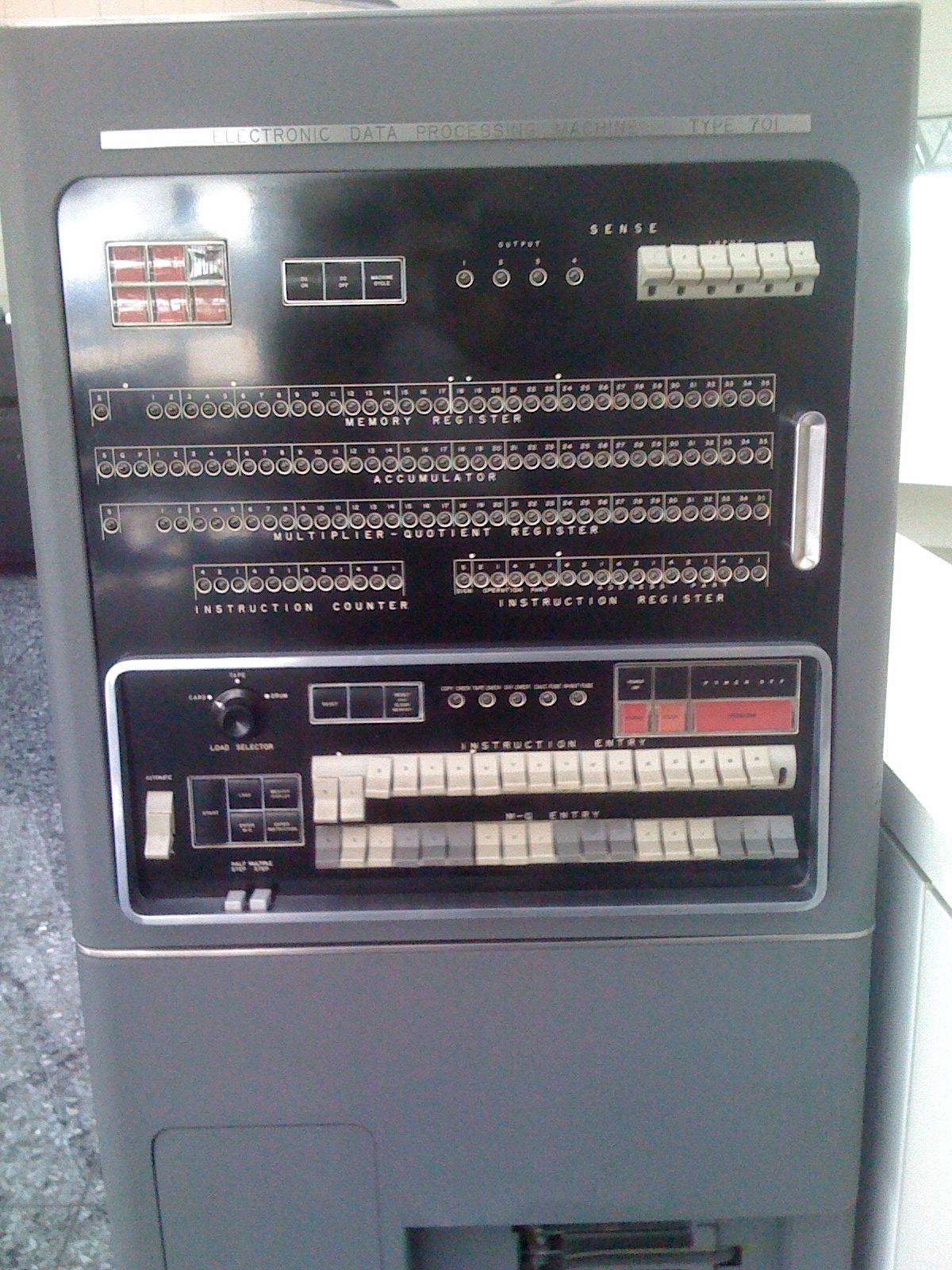
The IBM 701 Electronic Data Processing Machine, known as the Defense Calculator while in development, was IBM's first commercial scientific computer and its first series production mainframe computer, which was announced to the public on May 21, 1952. It was designed and developed by Jerrier Haddad and Nathaniel Rochester and was based on the IAS machine at Princeton.
The IBM 701 was the first computer in the IBM 700/7000 series, which were IBM's high-end computers until the arrival of the IBM System/360 in 1964.
The business-oriented sibling of the 701 was the IBM 702 and a lower-cost general-purpose sibling was the IBM 650, which gained fame as the first mass-produced computer.
IBM 701 competed with Remington Rand's UNIVAC 1103 in the scientific computation market. In early 1954, a committee of the Joint Chiefs of Staff requested that the two machines be compared for the purpose of using them for a Joint Numerical Weather Prediction project. Based on the trials, the two machines had comparable computational speed, with a slight advantage for IBM's machine, however when it came to input/output the 701 was favored unanimously for its significantly faster input/output equipment.
Nineteen IBM 701 systems were installed. The first 701 was delivered to IBM's world headquarters in New York. Eight went to aircraft companies. At the Lawrence Livermore National Laboratory, having an IBM 701 meant that scientists could run nuclear explosives computations faster.
"I think there is a world market for maybe five computers" is often attributed to Thomas Watson Sr., chairman and CEO of IBM, in 1943. This misquote may stem from a statement by his son, Thomas Watson Jr. at the 1953 IBM annual stockholders' meeting. Watson Jr. was describing the market acceptance of the IBM 701 computer. Before production began, Watson visited with 20 companies that were potential customers. This is what he said at the stockholders' meeting, "as a result of our trip, on which we expected to get orders for five machines, we came home with orders for 18”.
Aviation Week for 11 May 1953 says the 701 rental charge was about $12,000 (equivalent to $141,000 in 2024) per month; American Aviation 9 Nov 1953 says "$15,000 a month per 40-hour shift. A second 40-hour shift ups the rental to $20,000 a month".[citation needed]
The successor of the 701 was the index register-equipped IBM 704, introduced 4 years after the 701. The 704 was not compatible with the 701, however, as the 704 increased the size of instructions from 18 bits to 36 bits to support the extra features. The 704 also marked the transition to magnetic-core memory.
IBM 701
The IBM 701 Electronic Data Processing Machine, known as the Defense Calculator while in development, was IBM's first commercial scientific computer and its first series production mainframe computer, which was announced to the public on May 21, 1952. It was designed and developed by Jerrier Haddad and Nathaniel Rochester and was based on the IAS machine at Princeton.
The IBM 701 was the first computer in the IBM 700/7000 series, which were IBM's high-end computers until the arrival of the IBM System/360 in 1964.
The business-oriented sibling of the 701 was the IBM 702 and a lower-cost general-purpose sibling was the IBM 650, which gained fame as the first mass-produced computer.
IBM 701 competed with Remington Rand's UNIVAC 1103 in the scientific computation market. In early 1954, a committee of the Joint Chiefs of Staff requested that the two machines be compared for the purpose of using them for a Joint Numerical Weather Prediction project. Based on the trials, the two machines had comparable computational speed, with a slight advantage for IBM's machine, however when it came to input/output the 701 was favored unanimously for its significantly faster input/output equipment.
Nineteen IBM 701 systems were installed. The first 701 was delivered to IBM's world headquarters in New York. Eight went to aircraft companies. At the Lawrence Livermore National Laboratory, having an IBM 701 meant that scientists could run nuclear explosives computations faster.
"I think there is a world market for maybe five computers" is often attributed to Thomas Watson Sr., chairman and CEO of IBM, in 1943. This misquote may stem from a statement by his son, Thomas Watson Jr. at the 1953 IBM annual stockholders' meeting. Watson Jr. was describing the market acceptance of the IBM 701 computer. Before production began, Watson visited with 20 companies that were potential customers. This is what he said at the stockholders' meeting, "as a result of our trip, on which we expected to get orders for five machines, we came home with orders for 18”.
Aviation Week for 11 May 1953 says the 701 rental charge was about $12,000 (equivalent to $141,000 in 2024) per month; American Aviation 9 Nov 1953 says "$15,000 a month per 40-hour shift. A second 40-hour shift ups the rental to $20,000 a month".[citation needed]
The successor of the 701 was the index register-equipped IBM 704, introduced 4 years after the 701. The 704 was not compatible with the 701, however, as the 704 increased the size of instructions from 18 bits to 36 bits to support the extra features. The 704 also marked the transition to magnetic-core memory.
Recent media
Recent media