



Community hub
IBM 701
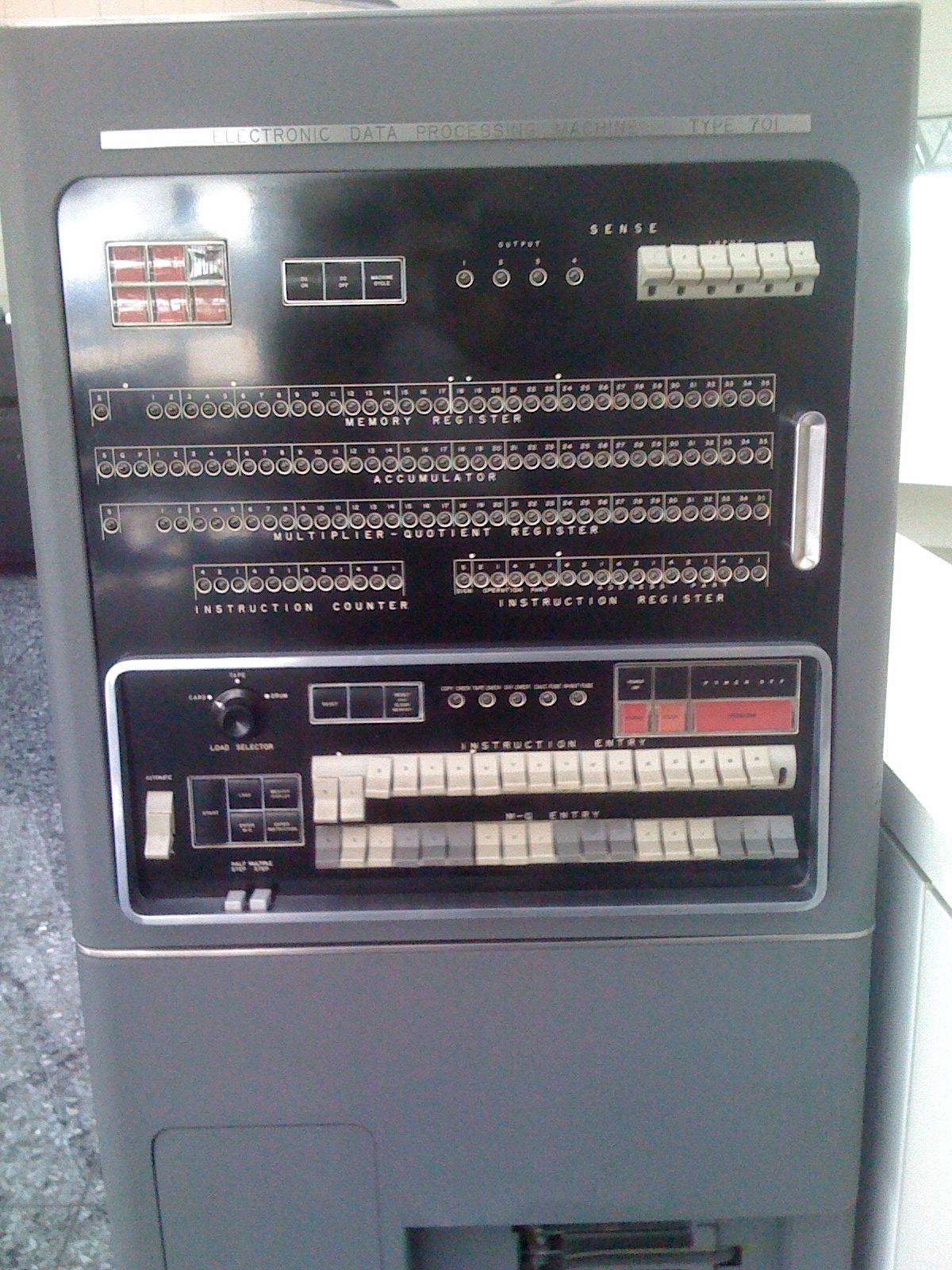
View on Wikipedia IBM 701 operator's console | |
| Also known as | Defense Calculator |
|---|---|
| Developer | Jerrier Haddad Nathaniel Rochester |
| Manufacturer | IBM |
| Release date | 1952 |
| Introductory price | $12,000 a month rental charge / $15,000 a month per 40-hour shift |
| Units shipped | 19 |
| Memory | Total memory of 2048 words of 36 bits each (72 Williams tubes with a capacity of 1024 bits each) |
| Successor | IBM 704 |
The IBM 701 Electronic Data Processing Machine, known as the Defense Calculator while in development, was IBM's first commercial scientific computer and its first series production mainframe computer, which was announced to the public on May 21, 1952.[1] It was designed and developed by Jerrier Haddad and Nathaniel Rochester and was based on the IAS machine at Princeton.[2][3][4]
The IBM 701 was the first computer in the IBM 700/7000 series, which were IBM's high-end computers until the arrival of the IBM System/360 in 1964.[5]
The business-oriented sibling of the 701 was the IBM 702 and a lower-cost general-purpose sibling was the IBM 650, which gained fame as the first mass-produced computer.[4][6]
History
[edit]IBM 701 competed with Remington Rand's UNIVAC 1103 in the scientific computation market.[7] In early 1954, a committee of the Joint Chiefs of Staff requested that the two machines be compared for the purpose of using them for a Joint Numerical Weather Prediction project. Based on the trials, the two machines had comparable computational speed, with a slight advantage for IBM's machine, however when it came to input/output the 701 was favored unanimously for its significantly faster input/output equipment.[8][9][10]
Nineteen IBM 701 systems were installed.[11] The first 701 was delivered to IBM's world headquarters in New York. Eight went to aircraft companies. At the Lawrence Livermore National Laboratory, having an IBM 701 meant that scientists could run nuclear explosives computations faster.
"I think there is a world market for maybe five computers" is often attributed to Thomas Watson Sr., chairman and CEO of IBM, in 1943. This misquote may stem from a statement by his son, Thomas Watson Jr. at the 1953 IBM annual stockholders' meeting. Watson Jr. was describing the market acceptance of the IBM 701 computer. Before production began, Watson visited with 20 companies that were potential customers. This is what he said at the stockholders' meeting, "as a result of our trip, on which we expected to get orders for five machines, we came home with orders for 18”.[12]
Aviation Week for 11 May 1953 says the 701 rental charge was about $12,000 (equivalent to $141,000 in 2024) per month; American Aviation 9 Nov 1953 says "$15,000 a month per 40-hour shift. A second 40-hour shift ups the rental to $20,000 a month".[citation needed]
The successor of the 701 was the index register-equipped IBM 704, introduced 4 years after the 701. The 704 was not compatible with the 701, however, as the 704 increased the size of instructions from 18 bits to 36 bits to support the extra features. The 704 also marked the transition to magnetic-core memory.
Social impact
[edit]In 1952, IBM paired with language scholars from Georgetown University to develop translation software for use on computers. On January 7, 1954, the team developed an experimental software program that allowed the IBM 701 computer to translate from Russian to English. This was the Georgetown–IBM experiment. The Mark 1 Translating Device, which was developed for the US Air Force, was able to produce its first automated Russian-to-English translation in 1959 and was shown to the public in 1964.[13]
In 1954, a group of scientists ran millions of simulated hands of blackjack on an IBM 701 looking to determine the best playing decision for every combination of cards. The result of the study was the set of correct rules for hitting, standing, doubling or splitting in a blackjack game which are still the same today.[13]
The IBM 701 has a claim to be the first computer displaying the potential of artificial intelligence in Arthur Samuel's checkers-playing program on February 24, 1956. The program, which was developed for play on the IBM 701, was demonstrated to the public on television. Self-proclaimed checkers master Robert Nealey played the game on an IBM 7094 computer in 1962 and the computer won. It is still considered a milestone for artificial intelligence and it offered the public during the early 1960s an example of the capabilities of an electronic computer.[14]
The University of California Radiation Laboratory at Livermore developed a language compilation and runtime system called the KOMPILER for their IBM 701. Speedcode was the first high-level programming language created for an IBM computer.[15] The language was developed by John Backus in 1953 for the IBM 701 to support computation with floating-point numbers. The Fortran compiler also developed by Backus was not released by IBM until the IBM 704.
Description
[edit]Hardware configuration
[edit]

The IBM 701 system[16] was composed of the following units:
- IBM 701 - Analytical Control Unit (CPU)
- IBM 706 - Electrostatic Storage Unit (2048 words of Williams tube Memory)
- IBM 711 - Punched Card Reader (150 cards/min.)
- IBM 716 - Printer (150 lines/min.)
- IBM 721 - Punched Card Recorder (100 cards/min.)
- IBM 726 - Magnetic Tape Reader/Recorder (100 bits/inch)
- IBM 727 - Magnetic Tape Reader/Recorder (200 bits/inch)
- IBM 731 - Magnetic Drum Reader/Recorder
- IBM 736 - Power Frame #1
- IBM 737 - Magnetic Core Storage Unit (4096 words of 12 μs core memory)
- IBM 740 - Cathode Ray Tube Output Recorder
- IBM 741 - Power Frame #2
- IBM 746 - Power Distribution Unit
- IBM 753 - Magnetic Tape Control Unit (controlled up to ten IBM 727s)
The total weight (depending on configuration) was about 20,516 pounds (10.3 short tons; 9.3 t).[17]
Memory
[edit]
The system used vacuum tube logic circuitry and electrostatic storage, consisting of 72 Williams tubes with a capacity of 1024 bits each, giving a total memory of 2048 words of 36 bits each. Each of the 72 Williams tubes was 3 inches in diameter. Memory could be expanded to a maximum of 4096 words of 36 bits by the addition of a second set of 72 Williams tubes or (later) by replacing the entire memory with magnetic-core memory. The Williams tube memory and later core memory each had a memory cycle time of 12 microseconds. The Williams tube memory required periodic refreshing, mandating the insertion of refresh cycles into the 701's timing. An addition operation required five 12-microsecond cycles, two of which were refresh cycles, while a multiplication or division operation required 38 cycles (456 microseconds). In addition, magnetic drum and magnetic tape were utilized for secondary storage.[18]
Instruction set
[edit]Instructions were 18 bits long, single address.
- Sign (1 bit) - Whole word (-) or Half word (+) operand address
- Opcode (5 bits) - 32 instructions
- Address (12 bits) - 4096 Half word addresses
Numbers were either 36 bits or 18 bits long, signed magnitude, fixed point. The full word has a precision of about ten decimal digits. A decimal digit corresponds to or 3.322 bits.

The IBM 701 had only two programmer accessible registers:
- The accumulator was 38 bits long (adding two overflow bits).
- The multiplier/quotient register was 36 bits long.
Peripherals
[edit]The Magnetic Drum Reader/Recorder was added on the recommendation of John von Neumann, who said it would reduce the need for high speed I/O.[19]
The first magnetic tape drives were used on the Tape Processing Machine (TPM) and then adapted to the 701.[20]
IBM 701 customers
[edit]- IBM World Headquarters, New York, N.Y. (1952)
- University of California., Los Alamos, N.M. (1953)
- Lockheed Aircraft Company, Glendale, Cal. (1953)
- National Security Agency, Washington, D.C. (1953)
- Douglas Aircraft Company, Santa Monica, Cal. (1953)
- General Electric Company., Lockland, Ohio (1953)
- Convair, Fort Worth, Tex. (1953)
- U.S. Navy, Inyokern, Cal. (1953)
- United Aircraft, East Hartford, Conn. (1953)
- North American Aviation, Santa Monica, Cal. (1953)
- Rand Corporation., Santa Monica, Cal. (1953)[21]
- Boeing Corporation, Seattle, Wash. (1953)
- Douglas Aircraft Company, El Segundo, Cal. (1954)
- Naval Aviation Supply, Philadelphia, Pa. (1954)
- University of California, Livermore, Cal. (1954)
- General Motors Corporation, Detroit, Mich. (1954)
- Lockheed Aircraft Company, Glendale, Cal. (1954)
- U.S. Weather Bureau, Washington, D.C. (1955)
- Dupont Central Research, Wilmington, DE (1954)[22]
See also
[edit]- BINAC, first commercially available computer
- Ferranti Mark 1, first working commercially available computer
- IBM 700/7000 series
- LEO (computer), first commercially available computer for business applications
- List of IBM products
- List of vacuum-tube computers
- SHARE (computing)
- Strela computer, comparable Soviet design
References
[edit]- ^ "IBM 701 Electronic analytical control unit". IBM. 23 January 2003. Archived from the original on 21 May 2022. Retrieved 30 July 2022.
- ^ Electronic data processing machine Patent US3197624A filed in 1954, granted in 1965, Jerrier Haddad, Richard K Richards, Rochester Nathaniel, Jr Harold D Ross
- ^ Dyson, George (2012). Turing's Cathedral. Knopf Doubleday Publishing. pp. 267–268, 287. ISBN 978-1-4000-7599-7.
- ^ a b Pichler, Franz (25 January 2018). Computer Aided Systems Theory. Springer. p. 60. ISBN 9783319747187.
- ^ "The IBM 700 Series: Computing Comes to Business". IBM.com. 7 March 2012. Archived from the original on 18 January 2023. Retrieved 30 July 2022.
- ^ "The IBM 650 Magnetic Drum Calculator". Columbia.edu. Retrieved 30 July 2022.
- ^ Tomash, Erwin; Cohen, Arnold A. (April 1979). "The Birth of an ERA: Engineering Associates, Inc. 1946-1955". Annals of the History of Computing. 1 (2): 90. doi:10.1109/MAHC.1979.10015. S2CID 18712001.
- ^ Pugh, Emerson W.; Johnson, Lyle R.; Palmer, John H. (1991). IBM's 360 and early 370 systems. MIT Press. pp. 23–34. ISBN 0-262-16123-0.
- ^ Goldstine, Herman H. (2 September 2008). The Computer from Pascal to von Neumann. Princeton University Press. pp. 328–329. ISBN 978-1-4008-2013-9. Retrieved 17 June 2024.
- ^ Smagorjnsky, Joseph (1983). "The Beginnings of Numerical Weather Prediction and General Circulation Modeling: Early Recollections". Advances in Geophysics. 25: 36. Bibcode:1983AdGeo..25....3S. doi:10.1016/S0065-2687(08)60170-3. ISBN 978-0-12-018825-3. Retrieved 17 June 2024.
- ^ "IBM Archives: 701 Customers". IBM Archives. 23 January 2003. Archived from the original on 11 May 2021. Retrieved 19 December 2020.
- ^ "Frequently Asked Questions" (PDF). IBM. April 10, 2007. p. 26. Archived from the original (PDF) on June 21, 2007.
- ^ a b "The IBM 700 Series: Cultural Impacts". IBM. 7 March 2012. Archived from the original on 5 January 2019. Retrieved 30 July 2022.
- ^ Ed Feigenbaum; Gio Wiederhold; John McCarthy (1990). "Memorial Resolution: Arthur L. Samuel" (PDF). Stanford University Historical Society. Archived from the original (PDF) on May 26, 2011. Retrieved April 29, 2011.
- ^ "IBM 701 Speedcoding System" (PDF). New York: IBM Scientific Computing Service. 1953.
- ^ "IBM Type 701 Electronic Data Processing Machine" (PDF). Digital Computer Newsletter. 5 (4): 7–8. October 1953.
- ^
- Weik, Martin H. (March 1961). "IBM 701". www.ed-thelen.org. A Third Survey of Domestic Electronic Digital Computing Systems. Retrieved 2018-05-25.
What's included in total weight: - Weik, Martin H. (December 1955). "IBM-701". www.ed-thelen.org. A Survey of Domestic Electronic Digital Computing Systems. Retrieved 2018-05-25.
- Weik, Martin H. (March 1961). "IBM 701". www.ed-thelen.org. A Third Survey of Domestic Electronic Digital Computing Systems. Retrieved 2018-05-25.
- ^ Hayes, John P. (1978). Computer Architecture and Organization. McGraw-Hill. p. 22. ISBN 0-07-027363-4.
- ^ John von Neumann: Selected Letters, Letter to R.S. Burlington. American Mathematical Society and London Mathematical Society. 2005. p. 73.
- ^ da Cruz, Frank (July 2003). "IBM 701 Tape Drive - The First Magnetic Tape Drive for Computer Data Storage". Columbia University Computing History. Retrieved 19 December 2020.
- ^ "RAND and the Information Evolution: A History in Essays and Vignettes" (PDF). rand.org. 2008. Retrieved 19 December 2020.
- ^ "The Dream in the Machine". Science History Institute. 2010-08-26. Archived from the original on 2019-05-10. Retrieved 2019-05-10.
- Notes
- Bashe, Charles J.; Johnson, Lyle R.; Palmer, John H.; Pugh, Emerson W. (1986). IBM's Early Computers. Cambridge: MIT Press.
- Hurd, Cuthbert, ed. (1983). "Special Issue: The IBM 701 Thirtieth Anniversary - IBM Enters the Computing Field". Annals of the History of Computing. 5 (2).
External links
[edit]- A Notable First: The IBM 701 (IBM Archives)
- Oral history interview with Gene Amdahl Charles Babbage Institute, University of Minnesota, Minneapolis. Amdahl discusses his role in the design of several computers for IBM including the IBM 701, the IBM 704 and the STRETCH. He discusses his work with Nathaniel Rochester and IBM's management of the design process for computers.
- The Williams Tube
IBM 701
View on GrokipediaOverview
Design Purpose
The IBM 701, originally nicknamed the "Defense Calculator," was designed as the first mass-produced commercial computer specifically tailored for scientific and engineering calculations, marking IBM's entry into the market for electronic stored-program computers.[1] This focus stemmed from the urgent need to perform complex numerical computations in defense-related applications, driven by a U.S. government request during the Korean War to accelerate military and scientific problem-solving.[1] Unlike IBM's prior punched-card tabulating machines, which were oriented toward business data processing, the 701 emphasized high-speed arithmetic operations and reliability for demanding analytical tasks, such as simulations in aerodynamics and nuclear research.[1] Development of the 701 was heavily influenced by requirements from key government entities, including the U.S. Air Force for defense computations and the Atomic Energy Commission for nuclear and energy-related research.[5][6] These organizations sought a versatile machine capable of handling time-intensive calculations that manual methods or earlier electromechanical systems could not efficiently process, positioning the 701 as a tool for national security and scientific advancement rather than routine administrative work.[1] The design prioritized flexibility and speed to support a broad range of applications, from military simulations to foundational studies in physics and chemistry, while leveraging vacuum tube technology for rapid electronic processing.[7] IBM announced the 701 on April 29, 1952, to its shareholders, highlighting it as a groundbreaking general-purpose system for solving intricate engineering and scientific challenges that had previously required extensive human effort.[8] This public reveal underscored IBM's strategic shift toward electronic computing, with initial orders primarily from government and defense clients, affirming its role in meeting postwar computational demands.[1]Key Specifications
The IBM 701 employed electrostatic storage tubes, known as Williams-Kilburn tubes, for its core memory, offering a standard capacity of 2,048 words each consisting of 36 bits, with expandability to 4,096 words through the addition of a supplementary storage unit. Processing performance included approximately 16,000 additions per second, while average multiplication times measured 456 microseconds; these capabilities stemmed from vacuum-tube-based logic circuits operating at microsecond speeds.[1][9] The system incorporated 5,600 vacuum tubes overall and utilized an 18-bit instruction format, with two instructions per 36-bit word, to manage operations.[10] It required approximately 65 kW of power and measured 15.5 ft in length, 7.5 ft in width, and 9.5 ft in height, with a total weight of approximately 7 tons.[11] Arithmetic operations were conducted in binary, lacking built-in floating-point hardware and instead implementing such functions through software subroutines.[2]Development and History
Origins and Announcement
The development of the IBM 701 was initiated in early 1951 amid the Korean War, as IBM sought to contribute to national defense efforts through advanced computing capabilities.[12] Under the direction of IBM Chairman Thomas J. Watson Sr., who emphasized the company's patriotic role in technological innovation, an executive committee was formed to specify a new "Defense Calculator" for scientific and military applications.[5] Nathaniel Rochester, an experienced engineer who had joined IBM in 1948, led the engineering team responsible for designing the machine's architecture, drawing on his prior work in electronic computing during World War II.[13] The 701's design was influenced by pioneering earlier computers such as the Harvard Mark I, an electromechanical device IBM helped build in the 1940s for complex calculations, and the ENIAC, the first general-purpose electronic computer that demonstrated the feasibility of vacuum-tube-based processing.[14] Unlike these custom-built, one-off systems, however, the 701 prioritized commercial viability through standardized production, modular components, and a focus on reliability for broader scientific computing needs.[1] Internally at IBM, the project adopted the code name "701" starting in early 1951, reflecting its designation as the company's inaugural stored-program electronic data processing machine.[1] The public announcement occurred on April 29, 1952, during IBM's annual shareholders meeting in New York, where President Thomas J. Watson Jr. unveiled the machine as the IBM 701 Electronic Data Processing Machine.[1] This reveal was bolstered by an initial order from the U.S. Air Force for six units, signaling a pivotal shift in IBM's strategy from bespoke engineering projects to scalable, production-line manufacturing of computers.[1]Production and Deployment
Production of the IBM 701 took place from 1952 to 1955 at IBM's manufacturing facility in Poughkeepsie, New York, where a team of over 150 engineers developed and assembled the machines in repurposed spaces including a former tie factory and an abandoned supermarket.[1][15] In total, IBM delivered 19 units during this period, marking the company's entry into large-scale electronic computing production.[16] The first unit was installed at IBM's world headquarters in New York in December 1952 for demonstration and testing purposes, while the initial commercial delivery occurred in early 1953 to Los Alamos National Laboratory, establishing a key partnership for scientific computing.[17][3] Subsequent installations followed at universities, government agencies, aircraft companies, and other research institutions across the United States, with the final unit delivered to the U.S. Department of Defense in 1955.[1] Pricing for the IBM 701 was structured primarily around leasing rather than outright purchase, at approximately $15,000 per month, reflecting its high development and operational costs in an era of emerging technology.[16] This rental model made the system accessible to organizations despite its expense, equivalent to about $170,000 per month in 2025 dollars when adjusted for inflation using the U.S. Consumer Price Index (as of November 2025).[18] Production scaling presented significant challenges, particularly with vacuum tube reliability, as the system's approximately 4,000 tubes were prone to frequent failures that disrupted assembly and testing timelines.[19] Engineers addressed these issues through iterative design tweaks, including improvements to the Williams tube electrostatic memory to mitigate instability and leakage problems, which ultimately enhanced overall system dependability during the limited production run.[1][20]Technical Architecture
Central Processing Unit
The IBM 701 employed a single-address architecture in its central processing unit, utilizing 18-bit instructions composed of a 1-bit sign, 5-bit operation code, and 12-bit address field.[21] The programmer-accessible registers were limited to the 38-bit accumulator (including two overflow bits for fixed-point arithmetic) and the 36-bit quotient register, with no index registers available for addressing modifications.[1] The arithmetic unit supported fixed-point binary operations on 36-bit words, processing data serially through vacuum-tube logic. Addition required approximately 60 microseconds, while multiplication took 456 microseconds, reflecting the unit's design for scientific computations without floating-point support.[22] The control unit, termed the Electronic Analytical Control Unit, managed instruction sequencing through hardwired electronic logic, coordinating data flow between the arithmetic unit, registers, and storage. An optional magnetic drum provided intermediate storage that could store temporary control data or operands to assist in sequencing complex operations.[1] The CPU's implementation relied on over 4,000 vacuum tubes for logic circuitry, necessitating robust heat dissipation via forced-air cooling and frequent maintenance to replace failing tubes and prevent thermal issues.[23]Memory and Storage
The primary memory of the IBM 701 utilized electrostatic cathode-ray tube technology known as Williams-Kilburn tubes, providing high-speed random access storage. This system consisted of 72 tubes, each 3 inches in diameter and capable of storing 1,024 bits in a 32 by 32 dot matrix configuration, for a total capacity of 2,048 36-bit words; it could be expanded to 4,096 words by adding a second bank of 72 tubes.[24][25][23] The memory operated with a cycle time of 12 microseconds, during which data was read destructively and immediately rewritten to refresh the electrostatic charges on the tube surfaces, preventing decay. This refresh process was integrated into the machine's timing cycles to maintain data integrity without dedicated hardware overhead.[24][23] Data in the IBM 701's memory was represented in binary signed-magnitude format with fixed-point arithmetic, where the most significant bit indicated the sign and the remaining bits held the absolute value. Standard words were 36 bits long, but the architecture supported 18-bit half-words for instructions and operands, allowing programmers to pack two such units into a full word; 72-bit extended precision could be achieved by combining two consecutive 36-bit words.[26][24][27] The Williams tube memory suffered from inherent unreliability due to charge leakage and sensitivity to environmental factors, resulting in frequent bit errors and an average mean time between failures of about 15 minutes for the memory system overall. To mitigate this, the design lacked built-in hardware error correction, so programmers implemented software-based parity checks and correction routines to detect and recover from errors during critical computations.[28][25] For secondary storage, the IBM 701 offered an optional magnetic drum unit as an intermediate-speed buffer between primary memory and slower peripherals. Each drum provided 2,048 36-bit words of capacity, with up to four units configurable for a total of 8,192 words, organized into multiple tracks for sequential or random access. The drums rotated at 2,929 RPM, yielding average access times of around 10 milliseconds, though worst-case latency could reach up to 20 milliseconds depending on head positioning and rotational alignment.[23][25][29]Instruction Set
The IBM 701 featured a compact instruction set of 33 basic instructions, designed for efficient scientific and engineering computations using fixed-point arithmetic. These instructions were divided into categories such as load and store operations for data movement, arithmetic functions for addition, subtraction, multiplication, and division, shift operations for bit manipulation, conditional and unconditional transfers for program control, and input/output commands for peripheral interactions. The set emphasized single-address operations, where each instruction specified an operand location in memory or a device, reflecting the machine's focus on straightforward numerical processing without built-in support for complex data structures.[30][31] Each instruction occupied 18 bits, forming a half-word that could be packed two per 36-bit memory word. The format consisted of a sign bit (bit 0) indicating whether the operand was a full word (negative sign) or half word (positive sign), a 5-bit opcode (bits 1–5) selecting the operation from the 32 possible codes (with 33 defined instructions accounting for sign-dependent variants), and a 12-bit address field (bits 6–17) referencing one of 4096 half-word locations in the electrostatic storage. Unlike later IBM systems, the 701 lacked indirect addressing, requiring programmers to use explicit addresses or self-modifying code for dynamic computation. No dedicated index or tag fields were present in the format, limiting flexibility but simplifying hardware design.[31][24] Representative instructions included load/store operations like R ADD (opcode 10), which cleared the accumulator and loaded a value from the specified address (effectively a load), and STORE (opcode 12), which saved the accumulator's contents to memory. Arithmetic instructions encompassed ADD (opcode 9) for accumulator plus operand, SUB (opcode 5) for subtraction, MPY (opcode 16) for multiplication extending into the multiplier-quotient register, and DIV (opcode 18) for division. Control flow was handled by TR (opcode 1) for unconditional transfer to the address, with conditional variants like TR + (opcode 3) branching if the accumulator was positive. Input/output instructions, such as READ (opcode 24) and WRITE (opcode 26), initiated transfers to/from devices like magnetic tapes or drums, using the address field to select units. A basic logical operation was provided by EXTR (opcode 13 with negative sign), performing a bitwise AND between the accumulator and operand before storing. Shift instructions, including L LEFT (opcode 20) and A RIGHT (opcode 23), allowed left or right shifts of the combined accumulator and multiplier-quotient registers by the address value, useful for normalization and scaling.[30] Programming the 701 relied on SOAP (Symbolic Optimal Assembly Program), an early assembly language that allowed symbolic addresses and operation mnemonics instead of raw binary codes, streamlining development for complex calculations. For example, a simple arithmetic sequence to add two numbers might appear in SOAP as:-RADD 10 ; Load first number from address 10 into accumulator
-ADD 12 ; Add second number from address 12
STORE 14 ; Store result at address 14
TR 0 ; Transfer control (e.g., to halt or next routine)