



Community hub
Recent from talks
Knowledge base stats:
Talk channels stats:
Members stats:
IBM 7090
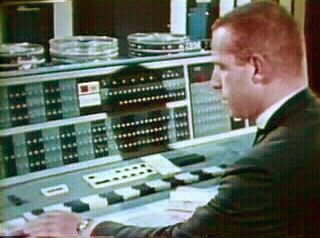
The IBM 7090 is a second-generation transistorized version of the earlier IBM 709 vacuum-tube mainframe computer that was designed for "large-scale scientific and technological applications". The 7090 is the fourth member of the IBM 700/7000 series scientific computers. The first 7090 installation was in December 1959. In 1960, a typical system sold for $2.9 million (equivalent to $23 million in 2024) or could be rented for $63,500 a month (equivalent to $514,000 in 2024).
The 7090 uses a 36-bit word length, with an address space of 32,768 words (15-bit addresses). It operates with a basic memory cycle of 2.18 μs, using the IBM 7302 Core Storage core memory technology from the IBM 7030 (Stretch) project.
With a processing speed of around 100 Kflop/s, the 7090 is six times faster than the 709, and could be rented for half the price. An upgraded version, the 7094, was up to twice as fast. Both the 7090 and the 7094 were withdrawn from sale on July 14, 1969, but systems remained in service for more than a decade after. In 1961, the IBM 7090 famously employed a speech synthesis program to sing "Daisy Bell", becoming something of a cultural icon.
Although the 709 was a superior machine to its predecessor, the 704, it was being built and sold at the time that transistor circuitry was supplanting vacuum tube circuits. Hence, IBM redeployed its 709 engineering group to the design of a transistorized successor. That project became called the 709-T (for transistorized), which because of the sound when spoken, quickly shifted to the nomenclature 7090 (i.e., seven - oh - ninety). Similarly, the related machines such as the 7070 and other 7000 series equipment were sometimes called by names of digit - digit - decade (e.g., seven - oh - seventy).[citation needed]
An upgraded version, the IBM 7094, was first installed in September 1962. It has seven index registers, instead of three on the earlier machines. The 7151-2 Console Control Unit for the 7094 has a distinctive box on top that displays lights for the four new index registers. The 7094 introduced double-precision floating-point arithmetic and additional instructions, but largely maintained backward compatibility with the 7090. Although the 7094 has four more index registers than the 709 and 7090, at power-on time it is in multiple tag mode, compatible with the 709 and 7090, and requires a Leave Multiple Tag Mode instruction in order to enter seven index register mode and use all seven index registers. In multiple tag mode, when more than one bit is set in the tag field, the contents of the two or three selected index registers are logically ORed, not added, together, before the decrement takes place. In seven index register mode, if the three-bit tag field is not zero, it selects just one of seven index registers, however, the program can return to multiple tag mode with the instruction Enter Multiple Tag Mode, restoring 7090 compatibility.
In April 1964, the first 7094 II was installed, which had almost twice as much general speed as the 7094 due to a faster clock cycle, dual memory banks and improved overlap of instruction execution, an early instance of pipelined design.
In 1963, IBM introduced two new, lower-cost machines called the IBM 7040 and 7044. They have a 36-bit architecture based on the 7090, but with some instructions omitted or optional, and simplified input/output that allows the use of more modern, higher-performance peripherals from the IBM 1400 series.
The 7094/7044 Direct Coupled System (DCS) was initially developed by an IBM customer, the Aerospace Corporation, seeking greater cost efficiency and scheduling flexibility than IBM's IBSYS tape operating system provided. DCS used a less expensive IBM 7044 to handle input/output (I/O) with the 7094 performing mostly computation. Aerospace developed the Direct Couple operating system, an extension to IBSYS, which was shared with other IBM customers. IBM later introduced the DCS as a product.
Hub AI
IBM 7090 AI simulator
(@IBM 7090_simulator)
IBM 7090
The IBM 7090 is a second-generation transistorized version of the earlier IBM 709 vacuum-tube mainframe computer that was designed for "large-scale scientific and technological applications". The 7090 is the fourth member of the IBM 700/7000 series scientific computers. The first 7090 installation was in December 1959. In 1960, a typical system sold for $2.9 million (equivalent to $23 million in 2024) or could be rented for $63,500 a month (equivalent to $514,000 in 2024).
The 7090 uses a 36-bit word length, with an address space of 32,768 words (15-bit addresses). It operates with a basic memory cycle of 2.18 μs, using the IBM 7302 Core Storage core memory technology from the IBM 7030 (Stretch) project.
With a processing speed of around 100 Kflop/s, the 7090 is six times faster than the 709, and could be rented for half the price. An upgraded version, the 7094, was up to twice as fast. Both the 7090 and the 7094 were withdrawn from sale on July 14, 1969, but systems remained in service for more than a decade after. In 1961, the IBM 7090 famously employed a speech synthesis program to sing "Daisy Bell", becoming something of a cultural icon.
Although the 709 was a superior machine to its predecessor, the 704, it was being built and sold at the time that transistor circuitry was supplanting vacuum tube circuits. Hence, IBM redeployed its 709 engineering group to the design of a transistorized successor. That project became called the 709-T (for transistorized), which because of the sound when spoken, quickly shifted to the nomenclature 7090 (i.e., seven - oh - ninety). Similarly, the related machines such as the 7070 and other 7000 series equipment were sometimes called by names of digit - digit - decade (e.g., seven - oh - seventy).[citation needed]
An upgraded version, the IBM 7094, was first installed in September 1962. It has seven index registers, instead of three on the earlier machines. The 7151-2 Console Control Unit for the 7094 has a distinctive box on top that displays lights for the four new index registers. The 7094 introduced double-precision floating-point arithmetic and additional instructions, but largely maintained backward compatibility with the 7090. Although the 7094 has four more index registers than the 709 and 7090, at power-on time it is in multiple tag mode, compatible with the 709 and 7090, and requires a Leave Multiple Tag Mode instruction in order to enter seven index register mode and use all seven index registers. In multiple tag mode, when more than one bit is set in the tag field, the contents of the two or three selected index registers are logically ORed, not added, together, before the decrement takes place. In seven index register mode, if the three-bit tag field is not zero, it selects just one of seven index registers, however, the program can return to multiple tag mode with the instruction Enter Multiple Tag Mode, restoring 7090 compatibility.
In April 1964, the first 7094 II was installed, which had almost twice as much general speed as the 7094 due to a faster clock cycle, dual memory banks and improved overlap of instruction execution, an early instance of pipelined design.
In 1963, IBM introduced two new, lower-cost machines called the IBM 7040 and 7044. They have a 36-bit architecture based on the 7090, but with some instructions omitted or optional, and simplified input/output that allows the use of more modern, higher-performance peripherals from the IBM 1400 series.
The 7094/7044 Direct Coupled System (DCS) was initially developed by an IBM customer, the Aerospace Corporation, seeking greater cost efficiency and scheduling flexibility than IBM's IBSYS tape operating system provided. DCS used a less expensive IBM 7044 to handle input/output (I/O) with the 7094 performing mostly computation. Aerospace developed the Direct Couple operating system, an extension to IBSYS, which was shared with other IBM customers. IBM later introduced the DCS as a product.