
Recent from talks
IBM PC Series
Knowledge base stats:
Talk channels stats:
Members stats:
IBM PC Series
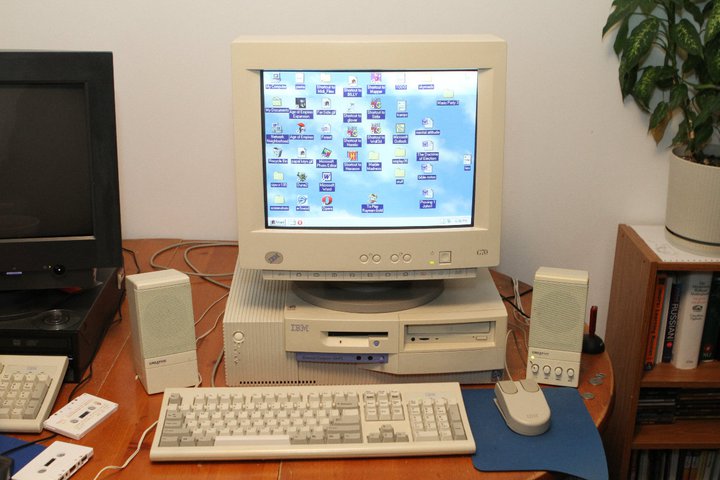
The Personal Computer Series, or PC Series, was IBM's follow-up to the Personal System/2 and PS/ValuePoint. Announced in October 1994 and withdrawn in October 2000, it was replaced by the IBM NetVista, apart from the Pentium Pro-based PC360 and PC365, which were replaced by the IBM IntelliStation. The PC series was more business-oriented than the Aptiva line.
The PC 100 was a budget model, available only in selected markets.
The PC 140 was a budget model, available only in selected markets.
Industry standard ISA/PCI architecture, first IBM machines with USB. Processors ranged from the 486DX2-50, 486SX-25, 486DX4-100 to the Pentium 200 and in case of the Models 360 and 365 the Pentium Pro. 486 models had a selectable bus architecture (SelectaBus) through a replaceable riser card, offering the choice of either VESA Local Bus/ISA or PCI/ISA. Within the 300 series the following models appeared:
Its last sub-model used the Pentium P54C processor clocked at 100, 133, 166, or 200 MHz. It had, depending on the sub-model, up to 4 ISA and/or 3 PCI expansion slots and four (2 external 5.25", 1 external and 1 internal 3.5") drive bays. It had in its latest version, the 6577, one DIMM-168 and 4 SIMM-72 memory slots, and featured an IBM SurePath BIOS. This PC has 2 USB 1.0 slots in the back. The latest version of Windows which can be installed on this PC is Windows XP, though Windows 2000 and Windows ME are optimal choices.
The DIMM-168 memory slot takes 5V EDO DRAM and is incompatible with the more commonly used 3.3V SDRAM. The slot looks the same at first glance, but the keying is different. Trying to force a 3.3V SDRAM module into the slot could damage both it and the memory module.
Submodels were:
The PC 340, introduced in 1996, was a budget model. It used the Pentium processor clocked at 100, 133 or 166 MHz. It had 4 ISA and 3 PCI expansion slots and four (2 external 5.25 inch, 1 external and 1 internal 3.5 inch) drive bays. It had 4 SIMM-72 RAM slots, and featured an IBM SurePath BIOS.
Hub AI
IBM PC Series AI simulator
(@IBM PC Series_simulator)
IBM PC Series
The Personal Computer Series, or PC Series, was IBM's follow-up to the Personal System/2 and PS/ValuePoint. Announced in October 1994 and withdrawn in October 2000, it was replaced by the IBM NetVista, apart from the Pentium Pro-based PC360 and PC365, which were replaced by the IBM IntelliStation. The PC series was more business-oriented than the Aptiva line.
The PC 100 was a budget model, available only in selected markets.
The PC 140 was a budget model, available only in selected markets.
Industry standard ISA/PCI architecture, first IBM machines with USB. Processors ranged from the 486DX2-50, 486SX-25, 486DX4-100 to the Pentium 200 and in case of the Models 360 and 365 the Pentium Pro. 486 models had a selectable bus architecture (SelectaBus) through a replaceable riser card, offering the choice of either VESA Local Bus/ISA or PCI/ISA. Within the 300 series the following models appeared:
Its last sub-model used the Pentium P54C processor clocked at 100, 133, 166, or 200 MHz. It had, depending on the sub-model, up to 4 ISA and/or 3 PCI expansion slots and four (2 external 5.25", 1 external and 1 internal 3.5") drive bays. It had in its latest version, the 6577, one DIMM-168 and 4 SIMM-72 memory slots, and featured an IBM SurePath BIOS. This PC has 2 USB 1.0 slots in the back. The latest version of Windows which can be installed on this PC is Windows XP, though Windows 2000 and Windows ME are optimal choices.
The DIMM-168 memory slot takes 5V EDO DRAM and is incompatible with the more commonly used 3.3V SDRAM. The slot looks the same at first glance, but the keying is different. Trying to force a 3.3V SDRAM module into the slot could damage both it and the memory module.
Submodels were:
The PC 340, introduced in 1996, was a budget model. It used the Pentium processor clocked at 100, 133 or 166 MHz. It had 4 ISA and 3 PCI expansion slots and four (2 external 5.25 inch, 1 external and 1 internal 3.5 inch) drive bays. It had 4 SIMM-72 RAM slots, and featured an IBM SurePath BIOS.
Recent media