Hubbry Logo
IBookIBookMain
Open search
IBook
Community hub
IBook
logo
8 pages, 0 posts
0 subscribers
Be the first to start a discussion here.
Contribute something
IBook
IBook
from Wikipedia

iBook
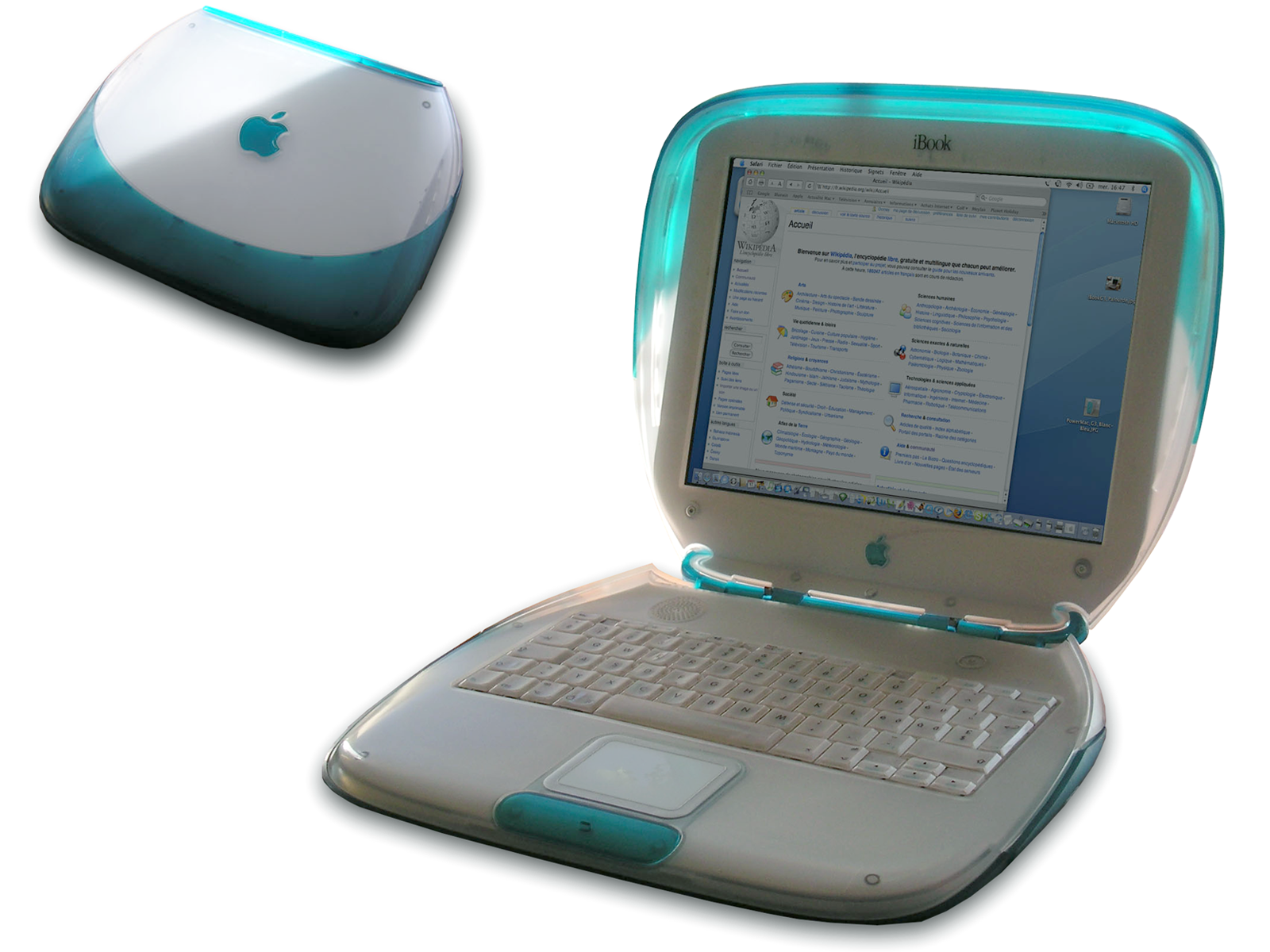
The first-generation iBook G3 "Clamshell" in Blueberry Color opened and closed.
DeveloperApple Computer
Product familyMac
TypeLaptop
Release dateJuly 21, 1999 (1999-07-21)
DiscontinuedMay 16, 2006
Operating system
CPU @ 300 MHz – 1.42 GHz
DisplayTFT LCD
SuccessorMacBook
Related
Websitewww.apple.com/ibook/ at the
Wayback Machine (archived
October 1, 1999)

iBook is a line of laptop computers designed, manufactured, and sold by Apple Computer from 1999 to 2006. The line targeted entry-level, consumer and education markets, with lower specifications and prices than the PowerBook, Apple's higher-end line of laptop computers. It was the first mass consumer product to offer Wi-Fi network connectivity, which was then branded by Apple as AirPort.[1][2]

The iBook had three different designs during its lifetime. The first, known as the "Clamshell", was inspired by the design of Apple's popular iMac line at the time. It was a significant departure from previous portable computer designs due to its shape, bright colors, incorporation of a handle into the casing, lack of a display closing latch, lack of a hinged cover over the external ports and built-in wireless networking. Two years later, the second generation abandoned the original form factor in favor of a more conventional, rectangular design. In October 2003, the third generation was introduced, adding a PowerPC G4 chip, USB 2.0 and a slot-loading drive. iBooks were very popular in education, with Henrico County Public Schools being the first of many school systems in the United States to distribute one to every student.

Apple replaced the iBook line with the MacBook in May 2006 during the Mac transition to Intel processors.

iBook G3 ("Clamshell"; 1999-2001)

[edit]

iBook G3 ("Clamshell")
The iBook (Firewire) in Indigo color
DeveloperApple Computer
TypeLaptop
Release dateJuly 21, 1999
Introductory priceUS$1,599 (equivalent to $3,018 in 2024)
DiscontinuedMay 1, 2001
CPUPowerPC G3, 300–466 MHz
SuccessoriBook G3 (Snow)
Related

In the late 1990s, Apple was trimming its product line from the large number of intersecting Performa, Quadra, LC, Power Macintosh and PowerBook models to a simplified "four box" strategy: desktop and portable computers, each in both consumer and professional models. Three boxes of this strategy were already in place: The newly introduced iMac was the consumer desktop, the Power Macintosh G3 filled the professional desktop box, and the PowerBook G3 line served as the professional portable line. This left only the consumer portable space empty, leading to much rumor on the Internet of potential designs and features. Putting an end to this speculation, on July 21, 1999, Steve Jobs unveiled the iBook G3 during the keynote presentation of Macworld Conference & Expo, New York City.

Like the iMac, the iBook G3 had a PowerPC G3 CPU, and no legacy Apple interfaces. USB, Ethernet, modem ports and an optical drive were standard. The ports were left uncovered along the left side, as a cover was thought to be fragile and unnecessary with the iBook's new interfaces, which lacked the exposed pins of earlier connectors. Featuring a clamshell design, when the lid was closed, the hinge kept it firmly shut, so there was no need for a latch on the screen. The hinge included an integrated carrying handle. Additional power connectors on the bottom surface allowed multiple iBook G3s to be charged on a custom-made rack. The iBook G3 was the first Mac to use Apple's new "Unified Logic Board Architecture", which condensed all of the machine's core features into two chips, and added AGP and Ultra DMA support.

The iBook was the first mainstream computer designed and sold with integrated wireless networking.[3] On the iBook's introduction, Phil Schiller, Apple's VP of Marketing, held an iBook while jumping off a height as data from the computer was transferred to another in order to demonstrate the wireless networking capability. The display bezel contained the wireless antenna, which attached to an optional internal wireless card. Lucent Technologies helped create this wireless capability which established the industry standard. Apple released the AirPort Wireless Base Station at the same time.

There was heated debate over many things such as the aesthetics, features, weight, performance and pricing.[4][5] To provide sufficient impact protection, the iBook was larger and heftier than the PowerBook of the time, and yet had lower specifications. Standard features like PC card slots were absent, and so were speculated features such as touch screens and an ultra-long battery life. The iBook gained the label "Barbie's toilet seat", due to the distinctive design.[6] Nevertheless, this same design made the iBook G3 unmistakable in movies and television shows.

The iBook was a commercial success.[7] The line continually received processor, memory, and hard disk upgrades. FireWire and video out were later added alongside colors Indigo and Key Lime. The design was discontinued in May 2001, in favor of the new "Dual USB" iBooks.

Design

[edit]
iBook G3 ("Clamshell") in all five colors: "Tangerine" and "Blueberry" on the top row, and "Graphite", "Indigo" and "Key Lime" on the bottom row. Key Lime was an Apple Online Store exclusive.

The design was clearly influenced by Apple's consumer desktop, the iMac. In fact, one of the marketing slogans for the iBook was "iMac to go." The clamshell design also echoed the eMate 300. Apple continued its trend of using transparent colored plastics for the shell, and released the iBook clamshell series in several colors, starting with Blueberry and Tangerine, later adding Indigo, Graphite and Key Lime colors when the iBook line was refreshed. However, unlike the iMac, the iBook did not feature pinstripes. Steve Jobs announced that the Key Lime color, "a little less conservative, a little more fun", was exclusive to the online Apple Store. This resulted in some crowd members booing, to which Jobs replied: "Don't you like buying on the Apple Online Store?"[8]

Compared to follow-up iBook and PowerBook notebook computers, the Clamshell iBook proved to be the more reliable model.[9] The original iBook is on exhibition at the London Design Museum and the Yale University Art Gallery.[10][11] Vestiges of design ideas first adopted in the iBook G3 can still be seen today: moving interface ports from the back to the sides and leaving them uncovered, omitting a latch for the computer's lid, and providing multiple color options.

Technical specifications

[edit]

According to Apple, all of these models are obsolete.[a][12]

Model Original SE (Special Edition) FireWire FireWire SE
Timetable Released July 21, 1999 February 16, 2000 September 13, 2000
Discontinued February 16, 2000 September 13, 2000 May 1, 2001
Color(s)   Blueberry
  Tangerine
  Graphite   Indigo
  Key Lime (exclusive to Apple Online Store)
  Graphite
  Key Lime (exclusive to Apple Online Store)
Ordering info. Order number M7707 (Blueberry) or M7619 (Tangerine)[13] M7717 (Blueberry) or M7718 (Tangerine) M7716 M7721 (Indigo) or M7722 (Key Lime) M7720 (Graphite) or M8245 (Key Lime)
Model identifier PowerBook 2,1 PowerBook 2,2
Model number M2453 (EMC 1847) M6411 (EMC N/A)
Performance Processor PowerPC G3 (750) PowerPC G3 (750CXe)
Clock speed 300 MHz 366 MHz 466 MHz
Cache 64 KB L1, 512 KB L2 backside cache (1:2) 64 KB L1, 256 KB L2 cache (1:1)
Front side bus 66 MHz
Memory 32 MB of PC66 SDRAM (soldered to the logic board)
Expandable to 544 MB (288 MB specified by Apple)
64 MB of PC66 SDRAM (soldered to the logic board)
Expandable to 576 MB (320 MB specified by Apple)
64 MB of PC100 SDRAM (soldered to the logic board)
Expandable to 576 MB (320 MB specified by Apple)
Video Display 12" active-matrix TFT display, 800×600 pixel resolution
Graphics ATI Rage with 4 MB of SDRAM ATI Rage 128 with 8 MB of SDRAM
AGP 2x
Storage Hard drive 3.2 GB or 6 GB ATA 6 GB ATA 10 GB ATA
Optical drive
Tray loading
24× CD-ROM 4× DVD-ROM
Connections Connectivity 10/100 BASE-T Ethernet
56k V.90 modem
Optional AirPort 802.11b
Peripherals 1x USB 1.1
Audio out mini-jack
1x USB 1.1
Audio out mini-jack
1x FireWire 400
Video out Composite video out
Battery 45-watt-hour removable lithium-ion
Operating system Original Mac OS 8.6 Mac OS 9.0.2 Mac OS 9.0.4
Maximum Mac OS X 10.3.9 "Panther" and Mac OS 9.2.2
Unofficially, can run Mac OS X 10.4.11 "Tiger" with XPostFacto.
Mac OS X 10.4.11 "Tiger" and Mac OS 9.2.2
Unofficially, can run Mac OS X 10.5.8 "Leopard" with a G4 processor upgrade.
Dimensions Weight 6.7 lbs / 3.0 kg
Volume 1.8×13.5×11.6 in / 4.6 x 34.3 x 29.5 cm

Expandability and upgrades

[edit]

The original iBook's only customer-serviceable parts were the RAM and AirPort card, accessed via two slots under the keyboard. No other modifications were possible in-warranty. There was no PCMCIA port for additional expansion capabilities. 40 screws needed to be removed to access the hard drive. The optical drive, however, can be accessed far more easily, requiring only 11 screws and one standoff to be removed. Later on, some users transplanted a 1024×768 LCD from the more recent white iBook into a clamshell iBook. This is only possible with the "FireWire" and "FireWire SE" models, as they have 8 MB of video RAM; the older ones only have 4 MB.[14]

All clamshell iBooks shipped with Mac OS 8.6 or 9.0. All clamshell iBooks supported Mac OS X 10.0 through 10.3.9. Mac OS X Tiger (v10.4) can also be installed.

iBook G3 Dual USB ("Snow"; 2001-2003)

[edit]
iBook G3 ("Snow")
The iBook G3 "Snow" (12.1 in).
DeveloperApple Computer
TypeLaptop
Release dateMay 1, 2001
Introductory priceUS$1,299 (equivalent to $2,307 in 2024)-US$1,799 (equivalent to $3,195 in 2024)[15]
DiscontinuedOctober 22, 2003
CPUPowerPC G3, 500–900 MHz
PredecessoriBook G3 (Clamshell)
SuccessoriBook G4
Related

Apple debuted the next-generation iBook G3 at a press conference in Cupertino, California, on May 1, 2001. The previous bold colors and bulky form-factor were abandoned, as were the handle, latch-less design and additional power connectors on the bottom surface.

The resulting iBook was available in white only, hence the name "Snow" and incorporated transparent polycarbonate in its casing. It was 30% lighter, and occupied less than half of the volume of the model it replaced, being smaller in all three dimensions. Despite that, it added an extra USB port and a higher resolution screen. Apple claimed the compact design did not sacrifice durability, saying it was "Twice as durable" as the previous model. This is the model seen in the first iPod commercial.

With this revision, Apple began transitioning to translucent and white polycarbonate casings in most of its consumer line, such as the iMac and the eMac. In contrast, most of its professional products used an anodized aluminium finish. Near the end of its run, the Snow iBook G3 case became opaque and white instead of translucent white and magnesium.

Technical specifications

[edit]

According to Apple, all of these models are obsolete.[a][12]

Model Mid 2001 Late 2001 Early 2002 Mid 2002 Late 2002 Early 2003
Timetable Released May 1, 2001 October 16, 2001 January 7, 2002 May 20, 2002 November 6, 2002 April 22, 2003
Discontinued October 16, 2001 May 20, 2002 January 7, 2002 May 20, 2002 November 6, 2002 April 22, 2003 October 22, 2003
Color Translucent White Opaque White Translucent White Opaque White
Ordering info. Model identifier PowerBook 4,1 PowerBook 4,2 PowerBook 4,3
Model number M6497 (EMC 1875) M8413 A1005 (EMC 1916) A1007 (EMC 1924) A1005 (EMC 1916) A1007 (EMC 1924) A1005 (EMC 1916C) A1007 (EMC 1924)
Order number M7698 M7692 M7699 M8520 M8597 M8598 M8599 M7701 M8600 M8602 M8603 M8860 M8861 M8862 M8758 M9018 M9009
Performance Processor PowerPC G3 (750cxe) PowerPC G3 (750cx) PowerPC G3 (745/755) PowerPC G3 (750fx)
Clock speed 500 MHz 600 MHz 700 MHz 800 MHz 900 MHz
Cache 64 KB L1, 256 KB L2 cache (1:1) 64 KB L1, 512 KB L2 cache (1:1)
Front side bus 66 MHz 100 MHz
Memory 64 MB of PC100 SDRAM (soldered to the logic board)
Expandable to 576 MB
128 MB of PC100 SDRAM (soldered to the logic board)
Expandable to 640 MB
128 MB of PC100 SDRAM (soldered to the logic board) (12")
256 MB of PC100 SDRAM (128 MB soldered to the logic board) (14")
Expandable to 640 MB
Video Display 12.1" 14.1" 12.1" 14.1" 12.1" 14.1"
TFT XGA active matrix display, 1024×768 pixel resolution
Graphics ATI Rage 128 with 8 MB of SDRAM
AGP 2x
ATI Radeon with 16 MB of SDRAM
AGP 2x
ATI Radeon 7500 with 16 MB SDRAM
AGP 2x
ATI Radeon 7500 with 32 MB SDRAM
AGP 2x
Storage Hard drive 10 GB
20 GB optional
Ultra/ATA
15 GB or 20 GB
30 GB optional
Ultra/ATA
15 GB
30 GB optional
Ultra/ATA
20 GB
30 GB optional
Ultra/ATA
20 GB
Ultra/ATA
30 GB
Ultra/ATA
20 GB
Ultra/ATA
30 GB
Ultra/ATA
40 GB
Ultra/ATA
Optical drive
Tray-loading
CD-ROM DVD-ROM CD-RW Combo drive CD-ROM DVD-ROM Combo drive CD-ROM Combo drive CD-ROM Combo drive CD-ROM Combo drive
Connections Connectivity 10/100 BASE-T Ethernet
56k V.90 modem
Optional AirPort 802.11b
Peripherals 2x USB 1.1
1x FireWire 400
Audio out mini-jack
Video out A/V Port (VGA, composite video/sound) via adaptors Mini-VGA (VGA, composite and S-Video) via adaptors
Operating system Original Mac OS 9.1 Mac OS 9.2.1 / Mac OS X 10.1 Mac OS 9.2.2 / Mac OS X 10.1.4 Mac OS 9.2.2 / Mac OS X 10.1.5 Mac OS 9.2.2 / Mac OS X 10.2.4 "Jaguar"
Maximum Mac OS X 10.4.11 "Tiger" and Mac OS 9.2.2
Dimensions Weight 4.9 lbs / 2.2 kg 5.9 lbs / 2.7 kg 4.9 lbs / 2.2 kg (12")
5.9 lbs / 2.7 kg (14")
Volume 1.35 x 11.2 x 9.6 inches / 3.4 x 28.5 x 23.0 cm 1.35 x 12.7 x 10.2 inches / 3.4 x 32.3 x 25.9 cm 1.35 x 11.2 x 9.6 inches / 3.4 x 28.5 x 23.0 cm (12")
1.35 x 12.7 x 10.2 inches / 3.4 x 32.3 x 25.9 cm (14")

iBook G4 (2003-2006)

[edit]
iBook G4
iBook G4 (12 inch)
DeveloperApple Computer
TypeLaptop
Release dateOctober 22, 2003
Introductory priceUS$1,099 (equivalent to $1,879 in 2024)-US$1,499 (equivalent to $2,562 in 2024)[16]
DiscontinuedMay 16, 2006
CPUPowerPC G4, 800 MHz – 1.42 GHz
PredecessoriBook G3 (Snow)
SuccessorMacBook
Related

Apple added a PowerPC G4 chip to the iBook Snow design on October 22, 2003, finally ending Apple's use of the PowerPC G3 chip. A slot-loading optical drive replaced the disc tray. The iBook G4 notebook also features an opaque white case finish and keyboard and a plastic display hinge. This is also the last iBook laptop released before MacBooks replaced the iBook line in 2006.

Technical specifications

[edit]

According to Apple, all of these models are obsolete.[a][12]

Model Late 2003 Early 2004 Late 2004 Mid 2005
Timetable Released October 22, 2003 April 19, 2004 October 19, 2004 July 26, 2005
Discontinued April 19, 2004 October 19, 2004 July 26, 2005 May 16, 2006
Color Opaque White
Ordering info. Order number M9164 M9388 M9165 M9426 M9418 M9419 M9623 M9627 M9628 M9846 M9848
Model identifier PowerBook 6,3 PowerBook 6,5 PowerBook 6,7
Model number A1054 A1055 A1054 A1055 A1054 A1055 A1133 A1134
Performance Processor PowerPC G4 (7457) PowerPC G4 (7447A)
Clock speed 800 MHz 933 MHz 1 GHz 1.07 GHz 1.2 GHz 1.33 GHz 1.42 GHz
Cache 64 KB L1, 256 KB L2 cache (1:1) 64 KB L1, 512 KB L2 cache (1:1)
Front side bus 133 MHz 142 MHz
Memory 256 MB of 266 MHz PC2100 DDR SDRAM (128 soldered to logic board)
Expandable to 1.128 GB
256 MB of 266 MHz PC2100 DDR SDRAM (soldered to logic board)
Expandable to 1.256 GB
512 MB of 333 MHz PC2700 DDR SDRAM (soldered to logic board)
Expandable to 1.5 GB
Video Display 12.1" 14.1" 12.1" 14.1" 12.1" 14.1" 12.1" 14.1"
TFT XGA active matrix display, 1024×768 pixel resolution
Graphics ATI Radeon 9200 with 32 MB of SDRAM ATI Radeon 9550 with 32 MB of SDRAM
AGP 4x
Storage Hard drive 30 GB 4200-rpm Ultra/ATA 100 40 GB 4200-rpm Ultra/ATA 100 60 GB 4200-rpm Ultra/ATA 100 30 GB 4200-rpm Ultra/ATA 100 40 GB 4200-rpm Ultra/ATA 100 60 GB 4200-rpm Ultra/ATA 100 30 GB 4200-rpm Ultra/ATA 100 60 GB 4200-rpm Ultra/ATA 100 40 GB 4200-rpm Ultra/ATA 100 60 GB 4200-rpm Ultra/ATA 100
Optical drive
Slot-loading
DVD-ROM/CD-RW Combo Drive DVD-ROM/CD-RW Combo Drive
Optional DVD±RW SuperDrive
DVD-RW SuperDrive DVD-ROM/CD-RW Combo Drive
Optional DVD±RW SuperDrive
DVD-RW SuperDrive
Connections Connectivity 10/100BASE-T Ethernet
56k v.92 modem
Optional AirPort Extreme 802.11b/g
Optional Bluetooth 1.1
10/100BASE-T Ethernet
56k v.92 modem
Integrated AirPort Extreme 802.11b/g
Optional Bluetooth 1.1
10/100BASE-T Ethernet
56k v.92 modem
Integrated AirPort Extreme 802.11b/g
Integrated Bluetooth 2.0+EDR
Peripherals 2x USB 2.0
1x FireWire 400
Audio out mini-jack
Video out Mini-VGA (VGA, composite and S-Video) via adaptors
Operating system Original Mac OS X 10.3 "Panther" Mac OS X 10.4 "Tiger"
Maximum Mac OS X 10.4.11 "Tiger"
Unofficially can run Mac OS X 10.5 "Leopard" with a RAM upgrade
Mac OS X 10.5.8 "Leopard" If less than 512 MB of RAM are installed, then only 10.4.11 Mac OS X 10.5.8 "Leopard"
Dimensions Weight 4.9 lbs / 2.2 kg 5.9 lbs / 2.7 kg 4.9 lbs / 2.2 kg 5.9 lbs / 2.7 kg 4.9 lbs / 2.2 kg 5.9 lbs / 2.7 kg 4.9 lbs / 2.2 kg 5.9 lbs / 2.7 kg
Volume 1.35 x 11.2 x 9.1 inches / 3.4 x 28.4 x 23.1 cm 1.35 x 12.7 x 10.2 inches / 3.4 x 32.3 x 25.9 cm 1.35 x 11.2 x 9.1 inches / 3.4 x 28.4 x 23.1 cm 1.35 x 12.7 x 10.2 inches / 3.4 x 32.3 x 25.9 cm 1.35 x 11.2 x 9.1 inches / 3.4 x 28.4 x 23.1 cm 1.35 x 12.7 x 10.2 inches / 3.4 x 32.3 x 25.9 cm 1.35 x 11.2 x 9.1 inches / 3.4 x 28.4 x 23.1 cm 1.35 x 12.7 x 10.2 inches / 3.4 x 32.3 x 25.9 cm

Supported operating systems

[edit]
Supported macOS releases
OS release iBook G3 (Clamshell) iBook G3 (Snow) iBook G4
Mid 1999 Early 2000 Late 2000 Mid 2001 Late 2001 Early 2002 Mid 2002 Late 2002 Early 2003 Late 2003 Early 2004 Late 2004 Mid 2005
Mac OS 8 8.6 No No No No No No No No No No No No
Mac OS 9 9.0 9.0.2 9.0.4 9.1 9.2.1 9.2.1 9.2.2 9.2.2 9.2.2 Emulation only
10.0 Cheetah Yes Yes Yes Yes No No No No No No No No No
10.1 Puma Yes Yes Yes Yes Yes 10.1.2 10.1.4 10.1.5 No No No No No
10.2 Jaguar Yes Yes Yes Yes Yes Yes Yes Yes 10.2.4 No No No No
10.3 Panther Yes Yes Yes Yes Yes Yes Yes Yes Yes Yes 10.3.3 10.3.5 No
10.4 Tiger Yes Yes Yes Yes Yes Yes Yes Yes Yes Yes Yes Yes 10.4.2
10.5 Leopard[Note 1] No No No No No No No No No patch, requires RAM upgrade With 512 MB RAM Yes
  1. ^ Mac OS X Leopard is the final release to support PowerPC Macs.

Expandability and upgrades

[edit]
AirPort Extreme installed in an iBook G4

The iBook keyboard lifts up, allowing installation of the AirPort (wireless) card and additional memory. This gives the keyboard a "spongy" effect, especially in G3 iBooks with the translucent keyboard. The "sponginess" was corrected in the PowerPC G4 models.

Accessing the hard disk drive is complex and time-consuming, involving partial disassembly of the unit and the removal of over 30 different-sized screws.[17]

The memory in the iBook G4 is covered by a removable AirPort card, and accessible by removing the RAM shield with a Phillips screwdriver. While some of the earlier models (e.g., 800 MHz and 933 MHz) have a specified 640 MB RAM limit, it is possible to have a total of 1.12 GB of RAM installed (128 MB built-in, plus a 1 GB SO-DIMM), or 1.25 or 1.5 GB in the later models with 256 or 512 MB of RAM soldered to the logic board.

Although no longer officially supported by macOS versions beyond those given in the chart above, the system has also been supported via MorphOS (an Amiga compatible OS) since version 3.2.

Notes

[edit]

Quality issues

[edit]

Display issues with the iBook line were caused by a notoriously problematic graphics chip, which could have issues with the heatsink or the BGA soldering work done at the factory. This would manifest in symptoms such as system lockups (as the graphics chip hangs from reaching the thermal limit), or visible graphical artifacts appearing on the screen (from the graphics chip failing).[18]

Apple initiated the "iBook Logic Board Repair Extension Program" in January 2004, which covered the expense of repairing display problems of iBook G3 models for three years.[19] In June 2004, the Repair Extension Program was expanded to cover all White G3 iBooks.[20][21]

Early models of the iBook G4 also suffered from display problems similar to those of the iBook G3, but were not covered by the repair extension program.[22] Owners of iBooks that required expensive repairs for these problems submitted new class action lawsuits in December 2006.[citation needed]

On May 2, 2007, the Danish Consumer Board published an extensive 3rd party report[23][24] concerning the Apple iBook G4 logic board issue. A press release[25] referred to the global consequences that this could have for possible guarantee claims.

Some owners of the iBooks that experienced this flaw solved these issues temporarily through applying pressure to the heatsink or graphics chip, using a thin metal shim placed between the heatsink and the graphics chip. This both pushed the heatsink and graphics chip together, bridging the thermal gap, and pushing the graphics chip against the motherboard, temporarily reheating the solder beads back together.[26]

Timeline

[edit]
Timeline of portable Macintoshes
Mac transition to Apple siliconiMac ProApple WatchiPadiPhoneMac ProPower Mac G5Power Mac G4Power Macintosh G3Power MacintoshCompact MacintoshMacBook Pro (Apple silicon)MacBook Pro (Apple silicon)MacBook Air (Apple silicon)MacBook Air (Apple silicon)MacBook Pro (Apple silicon)MacBook Pro (Apple silicon)MacBook Pro (Apple silicon)MacBook Air (Apple silicon)MacBook Pro (Intel-based)MacBook Pro (Intel-based)MacBook Pro (Intel-based)MacBook Pro (Intel-based)MacBook Air (Intel-based)MacBook Pro (Intel-based)MacBook Pro (Intel-based)12-inch MacBookMacBook Pro (Intel-based)MacBook Air (Intel-based)MacBook Air (Intel-based)MacBook (2006–2012)MacBook Pro (Intel-based)MacBook Pro (Intel-based)MacBook (2006–2012)MacBook Air (Intel-based)MacBook Pro (Intel-based)MacBook Pro (Intel-based)MacBook (2006–2012)PowerBook G4PowerBook G4PowerBook G4iBook G4iBook G4PowerBook G4iBook (white)iBook (white)iBook ClamshelliBook ClamshellPowerBook G3PowerBook G3PowerBook G3PowerBook 3400cPowerBook 1400PowerBook 2400cPowerBook 500 seriesPowerBook 5300PowerBook 190PowerBook DuoPowerBook 500 seriesPowerBook 500 seriesPowerBook 500 seriesPowerBook 500 seriesPowerBook 150PowerBook DuoPowerBook DuoPowerBook 180PowerBook 160PowerBook 140PowerBook DuoPowerBook DuoPowerBook 180PowerBook 160PowerBook 160PowerBook 140PowerBook Duo 230PowerBook Duo 210PowerBook 170PowerBook 140PowerBook 100Macintosh Portable

See also

[edit]

Notes

[edit]

References

[edit]
[edit]
Revisions and contributorsEdit on WikipediaRead on Wikipedia
from Grokipedia
The iBook is a line of laptop computers designed, manufactured, and marketed by Apple Inc. from 1999 to 2006, targeting entry-level consumers and the education market with affordable, portable devices featuring innovative designs inspired by the iMac. Introduced on July 21, 1999, at Macworld Expo New York, the original iBook G3 "Clamshell" model featured a distinctive translucent, colorful polycarbonate chassis in flavors like Blueberry, Tangerine, and Graphite, along with a built-in handle for portability and a 12.1-inch display. Powered by a 300 MHz PowerPC G3 processor, it offered up to 64 MB of RAM, a 6 GB hard drive, and a 24x CD-ROM drive, starting at a price of $1,599, making it Apple's first consumer-oriented laptop aimed at students and everyday users. A key innovation was its optional AirPort wireless networking card, one of the first consumer laptops to support 802.11b Wi-Fi, enabling up to 10 devices per base station and ushering in widespread adoption of wireless computing. The iBook line evolved through several generations, transitioning from the bold clamshell aesthetics to sleeker, white "" models in with dual USB ports and improved battery life of up to 5 hours. By 2002, Apple introduced 12-inch and 14-inch variants with PowerPC G3 processors up to 900 MHz, emphasizing quiet operation and education-focused features like durable construction. The shift to processors began in October 2003 with models offering speeds of 800 MHz and 1.0 GHz, brighter displays, and combo DVD/ drives, while maintaining the line's emphasis on and value. The final iBook G4, released on July 26, 2005, featured a 1.42 GHz G4, up to 1.5 GB RAM, and an opaque white finish, but was discontinued in May 2006 as Apple transitioned to Intel-based MacBooks. Throughout its run, the iBook pioneered Apple's Unified Motherboard Architecture for cost-efficient production and became a in , selling millions of units and influencing the design of future portables with its focus on simplicity, color, and wireless connectivity. It represented Apple's successful push into consumer laptops during a period of financial recovery, bridging the gap between the professional line and broader market accessibility before the era.

Introduction

Overview

The iBook was a line of laptop computers designed, manufactured, and sold by Apple Inc. from 1999 to 2006, targeting entry-level consumers and the education market as an affordable portable alternative to the iMac desktop series. Positioned below the professional PowerBook line, the iBook emphasized accessibility, portability, and innovative features to appeal to students, home users, and first-time laptop buyers. Introduced on July 21, 1999, the original iBook featured a colorful with translucent plastic cases initially in hues like and (later including ), weighing 6.7 pounds and powered by a 300 MHz PowerPC G3 processor. It included a 12.1-inch TFT display, USB and Ethernet ports, and was the first to support built-in networking through Apple's card, revolutionizing portable connectivity at the time. Priced starting at $1,599, the iBook quickly gained popularity for its user-friendly design and integration with Mac OS 8.6, helping to revitalize Apple's sales. Over its lifespan, the iBook evolved through three main generations: the original G3 Clamshell (1999–2001), the G3 Dual USB "Snow" models (2001–2003) with white polycarbonate chassis and improved USB support, and the G4 series (2003–2006) featuring PowerPC G4 processors for enhanced performance. The line was discontinued in May 2006 amid Apple's transition to Intel processors, with the MacBook succeeding it as the new consumer laptop offering.

Development and Launch

The development of the iBook began in the late 1990s under ' leadership following his return to Apple in 1997, as part of the company's strategy to extend the consumer-friendly design ethos of the into the portable computing market. , Apple's senior vice president of , led the team in crafting a clamshell form factor with translucent, colorful enclosures—initially in Blueberry and Tangerine—to appeal to students and entry-level users, emphasizing durability, simplicity, and a playful aesthetic that mirrored the iMac's "lickable" appeal. The design process incorporated innovations like a latchless with spring-loaded hinges that automatically powered on the device when opened, a unified logic board architecture compressing core components into fewer chips for efficiency, and the elimination of legacy ports such as the floppy drive in favor of USB and Ethernet connectivity. Apple collaborated with Lucent Technologies to integrate wireless networking capabilities, marking a pivotal shift toward mainstream adoption. Positioned as the "iMac to go," the iBook targeted the and consumer segments, distinct from Apple's higher-end line for professionals, with a focus on affordability and portability—including a 12.1-inch TFT display, a full-size keyboard, and up to six hours of battery life powered by a 300 MHz PowerPC G3 processor. The project emphasized seamless , such as built-in antennas for optional wireless cards and a yo-yo-style power adapter for easy winding and multi-unit charging. The iBook was unveiled on July 21, 1999, at the Macworld Expo in by , who highlighted its wireless potential by demonstrating connectivity during the presentation, with Apple executive dramatically leaping 20 feet to showcase untethered internet access. Priced starting at $1,599 for the base model with 32 MB RAM, 3.2 GB hard drive, and drive, it became available for purchase in September 1999, quickly gaining acclaim for democratizing wireless computing and helping Apple capture significant in the education sector. Later color variants, including Graphite, , and , were introduced to expand appeal, with the latter available exclusively online.

First-Generation Models

iBook G3 Clamshell (1999–2001)

The iBook G3 Clamshell, Apple's inaugural consumer laptop line, was unveiled on July 21, 1999, at the Macworld Expo in New York by , completing Apple's "four-square" product matrix alongside the , Power Mac, and . Targeted at students, educators, and home users, it emphasized affordability, portability, and connectivity, starting at a price of US$1,599—significantly lower than comparable Windows laptops costing $3,000 or more. The design drew inspiration from the colorful , featuring translucent plastic cases in bold hues and a built-in handle, positioning it as a friendly, approachable device that prioritized ease of use over professional power. Key innovations included the first consumer with built-in USB and 10/100 Ethernet ports, enabling seamless peripheral and network integration without adapters. It also introduced Apple's wireless networking option (802.11b at 11 Mbps), the first such technology in a mass-market portable, available for an additional $99 card and $299 . The 12.1-inch active-matrix TFT display supported 800×600 resolution with millions of colors, paired with a full-size keyboard, trackpad, and latch-free that powered on the device upon opening. Battery life reached up to six hours via a user-replaceable 45 Wh lithium-ion pack, a standout for the era, while the 24x drive and 56k supported and online access. The original iBook G3/300 model, codenamed "P1," shipped in September 1999 with a 300 MHz PowerPC 750 (G3) processor, 32 MB of PC66 SDRAM (expandable to 544 MB via one SO-DIMM slot), and a 3.2 GB Ultra ATA hard drive. were handled by an ATI Rage Mobility chip with 4 MB dedicated SDRAM and 2x AGP support, suitable for basic multimedia but lacking video output or a . In February 2000, Apple updated the line with the iBook G3/366 , boosting the processor to 366 MHz, standardizing 64 MB RAM (max 576 MB), and a 6 GB drive, while adding a graphite color option. A major refresh arrived in September 2000, introducing FireWire 400 for faster external device connectivity and upgrading to an ATI Rage Mobility 128 GPU with 8 MB VRAM. The iBook G3/366 FireWire model retained the 366 MHz speed but featured a 10 GB drive and or cases, priced at $1,499. The higher-end iBook G3/466 Special Edition added a 466 MHz processor and a 4x DVD-ROM drive, priced at $1,799, while maintaining the same memory and storage options. All models shared a 6.7-pound weight, dimensions of 11.6 x 13.5 x 1.8 inches, and a hybrid A/V port for /audio output in later variants.
ModelIntro DateProcessorRAM (Std/Max)StorageDriveColorsKey Features
G3/300 OriginalJul 1999300 MHz G332 MB/544 MB3.2–6 GB24x Tangerine, BlueberryUSB, Ethernet, AirPort option
G3/366 SEFeb 2000366 MHz G364 MB/576 MB6 GB24x GraphiteSpeed upgrade, new color
G3/366 FireWireSep 2000366 MHz G364 MB/576 MB10 GB24x , Key LimeFireWire, 8 MB VRAM
G3/466 SE FireWireSep 2000466 MHz G364 MB/576 MB10 GB4x , Key LimeDVD drive, top speed
The iBook G3 Clamshell line was discontinued on May 1, 2001, paving the way for the slimmer Dual USB models, but it left a lasting legacy by popularizing wireless networking and helping Apple capture over 30% of the U.S. education market in 1999. Its modular design allowed user upgrades to RAM, hard drives, and cards, fostering a dedicated retro community.

Design and Features

The iBook G3 Clamshell introduced a portable clamshell form factor that echoed the colorful, translucent aesthetic of the contemporary , marking Apple's first consumer-oriented . Available initially in and hues, the enclosure utilized impact-resistant plastic with rubber over-molding for enhanced grip and durability, while a integrated pullout in the hinge area facilitated easy transport. The design measured 13.5 inches wide by 11.6 inches deep by 1.8 inches thick, and weighed 6.7 pounds, prioritizing portability without compromising structural integrity. Latchless spring-loaded s allowed for seamless opening, and the fanless internal layout contributed to silent operation, a notable feature for battery-powered computing at the time. In February 2000, Apple expanded color options to include Graphite, aligning with broader product line updates. The display was a 12.1-inch TFT active-matrix LCD panel with an 800 x 600 SVGA resolution, capable of rendering millions of colors for vibrant visuals suitable for consumer tasks like web browsing and light multimedia. Input relied on a full-sized translucent keyboard with white keys accented by color-matched modifier keys (such as function keys in Blueberry or Tangerine), providing tactile feedback and visibility in low light; a large, square trackpad with a dedicated button offered intuitive navigation. The keyboard included programmable hot keys for quick access to applications, enhancing usability for everyday users. Connectivity emphasized accessibility for non-technical users, featuring a single USB 1.1 port for peripherals, a built-in V.90 56K for dial-up , and 10/100BASE-T Ethernet for wired networking. An optional card enabled 802.11b networking at up to 11 Mbps within a 150-foot range, a pioneering solution that required a separate but included internal antennas for seamless integration. Audio output was handled by a single built-in mono speaker and a 16-bit stereo headphone jack, though no input was provided. included a removable offering up to six hours of use, supported by a retractable "yo-yo" AC cord and bottom-mounted charging contacts compatible with multi-unit docking stations for classrooms or offices. A distinctive sleep indicator light faded in and out to signal low-power states, adding a playful yet functional touch to the .

Technical Specifications

The first-generation iBook G3 Clamshell models, introduced between 1999 and 2001, utilized PowerPC G3 processors running at speeds of 300 MHz to 466 MHz, with integrated units (PMMUs) and floating-point units (FPUs), a 64-bit 66 MHz data path, 64 KB L1 cache, and 512 KB L2 cache in early variants or 256 KB on-chip L2 cache in later FireWire models. Memory configurations started with 32 MB or 64 MB of PC66 SDRAM soldered to the logic board in the original 300 MHz model, expandable via a single 144-pin SO-DIMM slot up to 576 MB (though officially supported to 320 MB), using modules of 32, 64, 128, or 256 MB at 10 ns speed. Later models standardized at 64 MB base RAM with the same expansion capabilities.
ModelProcessorBase RAM (Max)StorageOptical DriveGraphics
iBook G3/300 (1999)300 MHz PowerPC 75032/64 MB (576 MB)3.2/6.0 GB HDD
iBook G3/366 SE (2000)366 MHz PowerPC 75064 MB (576 MB)6.0 GB HDD
iBook G3/366 FireWire (2000)366 MHz PowerPC 750cx64 MB (576 MB)10.0 GB HDD
iBook G3/466 SE FireWire (2000)466 MHz PowerPC 750cx64 MB (576 MB)10.0 GB HDD
All models featured a 12.1-inch TFT active-matrix LCD display with 800x600 and 60 Hz , lacking external video output in pre-FireWire versions but adding a hybrid A/V port for composite audio/video in FireWire models. Storage used 2.5-inch (9.5 mm) Ultra ATA/IDE hard drives, with capacities ranging from 3.2 GB to 10.0 GB across variants. Connectivity included one USB 1.1 port, a 56k v.90 RJ-11 modem, and 10/100Base-T RJ-45 Ethernet in all models; FireWire variants added a FireWire 400 port and supported optional 802.11b AirPort wireless via an internal slot. Audio output was handled by a built-in mono speaker and a headphone jack; no microphone input was provided. Power was provided by a 45 Wh lithium-ion battery in original models, upgraded to 50 Wh in FireWire versions, offering approximately 6 hours of runtime under typical use, with AC input supporting 100-240 V at 50-60 Hz and a maximum draw of 45 W. The chassis measured 11.6 x 13.5 x 1.8 inches and weighed 6.7 pounds (3.04 kg) across all variants, constructed from translucent polycarbonate in colors like , , , and later indigo or .

Second-Generation Models

iBook G3 Dual USB (2001–2003)

The iBook G3 Dual USB series marked Apple's second-generation consumer lineup, succeeding the original clamshell models with a slimmer, more portable design in translucent white that weighed 4.9 pounds and measured 1.35 inches thick. Introduced on May 1, 2001, it debuted with a 500 MHz PowerPC G3 processor, a 12.1-inch TFT XGA display at 1024×768 resolution, and dual USB 1.1 ports alongside FireWire for enhanced connectivity. Priced starting at $1,299 for the base configuration with 64 MB RAM and a 10 GB hard drive, the line targeted students and enthusiasts with up to 5 hours of battery life from its 42-watt-hour . Over its production run through 2003, the series received several updates to processor speeds, screen sizes, and storage options while maintaining the core boxy with rounded edges and no carrying handle. In October 2001, Apple bumped the base model to 600 MHz and refreshed the 500 MHz variant with 128 MB standard RAM, alongside options for , DVD-ROM, , or Combo DVD/ drives. By January 2002, 14.1-inch models joined the lineup at the same speeds, offering larger displays for improved productivity. Further revisions in May 2002 introduced 700 MHz processors with ATI 7500 graphics supporting Extreme acceleration, 20–40 GB hard drives, and up to 6 hours of battery life; these models shifted to an opaque white plastic exterior for durability. The final updates arrived in November 2002 with 800 MHz variants and April 2003 with 900 MHz top-end models featuring 256 MB RAM standard and 30–60 GB storage. Key features emphasized portability and multimedia capabilities, including built-in stereo speakers, an internal microphone, 56K modem, and 10/100 Ethernet for networking, with optional 802.11b wireless. Video output supported VGA and composite via an included , enabling external monitor connections up to 1024×768. Graphics were handled by the Mobility 128 with 8 MB VRAM in early models, upgrading to 16–32 MB in later ones for better performance in applications like 2, which shipped pre-installed along with . was expandable to 640 MB via a single PC100 SDRAM slot, though early 500 MHz units had 64 MB soldered; later models supported up to 1 GB. The series ran Mac OS 9.1 out of the box, with compatibility up to Mac OS X 10.4 Tiger.
Model VariantRelease DateProcessorScreen SizeBase RAM/StorageStarting Price (USD)
500 MHz (Initial)May 2001500 MHz G312.1"64 MB / 10 GB$1,299
600 MHzOct 2001600 MHz G312.1"128 MB / 20 GB$1,299
500 MHz (14")Jan 2002500 MHz G314.1"128 MB / 20 GB$1,499
600 MHz (14")Jan 2002600 MHz G314.1"128 MB / 30 GB$1,699
700 MHzMay 2002700 MHz G312.1"256 MB / 30 GB$1,299
700 MHz (14")May 2002700 MHz G314.1"256 MB / 40 GB$1,499
800 MHzNov 2002800 MHz G312.1"/14.1"256 MB / 40 GB (12"), 60 GB (14")$1,099 (12"), $1,299 (14")
900 MHz (Final)Apr 2003900 MHz G312.1"256 MB / 40 GB$999
The line was discontinued on October 22, 2003, with the introduction of the iBook G4 series featuring processors, though early models (500-700 MHz) experienced logic board failures affecting up to 73% of those units, prompting Apple to extend repair programs in 2004.

Design and Features

The second-generation iBook G3 Dual USB adopted a sleek, white "" design in translucent for the initial models, transitioning to a more durable opaque white plastic from May 2002. This boxy form factor measured 11.7 inches wide by 9.8 inches deep by 1.35 inches thick for the 12-inch version (weighing 4.9 pounds) and slightly larger for the 14.1-inch variant (5.4 pounds), emphasizing portability without the of the previous clamshell. The latchless lid opened smoothly with spring-loaded hinges, and the fanless design in early models ensured silent operation, though later variants included a quiet fan. The display was a 12.1-inch or 14.1-inch TFT active-matrix LCD with ×768 XGA resolution at 60 Hz, supporting millions of colors for enhanced clarity in web browsing, documents, and media playback compared to the prior generation's SVGA. Input featured a full-sized keyboard with white keys and ambient blue backlighting on the power indicator, paired with a large trackpad and click button for intuitive control. Programmable function keys allowed quick access to volume, brightness, and sleep functions. Connectivity was improved for education and home use, with two USB 1.1 ports, one FireWire 400 port, a 56K V.90 , and 10/100BASE-T Ethernet. Optional 802.11b wireless provided up to 11 Mbps speeds within 150 feet. Video output via a port supported external displays up to 1024×768 with included adapters for VGA or composite. Audio included built-in speakers, an internal microphone for and recording, and a headphone jack. Power came from a 42 Wh (early) or 48 Wh (later) offering 5-6 hours of runtime, charged via a 45W with a retractable cord. A pulsating sleep light on the front edge indicated low-power mode.

Technical Specifications

The second-generation iBook G3 Dual USB models utilized PowerPC G3 (750cx/fx) processors at speeds from 500 MHz to 900 MHz, with integrated FPUs, 64-bit data path at 66-100 MHz bus, 64 KB L1 cache, and 512 KB L2 cache. Memory started at 64-256 MB PC100/PC133 SDRAM (some soldered in early models), expandable via one SO-DIMM slot to MB (up to 1 GB unofficially in later models) using 128-512 MB modules.
ModelProcessorBase RAM (Max)StorageOptical DriveGraphics
iBook G3/500 (Mid 2001)500 MHz PowerPC 750cx64 MB (640 MB)10 GB HDD24x CD-ROMATI Rage 128 Mobility, 8 MB SDRAM
iBook G3/600 (Late 2001)600 MHz PowerPC 750cx128 MB (640 MB)20 GB HDD24x CD-ROM / DVD-ROM / CD-RWATI Rage 128 Mobility, 16 MB SDRAM
iBook G3/500-600 (Early 2002, 14")500/600 MHz PowerPC 750cx128 MB (640 MB)20/30 GB HDD24x CD-ROM / DVD-ROM / CD-RWATI Rage 128 Mobility, 16 MB SDRAM
iBook G3/700 (Mid 2002)700 MHz PowerPC 750fx256 MB (1 GB)30/40 GB HDDCombo DVD/CD-RWATI Mobility Radeon 7500, 16/32 MB DDR
iBook G3/800 (Late 2002)800 MHz PowerPC 750fx256 MB (1 GB)40/60 GB HDDCombo DVD/CD-RWATI Mobility Radeon 7500, 32 MB DDR
iBook G3/900 (Early 2003)900 MHz PowerPC 750fx256 MB (1 GB)40 GB HDDCombo DVD/CD-RWATI Mobility Radeon 7500, 32 MB DDR
All models featured 12.1-inch or 14.1-inch displays with 1024×768 resolution and 60 Hz refresh, with video out supporting external displays. Storage used 2.5-inch Ultra ATA HDDs from 10-60 GB. Connectivity: 2x USB 1.1, 1x FireWire 400, 56k modem, 10/100 Ethernet, optional . Audio: stereo speakers, mic, headphone jack. Power: 42-48 Wh Li-ion battery (5-6 hours), 45W AC adapter (100-240V). Dimensions: 11.7 x 9.8 x 1.35 in (12"), 5.4 lbs; 12.7 x 10.2 x 1.2 in (14"), 5.9 lbs (later models slimmer).

Third-Generation Models

iBook G4 (2003–2006)

The iBook G4 series, launched on October 22, 2003, represented Apple's first consumer laptop to incorporate PowerPC G4 processors, succeeding the G3-based models and emphasizing affordability, portability, and wireless connectivity in a durable polycarbonate design. Priced starting at $1,099, the initial lineup included a 12.1-inch model with an 800 MHz G4 processor and two 14.1-inch variants at 933 MHz and 1.0 GHz, all equipped with 256 MB of DDR SDRAM (expandable to 640 MB), ATI Mobility Radeon 9200 graphics with 32 MB of dedicated memory, and a slot-loading Combo drive for DVD-ROM/CD-RW functionality. These models weighed 4.9 pounds for the 12-inch version and 5.9 pounds for the 14-inch, with up to 6 hours of battery life from a 50- or 56-watt-hour lithium-ion battery, and included optional Bluetooth alongside standard FireWire 400, two USB 2.0 ports, and a 56K modem. AirPort Extreme (802.11g) Wi-Fi support (optional in initial models, built-in from October 2004), enabling faster wireless performance compared to prior generations. Over its lifespan, the iBook G4 evolved through several updates to enhance performance and usability while maintaining its position as an entry-level G4 . In April 2004, Apple refreshed the line with faster processors up to 1.2 GHz, doubled memory expandability to 1.25 GB, and introduced an optional for DVD±RW burning, all while keeping pricing at $1,099 for the base 12-inch model and up to $1,499 for the top 14-inch configuration; '04 and Mac OS X 10.3 Panther came pre-installed. By October 2004, built-in became standard across models (now at 1.2 GHz for 12-inch and 1.33 GHz for 14-inch), with optional internal , a brighter display option on higher-end units, and pricing lowered to $999 for the entry-level, alongside Combo or choices. The final update in July 2005 boosted speeds to 1.33 GHz (12-inch) and 1.42 GHz (14-inch), standardized 512 MB RAM (expandable to 1.5 GB), upgraded to ATI Mobility Radeon 9550 graphics, and added innovative features like a Scrolling Trackpad for gesture-based navigation and a Sudden Motion Sensor to park the hard drive during detected falls, protecting data in mobile scenarios; 2.0+EDR was now built-in, and battery life remained at up to 6 hours. The iBook G4's design retained the iconic clamshell form with an opaque white for impact resistance, a backlit keyboard, and a glowing Apple logo on the lid, prioritizing consumer appeal over the professional line. Displays featured 1024x768 resolution panels with anti-glare options, suitable for everyday tasks like web browsing, document editing, and media playback via the integrated optical drive. Storage options ranged from 30 GB to 80 GB hard drives, with audio via built-in stereo speakers and a for iChat video calls. These laptops shipped with Mac OS X, supporting applications in and creative fields, and were praised for delivering "improved speed, efficiency and overall system performance" through the G4 architecture and DDR memory.
Model UpdateProcessor OptionsDisplay SizesStarting Price (USD)Key Additions
October 2003800 MHz (12"), 933 MHz/1.0 GHz (14")12.1", 14.1"$1,099Slot-loading Combo drive, optional ,
April 20041.0 GHz (12"/14"), 1.2 GHz (14")12.1", 14.1"$1,099Optional , expanded RAM to 1.25 GB, iLife '04
October 20041.2 GHz (12"), 1.33 GHz (14")12.1", 14.1"$999Built-in standard, brighter display on select models
July 20051.33 GHz (12"), 1.42 GHz (14")12.1", 14.1"$999Scrolling Trackpad, Sudden Motion Sensor, 2.0, 512 MB RAM standard
The series was discontinued on May 16, 2006, paving the way for the Intel-based MacBook, which unified Apple's consumer and education laptop offerings under a new branding and architecture.

Design and Features

The iBook G4 featured a clamshell form factor with an opaque white polycarbonate chassis designed for durability and impact resistance, distinguishing it from the translucent designs of earlier models. The enclosure measured approximately 11.2 inches wide by 9.1 inches deep by 1.35 inches thick for the 12-inch model (weighing 4.9 pounds) and 12.7 inches wide by 10.0 inches deep by 1.3 inches thick for the 14-inch model (weighing 5.9 pounds), emphasizing portability for students and consumers. Spring-loaded hinges allowed for easy opening without a latch, and the overall design included a glowing white Apple logo on the lid for a premium feel. The display was a 12.1-inch or 14.1-inch active-matrix panel with 1024x768 XGA resolution, capable of displaying millions of colors, suitable for web browsing, document work, and DVD playback; later models offered optional anti-glare coatings and brighter backlighting on higher configurations. Input was provided by a full-size white keyboard with 77 (U.S.) or 78 (ISO) keys, including dedicated function keys and inverted-T arrow arrangement, offering comfortable typing without backlighting. The integrated trackpad was large and responsive, with a separate ; the July 2005 models introduced a Scrolling Trackpad supporting two-finger gestures for scrolling and panning. Connectivity focused on ease of use, with two USB 2.0 ports, one FireWire 400 port, 10/100BASE-T Ethernet, a 56K v.92 , and video output supporting VGA (via adapter), , and for external displays. Wireless options included an internal slot for optional (802.11g) in early models, becoming built-in by October 2004, and optional or built-in (up to 2.0+EDR in 2005). Audio features comprised built-in stereo speakers, a for video calls, and a headphone jack. Power was supplied by a removable providing up to 6 hours of use, with an AC adapter featuring a captive cord. The July 2005 models added a Sudden Motion Sensor to protect the hard drive during sudden drops.

Technical Specifications

The third-generation iBook G4 models, produced from 2003 to 2006, used (7457/7447a) processors at speeds from 800 MHz to 1.42 GHz, featuring 64-bit data path, 64 KB L1 cache, and 1 MB L2 cache at processor speed. All models included integrated MAC, optional , and support for . Memory was DDR SDRAM (PC2100 or PC2700), with base configurations from 256 MB (early models) to 512 MB (2005), using one SO-DIMM slot for expansion. Official maximums varied: 640 MB for October 2003 models, 1.25 GB for 2004 updates, and 1.5 GB for July 2005.
ModelProcessorBase RAM (Max)StorageOptical DriveGraphics
iBook G4/800 12" (Oct 2003)800 MHz PowerPC 7457256 MB (640 MB) DDR30 GB HDD8x Combo (DVD-ROM/CD-RW)ATI Mobility Radeon 9200, 32 MB VRAM
iBook G4/933 14" (Oct 2003)933 MHz PowerPC 7457256 MB (640 MB) DDR40 GB HDD8x Combo (DVD-ROM/CD-RW)ATI Mobility Radeon 9200, 32 MB VRAM
iBook G4/1.0 14" (Oct 2003)1.0 GHz PowerPC 7457256 MB (640 MB) DDR60 GB HDD8x Combo (DVD-ROM/CD-RW)ATI Mobility Radeon 9200, 32 MB VRAM
iBook G4/1.2 14" (Apr 2004)1.2 GHz PowerPC 7447a256 MB (1.25 GB) DDR60 GB HDD8x Combo or SuperDriveATI Mobility Radeon 9200, 32 MB VRAM
iBook G4/1.33 14" (Oct 2004)1.33 GHz PowerPC 7447a256 MB (1.25 GB) DDR60/80 GB HDD8x Combo or SuperDriveATI Mobility Radeon 9200, 32 MB VRAM
iBook G4/1.42 14" (Jul 2005)1.42 GHz PowerPC 7447a512 MB (1.5 GB) DDR60 GB HDD8x Combo or SuperDriveATI Mobility Radeon 9550, 32 MB VRAM
All models featured a 12.1-inch or 14.1-inch TFT active-matrix LCD display with 1024x768 and 60 Hz , supporting external video output via VGA adapter (up to 1024x768). Storage utilized 2.5-inch Ultra ATA/100 hard drives at 4200 rpm, with capacities from 30 GB to 80 GB. Connectivity included two USB 2.0 ports, one FireWire 400 port, 10/100BASE-T Ethernet (RJ-45), 56K v.92 (RJ-11), and video ports for /composite out. Audio was via built-in stereo speakers (2x 1.8 W), microphone, and headphone jack. Power used 50 Wh or 56 Wh lithium-ion batteries offering up to 6 hours, with 65 W (100-240 V, 50-60 Hz). The chassis was opaque white , measuring 11.2 x 9.1 x 1.35 inches (12-inch) or 12.7 x 10.0 x 1.3 inches (14-inch), weighing 4.9-5.9 pounds.

Software Support

Operating Systems

The iBook line of laptops, produced by Apple from 1999 to 2006, supported both the and the transition to Mac OS X, with compatibility varying by model generation and hardware specifications. First-generation iBook G3 (Clamshell) models, introduced in July 1999, shipped with Mac OS 8.6 pre-installed and were compatible with upgrades to Mac OS 9.2.2. These models also supported early versions of Mac OS X, with Apple recommending at least 128 MB of RAM for optimal performance; early variants (300/366 MHz) had a maximum supported version of Mac OS X 10.3.9 (Panther), while later FireWire models (366/466 MHz) supported up to 10.4.11 (Tiger). Second-generation iBook G3 Dual USB models, launched in May 2001, marked Apple's first inclusion of as a shipping option alongside . These iBooks shipped with Mac OS 9.1 and (Puma), enabling dual-boot configurations that allowed users to run legacy applications in the environment under OS X. Later revisions in the series, such as the 2002 updates, shipped with Mac OS 9.2.2 and (). All Dual USB models supported upgrades to Mac OS 9.2.2 and up to (), though performance on required at least 512 MB of RAM for smooth operation. Third-generation iBook G4 models, introduced in October 2003, fully embraced Mac OS X as the primary operating system, shipping exclusively with Mac OS X 10.3 (Panther). These PowerPC G4-based iBooks provided backward compatibility with Mac OS 9.2.2 via the Classic environment in early OS X versions. Support extended to Mac OS X 10.4.11 (Tiger) across all models, with higher-speed variants (867 MHz or faster) additionally compatible with Mac OS X 10.5 (Leopard), which required a minimum of 512 MB RAM and a DVD drive for installation. Subsequent updates, such as the 10.5.8 combo update for Leopard, addressed stability and compatibility issues for PowerPC hardware like the iBook G4. No iBook models received official support for Mac OS X 10.6 (Snow Leopard) or later, as Apple shifted to Intel processors in 2006.

Compatibility and Upgrades

The iBook line, spanning the second-generation G3 Dual USB models (2001–2003) and third-generation G4 models (2003–2006), exhibited varying levels of software compatibility, primarily limited by their PowerPC processors and hardware architecture. All models supported classic Mac OS 9 applications either natively or via the Classic environment in Mac OS X, but booting capabilities differed. The G3 Dual USB models officially supported Mac OS 9.1 through Mac OS 9.2.2 and Mac OS X up to version 10.4.11 Tiger, with 128 MB of RAM recommended for smooth performance under Mac OS X. In contrast, the G4 models shipped with Mac OS X 10.3 Panther and supported upgrades to 10.5.8 Leopard, though they could not boot Mac OS 9 natively and relied on the Classic mode for legacy software. No iBook model received official support for macOS versions beyond Leopard due to the shift to Intel processors in 2006. Hardware compatibility across the iBook series emphasized consumer-friendly connectivity for the era. Both G3 Dual USB and G4 models featured USB 1.1 ports (with USB 2.0 on later G4 variants), 10/100 Ethernet, and VGA output for external displays via an included adapter, enabling connections to standard monitors and projectors at resolutions up to 1024x768. FireWire 400 ports were standard on G3 Dual USB and all G4 models, supporting high-speed data transfer for external storage and peripherals like digital video cameras. AirPort wireless networking was compatible via an optional internal card slot, with G4 models additionally supporting AirPort Extreme (802.11g) for faster Wi-Fi. These interfaces ensured broad compatibility with contemporary peripherals, including printers, keyboards, mice, and external hard drives, though ADB (Apple Desktop Bus) support was absent after the original clamshell models. Upgrades for iBooks focused on enhancing performance and storage within the constraints of their soldered components and IDE interfaces. RAM upgrades were user-accessible via a single SO-DIMM slot on all models, accessible by removing a panel on the bottom case. For G3 Dual USB models, such as the 500 MHz and 600 MHz variants, PC100 SDRAM modules up to 512 MB could be installed, achieving a maximum of 640 MB total (including 128 MB onboard). G4 models used PC2100 or PC2700 DDR SDRAM, with maximum capacities ranging from 1.25 GB on early units (e.g., 800 MHz 12-inch) to 1.5 GB on mid-2005 models (e.g., 1.33 GHz 12-inch), significantly improving multitasking under Mac OS X. Storage upgrades involved replacing the internal 2.5-inch IDE hard drive, typically ranging from 10 GB to 60 GB stock, with larger capacities up to 128 GB or more using compatible PATA drives; modern users often install SSDs via mSATA-to-IDE adapters for improved speed, though Apple provided no official support for such modifications. Optical drives, such as or Combo drives in G3 models and DVD±RW SuperDrives in later , could be swapped for higher-capacity units like dual-layer DVD burners, but this required advanced disassembly and was not endorsed by Apple. Other minor upgrades included battery replacements for extended runtime (up to 5–10 hours depending on model) and card installations for wireless connectivity, both straightforward via internal access panels. Processor upgrades were not feasible due to soldered chips, limiting longevity compared to more modular laptops.
Upgrade TypeG3 Dual USB (2001–2003)G4 (2003–2006)
RAM Max640 MB (PC100 SDRAM, 1 slot)1.25–1.5 GB (PC2100/2700 DDR, 1 slot)
Storage InterfaceIDE (2.5-inch, up to ~128 GB HDD/SSD)IDE (2.5-inch, up to ~128 GB HDD/SSD)
Optical UpgradeCD-ROM to Combo (unsupported)Combo to (unsupported)
Wireless (802.11b, optional card) (802.11g, optional card)

Legacy

Quality Issues

The iBook line, particularly the later G3 and G4 models, experienced several notable quality issues related to hardware reliability, leading to official repair programs and recalls. One of the most prominent problems affected the iBook G3 (white) models manufactured between May 2002 and April 2003, where logic board failures caused video display malfunctions. Symptoms included scrambled or distorted video, unexpected lines on the screen, intermittent video images, video freezes, and blank screens upon startup. In response, Apple launched a worldwide Repair Extension Program in January 2004, providing free logic board replacements for three years from the original purchase date for affected serial numbers ranging from UV220XXXXXX to UV318XXXXXX. The iBook G4 models faced even more widespread logic board concerns, primarily a systemic flaw that prevented the device from booting after approximately one year of use. Independent analysis by Delta Elektronik revealed the issue stemmed from a loose joint on the mainboard chip, which degraded with each power cycle, ultimately breaking the connection. The Danish Complaints Board investigated and confirmed this as an inherent defect, affecting thousands of units globally and ruling in favor of affected consumers by mandating Apple to replace the devices. Apple maintained that the failures were not systemic but handled cases individually, often requiring out-of-warranty repairs unless users presented lab evidence; the company denied a broader fault despite international scrutiny. User reports on forums corroborated the pattern, with some discussions moderated or removed by Apple. Battery safety emerged as another critical quality concern for the 12-inch iBook G4, prompting a voluntary recall announced by Apple in August 2006 in cooperation with the U.S. Consumer Product Safety Commission. The affected lithium-ion batteries (model A1061, serial numbers ZZ338 through ZZ427, 3K429 through 3K611, and 6C519 through 6C552) could overheat, posing a fire hazard. Approximately 1.1 million units were recalled in the U.S. alone, with an additional 700,000 internationally. Nine incidents of overheating were reported, including two minor burns and minor property damage, though no serious injuries occurred. Apple offered free replacements to affected customers via phone or their support website. These issues contributed to perceptions of reliability challenges in the iBook series, particularly as the line transitioned toward the more robust MacBook models.

Impact and Discontinuation

The iBook series significantly boosted Apple's presence in the consumer and laptop markets during its run from 1999 to 2006, helping the company transition from a niche player to a major force in portable computing. Launched with the colorful iBook G3 "Clamshell" in 1999, the line emphasized affordability, portability, and innovative design features like wireless networking via , which appealed to students and educators. In the U.S. sector, Apple achieved a 30.6% in Q4 1999 and 23.6% for the full year, more than double its closest competitor, driven largely by iBook sales. By 2000, the iBook captured 18.2% of the U.S. education portable market and led overall portable shipments to schools, with education-specific sales tripling year-over-year in fiscal Q4—a 205% increase—solidifying its role in classroom adoption. The iBook's design innovations, such as the rounded polycarbonate chassis and integrated features like the Sudden Motion Sensor in later G4 models, influenced broader laptop aesthetics and functionality, inspiring competitors like HP and Dell to adopt similar compact, consumer-friendly forms. Its low-end positioning complemented Apple's premium PowerBook line, broadening accessibility and contributing to the company's laptop market growth, where it made Apple devices "cool and ubiquitous" among everyday users and in educational settings. However, Apple's overall education market share declined from 37% in the 1999-2000 school year to 26% by 2001-2002 amid competition from cheaper PCs. Despite this, the iBook's emphasis on ease of use and durability left a lasting legacy in promoting laptop integration in learning environments. Apple discontinued the iBook line on May 16, 2006, as part of its broader transition from PowerPC to Intel processors, which necessitated a unified product strategy. The final iBook G4 model, released on July 26, 2005, featured a 1.42 GHz G4, up to 1.5 GB RAM, and an opaque white finish, but was discontinued in May 2006 as Apple transitioned to Intel-based MacBooks.

Timeline

Key Milestones

The iBook line marked several pivotal advancements in consumer design and connectivity during its seven-year run, beginning with groundbreaking wireless integration and evolving toward more powerful, education-focused portables. On July 21, 1999, Apple introduced the original iBook G3 "Clamshell" at Macworld Expo in New York, featuring a colorful chassis in or , a 12.1-inch display, and built-in wireless networking—making it the first mass-market with 802.11b capability. A (SE) followed on February 16, 2000, with upgraded 366 MHz processors, 64 MB RAM, and larger 6 GB hard drives, enhancing performance for educational users while maintaining the $1,799 starting price. On May 1, 2001, Apple unveiled the iBook G3 "" series, shifting to a translucent white design inspired by the , adding dual USB ports, 10/100 Ethernet, and optional drives; this model targeted the back-to-school market and became Apple's best-selling laptop at the time. October 22, 2003, saw the debut of the iBook G4, Apple's first sub-$1,000 laptop with a processor (starting at 800 MHz), a slot-loading DVD-ROM drive, and up to six hours of battery life, bridging the gap between consumer and professional portables while retaining the white aesthetic. Subsequent G4 updates included the April 19, 2004, refresh with 1.2 GHz options and built-in , followed by the October 19, 2004, models adding video mirroring and faster 1.33 GHz speeds, further solidifying the iBook's role in education with features like iLife software integration. The line reached its final milestone on May 16, 2006, when Apple discontinued the iBook G4 (last updated July 26, 2005, with 1.42 GHz processors), replacing it with the Intel-based to unify Apple's consumer laptop branding under a single name.

Model Comparison

The iBook lineup spanned seven years and multiple generations, beginning with the distinctive translucent in 1999 and evolving into slimmer, widescreen models by 2005. Early G3-based iBooks prioritized affordability and battery life for consumer users, featuring basic connectivity like USB 1.1 and modest storage, while later G4 models introduced faster processors, USB 2.0, and optional larger displays to compete in the growing portable market. Key differentiators across models included processor speed, which doubled from 300 MHz to over 1 GHz; capacity, expanding from 32 MB standard to 512 MB; and weight, reducing from nearly 7 pounds to under 5 pounds for greater portability. These changes reflected Apple's shift toward capabilities and wireless features like built-in in post-2003 models. The following table compares representative configurations from major iBook generations, focusing on base 12-inch models where applicable (14-inch variants offered similar specs with larger screens and slightly higher weights/prices). Data emphasizes core hardware evolution without exhaustive variants.
ModelRelease YearProcessorRAM (Standard / Maximum)Storage (Standard)DisplayWeightStarting Price
iBook G3 Clamshell1999300 MHz PowerPC G332 MB / 288 MB3.2 GB HDD12.1" TFT XGA6.7 lbs$1,599
iBook G3 Dual USB2001500 MHz PowerPC G364 MB / 576 MB10 GB HDD12.1" TFT XGA4.9 lbs$1,299
iBook G4 (Original)2003800 MHz PowerPC G4256 MB / 1.25 GB30 GB HDD12.1" TFT XGA4.9 lbs$999
iBook G4 (Early 2004)20041.0 GHz PowerPC G4256 MB / 1.25 GB30 GB HDD12.1" TFT XGA4.9 lbs$999
iBook G4 (Mid 2005)20051.33 GHz PowerPC G4512 MB / 1.5 GB40 GB HDD12.1" TFT XGA4.9 lbs$999
Sources for table: EveryMac.com iBook G3 Clamshell, EveryMac.com iBook G3 Dual USB, EveryMac.com iBook G4 Original, Apple Support iBook G4 Early 2004, EveryMac.com iBook G4 Mid 2005. Battery life improved progressively from 4-5 hours in G3 models to 5-6 hours in G4, with all supporting up to Mac OS X 10.4 Tiger (and limited 10.5 Leopard on later G4s). Discontinuation in 2006 marked the transition to Intel-based MacBooks, rendering iBooks legacy hardware.

References

Add your contribution
Related Hubs
Contribute something
User Avatar
No comments yet.