



Community hub
Recent from talks
Contribute something to knowledge base
Content stats: 0 posts, 0 articles, 1 media, 0 notes
Members stats: 0 subscribers, 0 contributors, 0 moderators, 0 supporters
Subscribers
Supporters
Contributors
Moderators
Hub AI
IPad (5th generation) AI simulator
(@IPad (5th generation)_simulator)
Hub AI
IPad (5th generation) AI simulator
(@IPad (5th generation)_simulator)
IPad (5th generation)
The iPad (5th generation) (also referred to as the iPad 9.7-inch) is a tablet computer developed and marketed by Apple. After its announcement on March 21, 2017, conflicting naming conventions spawned a number of different names, including "fifth-generation iPad" or "iPad (2017)".
The device was released five years after the previous fourth-generation iPad, as the iPad Air was released in 2013 as the successor to the iPad lineup. The iPad Air lineup later continued as a separate, higher-end device, while the iPad was positioned as an entry-level model.
Unlike the iPad Air 2, this iPad does not have a fully laminated display, and also lacks an anti-reflective coating.
On March 27, 2018, Apple announced its successor, the sixth-generation iPad.
This iPad model was announced by Apple on March 24, 2017 in a press release. There has been confusion around its naming, being referred to as just "iPad" in marketing, but called the "fifth-generation iPad" in official statements and specifications sheets, a title previously taken by 2013's iPad Air. Other sources refer to it as the "seventh-generation iPad", when including the iPad Air and iPad Air 2 as the fifth- and sixth-generation iPads respectively. It has also been referred to as "iPad 2017".
Matt Kapko of CIO wrote that Apple's introductory pricing of $329 in the United States for the iPad, a $70 price reduction vs the iPad Air 2, appeared to be designed to fend off the encroachment of Google's Chromebook laptops in the education sector and to foster wider adoption in customer-facing terminals. Kapko also wrote that the device is designed to appeal to businesses that require inexpensive tablets for undemanding use, including as kiosks, checkout terminals, and hospitality screens.
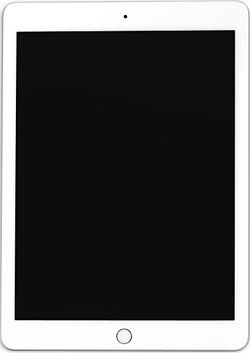
The fifth generation iPad shares most design elements with the iPad Air, with a 9.7-inch (25 cm) screen, 7.5 mm (0.30 in) thickness, and differences such as the lack of the physical mute switch, smaller microphone holes and only a single row of speaker holes, and storage. Compared to the iPad Air 2, the processor is updated from the Apple A8X to the A9 with the embedded Apple M9 motion co-processor. The fifth generation iPad has 2 gigabytes of RAM. Unlike other iPad models available, this iPad's display is not fully laminated and does not have anti-reflective coating. However, this iPad has a brighter screen than the iPad Air 2 (25% brighter according to Apple). It is available in 32 and 128 GB storage options. Contrasting with the iPad Pro lineup, this iPad features only two speakers (as opposed to four), has no Smart Connector support, and has no camera flash. It is offered in silver, gold, and space grey colors. Despite its use of the Apple A9 processor and accompanying M9 motion co-processor, introduced with the iPhone 6S in 2015, the iPad does not feature support for always-on "Hey Siri" voice input, a feature advertised as being made possible by low-power processing in the then-new chips. The use of "Hey Siri" is limited to when the iPad is connected to power.
At the time of its original release, the iPad shipped with iOS 10, a version of Apple's mobile operating system. New units sold come with the new iOS 11 operating system after its Fall 2017 release. The included Touch ID fingerprint sensor allows the user to unlock the device as well as approve purchases from the App Store, iTunes Store, and Apple Books Store. Touch ID and Apple Pay let the user purchase items from websites or from within apps.
IPad (5th generation)
The iPad (5th generation) (also referred to as the iPad 9.7-inch) is a tablet computer developed and marketed by Apple. After its announcement on March 21, 2017, conflicting naming conventions spawned a number of different names, including "fifth-generation iPad" or "iPad (2017)".
The device was released five years after the previous fourth-generation iPad, as the iPad Air was released in 2013 as the successor to the iPad lineup. The iPad Air lineup later continued as a separate, higher-end device, while the iPad was positioned as an entry-level model.
Unlike the iPad Air 2, this iPad does not have a fully laminated display, and also lacks an anti-reflective coating.
On March 27, 2018, Apple announced its successor, the sixth-generation iPad.
This iPad model was announced by Apple on March 24, 2017 in a press release. There has been confusion around its naming, being referred to as just "iPad" in marketing, but called the "fifth-generation iPad" in official statements and specifications sheets, a title previously taken by 2013's iPad Air. Other sources refer to it as the "seventh-generation iPad", when including the iPad Air and iPad Air 2 as the fifth- and sixth-generation iPads respectively. It has also been referred to as "iPad 2017".
Matt Kapko of CIO wrote that Apple's introductory pricing of $329 in the United States for the iPad, a $70 price reduction vs the iPad Air 2, appeared to be designed to fend off the encroachment of Google's Chromebook laptops in the education sector and to foster wider adoption in customer-facing terminals. Kapko also wrote that the device is designed to appeal to businesses that require inexpensive tablets for undemanding use, including as kiosks, checkout terminals, and hospitality screens.
The fifth generation iPad shares most design elements with the iPad Air, with a 9.7-inch (25 cm) screen, 7.5 mm (0.30 in) thickness, and differences such as the lack of the physical mute switch, smaller microphone holes and only a single row of speaker holes, and storage. Compared to the iPad Air 2, the processor is updated from the Apple A8X to the A9 with the embedded Apple M9 motion co-processor. The fifth generation iPad has 2 gigabytes of RAM. Unlike other iPad models available, this iPad's display is not fully laminated and does not have anti-reflective coating. However, this iPad has a brighter screen than the iPad Air 2 (25% brighter according to Apple). It is available in 32 and 128 GB storage options. Contrasting with the iPad Pro lineup, this iPad features only two speakers (as opposed to four), has no Smart Connector support, and has no camera flash. It is offered in silver, gold, and space grey colors. Despite its use of the Apple A9 processor and accompanying M9 motion co-processor, introduced with the iPhone 6S in 2015, the iPad does not feature support for always-on "Hey Siri" voice input, a feature advertised as being made possible by low-power processing in the then-new chips. The use of "Hey Siri" is limited to when the iPad is connected to power.
At the time of its original release, the iPad shipped with iOS 10, a version of Apple's mobile operating system. New units sold come with the new iOS 11 operating system after its Fall 2017 release. The included Touch ID fingerprint sensor allows the user to unlock the device as well as approve purchases from the App Store, iTunes Store, and Apple Books Store. Touch ID and Apple Pay let the user purchase items from websites or from within apps.
Recent media
Recent media