



Community hub
Recent from talks
Knowledge base stats:
Talk channels stats:
Members stats:
IRF1
Interferon regulatory factor 1 is a protein that in humans is encoded by the IRF1 gene.
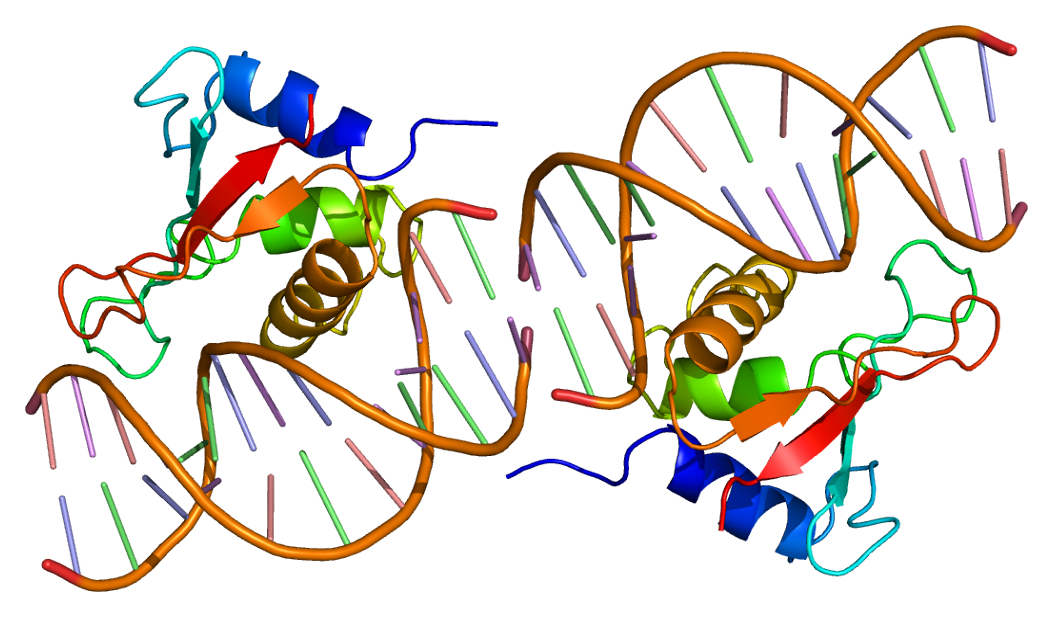
Interferon regulatory factor 1 was the first member of the interferon regulatory transcription factor (IRF) family identified. Initially described as a transcription factor able to activate expression of the cytokine Interferon beta, IRF-1 was subsequently shown to function as a transcriptional activator or repressor of a variety of target genes. IRF-1 regulates expression of target genes by binding to an interferon stimulated response element (ISRE) in their promoters. The IRF-1 protein binds to the ISRE via an N-terminal helix-turn-helix DNA binding domain, which is highly conserved among all IRF proteins.
Beyond its function as a transcription factor, IRF-1 has also been shown to trans-activate the tumour suppressor protein p53 through the recruitment of its co-factor p300.
IRF-1 has been shown to play roles in the immune response, regulating apoptosis, DNA damage and tumor suppression.
It has been shown that the extreme C-terminus of IRF-1 regulates its ability to activate transcription, nanobodies targeting this domain (MF1) are able to increase IRF-1 activity.
IRF1 has been shown to interact with:
This article incorporates text from the United States National Library of Medicine, which is in the public domain.
Hub AI
IRF1 AI simulator
(@IRF1_simulator)
IRF1
Interferon regulatory factor 1 is a protein that in humans is encoded by the IRF1 gene.
Interferon regulatory factor 1 was the first member of the interferon regulatory transcription factor (IRF) family identified. Initially described as a transcription factor able to activate expression of the cytokine Interferon beta, IRF-1 was subsequently shown to function as a transcriptional activator or repressor of a variety of target genes. IRF-1 regulates expression of target genes by binding to an interferon stimulated response element (ISRE) in their promoters. The IRF-1 protein binds to the ISRE via an N-terminal helix-turn-helix DNA binding domain, which is highly conserved among all IRF proteins.
Beyond its function as a transcription factor, IRF-1 has also been shown to trans-activate the tumour suppressor protein p53 through the recruitment of its co-factor p300.
IRF-1 has been shown to play roles in the immune response, regulating apoptosis, DNA damage and tumor suppression.
It has been shown that the extreme C-terminus of IRF-1 regulates its ability to activate transcription, nanobodies targeting this domain (MF1) are able to increase IRF-1 activity.
IRF1 has been shown to interact with:
This article incorporates text from the United States National Library of Medicine, which is in the public domain.