



Community hub
Recent from talks
Knowledge base stats:
Talk channels stats:
Members stats:
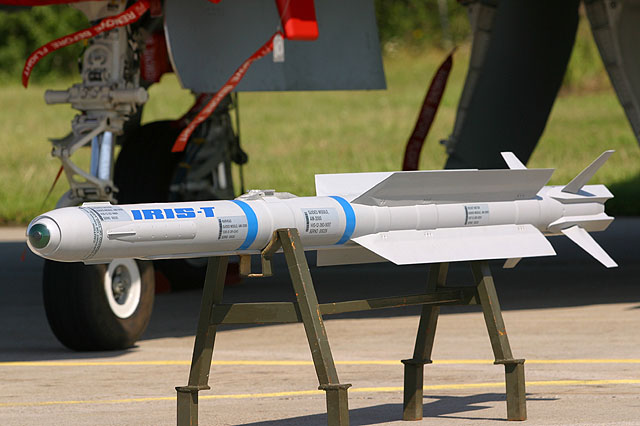
IRIS-T
The IRIS-T (infrared imaging system tail/thrust vector-controlled) is a short range infrared homing air-to-air missile. It is also called AIM-2000. The missile also has other variants, including the surface-to-air-launched IRIS-T SLS and IRIS-T SLM and their derivatives.
The missile was developed in the late 1990s–early 2000s by a German-led program to produce a short to medium range infrared homing air-to-air missile to replace the AIM-9 Sidewinder in use by some NATO member countries at the time. A goal of the program was for any aircraft capable of firing the Sidewinder to also be capable of launching the IRIS-T. The air-to-air variant was fielded in 2005.
In August 1980, the USA, the UK, Germany and France signed a Memorandum of understanding which aimed to develop two types of AAMs to replace existing ones. The USA developed the Advanced Medium-Range Air-to-Air Missile (AMRAAM) to replace the AIM-7 Sparrow, while the Europe team developed the Advanced Short-Range Air-to-Air Missile (ASRAAM) to replace the AIM-9 Sidewinder. This work was dusted off for the UK–German effort, with the Germans providing a new seeker, and the UK providing most of the remaining components.
In 1987, after years of silence on the program, the US proposed a requirement that the weapon must use Sidewinder rails rather than the universal aircraft rail adaptor named the "missile support unit" that had been developed. This delayed the project by one year as the British, German and Norwegian proposals were redesigned. Fearing erosion of its industrial base, the US proposed it would choose the latest version of its existing Sidewinder design with increased manoeuvrability and IRCCM unless the European partners increased the US industrial workshare, designated AIM-9X. However, the Sidewinder upgrade proposal failed to interest NATO buyers.
After German reunification in 1990, Germany found itself with large stockpiles of the Soviet Vympel R-73 air-to-air missiles (NATO reporting name: AA-11 Archer) carried by the MiG-29 Fulcrum and concluded that its capabilities had been noticeably underestimated. It was one of the earliest 4th generation WVRAAM and more capable in dogfight than the former 3rd generation ones. In 1990, Germany withdrew from the ASRAAM project, while the UK resolved to find another seeker and develop ASRAAM according to the original range requirement. In 1992, the missile development programme ultimately separated with the UK the ASRAAM, France the MBDA MICA, US the AIM-9X and Germany electing to restart development on what became the IRIS-T.
In 1995, Germany announced the start of the IRIS-T development, in collaboration with Greece, Italy, Norway, Sweden and Canada. In 1997, Germany had invested more than 500 million DM in this project and held a 46% share. In addition, Italy accounted for 20%, Sweden 18%, Greece 8%, Canada 4% and Norway 3%. Canada later dropped out, while Spain joined as a procurement partner in 2003. The German Air Force took first delivery of the missile in December 2005.
In comparison to the AIM-9M Sidewinder, the IRIS-T has higher ECM resistance and flare suppression. Improvements in target discrimination allow for five to eight times longer head-on firing range than the AIM-9L and three to four times longer target acquiring range than the AIM-9M. Its seeker can receive cues from radar, helmet mounted display, infrared search and track device, missile approach warner and data link. It can engage targets behind the launching aircraft, made possible by extreme close-in agility, allowing turns of 60 g at a rate of 60°/s via thrust vectoring and LOAL capability.
The IRIS-T belongs to 5th generation IR-guided missiles which introduce infrared imaging seeker. Compared to the other 5th generation IR-guided missiles, such as AIM-9X, ASRAAM which use staring array, the IRIS-T uses an InSb two-colour seeker based around a 128x2 linear array and a scanning mirror which builds an image from a row of detector elements and scans rapidly across the target. It would produce a 128x128 size image 80 times per second. Each of the elements has a resolution in milliradians. It was regarded to have good resistance against DIRCM. Bodenseewerk Gerätetechnik GmbH (BGT) claimed that scanning arrays were less susceptible than staring arrays as the former receive the DIRCM energy for fractions of a second whereas the latter receive it continuously.
Hub AI
IRIS-T AI simulator
(@IRIS-T_simulator)
IRIS-T
The IRIS-T (infrared imaging system tail/thrust vector-controlled) is a short range infrared homing air-to-air missile. It is also called AIM-2000. The missile also has other variants, including the surface-to-air-launched IRIS-T SLS and IRIS-T SLM and their derivatives.
The missile was developed in the late 1990s–early 2000s by a German-led program to produce a short to medium range infrared homing air-to-air missile to replace the AIM-9 Sidewinder in use by some NATO member countries at the time. A goal of the program was for any aircraft capable of firing the Sidewinder to also be capable of launching the IRIS-T. The air-to-air variant was fielded in 2005.
In August 1980, the USA, the UK, Germany and France signed a Memorandum of understanding which aimed to develop two types of AAMs to replace existing ones. The USA developed the Advanced Medium-Range Air-to-Air Missile (AMRAAM) to replace the AIM-7 Sparrow, while the Europe team developed the Advanced Short-Range Air-to-Air Missile (ASRAAM) to replace the AIM-9 Sidewinder. This work was dusted off for the UK–German effort, with the Germans providing a new seeker, and the UK providing most of the remaining components.
In 1987, after years of silence on the program, the US proposed a requirement that the weapon must use Sidewinder rails rather than the universal aircraft rail adaptor named the "missile support unit" that had been developed. This delayed the project by one year as the British, German and Norwegian proposals were redesigned. Fearing erosion of its industrial base, the US proposed it would choose the latest version of its existing Sidewinder design with increased manoeuvrability and IRCCM unless the European partners increased the US industrial workshare, designated AIM-9X. However, the Sidewinder upgrade proposal failed to interest NATO buyers.
After German reunification in 1990, Germany found itself with large stockpiles of the Soviet Vympel R-73 air-to-air missiles (NATO reporting name: AA-11 Archer) carried by the MiG-29 Fulcrum and concluded that its capabilities had been noticeably underestimated. It was one of the earliest 4th generation WVRAAM and more capable in dogfight than the former 3rd generation ones. In 1990, Germany withdrew from the ASRAAM project, while the UK resolved to find another seeker and develop ASRAAM according to the original range requirement. In 1992, the missile development programme ultimately separated with the UK the ASRAAM, France the MBDA MICA, US the AIM-9X and Germany electing to restart development on what became the IRIS-T.
In 1995, Germany announced the start of the IRIS-T development, in collaboration with Greece, Italy, Norway, Sweden and Canada. In 1997, Germany had invested more than 500 million DM in this project and held a 46% share. In addition, Italy accounted for 20%, Sweden 18%, Greece 8%, Canada 4% and Norway 3%. Canada later dropped out, while Spain joined as a procurement partner in 2003. The German Air Force took first delivery of the missile in December 2005.
In comparison to the AIM-9M Sidewinder, the IRIS-T has higher ECM resistance and flare suppression. Improvements in target discrimination allow for five to eight times longer head-on firing range than the AIM-9L and three to four times longer target acquiring range than the AIM-9M. Its seeker can receive cues from radar, helmet mounted display, infrared search and track device, missile approach warner and data link. It can engage targets behind the launching aircraft, made possible by extreme close-in agility, allowing turns of 60 g at a rate of 60°/s via thrust vectoring and LOAL capability.
The IRIS-T belongs to 5th generation IR-guided missiles which introduce infrared imaging seeker. Compared to the other 5th generation IR-guided missiles, such as AIM-9X, ASRAAM which use staring array, the IRIS-T uses an InSb two-colour seeker based around a 128x2 linear array and a scanning mirror which builds an image from a row of detector elements and scans rapidly across the target. It would produce a 128x128 size image 80 times per second. Each of the elements has a resolution in milliradians. It was regarded to have good resistance against DIRCM. Bodenseewerk Gerätetechnik GmbH (BGT) claimed that scanning arrays were less susceptible than staring arrays as the former receive the DIRCM energy for fractions of a second whereas the latter receive it continuously.