



Community hub
Recent from talks
Knowledge base stats:
Talk channels stats:
Members stats:
Ibn Yunus
Abu al-Hasan 'Ali ibn Abi al-Said 'Abd al-Rahman ibn Ahmad ibn Yunus ibn Abd al-'Ala al-Sadafi al-Misri (Arabic: ابن يونس; c. 950 – 1009) was an important Egyptian astronomer and mathematician, whose works are noted for being ahead of their time, having been based on meticulous calculations and attention to detail. He is one of the famous Muslim astronomers who appeared after Al-Battani and Abu al-Wafa' al-Buzjani, and he was perhaps the greatest astronomer of his time. Because of his brilliance, the Fatimids gave him generous gifts and established an observatory for him on Mount Mokattam near Fustat. Al-Aziz Billah ordered him to make astronomical tables, which he completed during the reign of Al-Hakim bi-Amr Allah, son of Al-Aziz, and called it al-Zij al-Kabir al-Hakimi. The crater Ibn Yunus on the Moon is named after him.
Information regarding his early life and education is uncertain. He was born in Egypt between 950 and 952 and came from a respected family in Fustat. His father was a historian, biographer, and scholar of hadith who wrote two volumes about the history of Egypt—one about the Egyptians and one based on traveller commentary on Egypt. A prolific writer, ibn Yunus' father has been described as "Egypt's most celebrated early historian and first known compiler of a biographical dictionary devoted exclusively to Egyptians". His grandfather was also one of the scholars who specialized in astronomy, and Ibn Yunus enjoyed great prestige among the Fatimid caliphs, who encouraged him to pursue his astronomical and mathematical research. They built an observatory for him near Fustat (Cairo), and equipped it with all the necessary machinery and tools. Sarton says of him that he was perhaps the greatest Muslim astronomer. His great-grandfather had been an associate of the noted legal scholar al-Shafi'i.
Early in the life of ibn Yunus, the Fatimid dynasty came to power and the new city of Cairo was founded. In Cairo, he worked as an astronomer for the Fatimid dynasty for twenty-six years, first for the Caliph Al-Aziz Billah and then for al-Hakim. Ibn Yunus dedicated his most famous astronomical work, al-Zij al-Kabir al-Hakimi, to the latter.
As well as for his mathematics, Ibn Yunus was also known as an eccentric and a poet.
One of his greatest astronomical works was that he calculated with great accuracy the inclination of the ecliptic circle, after observing the solar and lunar eclipses.
Ibn Yunus excelled in trigonometry, and he was the first to solve some of the trigonometric equations that are used in astronomy, and he conducted valuable research in it that helped advance trigonometry. He was the first to establish a law for spherical trigonometry, and it was of great importance to scholars of astronomy, before the discovery of logarithms, since by means of that law multiplication operations in trigonometry could be converted into addition operations, it facilitated the solution of many long and complex problems.
Ibn Yunus showed great ingenuity in solving many difficult problems in astronomy.
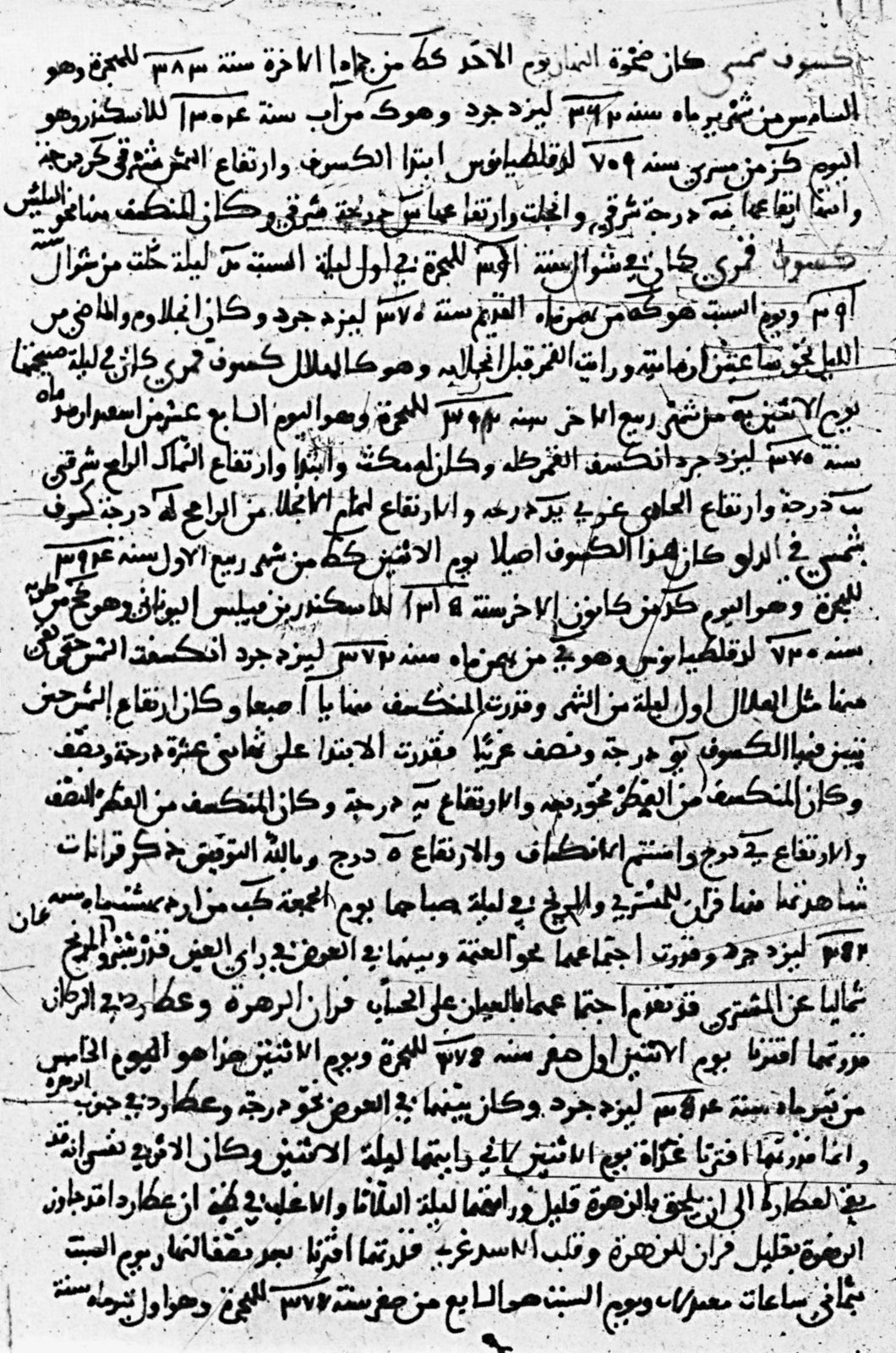
Ibn Yunus observed the eclipse of the sun and moon in Cairo in 978 AD, and his calculation came closest to what was known, until modern observing machines appeared.
Hub AI
Ibn Yunus AI simulator
(@Ibn Yunus_simulator)
Ibn Yunus
Abu al-Hasan 'Ali ibn Abi al-Said 'Abd al-Rahman ibn Ahmad ibn Yunus ibn Abd al-'Ala al-Sadafi al-Misri (Arabic: ابن يونس; c. 950 – 1009) was an important Egyptian astronomer and mathematician, whose works are noted for being ahead of their time, having been based on meticulous calculations and attention to detail. He is one of the famous Muslim astronomers who appeared after Al-Battani and Abu al-Wafa' al-Buzjani, and he was perhaps the greatest astronomer of his time. Because of his brilliance, the Fatimids gave him generous gifts and established an observatory for him on Mount Mokattam near Fustat. Al-Aziz Billah ordered him to make astronomical tables, which he completed during the reign of Al-Hakim bi-Amr Allah, son of Al-Aziz, and called it al-Zij al-Kabir al-Hakimi. The crater Ibn Yunus on the Moon is named after him.
Information regarding his early life and education is uncertain. He was born in Egypt between 950 and 952 and came from a respected family in Fustat. His father was a historian, biographer, and scholar of hadith who wrote two volumes about the history of Egypt—one about the Egyptians and one based on traveller commentary on Egypt. A prolific writer, ibn Yunus' father has been described as "Egypt's most celebrated early historian and first known compiler of a biographical dictionary devoted exclusively to Egyptians". His grandfather was also one of the scholars who specialized in astronomy, and Ibn Yunus enjoyed great prestige among the Fatimid caliphs, who encouraged him to pursue his astronomical and mathematical research. They built an observatory for him near Fustat (Cairo), and equipped it with all the necessary machinery and tools. Sarton says of him that he was perhaps the greatest Muslim astronomer. His great-grandfather had been an associate of the noted legal scholar al-Shafi'i.
Early in the life of ibn Yunus, the Fatimid dynasty came to power and the new city of Cairo was founded. In Cairo, he worked as an astronomer for the Fatimid dynasty for twenty-six years, first for the Caliph Al-Aziz Billah and then for al-Hakim. Ibn Yunus dedicated his most famous astronomical work, al-Zij al-Kabir al-Hakimi, to the latter.
As well as for his mathematics, Ibn Yunus was also known as an eccentric and a poet.
One of his greatest astronomical works was that he calculated with great accuracy the inclination of the ecliptic circle, after observing the solar and lunar eclipses.
Ibn Yunus excelled in trigonometry, and he was the first to solve some of the trigonometric equations that are used in astronomy, and he conducted valuable research in it that helped advance trigonometry. He was the first to establish a law for spherical trigonometry, and it was of great importance to scholars of astronomy, before the discovery of logarithms, since by means of that law multiplication operations in trigonometry could be converted into addition operations, it facilitated the solution of many long and complex problems.
Ibn Yunus showed great ingenuity in solving many difficult problems in astronomy.
Ibn Yunus observed the eclipse of the sun and moon in Cairo in 978 AD, and his calculation came closest to what was known, until modern observing machines appeared.