


Community hub
Recent from talks
Contribute something
Nothing was collected or created yet.
Hadith
View on Wikipedia| Part of a series on |
| Hadith |
|---|
 |
 Islam portal • Category Islam portal • Category |
| ||
|---|---|---|
|
Career Views and Perspectives
|
||


Hadith[b] is the Arabic word for a 'report' or an 'account [of an event]'[3][4][5]: 471 and refers to the Islamic oral tradition of anecdotes containing the purported words, actions, and the silent approvals of the Islamic prophet Muhammad or his immediate circle (companions in Sunni Islam,[6][7] Ahl al-Bayt in Shiite Islam).[8]
Each hadith is associated with a chain of narrators (isnad), a lineage of people who reportedly heard and repeated the hadith from which the source of the hadith can be traced.[9] The authentication of hadith became a significant discipline, focusing on the isnad (chain of narrators) and matn (main text of the report).[10][11][12][13][14] This process aimed to address contradictions and questionable statements within certain narrations.[15] Beginning one or two centuries after Muhammad's death, Islamic scholars, known as muhaddiths, compiled hadith into distinct collections that survive in the historical works of writers from the second and third centuries of the Muslim era (c. 700−1000 CE).
For many Muslim sects, hadith was a reliable source for religious and moral guidance known as sunnah, which ranks second to that of the Quran in authority,[16] widely respected in mainstream Islamic thought, so that the majority of Sharia rules derived from hadith rather than the Quran.[17][Note 1] However, in the early Islamic society the use of hadith as it is understood today (documentation, isnads, etc.) came gradually. Sunnah originally meant a tradition that did not contain the definition of good and bad.[19][20][21][22][23] Later, "good traditions" began to be referred to as sunnah and the concept of "Muhammad's sunnah" was established.[19] Muhammad's sunnah gave way to the "hadiths of Muhammad"[3] which were being transmitted orally, then recorded in the corpuses that continued to be collected, classified and purified according to various criteria in the following centuries. Scholars have categorized hadith based on their reliability, sorting them into classifications such as sahih ('authentic'), hasan ('good'), and da'if ('weak').[24] This classification is subjective to the person doing this study[25] and differences in classification have led to variations in practices among the different Islamic schools and branches.[26] The study of hadith is a central discipline in Islam, known as the hadith sciences, and is also examined in the contemporary historiographical field of hadith studies.
After being compiled in the 10th and 11th centuries, the Hadith were originally imposed in the 14th century by socio-political and spiritual authorities.[27] A minority of Muslims criticise the hadith and reject them, including Quranists, who assert that Islamic guidance should rely solely on the Quran. They argue that many hadith are fabrications (pseudepigrapha) from the 8th and 9th centuries, falsely attributed to Muhammad.[28][29] Historically, some sects of the Kharijites also rejected the hadiths, while Mu'tazilites rejected the hadiths as the basis for Islamic law, while at the same time accepting the Sunnah and Ijma.[30][31]
Western scholars participating in the field of hadith studies are generally skeptical of the value of hadith for understanding the true historical Muhammad. Reasons for skepticism include the late compilation of hadith (often centuries after Muhammad’s death), difficulties in verifying chains of transmission, the prevalence of hadith fabrication, and doubts about the traditional methods of hadith authentication. This skepticism extends even to hadith classified as sahih by Muslim scholars, as such narrations may still reflect later historical or theological concerns rather than the authentic teachings of Muhammad.[9][32]
Etymology
[edit]In Arabic, the noun ḥadīth (حديث IPA: [ħæˈdiːθ]) means 'report', 'account', or 'narrative'.[33][34] Its Arabic plural is aḥādīth (أحاديث [ʔæħæːˈdiːθ]).[3] Hadith also refers to the speech of a person.[35]
Definition / Evolution of the concept
[edit]In Islamic terminology, according to Juan Campo, the term hadith refers to reports of statements or actions of Muhammad, or of his tacit approval or criticism of something said or done in his presence.[14] Classical hadith specialist Ibn Hajar al-Asqalani says that the intended meaning of hadith in religious tradition is something attributed to Muhammad, but that is not found in the Quran.[36]
In contrast, according to the Shia Islam Ahlul Bayt Digital Library Project, "when there is no clear Qur'anic statement, nor is there a Hadith upon which Muslim schools have agreed. ... Shi'a ... refer to Ahlul-Bayt [the family of Muhammad] to derive the Sunnah of the Prophet, implying that while hadith is limited to the "Traditions" of Muhammad, the Shi'a Sunna draws on the sayings, etc. of the Ahlul-Bayt, i.e. the Imams of Shi'a Islam.[37]
Hadith may be hadith qudsi (sacred hadith)—which some Muslims regard as the words of God[38]—or hadith sharif (noble hadith), which are Muhammad's own utterances.[39] According to as-Sayyid ash-Sharif al-Jurjani, the hadith qudsi differ from the Quran in that the former are "expressed in Muhammad's words", whereas the latter are the "direct words of God". A hadith qudsi need not be a sahih (sound hadith), but may be da'if (weak) or even mawdu' (fabricated).[40]
An example of a hadith qudsi is the hadith of Abu Hurairah who said that Muhammad said:
When God decreed the Creation He pledged Himself by writing in His book which is laid down with Him: My mercy prevails over My wrath.[41][non-primary source needed]
Non-prophetic hadith; Scholar Patricia Crone includes reports by others than Muhammad in her definition of hadith: "short reports (sometimes just a line or two) recording what an early figure, such as a companion of the prophet or Muhammad himself, said or did on a particular occasion, preceded by a chain of transmitters". However, she adds that "nowadays, hadith almost always means hadith from Muhammad himself."[42] Joseph Schacht quotes a hadith of Muhammad that is used "to justify reference" in Islamic law to the companions of Muhammad as religious authorities—"My companions are like lodestars."[43][44][45]
According to Schacht, (and other scholars)[46][47] in the very first generations after the death of Muhammad, use of hadith from Sahabah ("companions" of Muhammad) and Tabi'un ("successors" of the companions) "was the rule", while use of hadith of Muhammad himself by Muslims was "the exception".[48] Schacht credits Al-Shafi'i—founder of the Shafi'i school of fiqh (or madh'hab)—with establishing the principle of the using the hadith of Muhammad for Islamic law, and emphasizing the inferiority of hadith of anyone else, saying hadiths:
"... from other persons are of no account in the face of a tradition from the Prophet, whether they confirm or contradict it; if the other persons had been aware of the tradition from the Prophet, they would have followed it".[49][50]
This led to "the almost complete neglect" of traditions from the Companions and others.[51]


Collections of hadith sometimes mix those of Muhammad with the reports of others. Muwatta Imam Malik is usually described as "the earliest written collection of hadith" but sayings of Muhammad are "blended with the sayings of the companions",[54] (822 hadith from Muhammad and 898 from others, according to the count of one edition).[55][56] In Introduction to Hadith by Abd al-Hadi al-Fadli, Kitab Ali is referred to as "the first hadith book of the Ahl al-Bayt (family of Muhammad) to be written on the authority of the Prophet".[57] Hadiths were classified as follows according to the last person to whom they were attributed in the chain of narration; the acts, statements or approvals of Muhammad are called "Marfu hadith", while those of companions are called "mawquf (موقوف) hadith", and those of Tabi'un are called "maqtu' (مقطوع) hadith".
Relationship with sunnah
[edit]The word sunnah is also used in reference to a normative custom of Muhammad or the early Muslim community.[14] Joseph Schacht describes hadith as providing "the documentation" of the sunnah.[48] Some sources (Khaled Abou El Fadl) limit hadith to verbal reports, with the deeds of Muhammad and reports about his companions being part of the sunnah, but not hadith.[58]
Another source (Joseph A. Islam) distinguishes between the two saying:
Whereas the 'Hadith' is an oral communication that is allegedly derived from the Prophet or his teachings, the 'Sunna' (quite literally: mode of life, behaviour or example) signifies the prevailing customs of a particular community or people. ... A 'Sunna' is a practice which has been passed on by a community from generation to generation en masse, whereas the hadith are reports collected by later compilers often centuries removed from the source. ... A practice which is contained within the Hadith may well be regarded as Sunna, but it is not necessary that a Sunna would have a supporting hadith sanctioning it.[59]
Sunnah originally meant a tradition (urf) that did not mean good or bad.[19][20][21][22][23] Later, "good traditions" began to be referred to as sunnah in Islamic community and the concept of "Muhammad's sunnah" was established.[19] Muhammad's sunnah gave way to the "hadiths of Muhammad" which were transmitted orally,[3] then recorded in corpuses and systematized and purified within following centuries. Hadiths were later placed in a respected place among the sources of sharia in many Islamic sects, and thus replaced the sunnah in the establishment of sharia.
Similar literature
[edit]Islamic literary classifications similar to hadith (but not sunnah) are maghazi and sira. They differ from hadith in that they are organized "relatively chronologically" rather than by subject.
- Sīrat (literally 'way of going' or 'conduct'), biographies of Muhammad, written since the middle of the eighth century. Similar writings called maghazi (literally 'raid') preceded the sīrat literature, focusing on military actions of Muhammad, but also included non-military aspects of his life.[60] Therefore, there is overlap in the meaning of the terms, although maghazi suggests military aspects rather than general biographical ones.
Other traditions of Islam related to hadith include:
- Khabar (literally news, information, pl. akhbar) may be used as a synonym for hadith, but some scholars use it to refer to traditions about Muhammad's companions and their successors from the following generation, in contrast to hadith as defined as traditions about Muhammad himself. Another definition (by Ibn Warraq) describes them as "discrete anecdotes or reports" from early Islam which "include simple statements, utterances of authoritative scholars, saints, or statesmen, reports of events, and stories about historical events all varying in length from one line to several pages."[61]
- Conversely, athar (trace, remnant) usually refers to traditions about the companions and successors, though sometimes connotes traditions about Muhammad.
Compilation and collections
[edit]The hadith literature in use today is based on spoken reports in circulation after the death of Muhammad. Hadith were not promptly written down during Muhammad's lifetime or immediately after his death.[3] Hadiths are oral cultural products consisting of words and deeds, the majority of which were documented several centuries after the time of Muhammad (Sunni sources, approximately 200–300 years and Shiite hadith books 400–500) and attributed to Muhammad through a chain of narrators over 1-2 mi away from where Muhammad is thought to have lived.
Different branches of Islam refer to different collections of hadith, although the same incident may be found in hadith from different collections. In general, the difference between Shi'a and Sunni collections is that Shia give preference to hadiths attributed to Muhammad's family and close companions (Ahl al-Bayt), while Sunnis do not consider family lineage in evaluating hadith and sunnah narrated by any of twelve thousand companions of Muhammad.[62]
Sunni
[edit]
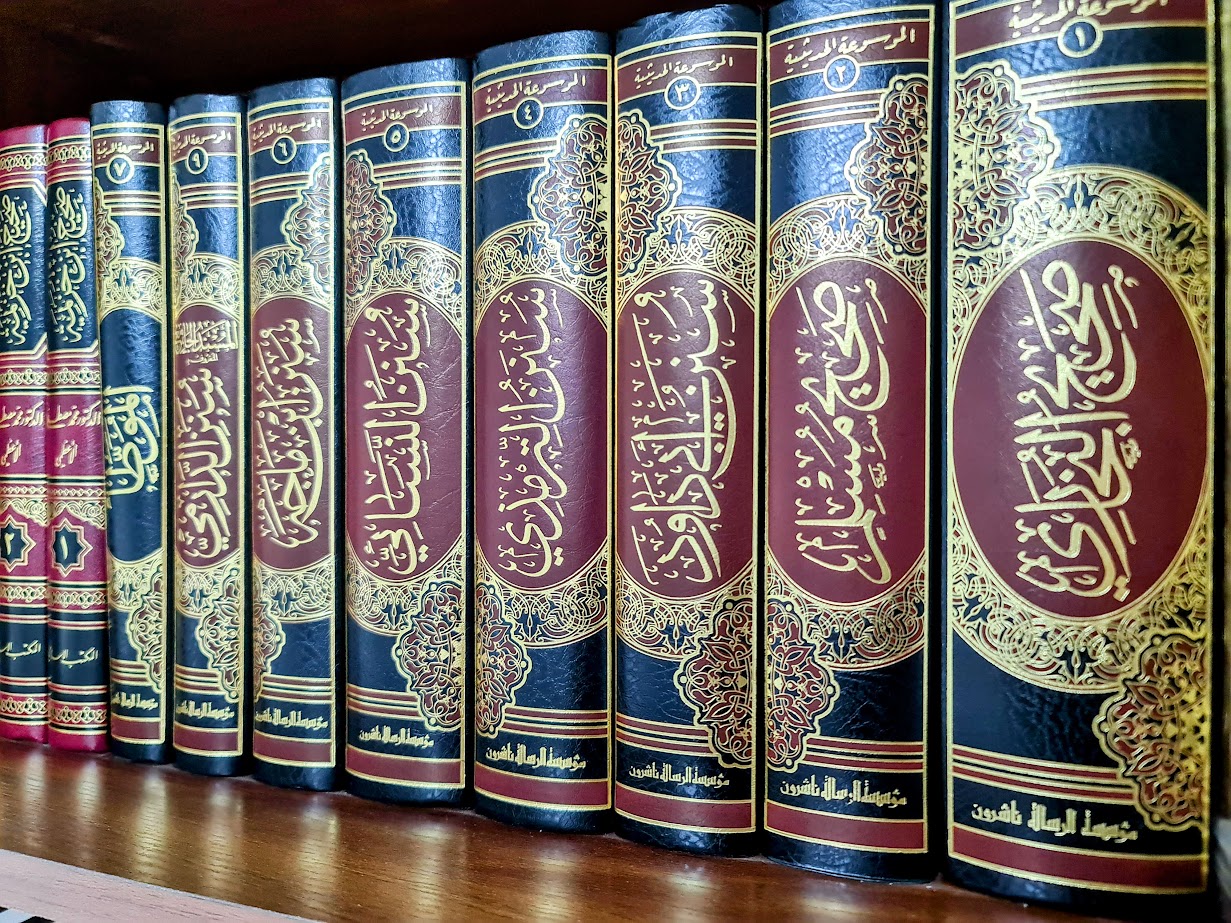
- In the Sunni branch of Islam, the canonical hadith collections are the six books, of which Sahih al-Bukhari and Sahih Muslim generally have the highest status. The other books of hadith are Sunan Abu Dawood, Jami' al-Tirmidhi, Al-Sunan al-Sughra and Sunan ibn Majah. However the Malikis, one of the four Sunni "schools of thought" (madhhabs), traditionally reject Sunan ibn Majah and assert the canonical status of Muwatta Imam Malik.
Shia
[edit]- In the Twelver Shi'a branch of Islam, the canonical hadith collections are the Four Books: Kitab al-Kafi, Man la yahduruhu al-Faqih, Tahdhib al-Ahkam, and Al-Istibsar.
- The Ismaili shia sects use the Da'a'im al-Islam as their hadith collection.
Ibadi
[edit]- In the Ibadi branch of Islam, the main canonical collection is the Tartib al-Musnad. This is an expansion of the earlier Jami Sahih collection, which retains canonical status in its own right.
Others
[edit]Impact
[edit]The hadith have been called by American-Sunni scholar Jonathan A. C. Brown as "the backbone" of Islamic civilization.[63] Much of the early Islamic history available today is also based on the hadith, although it has been challenged for its lack of basis in primary source material and the internal contradictions of available secondary material.[64]
The hadith had a profound and controversial influence on tafsir (commentaries of the Quran). The earliest commentary of the Quran known as Tafsir Ibn Abbas is sometimes attributed to the companion Ibn Abbas. "Many thousands of times" more numerous than the verses of the Quran,[65] hadith have been described as resembling layers surrounding the "core" of Islamic beliefs (the Quran). Well-known, widely accepted hadith make up the narrow inner layer, with a hadith becoming less reliable and accepted with each layer stretching outward.[26]
The hadith were used the form the basis of sharia (the religious law system forming part of the Islamic tradition), and fiqh (Islamic jurisprudence). The hadith are at the root of why there is no single fiqh system, but rather a collection of parallel systems within Islam. Some important elements, which are today taken to be a long-held part of Islamic practice and belief are not mentioned in the Quran, but are reported in hadiths.[18] The reports of Muhammad's (and sometimes his companions') behavior collected by hadith compilers include details of ritual religious practice such as the five salat (obligatory Islamic prayers) that are not found in the Quran, as well as everyday behavior such as table manners,[66] dress,[67] and posture.[68] Hadith are also regarded by Muslims as important tools for understanding things mentioned in the Quran but not explained, a source for tafsir (commentaries written on the Quran). Therefore, Muslims usually maintain that hadiths are a necessary requirement for the true and proper practice of Islam, as it gives Muslims the nuanced details of Islamic practice and belief in areas where the Quran is silent. Details of the prescribed movements and words of the prayer (known as rak'a) and how many times they are to be performed, are found in hadith. However, hadiths differ on these details and consequently salat is performed differently by different hadithist Islamic sects.[c]
Quranists, on the other hand, believe that if the Quran is silent on some matter, it is because God did not hold its detail to be of consequence; and that some hadith contradict the Quran, proving that some hadith are a source of corruption and not a complement to the Quran.[71]
Hadiths were also deployed to legitimize Sufism’s more formal structures of brotherhoods (tariqas), hierarchies of initiation, and rituals that were articulated from the 9th century onward. Some readings had a ceremonial value sanctifying occasions such as the ascent of a dynast or the birth of a child. (a religious scholar, religious or political leader)[72]
History, tradition and usage
[edit]History
[edit]According to British historian of Arab world Alfred Guillaume, it is "certain" that "several small collections" of hadith were "assembled in Umayyad times."[73] There are conflicting reports as to whether recording hadiths from the pre-Umayyad period was recommended[74][75] or prohibited, and there is no extant collection of hadiths from this period.[76] (see:Ban on Hadith)
In Islamic law, the use of hadith as it is understood today (hadith of Muhammad with documentation, isnads, etc.) came gradually. According to scholars such as Joseph Schacht, Ignaz Goldziher, and Daniel W. Brown, early schools of Islamic jurisprudence[77] used the rulings of the Prophet's Companions, the rulings of the Caliphs, and practices that "had gained general acceptance among the jurists of that school". On his deathbed, Caliph Umar instructed Muslims to seek guidance from the Quran, the early Muslims (muhajirun) who emigrated to Medina with Muhammad, the Medina residents who welcomed and supported the muhajirun (the ansar) and the people of the desert.[78]
It was Abū ʿAbdullāh Muhammad ibn Idrīs al-Shāfiʿī (150-204 AH), known as al-Shafi'i,[79][47] who emphasized the final authority of a hadith of Muhammad, so that even the Quran was "to be interpreted in the light of traditions (i.e. hadith), and not vice versa."[80][81] While traditionally the Qur'an has traditionally been considered superior in authority to the sunna, Al-Shafi'i "forcefully argued" that the sunna was "on equal footing with the Quran", (according to scholar Daniel Brown) for (as Al-Shafi'i put it) "the command of the Prophet is the command of God."[82][83] According to the scholars Harald Motzki and Daniel W. Brown the earliest Islamic legal reasonings that have come down to us were "virtually hadith-free", but gradually, over the course of second century A.H. "the infiltration and incorporation of Prophetic hadiths into Islamic jurisprudence" took place.[84][85]
In 851 the rationalist Mu`tazila school of thought fell out of favor in the Abbasid Caliphate.[citation needed] The Mu`tazila, for whom the "judge of truth ... was human reason,"[86] had clashed with traditionists who looked to the literal meaning of the Quran and hadith for truth. While the Quran had been officially compiled and approved, hadiths had not. One result was the number of hadiths began "multiplying in suspiciously direct correlation to their utility" to the quoter of the hadith (Traditionists quoted hadith warning against listening to human opinion instead of Sharia; Hanafites quoted a hadith stating that "In my community there will rise a man called Abu Hanifa [the Hanafite founder] who will be its guiding light". In fact one agreed upon hadith warned that, "There will be forgers, liars who will bring you hadiths which neither you nor your forefathers have heard, Beware of them."[87] In addition the number of hadith grew enormously. While Malik ibn Anas had attributed just 1720 statements or deeds to the Muhammad, it was no longer unusual to find people who had collected a hundred times that number of hadith.[citation needed]


Faced with a huge corpus of miscellaneous traditions supporting different views on a wide variety of controversial matters—some of them flatly contradicting each other—Islamic scholars of the Abbasid period sought to authenticate hadith. Scholars had to decide which hadith were to be trusted as authentic and which had been fabricated for political or theological purposes. To do this, they used a number of techniques which Muslims now call the science of hadith.[90]
The earliest surviving hadith manuscripts were copied on papyrus. A long scroll collects traditions transmitted by the scholar and qadi 'Abd Allāh ibn Lahīʻa (d. 790).[91] A Ḥadīth Dāwūd (History of David), attributed to Wahb ibn Munabbih, survives in a manuscript dated 844.[92] A collection of hadiths dedicated to invocations to God, attributed to a certain Khālid ibn Yazīd, is dated 880–881.[93] A consistent fragment of the Jāmiʿ of the Egyptian Maliki jurist 'Abd Allāh ibn Wahb (d. 813) is finally dated to 889.[94]
Shia and Sunni textual traditions
[edit]| Part of a series on |
| Islam |
|---|
 |
Sunni and Shia hadith collections differ because scholars from the two traditions differ as to the reliability of the narrators and transmitters. Narrators who sided with Abu Bakr and Umar rather than Ali, in the disputes over leadership that followed the death of Muhammad, are considered unreliable by the Shia; narrations attributed to Ali and the family of Muhammad, and to their supporters, are preferred. Sunni scholars put trust in narrators such as Aisha, whom Shia reject. Differences in hadith collections have contributed to differences in worship practices and shari'a law and have hardened the dividing line between the two traditions.
Extent and nature in the Sunni tradition
[edit]In the Sunni tradition, the number of such texts is somewhere between seven and thirteen thousand,[Note 2] but the number of hadiths is far greater because several isnad sharing the same text are each counted as individual hadith. If, say, ten companions record a text reporting a single incident in the life of Muhammad, hadith scholars can count this as ten hadiths. Thus, Musnad Ahmad, for example, has over 30,000 hadiths—but this count includes texts that are repeated in order to record slight variations within the text or within the chains of narrations. Identifying the narrators of the various texts, comparing their narrations of the same texts to identify both the soundest reporting of a text and the reporters who are most sound in their reporting occupied experts of hadith throughout the 2nd century. In the 3rd century of Islam (from 225/840 to about 275/889),[Note 3] hadith experts composed brief works recording a selection of about two- to five-thousand such texts which they felt to have been most soundly documented or most widely referred to in the Muslim scholarly community.[Note 4] The 4th and 5th century saw these six works being commented on quite widely. This auxiliary literature has contributed to making their study the place of departure for any serious study of hadith. In addition, Bukhari and Muslim in particular, claimed that they were collecting only the soundest of sound hadiths. These later scholars tested their claims and agreed to them, so that today, they are considered the most reliable collections of hadith.[96] Toward the end of the 5th century, Ibn al-Qaisarani formally standardized the Sunni canon into six pivotal works, a delineation which remains to this day.[97][98][99]
Over the centuries, several different categories of collections have emerged. Some are more general, such as the muṣannaf, the muʿjam, and the jāmiʿ, and some more specific, characterized either by the subjects covered, such as the sunan (restricted to legal-liturgical traditions), or bytheirs composition, such as the arbaʿīniyyāt (collections of forty hadiths).[100]
Extent and nature in the Shia tradition
[edit]Shi'a Muslims seldom if ever use the six major hadith collections followed by the Sunnis because they do not trust many of the Sunni narrators and transmitters. They have their own extensive hadith literature. The best-known hadith collections are The Four Books, which were compiled by three authors who are known as the 'Three Muhammads'.[101] The Four Books are: Kitab al-Kafi by Muhammad ibn Ya'qub al-Kulayni al-Razi (329 AH), Man la yahduruhu al-Faqih by Muhammad ibn Babuya and Al-Tahdhib and Al-Istibsar both by Shaykh Muhammad Tusi. Shi'a clerics also make use of extensive collections and commentaries by later authors.
Unlike Sunnis, the majority of Shia do not consider any of their hadith collections to be sahih (authentic) in their entirety. Therefore, each individual hadith in a specific collection must be investigated separately to determine its authenticity. The Akhbari school, however, considers all the hadith from the four books to be authentic.[102]
The importance of hadith in the Shia school of thought is well documented. This can be captured by Ali ibn Abi Talib, cousin of Muhammad, when he narrated that "Whoever of our Shia (followers) knows our Shariah and takes out the weak of our followers from the darkness of ignorance to the light of knowledge (Hadith) which we (Ahl al-Bayt) have gifted to them, he on the day of judgement will come with a crown on his head. It will shine among the people gathered on the plain of resurrection."[103] Hassan al-Askari, a descendant of Muhammad, gave support to this narration, stating "Whoever he had taken out in the worldly life from the darkness of ignorance can hold to his light to be taken out of the darkness of the plain of resurrection to the garden (paradise). Then all those whomever he had taught in the worldly life anything of goodness, or had opened from his heart a lock of ignorance or had removed his doubts will come out."[103]
Regarding the importance of maintaining accuracy in recording hadith, it has been documented that Muhammad al-Baqir, the great-grandson of Muhammad, has said that "Holding back in a doubtful issue is better than entering destruction. Your not narrating a Hadith is better than you narrating a Hadith in which you have not studied thoroughly. On every truth, there is a reality. Above every right thing, there is a light. Whatever agrees with the book of Allah you must take it and whatever disagrees you must leave it alone."[103]: 10 Al-Baqir also emphasized the selfless devotion of Ahl al-Bayt to preserving the traditions of Muhammad through his conversation with Jabir ibn Abd Allah, an old companion of Muhammad. He (Al-Baqir) said, "Oh Jabir, had we spoken to you from our opinions and desires, we would be counted among those who are destroyed. We speak to you of the hadith which we treasure from the Messenger of Allah, Oh Allah grant compensation to Muhammad and his family worthy of their services to your cause, just as they treasure their gold and silver."[103] Further, it has been narrated that Ja'far al-Sadiq, the son of al-Baqir, has said the following regarding hadith: "You must write it down; you will not memorize until you write it down."[103]: 33
Modern usage
[edit]Hadith as an Interpretation of the Quran:
Move not your tongue with it, to hasten with recitation of it. Indeed, upon Us is its collection and its recitation. So when We have recited it, then follow its recitation. Then upon Us is Interpretation. Surah Al Qiyamah, verse 16–19.[104]

Modern approaches include criticism of the text and content in addition to classical approaches that don't go beyond the criticism of the chain of narrators called "sanad" in order to verify a hadith;[105] Weakness in the pronunciation of the text, the strange meaning, contrary to the dalil syar'i (evidences of sharia), and the mind, related to the priority of the mind, contains abominations, isra'iliyyat and bid'ah, not found in the main hadith book and exaggerates the reward or punishment for light deeds etc.[106]
The mainstream sects consider hadith to be essential supplements to, and clarifications of, the Quran, Islam's holy book, as well as for clarifying issues pertaining to Islamic jurisprudence. Ibn al-Salah, a hadith specialist, described the relationship between hadith and other aspects of the religion by saying: "It is the science most pervasive in respect to the other sciences in their various branches, in particular to jurisprudence being the most important of them."[107] "The intended meaning of 'other sciences' here are those pertaining to religion," explains Ibn Hajar al-Asqalani, "Quranic exegesis, hadith, and jurisprudence. The science of hadith became the most pervasive due to the need displayed by each of these three sciences. The need hadith has of its science is apparent. As for Quranic exegesis, then the preferred manner of explaining the speech of God is by means of what has been accepted as a statement of Muhammad. The one looking to this is in need of distinguishing the acceptable from the unacceptable. Regarding jurisprudence, then the jurist is in need of citing as an evidence the acceptable to the exception of the later, something only possible utilizing the science of hadith."[108]
Western scholarship
[edit]Western scholarly criticism of hadith began in colonial India in the mid 19th century with the works of Aloys Sprenger and William Muir. These works were generally critical of the reliability of hadith, suggesting that traditional Muslim scholarship was incapable of determining the authenticity of hadith, and that the hadith tradition had been corrupted by widespread fabrication of fraudulent hadith. The late 19th century work of Ignaz Goldziher, Muhammedanische Studien (Muslim Studies), is considered seminal in the field of Western hadith studies. Goldziher took the same critical approach as Sprenger and Muir, suggesting that many hadith showed anachronistic elements indicating that they were not authentic, and that the many contradictory hadith made the value of the entire corpus questionable.[9]
The work of Joseph Schacht in the 1950s sought to obtain a critical understanding of the chains of transmission of particular hadith, focusing on the convergence of transmission chains of particular hadith back to a single "common link" from who all later sources ultimately obtained the hadith, who Schacht considered to be the likely true author of the hadith, which could allow dating of when particular hadith began circulating. This method is widely influential in Western hadith scholarship, though has received criticism from some scholars.[9] Schacht's arguments regarding the validity of hadith have been vigorously disputed by Muslim scholars like Muhammad Mustafa Azmi, who contended that hadiths were written down already during Muhammads lifetime, and that large scale creation of fraudulent hadiths was implausible.[109]
Some modern scholars have contested Schacht's assertion that the "common links" were likely forgers of the hadith, instead suggesting that they were avid collectors of hadiths, though their arguments for this have been criticised by other scholars.[9]
Studies and authentication
[edit]The two major aspects of a hadith are the text of the report (the matn), which contains the actual narrative, and the chain of narrators (the isnad), which documents the route by which the report has been transmitted.[11][14] The isnad was an effort to document that a hadith actually came from Muhammad, and Muslim scholars from the eighth century to the present have never ceased to repeat the mantra "The isnad is part of the religion—if not for the isnad, whoever wanted could say whatever they wanted."[11] The isnad literally means "support", and it is so named because hadith specialists rely on it to determine the authenticity or weakness of a hadith.[110] The isnad consists of a chronological list of the narrators, each mentioning the one from whom they heard the hadith, until mentioning the originator of the matn along with the matn itself.
The first people to hear hadith were the companions who preserved it and then conveyed it to those after them. Then the generation following them received it, thus conveying it to those after them and so on. So a companion would say, "I heard the Prophet say such and such." The Follower would then say, "I heard a companion say, 'I heard the Prophet.'" The one after him would then say, "I heard someone say, 'I heard a Companion say, 'I heard the Prophet ...''" and so on.[111]
Authenticity of a hadith is primarily verified by its chain of transmission (isnad) in classical Islam. Because a chain of transmission can be a forgery, the status of authenticity given by Muslim scholars are not generally accepted by Orientalists or historians, who largely consider hadith to be unverifiable. Ignác Goldziher demonstrated that several hadiths do not fit the time of Muhammad chronologically and content-wise.[112][113][114][self-published source?] As a result, Orientalists generally regard hadiths as having little value in understanding the life and times of the historical Muhammad but are instead valuable for understanding later theological developments in the Muslim community.[9][115] According to Bernard Lewis, "In the early Islamic centuries there could be no better way of promoting a cause, an opinion, or a faction than to cite an appropriate action or utterance of the Prophet."[116] To fight these forgeries, the elaborate tradition of hadith sciences was devised[116] to authenticate hadith known as ilm al jarh or ilm al dirayah[116][117] Hadith science use a number of methods of evaluation developed by early Muslim scholars in determining the veracity of reports attributed to Muhammad. This is achieved by:
- the individual narrators involved in its transmission,
- the scale of the report's transmission,
- analyzing the text of the report, and
- the routes through which the report was transmitted.
Based on these criteria, various classifications of hadith have been developed. The earliest comprehensive work in hadith science was Abu Muhammad al-Ramahurmuzi's al-Muhaddith al-Fasil, while another significant work was al-Hakim al-Naysaburi's Ma‘rifat ‘ulum al-hadith. Ibn al-Salah's ʻUlum al-hadith is considered the standard classical reference on hadith science.[14] Some schools of Hadith methodology apply as many as sixteen separate tests.[118]
In the Shia school of thought, there are two fundamental viewpoints of hadith: The Usuli view and the Akhbari view. The Usuli scholars emphasize the importance of scientific examination of hadiths through ijtihad while the Akhbari scholars consider all hadiths from the four Shia books as authentic .[119]
Biographical evaluation
[edit]Biographical analysis (‘ilm al-rijāl, lit. "science of people", also "science of Asma Al-Rijal or ‘ilm al-jarḥ wa al-taʻdīl" ("science of discrediting and accrediting"), in which details about the transmitter are scrutinized. This includes analyzing their date and place of birth; familial connections; teachers and students; religiosity; moral behaviour; literary output; their travels; as well as their date of death. Based upon these criteria, the reliability (thiqāt) of the transmitter is assessed. It is also determined whether the individual was actually able to transmit the report, which is deduced from their contemporaneity and geographical proximity with the other transmitters in the chain.[120][118] Examples of biographical dictionaries include: Abd al-Ghani al-Maqdisi's Al-Kamal fi Asma' al-Rijal, Ibn Hajar al-Asqalani's Tahdhīb al-Tahdhīb and al-Dhahabi's Tadhkirat al-huffaz.[121]
Scale of transmission
[edit]Hadith on matters of importance needed to come through a number of independent chains,[118] this was known as the scale of transmission. Reports that passed through many reliable transmitters in many isnad up until their collection and transcription are known as mutawātir. These reports are considered the most authoritative as they pass through so many different routes that collusion between all of the transmitters becomes an impossibility. Reports not meeting this standard are known as aahad, and are of several different types.[14]
Analyzing text
[edit]According to Muhammad Shafi, Hadith whose isnad has been scrutinized then have their text or matn examined for:
- contradiction of the Quran;[118]
- contradiction of reliable hadith;[118]
- making sense, being logical;[118]
- being a report about the importance of an individual (or individuals) which is transmitted only through their supporters or family, and which is not supported by reports from other independent channels.[118]
Terminology: admissible and inadmissible hadiths
[edit]Having been evaluated, hadith may be categorized. Two categories are:
- ṣaḥīḥ (sound, authentic),
- ḍaʿīf (weak)
Other classifications include:
- ḥasan (good), which refers to an otherwise ṣaḥīḥ report suffering from minor deficiency, or a weak report strengthened due to numerous other corroborating reports;
- mawḍūʿ (fabricated),
- munkar (denounced) which is a report that is rejected due to the presence of an unreliable transmitter contradicting another more reliable narrator.[122]
Both sahīh and hasan reports are considered acceptable for usage in Islamic legal discourse.
Criticism
[edit]The major points of intra-Muslim criticism of the hadith literature is based in questions regarding its authenticity.[123] However, Muslim criticism of hadith is also based on theological and philosophical Islamic grounds of argument and critique.
Historically, some sects of the Kharijites rejected the Hadith. There were some who opposed even the writing down of the Hadith itself for fear that it would compete, or even replace the Qur'an.[30] Mu'tazilites also rejected the hadiths as the basis for Islamic law, while at the same time accepting the Sunnah and ijma.[31] For Mu'tazilites, the basic argument for rejecting the hadiths was that "since its essence is transmission by individuals, [it] cannot be a sure avenue of our knowledge about the Prophetic teaching unlike the Qur'an about whose transmission there is a universal unanimity among Muslims".[31]
With regard to clarity, Imam Ali al-Ridha has narrated that "In our Hadith there are Mutashabih (unclear ones) like those in al-Quran as well as Muhkam (clear ones) like those of al-Quran. You must refer the unclear ones to the clear ones."[103]: 15
Muslim scholars have a long history of questioning the hadith literature throughout Islamic history. Western academics also became active in the field later (in Hadith studies), starting in 1890, but much more often since 1950.[124]
Some Muslim critics of hadith even go so far as to completely reject them as the basic texts of Islam and instead adhere to the movement called Quranism. Quranists argue that the Quran itself does not contain an invitation to accept hadith as a second theological source alongside the Quran. The expression "to obey God and the Messenger", which occurs among others in 3:132 or 4:69, is understood to mean that one follows the Messenger whose task it was to convey the Quran by following the Quran alone. Muhammad is, so to speak, a mediator from God to people through the Quran alone and not through hadith, according to Quranists.[125][126] Both modernist Muslims and Qur'anists believe that the problems in the Islamic world come partly from the traditional elements of the hadith and seek to reject those teachings.[127]
Among the most prominent Muslim critics of hadith in modern times are the Egyptian Rashad Khalifa, who became known as the "discoverer" of the Quran code (Code 19), the Malaysian Kassim Ahmad and the American-Turkish Edip Yüksel (Quranism).[128]
Western scholars, notably Ignaz Goldziher and Joseph Schacht among others, have criticised traditional hadith sciences as being almost entirely focused on scrutinizing the chain of transmittors (isnad) rather than the actual contents of the hadith (matn), and that scrutiny of isnad cannot determine the authenticity of a hadith.[129][9][130] Many Western scholars suspect that there was widespread fabrication of hadith (either entirely or by the misattribution of the views of early Muslim religious and legal thinkers to Muhammad) in the early centuries of Islam to support certain theological and legal positions.[9] In addition to fabrication, it is possible for the meaning of a hadith to have greatly drifted from its original telling through the different interpretations and biases of its varying transmitters, even if the chain of transmission is authentic.[131][132] While some hadith may genuinely originate from firsthand observation of Muhammad (particularly personal traits that were not of theological interest, like his fondness for tharid and sweets), Western scholars suggest that it is extraordinarily difficult if not impossible to determine which hadith accurately reflect the historical Muhammad.[132] Hadith scholar Muhammad Mustafa Azmi has disputed the claims made by Western scholars about the reliability of traditional hadith criticism.[133]
See also
[edit]References
[edit]Notes
[edit]- ^ The plural form of hadith in Arabic is aḥādīth, أحاديث, 'aḥādīth but hadith will be used instead in this article.
- ^ /ˈhædɪθ/[1] or /hɑːˈdiːθ/;[2] Arabic: حديث, romanized: ḥadīṯ, Arabic pronunciation: [ħadiːθ]; pl. aḥādīth, أحاديث, ʾaḥādīṯ,[3][a] Arabic pronunciation: [ʔaħaːdiːθ], lit. 'talk' or 'discourse'
- ^ Muslims have come to blows over differences in the proper ritual movement in salat prayer. In the 18th century, a man was "almost beaten to death" in the great mosque of Delhi for raising his hands during salat in the manner that revivalist preacher/scholar Shah Waliullah Dehlawi had advocated.[69] The victim's assailants supported the doctrine of traditionalists of Hanafi fiqh which held that one's hands should be raised only once during the ritual prayer, while Waliullah held that madhhab schools of fiqh had ignored authentic hadith which made clear hands should be raised over ears multiple times during the praying of salat.[70]
- ^ "The full systems of Islamic theology and law are not derived primarily from the Quran. Muhammad's sunnah was a second but far more detailed living scripture, and later Muslim scholars would thus often refer to Muhammad as 'The Possessor of Two Revelations'".[18]
- ^ See the references and discussion by Abdul Fattah Abu Ghuddah Thalathatu rasa'il fi ulum al-hadith; risalat abi dawud ila ahl makkata fi wasf sunanihi, pg 36, footnote. Beirut: Maktaba al-Matbu'at al-Islamiyah: 2nd ed 1426/2005.
- ^ The earliest book, Bukhari's Sahih was composed by 225/840 since he states that he spent sixteen years composing it (Hady al-Sari, introduction to Fath al-Bari, p. 489, Lahore: Dar Nashr al-Kutub al-Islamiya, 1981/1401) and also that he showed it to Yahya ibn Ma'in[95] who died in 233. Nasa'i, the last to die of the authors of the six books, died in 303/915. He probably completed this work a few decades before his death: by 275 or so.
- ^ Counting multiple narrations of the same texts as a single text, the number of hadiths each author has recorded roughly as follows: Bukhari (as in Zabidi's Mukhtasar of Bukhari's book) 2134, Muslim (as in Mundhiri's Mukhtasar of Muslim's book) 2200, Tirmidhi 4000, Abu Dawud 4000, Nasa'i 4800, Ibn Majah 4300. There is considerable overlap amongst the six books so that Ibn al-Athir's Jami' al-Usul, which gathers together the hadiths texts of all six books deleting repeated texts, has about 9500 hadiths.
Citations
[edit]- ^ "hadith". Oxford English Dictionary (Online ed.). Oxford University Press. (Subscription or participating institution membership required.)
- ^ "Hadith". Dictionary.com Unabridged (Online). n.d. Retrieved 13 August 2011.
- ^ a b c d e f Brown 2009, p. 3.
- ^ "Hans Wehr English&Arabic Dictionary". Retrieved 13 February 2025.
- ^ Mohammad Taqi al-Modarresi (26 March 2016). The Laws of Islam (PDF). Enlight Press. ISBN 978-0994240989. Archived from the original (PDF) on 2 August 2019. Retrieved 22 December 2017.
- ^ Motzki, Harald (2004). Encyclopedia of Islam and the Muslim World. Vol. 1. Thomson Gale. p. 285.
- ^ Al-Bukhari, Imam (2003). Moral Teachings of Islam: Prophetic Traditions from Al-Adab Al-mufrad By Muḥammad ibn Ismāʻīl Bukhārī. Rowman Altamira. ISBN 9780759104174.
- ^ al-Fadli, Abd al-Hadi (2011). Introduction to Hadith (2nd ed.). London: ICAS Press. p. vii. ISBN 9781904063476.
- ^ a b c d e f g h Brown, Daniel W. (2 January 2020), Brown, Daniel W. (ed.), "Western Hadith Studies", The Wiley Blackwell Concise Companion to the Hadith (1 ed.), Wiley, pp. 39–56, doi:10.1002/9781118638477.ch2, ISBN 978-1-118-63851-4, retrieved 26 June 2024
- ^ "Surah Al-Jumu'a, Word by word translation of verse number 2-3 (Tafsir included) | الجمعة - Quran O". qurano.com. Retrieved 31 January 2021.
- ^ a b c Brown 2009, p. 4.
- ^ Brown 2009, p. 6-7.
- ^ Islahi, Amin Ahsan (1989) [transl. 2009]. Mabadi Tadabbur-i-Hadith (translated as: "Fundamentals of Hadith Interpretation") (in Urdu). Lahore: Al-Mawrid. Retrieved 2 June 2011.
- ^ a b c d e f Campo, Juan Eduardo (2009). "Hadith". Encyclopedia of Islam. Infobase. ISBN 9781438126968.
- ^ Lewis, Bernard (1993). Islam and the West. Oxford University Press. p. 44. ISBN 9780198023937. Retrieved 28 March 2018.
hadith.
- ^ "Hadith". Encyclopaedia Britannica. Retrieved 31 July 2020.
- ^ Forte, David F. (1978). "Islamic Law; the impact of Joseph Schacht" (PDF). Loyola of Los Angeles International and Comparative Law Review. 1: 2. Retrieved 19 April 2018.
- ^ a b J.A.C. Brown, Misquoting Muhammad, 2014: p.18
- ^ a b c d Juynboll, G. H. A. (1997). "Sunna". In Bearman, P.; Bianquis, Th.; Bosworth, C. E.; van Donzel, E.; Heinrichs, W. P. (eds.). Encyclopaedia of Islam. Vol. 9 (2nd ed.). Brill. pp. 878–879.
- ^ a b "Sunnah". Archived from the original on 5 December 2010. Retrieved 14 May 2024.
- ^ a b Wehr, Hans. "A Dictionary of Modern Written Arabic" (PDF). Hans Wehr Searchable PDF. p. 369. Archived (PDF) from the original on 20 June 2018. Retrieved 15 June 2020.
- ^ a b "Sunnah". Oxford Islamic Studies Online. Archived from the original on 16 June 2013. Retrieved 15 June 2020.
- ^ a b Schacht, Joseph (1959) [1950]. The Origins of Muhammadan Jurisprudence. Oxford University Press. p. 58.
- ^ The Future of Muslim Civilisation by Ziauddin Sardar, 1979, page 26.
- ^ These collections contain the hadiths that are generally considered most likely to be accurate. Furthermore, works compiled after the dissemination of the canonical collections have challenged the reliability of some of the hadiths in those collections. See "Qurʾān - Islamic Scripture, Compilation, Revelation | Britannica". www.britannica.com. 13 February 2025.
- ^ a b J.A.C. Brown, Misquoting Muhammad, 2014: p.8
- ^ Boutammina, Nas E. (19 February 2018). The Retabulism. BoD - Books on Demand. ISBN 978-2-322-10408-6.
- ^ a b Aisha Y. Musa, The Qur’anists, Florida International University, accessed 22 May 2013.
- ^ a b Neal Robinson (2013), Islam: A Concise Introduction, Routledge, ISBN 978-0878402243, Chapter 7, pp. 85-89
- ^ a b Sindima, Harvey J. (2 November 2017). Major Issues in Islam: The Challenges within and Without. Rowman & Littlefield. ISBN 978-0-7618-7017-3.
- ^ a b c Deen, Sayyed M. (2007). Science Under Islam: Rise, Decline and Revival. Lulu.com. ISBN 9781847999429.
- ^ Little 2024, p. 163.
- ^ "Mawrid Reader". ejtaal.net.
- ^ al-Kuliyat by Abu al-Baqa’ al-Kafawi, p. 370; Mu'assasah l-Risalah. This last phrase is quoted by al-Qasimi in Qawaid al-Tahdith, p. 61; Dar al-Nafais.
- ^ Lisan al-Arab, by Ibn Manthour, vol. 2, p. 350; Dar al-Hadith edition.
- ^ al-Asqalani, Ahmad ibn 'Ali (2000). Fath al-Bari (in Arabic). Vol. 1. Egypt: al-Matba'ah al-Salafiyyah. p. 193. ISBN 978-1-902350-04-2.
- ^ "The Major Difference Between the Shi'a and the Sunni". Ahlul Bayt Digital Library Project. 12 November 2013. Retrieved 28 March 2018.
- ^ Graham, William A. (1977). Divine Word and Prophetic Word in Early Islam: A Reconsideration of the Sources, with Special Reference to the Divine Saying or Hadith Qudsi. Walter de Gruyter. ISBN 3110803593.
- ^ Glasse, Cyril (2001) [1989]. The New Encyclopedia of Islam. Altamira. p. 159.
- ^ "Qu'est-ce que le hadith Qudsi ?". aslamna.info. Archived from the original on 18 April 2010.
- ^ Related by al-Bukhari, Muslim, an-Nasa'i and Ibn Majah.
- ^ Crone, Patricia (10 June 2008). "What do we actually know about Muhammad?". Open Democracy. Retrieved 16 April 2018.
- ^ Schacht, Joseph (1959) [1950]. The Origins of Muhammadan Jurisprudence. Oxford University Press. p. 19.
- ^ Shafi'i. "Kitab Ikhtilaf Malid wal-Shafi'i, 57, 148". Kitab al-Umm vol. vii. p. 248.
- ^ see also Haddad, GF; Hajj Gibril. "The Hadith: "My Companions Are Like The Stars"". living islam.
- ^ Ignaz Goldziher, The Zahiris: Their Doctrine and their History, trans and ed. Wolfgang Behn (Leiden, 1971), 20 ff
- ^ a b Brown, Rethinking tradition in modern Islamic thought, 1996: p.7
- ^ a b Schacht, Joseph (1959) [1950]. The Origins of Muhammadan Jurisprudence. Oxford University Press. p. 3.
- ^ Schacht, Joseph (1959) [1950]. The Origins of Muhammadan Jurisprudence. Oxford University Press. p. 12.
- ^ Shafi'i. "Introduction. Kitab Ikhtilaf Malid wal-Shafi'i". Kitab al-Umm vol. vii.
- ^ Schacht, Joseph (1959) [1950]. The Origins of Muhammadan Jurisprudence. Oxford University Press. p. 4.
- ^ N. Abbott, Studies In Arabic Literary Papyri: Qur'anic Commentary And Tradition, 1967, Volume II, University of Chicago Press: Chicago (USA), p. 114.
- ^ "PERF No. 731: The Earliest Manuscript Of Malik's Muwatta' Dated To His Own Time". www.islamic-awareness.org. Retrieved 27 June 2022.
- ^ al-Fadli, Abd al-Hadi (2011). Introduction to Hadith (2nd ed.). London: ICAS Press. p. 59. ISBN 9781904063476.
- ^ Schacht, Joseph (1959) [1950]. The Origins of Muhammadan Jurisprudence. Oxford University Press. p. 22.
- ^ Zurqani (1310). Commentary on Malik's Muwatta', 4 vols. Vol. i. Cairo. p. 8.
- ^ al-Fadli, Abd al-Hadi (2011). Introduction to Hadith (2nd ed.). London: ICAS Press. p. 62. ISBN 9781904063476.
- ^ Abou El Fadl, Khaled (22 March 2011). "What is Shari'a?". ABC Religion and Ethics. Retrieved 20 June 2015.
- ^ Islam, Joseph A. "THE DIFFERENCE BETWEEN HADITH AND SUNNA". The Quran and Its Message. Retrieved 26 March 2018.
- ^ Pierce, Matthew (2016). Twelve Infallible Men. Harvard University Press. pp. 17–18. ISBN 9780674737075. Retrieved 26 October 2019.
- ^ Ibn Warraq, "Studies on Muhammad and the Rise of Islam", 2000: p.66
- ^ "Religions. Sunni and Shi'a". BBC. Retrieved 28 March 2018.
- ^ J.A.C. Brown, Misquoting Muhammad, 2014: p.6
- ^ Sayeed, Asma (20 October 2023). "Hadith". Encyclopedia of Britannica Online.
- ^ J.A.C. Brown, Misquoting Muhammad, 2014: p.94
- ^ An-Nawawi, Riyadh As-Salihin, 1975: chapter 100
- ^ An-Nawawi, Riyadh As-Salihin, 1975: chapters 117-122
- ^ An-Nawawi, Riyadh As-Salihin, 1975: chapters 127,128,310
- ^ J.A.C. Brown, Misquoting Muhammad, 2014: p.65
- ^ Abu Hibban; Abu Khuzaimah Ansari (28 May 2015). "Shaikh Shah Waliullahs Dehlawi's (1176H) Inclination in Fiqh and his Hanafiyyah – al-Allamah Shaikh Muhammad Ismaeel Salafi (1378H)". ahl ul hadeeth. Retrieved 14 June 2018.
- ^ Tschalaer, Mengia Hong (2017). Muslim Women's Quest for Justice: Gender, Law and Activism in India. Cambridge University Press. p. 31. ISBN 9781108225724. Retrieved 26 February 2020.
- ^ "Qurʾān - Islamic Scripture, Compilation, Revelation | Britannica". www.britannica.com. 13 February 2025. Retrieved 13 February 2025.
- ^ Guillaume, Alfred (1954). Islam (2nd (Revised) ed.). Penguin. p. 89. ISBN 0140135553
- ^ ^ Tirmidhi, "‘Ilm," 12.
- ^ ^ Collected in the Musnad of Ahmad (10\15-6\ 6510 and also nos. 6930, 7017 and 1720), Sunan Abu Dawud (Mukhtasar Sunan Abi Dawud (5\246\3499) and elsewhere.
- ^ Roman, provincial and Islamic law, Patricia Crone, p2
- ^ Brown, Rethinking tradition in modern Islamic thought, 1996: p.11
- ^ Ibn Sa’d, Tabaqat, III/1, 243. Cf G.H.A. Juynboll, Muslim Traditions: Studies in Chronology, Provenance and Authorship of Early Hadith (Cambridge, 1983; Juynboll, G.H.A., "Some New Ideas on the Development of Sunna as a Technical Term in Early Islam", ‘’Jerusalem Studies in Arabic and Islam’’ 10 (1987): p.108, cited in Brown, Daniel W. (1996). Rethinking tradition in modern Islamic thought. Cambridge University Press. p. 10. ISBN 978-0521570770. Retrieved 10 May 2018.
- ^ Joseph Schacht, The Origins of Muhammadan Jurisprudence (Oxford, 1950, repre. 1964) esp. 6-20 and 133-137): Ignaz Goldziher, The Zahiris: Their Doctrine and their History, trans and ed. Wolfgang Behn (Leiden, 1971), 20 ff...)]
- ^ J. SCHACHT, An Introduction to Islamic Law (1964), supra note 5, at 47
- ^ Forte, David F. (1978). "Islamic Law; the impact of Joseph Schacht" (PDF). Loyola Los Angeles International and Comparative Law Review. 1: 13. Retrieved 19 April 2018.
- ^ al-Shafii ‘’Kitab al-Risala’’, ed. Muhammad Shakir (Cairo, 1940), 84
- ^ Brown, Rethinking tradition in modern Islamic thought, 1996: p.8
- ^ Motzki, Harald (1991). "The Musannaf of Abd al-Razzaq al-San'ani as a Source of Authentic Ahadith of the First Century A.H.". Journal of Near Eastern Studies. 50: 21. doi:10.1086/373461. S2CID 162187154.
- ^ Brown, Rethinking tradition in modern Islamic thought, 1996: p.12
- ^ Martin, Matthew (2013). Mu'tazila - use of reason in Islamic theology. Amazon. Retrieved 8 September 2015.
- ^ Goldziher, Ignác (1967). Muslim Studies, Vol. 1. SUNY Press. p. 127. ISBN 0873952340
- ^ "PERF No. 665: The Earliest Extant Manuscript Of The Sirah Of Prophet Muhammad By Ibn Hisham". www.islamic-awareness.org. Retrieved 27 June 2022.
- ^ N. Abbott, Studies In Arabic Literary Papyri: Historical Texts, 1957, Volume I, University of Chicago Press: Chicago (USA), p. 61.
- ^ Islam – the Straight Path, John Eposito, p.81
- ^ Khoury, Raif Georges; Lahiah, Abd Allah Ibn; Lahīʻah, ʻAbd Allāh Ibn (1986). 'Abd Allah ibn Lahi'a (97-174/715-790) (in French). Otto Harrassowitz Verlag. ISBN 978-3-447-02578-2.
- ^ Munabbih, Wahb ibn; Khoury, Raif Georges (1972). Wahb b. Munabbih (in German). Otto Harrassowitz Verlag. ISBN 978-3-447-01469-4.
- ^ Tillier, Mathieu (2022). Supplier Dieu dans l'Égypte toulounide : Le florilège de l'invocation d'après Ḫālid b. Yazīd (IIIe/IXe siècle). Naïm Vanthieghem. Leiden: Brill. ISBN 978-90-04-52180-3. OCLC 1343008841.
- ^ David-Weill, Jean (1939–1948). Le Djâmiʻ dʹIbn Wahb. Cairo: Institut français d'archéologie orientale.
- ^ (Hady al-Sari, introduction to Fath al-Bari, p. 8
- ^ Muqaddimah Ibn al-Salah, p. 160 Dar al-Ma’aarif edition
- ^ Ignác Goldziher, Muslim Studies, vol. 2, p. 240. Halle, 1889-1890. ISBN 0-202-30778-6
- ^ Scott C. Lucas, Constructive Critics, Ḥadīth Literature, and the Articulation of Sunnī Islam, p. 106. Leiden: Brill Publishers, 2004.
- ^ Ibn Khallikan's Biographical Dictionary, translated by William McGuckin de Slane. Paris: Oriental Translation Fund of Great Britain and Ireland. Sold by Institut de France and Royal Library of Belgium. Vol. 3, p. 5.
- ^ Muhammad Zubayr Siddiqi, Hadith Literature, Cambridge, Islamic Texts Society, 1993, edited and revised by Abdal Hakim Murad.
- ^ Momen, Moojan, Introduction to Shi'i Islam, Yale University Press, 1985, p.174.
- ^ Mohammad A. Shomali (2003). Shi'i Islam: Origins, Faith and Practices (reprint ed.). ICAS Press. p. 35. ISBN 9781904063117.
- ^ a b c d e f ibn Ya’qub al-Kulayni, Abu Ja’far Muhammad (February 2013). Kitab al-Kafi (eBook ed.). New York: The Islamic Seminary Inc. ISBN 978-0-9890016-2-5.
- ^ "Surah Al-Qiyamah | 2 of 4 | al-Q̈iyamah | Chapter: 75 - Quran O". qurano.com. Retrieved 16 September 2022.
- ^ Brown 1999, p. 157n5.
- ^ Kirin, Arwansyah (30 April 2022). "View of [The Criteria of Hadith Mawdu' in the Book of Silsilah al-Ahadith al-Da'ifah wa al-Mawdu'ah by al-Albani] Kriteria Hadith Mawdu' dalam Kitab Silsilah al-Ahadith al-Da'ifah wa al-Mawdu'ah oleh al-Albani". Jurnal Islam Dan Masyarakat Kontemporari. 23 (1): 76–94. doi:10.37231/jimk.2022.23.1.582.
- ^ Ulum al-Hadith by Ibn al-Salah, p. 5, Dar al-Fikr, with the verification of Nur al-Din al-‘Itr.
- ^ Ibn Hajar, Ahmad. al-Nukat ala Kitab ibn al-Salah, vol. 1, p. 90. Maktabah al-Furqan.
- ^ Herbert Berg, The Development of Exegesis in Early Islam: The Authenticity of Muslim Literature from the Formative Period. Routledge Studies in the Qur'an. Transferred to digital publishing in 2005. he died in 20 December 2017 Routledge, 2013. ISBN 9781136115226 p.23-26
- ^ Tadrib al-Rawi, vol. 1, pp. 39–41 with abridgement.
- ^ Ilm al-Rijal wa Ahimiyatih, by Mualami, p. 16, Dar al-Rayah.
- ^ Schacht, Joseph (1960). "Problems of Modern Islamic Legislation". Studia Islamica (12). Brill: 99–129. doi:10.2307/1595112. JSTOR 1595112.
- ^ Goldziher, Ignaz (1890). Muhammedanische studien [Muslim studies] (PDF) (in German).
- ^ Boodhoo, FK (9 March 2020). The Impact of Western Criticisms of Hadith on Muslim Scholarship. pp. 4, 5.
Among the various works published on the subject by Western scholars, two major works stood out and became the basis of future Western studies on hadith. The first one was "Muhammedanische Studien" (Muslim Studies) by Ignaz Goldziher in 1889 and 1890, and the second was "The Origins of Muhammadan Jurisprudence" by Joseph Schacht published in 1950. Goldziher adopted a critical and historical-analytical approach to the study of hadith (Alshehri 2014). According to him there was no scientific guarantee to support the proposition that hadith reflected the actual words, action or consent of the Prophet. His studies on the subject led him to conclude that the bulk of hadith in existence was nothing more than the result of socio-religious growth that occurred in early Muslim society. According to Goldziher (1971) ,"hadith will not serve as a document for the history of the infancy of Islam, but rather as a reflection of the tendencies which appeared in the community during the mature ages of its development." Among the issues that led Goldziher to such conclusion was the fact that there were fewer hadith during the early stages of Islam compared to the later eras, and there were fewer narrations attributed to the senior companions as compared to the younger ones. Since a large portion of the traditions originated after the death of the Prophet and the companions, he concluded that there was an early large-scale fabrication of hadith by later generations to fulfil the legal need of the growing Muslim society and to fill in legal gaps which the Quran was not able to do (Goldziher 1973).
- ^ Lutz Berger "Islamische Theologie", Facultas Verlags- und Buchhandels AG 2010 isbn 978-3-8252-3303-7 p. 29
- ^ a b c Lewis, Bernard (2011). The End of Modern History in the Middle East. Hoover Institution Press. pp. 79–80. ISBN 9780817912963. Retrieved 28 March 2018.
- ^ Nasr, S.H. Ideals and Realities of Islam, 1966, p.80
- ^ a b c d e f g Shafi, Mohammad. "The HADITH - How it was Collected and Compiled" (PDF). Dar al-Islam. Archived from the original (PDF) on 1 November 2019. Retrieved 26 October 2019.
- ^ al-Kulayni, Muhammad ibn Ya'qub (2015). Al-Kafi (Volume 6 ed.). New York: Islamic Seminary Incorporated. ISBN 9780991430864.
- ^ Berg (2000) p. 8
- ^ See:
- Robinson (2003) pp. 69–70;
- Lucas (2004) p. 15
- ^ See:
- "Hadith," Encyclopedia of Islam Online;
- "Hadith," Encyclopedia of Islam and the Muslim world.
- ^ B. Hallaq, Wael (1999). "The Authenticity of Prophetic Ḥadîth: A Pseudo-Problem". Studia Islamica. 89 (1999) (89): 75–90. doi:10.2307/1596086. JSTOR 1596086.
- ^ See Western scholarship section in Criticism of hadith re: Ignatz Goldziher, Josef Schacht, Patricia Crone, John Esposito, and Reza Aslan in particular.
- ^ "DeRudKR - Kap. 27: Was bedeutet 'Gehorcht dem Gesandten'?". Alrahman (in German). 6 March 2006.
- ^ Khalifa, Rashad (2001), Quran, Hadith and Islam (in German), Dr. Rashad Khalifa Ph.D., retrieved 12 June 2021
- ^ "10 Forgotten Sects of Major Religions". 8 April 2016.
- ^ Musa: Ḥadīth as scripture. 2008, S. 85.
- ^ N.J. Coulson, "European Criticism of Hadith Literature, in Cambridge History of Arabic Literature: Arabic Literature to the End of the Umayyad Period, editor A.F.L. Beeston et al. (Cambridge, 1983) "[the authentication of hadith] was confined to a careful examination of the chain of transmitters who narrated the report and not report itself. 'Provided the chain was uninterrupted and its individual links deemed trustworthy persons, the Hadith was accepted as binding law. There could, by the terms of the religious faith itself, be no questioning of the content of the report; for this was the substance of divine revelation and therefore not susceptible to any form of legal or historical criticism"
- ^ Schacht, Joseph (1950). The Origins of Muhammadan Jurisprudence. Oxford: Clarendon. p. 163.
- ^ Hoyland, Robert (March 2007). "Writing the Biography of the Prophet Muhammad: Problems and Solutions". History Compass. 5 (2): 581–602. doi:10.1111/j.1478-0542.2007.00395.x. ISSN 1478-0542.
- ^ a b Görke, Andreas (2 January 2020), Brown, Daniel W. (ed.), "Muhammad", The Wiley Blackwell Concise Companion to the Hadith (1 ed.), Wiley, pp. 75–90, doi:10.1002/9781118638477.ch4, ISBN 978-1-118-63851-4, retrieved 29 June 2024
- ^ Azmi, Muhammad Mustafa (1996). On Schacht's Origins of Muhammadan Jurisprudence. Islamic Texts Society. p. 154.
Bibliography
[edit]- Berg, H. (2000). The development of exegesis in early Islam: the authenticity of Muslim literature from the formative period. Routledge. ISBN 0-7007-1224-0.
- Brown, Daniel W. (1996). Rethinking tradition in modern Islamic thought. Cambridge University Press. ISBN 0521570778. Retrieved 10 May 2018.
- Brown, Daniel (1999). Rethinking Tradition in Modern Islamic Thought. Cambridge University Press. ISBN 978-0-521-65394-7.
- Brown, Jonathan A. C. (2004). "Criticism of the Proto-Hadith Canon: Al-daraqutni's Adjustment of the Sahihayn". Journal of Islamic Studies. 15 (1): 1–37. doi:10.1093/jis/15.1.1.
- Brown, Jonathan A.C. (2007). The Canonization of al-Bukhārī and Muslim (PDF). Leiden, Netherlands: Brill. ISBN 9789004158399. Retrieved 3 October 2017.
- Brown, Jonathan A.C. (2009). Hadith: Muhammad's Legacy in the Medieval and Modern World (Foundations of Islam). Oneworld Publications. ISBN 978-1851686636.
- Brown, Jonathan A.C. (2014). Misquoting Muhammad: The Challenge and Choices of Interpreting the Prophet's Legacy. Oneworld Publications. ISBN 978-1780744209. Retrieved 4 June 2018.
- Hallaq, Wael B. (1999). "The Authenticity of Prophetic Ḥadîth: A Pseudo-Problem". Studia Islamica (89): 75–90. doi:10.2307/1596086. ISSN 0585-5292. JSTOR 1596086. S2CID 170916710.
- Ibn Warraq, ed. (2000). "1. Studies on Muhammad and the Rise of Islam". The Quest for the Historical Muhammad. Prometheus. pp. 15–88.
- Little, Joshua (2024). "'Where did you learn to write Arabic?': A Critical Analysis of Some Ḥadīths on the Origins and Spread of the Arabic Script". Journal of Islamic Studies. 35 (2): 145–178. doi:10.1093/jis/etae008.
- Lucas, S. (2004). Constructive Critics, Hadith Literature, and the Articulation of Sunni Islam. Brill Academic Publishers. ISBN 90-04-13319-4.
- Muhyi ad-Din Abu Zakariyya Yahya bin Sharaf an-Nawawi (1975). Riyadh as-Salihin [Gardens of the Righteous]. Translated by Mauhammad Zafulla Khan. New York: Olive Branch Press. Retrieved 18 May 2018.
- Robinson, C. F. (2003). Islamic Historiography. Cambridge University Press. ISBN 0-521-62936-5.
- Robson, J. "Hadith". In P.J. Bearman; Th. Bianquis; C.E. Bosworth; E. van Donzel; W.P. Heinrichs (eds.). Encyclopaedia of Islam Online. Brill Academic Publishers. ISSN 1573-3912.
- Schacht, Joseph (1950). The Origins of Muhammadan Jurisprudence. Oxford: Clarendon
- Senturk, Recep (2005). Narrative Social Structure: Anatomy of the Hadith Transmission Network, 610-1505. Stanford, CA: Stanford University Press. ISBN 9780804752077.
- Swarup, Ram (1983). Understanding Islam through Hadis. New Delhi: Voice of India. ISBN 9788185990736. Archived from the original on 10 October 2017. Retrieved 3 October 2017.
Further reading
[edit]- Encyclopedia of Sahih Al-Bukhari by Arabic Virtual Translation Center (New York 2019, Barnes & Noble ISBN 9780359672653)
- English Translation of over 60,000 Basic Ahadith Books from Ahl Al-Bayt, Online Shia Islamic Articles, Books, Khutbat, Calendar, Duas ( including Bihar ul Anwaar)
- 1000 Qudsi Hadiths: An Encyclopedia of Divine Sayings; New York: Arabic Virtual Translation Center; (2012) ISBN 978-1-4700-2994-4
- Gauthier H.A. Joynboll (2013). Encyclopedia of Canonical Hadith. London and Boston: Brill. p. 839. doi:10.1163/ej.9789004156746.i-804. ISBN 978-9004156746. OCLC 315870438. Archived from the original on 22 November 2018 – via archive.org.
- Lucas, S. (2002). The Arts of Hadith Compilation and Criticism. University of Chicago. OCLC 62284281.
- Musa, A. Y. Hadith as Scripture: Discussions on The Authority Of Prophetic Traditions in Islam, New York: Palgrave, 2008. ISBN 0-230-60535-4
- Fred M. Donner, Narratives of Islamic Origins (1998)
- Tottoli, Roberto, "Hadith", in Muhammad in History, Thought, and Culture: An Encyclopedia of the Prophet of God (2 vols.), Edited by C. Fitzpatrick and A. Walker, Santa Barbara, ABC-CLIO, 2014, Vol I, pp. 231–236.
Online
[edit]- Hadith by Topics and advice of PBUH Archived 22 December 2022 at the Wayback Machine
- Wasa'il al-Shia A Comprehensive Treasury of Shia Islamic Jurisprudential Hadith.
External links
[edit] Definitions from Wiktionary
 Media from Commons
 Quotations from Wikiquote
 Texts from Wikisource
 Resources from Wikiversity
 Data from Wikidata


- Hadith search engines – Search by keyword(s) to find relevant hadith(s) (including narrator):
- sunnah.com – find hadith(s) in English and Arabic
- islamicity.org – find hadith(s) in English and Arabic, including quick lesson and explanation
- ahadith.co.uk – find hadith(s) in English (NOTE: after entering keywords, click the "GO" button once or, if needed, twice)
- "Hadith" in Encyclopædia Britannica Online
- . New International Encyclopedia. 1905.
- . Encyclopedia Americana. 1920.
Islam topics | |||||||||||||
|---|---|---|---|---|---|---|---|---|---|---|---|---|---|
| |||||||||||||
| |||||||||||||
| |||||||||||||
| |||||||||||||


Hadith
View on GrokipediaEtymology and Conceptual Foundations
Etymology and Linguistic Origins
The term hadith (Arabic: حَدِيث, plural: أَحَادِيث aḥādīth) derives from the Arabic triliteral root ḥ-d-th (ح-د-ث), which conveys notions of occurrence, novelty, or narration.[6][7] The verbal form ḥadatha (حَدَثَ ) primarily means "to happen" or "to occur," extending in its derived forms to "to inform," "to relate," "to report," or "to converse."[8][9] This root's semantic field emphasizes something recent or newly arisen, as seen in related nouns like ḥāditha (حَادِثَة), denoting an "incident" or "event."[10] In classical Arabic, predating its specialized Islamic usage, hadith referred broadly to speech, discourse, account, or anecdote, often implying oral transmission of information.[11][12] This aligns with the language's Semitic heritage, where roots like ḥ-d-th facilitate derivations for communicative acts, though the term's form and primary meanings crystallized in the Hijazi dialect that influenced early Classical Arabic during the 7th century CE.[13] By the time of the Quran's revelation (circa 610–632 CE), hadith appeared in the text itself (e.g., Surah 31:6, 45:6, 77:50) to denote narratives or tales, sometimes in a pejorative sense contrasting divine revelation, without yet connoting prophetic traditions exclusively.[12] Linguistically, the word's morphology follows standard Arabic patterns: as a faʿīl (فَعِيل) form from the root, it yields an intensive or resultative sense of "that which is narrated" or "recent report," distinguishing it from synonyms like khabar (news) or riwāya (transmission).[9] This etymological flexibility allowed its adaptation in Islamic scholarship from the 8th century onward to specifically designate authenticated reports of Muhammad's words, deeds, or approvals, reflecting the oral culture's emphasis on verifiable chains (isnād).[6]Definition and Scope
A hadith constitutes a transmitted report attributing a statement (qawl), action (fi'l), or tacit approval (taqrir) to the Prophet Muhammad, serving as a primary record of his exemplary conduct known as the Sunnah.[14][15] These reports form the basis for understanding Muhammad's implementation of Islamic principles, distinct from the Quran, which Muslims regard as the verbatim divine revelation received by Muhammad over approximately 23 years from 610 to 632 CE.[16] The scope of hadith encompasses not only direct verbal utterances or observed behaviors but also Muhammad's endorsements or silences implying consent toward actions by others, thereby extending to interpretive guidance on Quranic injunctions lacking explicit detail, such as ritual prayer procedures or ethical norms.[14] Unlike the Quran's status as infallible and inimitable, hadith reports vary in reliability, requiring scholarly evaluation of their chains of transmission (isnad) and content (matn) to determine authenticity, with only a fraction deemed sahih (sound) after rigorous scrutiny by compilers like Muhammad al-Bukhari (d. 870 CE), who authenticated around 7,397 out of 600,000 reviewed narrations.[17] In Islamic jurisprudence (fiqh), hadith delineates the Prophet's authoritative precedent, complementing the Quran by providing practical elaboration— for instance, specifying the five daily prayers mandated in Quran 2:238 through Muhammad's demonstrated methods—while excluding post-prophetic innovations or unsubstantiated claims.[16] This delimitation underscores hadith's role as a secondary yet indispensable source for deriving legal rulings (ahkam), moral directives, and biographical details, though sectarian differences influence which collections fall within orthodox scope.[17]Relationship to Quran and Sunnah
The Sunnah encompasses the established practices, sayings, and tacit approvals of the Prophet Muhammad, functioning as a practical model for Muslim conduct and as an interpretive complement to the Quran. Hadith serve as the documented narrations of these elements, preserving the Sunnah through chains of transmission (isnad) from the Prophet's companions and subsequent generations.[18][19] In this framework, the Quran provides the foundational divine principles, while the Sunnah, accessed via authenticated Hadith, elucidates their application, such as detailing ritual prayer (salah) forms alluded to in Quranic verses like 2:43 without explicit procedural guidance.[20] Islamic jurisprudence (fiqh) recognizes the Quran and Sunnah—embodied in Hadith—as the twin primary sources (usul al-din) of Sharia, with the former's direct revelation taking precedence over the latter's prophetic exemplification. Quranic injunctions, such as in 4:59 ("Obey Allah and obey the Messenger") and 59:7 ("Whatever the Messenger gives you, accept it"), explicitly subordinate adherence to prophetic authority to divine command, thereby elevating authenticated Hadith to legislative status where they address Quranic ambiguities or silences.[21][22] This interrelation ensures Hadith do not supplant but expound the Quran; any narration contradicting explicit Quranic text is deemed inauthentic or abrogated during authentication processes.[23] The inseparability of Hadith from Sunnah underscores their role in causal continuity from the Prophet's era: without Hadith, the Sunnah would lack verifiable historical attestation, rendering Quranic mandates like establishing prayer or zakat practically inoperable absent prophetic demonstration. Orthodox scholarship maintains this triad's harmony, rejecting claims of inherent conflict as misinterpretations, though minority views, such as those of Quran-only adherents, dispute Hadith's binding force by prioritizing textual literalism over transmitted tradition.[24][25] Empirical analysis of early manuscripts, like those from the 8th-9th centuries CE, corroborates Hadith's role in systematizing Sunnah alongside Quranic exegesis (tafsir).[26]Historical Development of Transmission
Early Oral Period (7th-8th Centuries CE)
The transmission of hadith—reports of the Prophet Muhammad's sayings, actions, and approvals—began orally immediately following his death in 632 CE, relying on the direct memorization by his companions, the sahaba. In the oral-centric culture of 7th-century Arabia, where literacy was limited and poetry and genealogy were preserved verbatim through repetition, the sahaba served as the primary custodians, narrating these reports in gatherings, mosques, and during military campaigns. This period encompassed the Rashidun Caliphate (632–661 CE) and early Umayyad rule (661–750 CE), during which thousands of companions, such as Abu Bakr, Umar, and Ali, disseminated hadith to ensure the continuity of prophetic guidance alongside the Quran.[27][28] The sahaba emphasized fidelity through rigorous personal verification, often requiring multiple attestations before relaying a report, and employed methods like *sama' * (direct hearing from the source) and communal recitation to minimize errors. Prominent narrators included Abu Hurairah, who transmitted thousands of hadith based on his extended companionship with Muhammad from 628 CE onward, and Aisha bint Abi Bakr, who provided detailed accounts of domestic and legal matters. Transmission extended to the tabi'un (successors, born after 632 CE but meeting sahaba), such as Sa'id ibn al-Musayyib in Medina, who learned from multiple sources in the late 7th century. This chain (isnad) was recited aloud during narration, fostering accountability, though the rapid Islamic expansions and tribal conflicts introduced challenges like geographic separation and variant recitations.[28][29] Reliability in this era stemmed from cultural norms of verbatim memorization—evident in pre-Islamic Arabic odes spanning generations—and the sahaba's piety-driven incentives to preserve authentic prophetic precedent for jurisprudence (fiqh). However, early concerns over potential conflation with the Quran prompted caliphs like Umar ibn al-Khattab (r. 634–644 CE) to restrict widespread writing, prioritizing oral scrutiny to avoid scriptural ambiguity. Instances of fabrication emerged by the mid-8th century amid Umayyad-Abbasid political strife, where rival factions attributed reports to Muhammad for legitimacy, underscoring the vulnerabilities of unchecked oral chains despite methodological safeguards. Western scholars, analyzing the absence of contemporaneous non-Muslim corroboration, argue that many hadith likely evolved incrementally until stabilization in later written forms, contrasting Islamic claims of unbroken fidelity.[30][31][32]Transition to Written Compilation (8th-9th Centuries CE)
During the late Umayyad period, the caliph Umar ibn Abd al-Aziz (r. 717–720 CE) played a pivotal role in initiating the systematic recording of Hadith, instructing provincial governors such as Abu Bakr ibn Hazm to collect and transcribe reports from reliable narrators to prevent the loss of prophetic traditions amid the deaths of early transmitters.[33][34] This directive marked a departure from earlier reticence toward writing Hadith—stemming from the Prophet Muhammad's reported prohibitions to avoid conflation with Quranic revelation—toward proactive documentation driven by the expanding Islamic empire, linguistic diversification, and the risks of oral transmission over generations.[33] In the ensuing decades under Abbasid rule, this momentum accelerated, with scholars compiling organized collections to authenticate and preserve narrations. Imam Malik ibn Anas (d. 795 CE) produced Al-Muwatta, the earliest surviving major Hadith work, assembled over approximately 40 years in Medina and integrating around 500 narrations with legal opinions, primarily drawn from Medinan practice and verified chains (isnad).[35][36] Other early musannaf (topically arranged) compilations emerged, such as those by Abd Allah ibn Wahb (d. 812 CE) and Abd al-Razzaq al-San'ani (d. 827 CE), reflecting regional efforts to catalog traditions amid scholarly travels and debates over reliability.[27] The 9th century (3rd century AH) saw intensified compilation under stable Abbasid patronage, with figures like Muhammad al-Bukhari (d. 870 CE) sifting through over 600,000 narrations to select about 7,000 for Sahih al-Bukhari, emphasizing rigorous isnad scrutiny and matn (text) coherence.[37] Similarly, Muslim ibn al-Hajjaj (d. 875 CE) compiled Sahih Muslim with around 4,000 vetted reports. These efforts addressed empirical challenges like fabrication risks—exacerbated by theological disputes and political factions—through cross-verification, though later critical scholarship notes the retrospective nature of many biographical assessments of narrators.[2][38]Factors Influencing Early Reliability
The primary mode of Hadith transmission in the 7th and early 8th centuries CE was oral, relying on memorization within an Arab Bedouin culture accustomed to preserving poetry and genealogy through auditory means, though this method introduced risks of inadvertent alteration, conflation of reports, or selective emphasis over generations.[28][27] With the Prophet Muhammad's death in 632 CE and major compilations like Sahih al-Bukhari emerging only around 846 CE—a span of over two centuries involving multiple intergenerational handovers—the cumulative potential for mnemonic decay or interpretive drift increased, as no systematic written records from the Prophet's era survive to anchor the chains empirically.[39][40] Political upheavals, including the First Fitna (656–661 CE) and subsequent Umayyad-Abbasid conflicts (750 CE onward), incentivized fabrication to legitimize rulers or factions; for instance, Abbasid partisans reportedly multiplied invented traditions to bolster their dynastic claims against Umayyad precedents, while Shia-Umayyad rivalries spurred sectarian forgeries attributing favorable rulings to the Prophet.[41][42] Early caliphs like Umar ibn al-Khattab (r. 634–644 CE) initially restricted non-Quranic writing to prevent confusion, delaying documentation until the late 7th century under figures like 'Umar ibn 'Abd al-'Aziz (d. 720 CE), which allowed unverified reports to proliferate unchecked in the interim.[43][44] Sectarian and theological divergences further eroded reliability, as groups like the Kharijites or early Shi'a circulated traditions supporting their views on leadership succession or doctrinal purity, often without verifiable isnads until later scrutiny; traditional accounts acknowledge categories of fabricated Hadith driven by "political differences" or "heretics" (zanadiqah), with estimates of widespread invention in the 8th century tied to gaining favor or countering rivals.[45][46] Human factors, such as transmitters' piety levels or exposure to forgetfulness—assessed retrospectively via biographical dictionaries—varied, with early muhaddithun recognizing that reliability could fluctuate under social pressures, though empirical verification remained limited absent contemporaneous texts.[3][47] Despite these vulnerabilities, the era's emphasis on collective corroboration among companions (sahaba, d. by 100 CE) provided some bulwark, as cross-verification among dispersed urban centers like Medina and Kufa mitigated isolated errors, albeit imperfectly amid expanding Islamic territories.[28]Major Collections and Sectarian Variations
Sunni Canonical Collections (Sahih al-Bukhari, Sahih Muslim, etc.)
The Sunni canonical collections of hadith, collectively known as Kutub al-Sittah or the Six Books, comprise the most authoritative compilations in Sunni Islamic tradition, serving as primary sources for jurisprudence, theology, and ethics alongside the Quran.[48] These works were assembled in the 9th century CE by scholars who applied rigorous criteria for authenticity, including unbroken chains of trustworthy narrators (isnad) and content free of contradictions (matn).[49] Among them, Sahih al-Bukhari and Sahih Muslim hold the highest status, with their hadiths regarded as unequivocally authentic (sahih) by Sunni consensus, while the remaining four contain a mix of authentic and weaker narrations.[50] Sahih al-Bukhari, compiled by Muhammad ibn Ismail al-Bukhari (810–870 CE), a Persian scholar born in Bukhara, represents the pinnacle of hadith scholarship. Al-Bukhari undertook extensive travels across the Islamic world, from Baghdad to Mecca, memorizing and scrutinizing over 300,000 narrations before selecting approximately 7,563 hadiths (including repetitions; about 2,600 unique) over a 16-year period starting around age 21.[51] His methodology emphasized narrators of impeccable moral character, precision in transmission, and direct companionship with predecessors, reportedly praying for guidance and verifying each hadith multiple times.[52] The collection is organized into 97 books covering topics like faith, prayer, and transactions, influencing Sunni orthodoxy profoundly despite later scholarly debates on specific inclusions.[49] Sahih Muslim, authored by Muslim ibn al-Hajjaj al-Naysaburi (d. 875 CE), a contemporary and occasional student of al-Bukhari, parallels the former in rigor but differs in arrangement by grouping variant chains (turq) under single hadiths. Muslim evaluated around 300,000 narrations, compiling about 9,200 hadiths with repetitions (roughly 4,000 unique), focusing on narrators meeting stringent reliability standards akin to al-Bukhari's but with slightly broader acceptance of certain transmitters.[53][49] Divided into 56 books, it emphasizes systematic classification, such as chapters on purification and pilgrimage, and is valued for its comprehensive coverage of prophetic conduct.[48] The other four collections—Sunan Abu Dawood by Abu Dawood al-Sijistani (d. 889 CE), Jami' at-Tirmidhi by al-Tirmidhi (d. 892 CE), Sunan an-Nasa'i by al-Nasa'i (d. 915 CE), and Sunan Ibn Majah by Ibn Majah (d. 887 CE)—focus more on legal rulings (sunan) and include gradations of authenticity, with al-Tirmidhi notably commenting on hadith strength. Abu Dawood selected about 4,800 from 500,000 narrations, prioritizing actionable traditions; al-Nasa'i's work, with around 5,700 hadiths, is renowned for its emphasis on early Medinan reports; Ibn Majah's 4,300 entries cover broader topics but face more criticism for weaker chains.[48][49] These texts, while secondary to the Sahihayn (the two Sahihs), form the canonical core, with overlapping content estimated at significant portions across the six, reinforcing mutual corroboration in Sunni hadith study.[54]Shia Collections (Al-Kafi, etc.)
In Twelver Shia Islam, hadith collections prioritize narrations transmitted through the Prophet Muhammad and the Twelve Imams, whom adherents regard as infallible authorities preserving authentic teachings. Unlike Sunni collections, which emphasize companions of the Prophet as primary transmitters, Shia works rely on chains (isnad) linking back to the Imams, reflecting a doctrinal emphasis on their interpretive role in jurisprudence (fiqh) and theology (usul al-din). These collections emerged later than early Sunni ones, with systematic compilation accelerating after the occultation of the Twelfth Imam in 874 CE, amid efforts to document traditions amid political marginalization.[55] The most prominent Shia hadith corpus consists of the Four Books (al-Kutub al-Arba'ah), canonical in Twelver tradition and compiled between the 9th and 11th centuries CE. Al-Kafi, authored by Muhammad ibn Ya'qub al-Kulayni (d. 941 CE / 329 AH) in Baghdad, is the earliest and most comprehensive, assembled during the minor occultation (874–941 CE). It comprises approximately 16,199 narrations across three main divisions: Usul al-Kafi (principles of faith, with 1,162 hadiths on topics like divine unity and intellect), Furu' al-Kafi (branches of jurisprudence, with over 9,000 hadiths), and Rawda al-Kafi (miscellaneous ethical and supplicatory reports). Al-Kulayni drew from earlier Shia scholars and oral traditions, aiming for sufficiency (kafi) in religious knowledge, though he did not explicitly grade all entries for authenticity.[56][57] Shia scholars assess al-Kafi's hadiths via rigorous isnad scrutiny, narrator reliability, and content (matn) compatibility with Quran and reason, yielding gradings such as sahih (authentic), hasan (good), muwaththaq (reliable), and da'if (weak). One traditional count attributes 5,072 sahih, 144 hasan, 1,118 muwaththaq, and 302 qawi (strong) narrations to it, though estimates vary and not all are accepted without verification; claims of wholesale authenticity, as asserted by some like al-Kaf'ami (d. 905 AH), lack empirical consensus even among Shia ulama, who cross-reference with Quran and intellect. Critics, including Sunni analysts, highlight potential textual corruptions and sectarian fabrications due to the extended chains and reliance on non-companion transmitters, underscoring challenges in verifying transmissions over two centuries post-Prophet.[57][58] Complementing al-Kafi, Man La Yahduruhu al-Faqih by Ibn Babawayh al-Saduq (d. 991 CE / 381 AH) focuses on practical jurisprudence, compiling around 6,000 hadiths without weak ones per the author's claim, emphasizing self-sufficiency for jurists. Shaykh al-Tusi's (d. 1067 CE / 460 AH) Tahdhib al-Ahkam (refinement of rulings) organizes 13,590 narrations thematically for fiqh, while his Al-Istibsar (discernment) condenses 5,511 selected hadiths, resolving apparent contradictions from prior works. These texts form the backbone of Shia scholarship, influencing ijtihad, yet their authenticity remains debated empirically, as chains often traverse fewer than six degrees but involve narrators absent from Sunni biographical evaluations, raising questions of independent corroboration.[55][59]Ibadi and Other Minor Traditions
The Ibadi school, a surviving moderate strand of early Kharijism concentrated in regions like Oman and North Africa, preserves a distinct hadith corpus emphasizing transmissions from its foundational scholars. The core collection is the Jami' al-Sahih (or Musnad al-Rabi' ibn Habib), assembled by al-Rabi' ibn Habib al-Farahidi (d. 175 AH/791 CE) in Basra during the second Islamic century. This work draws predominantly from Jabir ibn Zayd (d. 93 AH/712 CE), an early Ibadi authority who narrated from companions including Aisha bint Abi Bakr, prioritizing muttasil (continuous) chains aligned with Ibadi doctrinal purity.[60][61] Ibadis authenticate these hadiths through rigorous isnad scrutiny, often rejecting broader Sunni narrations perceived as tainted by Umayyad or Abbasid influences.[62] By the 6th/12th century, al-Rabi's musnad underwent rearrangement into Tartib al-Musnad, attributed to compilers like Abu Ya'qub Yusuf ibn Ibrahim al-Warijlani, yielding 1,005 organized hadiths divided into topical books. This structured edition serves as the Ibadi equivalent of canonical Sunni works, with transmitters vetted for adherence to Ibadi principles of equity and rejection of unjust rule. While overlapping with some Sunni hadiths, the collection's selectivity reflects Ibadi emphasis on empirical fidelity to prophetic precedent over sectarian expansionism.[63] Zaydi Shia, another minor tradition rooted in 2nd-century AH Kufa, cultivated hadith compilations in a traditionist milieu, favoring narrations endorsing the activist imamate of Zayd ibn Ali (d. 122 AH/740 CE) and successors over quietist alternatives. These texts, emerging alongside proto-Sunni efforts, incorporate chains from shared early sources but subordinate them to Zaydi imperatives like rebellion against tyranny, without a singular canonical set comparable to Twelver Kutub al-Arba.[64] Zaydis historically cross-verified against empirical caliphal conduct, accepting select Sunni hadiths absent contradiction with imami authority.[65] Ismaili traditions exhibit minimal reliance on expansive hadith corpora, prioritizing esoteric interpretation (ta'wil) via hereditary imams over isnad-based authentication. Surviving collections, such as topical works on the virtues (fada'il) of Ali ibn Abi Talib, contain few dozen traditions with abbreviated chains, representing a fraction of Sunni volumes and serving auxiliary roles to living imamatic guidance.[66] This approach stems from early Ismaili critique of hadith proliferation as vulnerable to fabrication, favoring causal continuity in prophetic wisdom through imams.[67]Authentication Methodologies
Isnad: Chain of Narration Analysis
The isnad, or chain of narration, comprises the sequence of transmitters linking a hadith's matn (content) to the Prophet Muhammad. Its analysis evaluates the chain's structural integrity to determine transmission plausibility, distinct from individual narrator biographies.[68][3] Central to this scrutiny is verifying ittiṣāl (continuity), requiring each link to demonstrate direct hearing or reception, often through documented overlaps in narrators' active periods, geographic proximity, and recorded scholarly interactions.[3] A muttasil (continuous) isnad traces unbroken from the compiler to the Prophet, excluding partial chains to Companions or Successors alone.[68][3] Defects disrupt validity: a mursal omits one or more early links (e.g., a Successor citing the Prophet directly, skipping Companions); munqaṭiʿ features isolated breaks; muʿḍal skips multiple consecutive narrators; and muʿallaq suspends the chain entirely.[68] Additional flaws include tadlīs (obscuring weak intermediaries) or irsel (hurried omission), weakening the report unless multiple chains corroborate it.[3] Classical evaluation cross-checks parallel isnads for convergence, where independent paths to the same matn bolster authenticity, as in the 7,275 asnād of Sahih Muslim analyzed for shared transmitters.[3][69] This multi-chain approach, formalized by 8th-century scholars like Shuʿbah ibn al-Ḥajjāj (d. 776 CE), countered early forgeries by demanding evidentiary support over isolated reports.[3] Modern computational methods model isnads as directed graphs, quantifying metrics like network density (e.g., 0.002 in Sahih Muslim's 2,094 narrators) and centrality (e.g., Shuʿbah's betweenness of 0.016) to detect anomalous patterns or pivotal transmitters.[69] Such tools facilitate large-scale verification, revealing clusters around figures like Abu Hurayrah (1,498 transmissions) while highlighting potential fabrication risks in sparse links.[69]Matn: Content Scrutiny and Cross-Verification
In Hadith authentication, scrutiny of the matn—the textual content of a narration—serves as a complementary evaluation to isnad analysis, assessing whether the reported words or actions align with established Islamic principles, logic, and historical context. Traditional scholars, including early critics like al-Bukhari (d. 870 CE) and Muslim (d. 875 CE), applied matn examination to reject narrations exhibiting inconsistencies, even when chains appeared sound, often framing such rejections within broader reliability concerns to emphasize empirical transmission standards.[70][3] This process prioritizes causal consistency, ensuring the content reflects plausible prophetic conduct without fabricating elements that defy verifiable realities. Primary criteria for matn validity include non-contradiction with the Quran, as narrations opposing explicit verses—such as those denying vicarious atonement in light of Quran 53:38—are deemed fabricated (mawdu').[3] Similarly, incompatibility with corroborated Sunnah or prophetic precedents leads to classification as shadh (irregular), exemplified by al-Juzajani's (d. 870 CE) dismissal of a Hadith on prayer cycles deviating from consensus practice.[70] Logical impossibilities prompt rejection, as in Muslim's critique of a narration equating Quranic surahs in a manner defying textual structure, rendering it untenable.[3][70] Historical and empirical alignment further tests matn integrity; al-Bukhari rejected a report mentioning Byzantine coins predating their 7th-century minting, citing anachronism.[70] Linguistic scrutiny evaluates phrasing for era-appropriate Arabic, excluding vulgar expressions alien to prophetic demeanor, which alone suffices for invalidation regardless of isnad strength.[71] Alignment with the Prophet's documented character—avoiding attributions of implausible behaviors—reinforces this, as content contradicting known piety or rationality signals forgery.[71] Cross-verification enhances matn reliability through corroboration (shahid or mutaba'ah), requiring parallel narrations from independent sources to confirm consistency across variants, as practiced by Ibn Hibban (d. 965 CE) in multi-level chain checks.[3] Community praxis and long-standing consensus also validate matn, elevating solitary reports if upheld by generational application, though solitary (ahad) narrations remain probabilistically weaker absent such support.[3] These methods, while systematic, rely on interpretive judgment, with later compilations like those of Ibn Hajar (d. 1449 CE) integrating matn analysis to upgrade weak reports via evidential accumulation.[3]Narrator Biography and Reliability Assessment
In the authentication of hadith, the biographical evaluation of narrators, known as 'ilm al-rijal (science of men), forms a foundational component by scrutinizing the personal history, character, and transmission capabilities of each individual in the chain of narration (isnad). Sunni methodologies emphasize jarḥ wa taʿdīl (narrator criticism and validation), independent chains, and cross-verification through this biographical scrutiny, whereas Shia approaches incorporate doctrinal alignment with the Imamate (Imāma) and guardianship (Wilāya) as additional criteria for authenticity, potentially introducing circularity where hadith support the doctrine and the doctrine filters hadith. This discipline involves compiling detailed life accounts from contemporaries and successors, assessing factors such as the narrator's adherence to Islamic moral standards, interactions with previous transmitters, and absence of documented flaws in reliability. Early scholars like Yahya ibn Sa'id al-Qattan (d. 198 AH/814 CE) pioneered systematic criticism, emphasizing empirical verification through cross-referenced reports rather than mere acceptance of claims.[3] Reliability hinges on two primary criteria: 'adalah (integrity or justice) and dabt (precision). A narrator deemed 'adil must be Muslim, of sound mind and maturity, free from persistent major sins (e.g., adultery, theft, or false testimony), and exhibit piety through consistent religious observance, as judged by reports from peers and juristic authorities.[72] Precision requires demonstrated accuracy in memorization and reporting, often verified by the narrator's consistency across multiple transmissions or use of written aids, excluding those prone to forgetfulness or errors, such as the elderly without corroboration.[73] Scholars like al-Dhahabi (d. 748 AH/1348 CE) in his Mizan al-I'tidal cataloged thousands of narrators, grading them based on aggregated testimonies, with upgrades or downgrades possible upon new evidence.[74] Narrators are classified into hierarchical categories reflecting overall trustworthiness: thiqah (fully reliable, suitable for sahih hadith), saduq (honest but with minor imprecision), majhul (unknown, requiring further investigation), and da'if (weak, due to moral lapses, poor memory, or sectarian bias). For instance, a narrator accused of fabrication (kadhib) or heresy is rejected outright, while partial critics (jarh) must outweigh praises (ta'dil) for disqualification. This system, while rigorous, relies on subjective elements like character assessments derived from potentially biased contemporary reports, prompting later analysts to prioritize quantity and quality of attestations.[75] Comprehensive biographical dictionaries, such as Ibn Hajar al-Asqalani's Tahdhib al-Tahdhib (compiled 744-852 AH/1348-1449 CE), synthesize these evaluations, enabling cross-verification but highlighting the challenge of incomplete early records for transmitters from the 1st-2nd centuries AH.[74]| Narrator Category | Description | Implications for Hadith |
|---|---|---|
| Thiqah (Trustworthy) | Upright in faith and precise in transmission, with no major criticisms. | Supports sahih grading if chain is continuous.[73] |
| Saduq (Honest) | Generally reliable but with occasional lapses in accuracy. | May elevate to hasan (good) with supporting chains.[72] |
| Majhul (Unknown) | Lacking sufficient biographical data from credible sources. | Requires additional corroboration; often suspended. |
| Da'if (Weak) | Flawed by immorality, poor memory, or fabrication tendencies. | Excludes from authentic collections unless massively corroborated.[75] |
Authenticity Controversies and Empirical Challenges
Documented Cases of Forgery and Fabrication
Classical hadith scholars, including Ibn al-Jawzi and al-Dhahabi, compiled extensive lists of fabricated narrations, identifying thousands attributed falsely to the Prophet Muhammad, often motivated by political allegiance or sectarian bias.[76] Fabrication proliferated in the first two centuries after the Prophet's death in 632 CE, exacerbated by civil strife such as the First Fitna (656–661 CE), where supporters of Ali ibn Abi Talib invented traditions to undermine the legitimacy of Abu Bakr, Umar, and Uthman.[3] For instance, hadiths claiming "The caliphate belongs to the descendants of Fatima" were forged by early Shi'at Ali partisans to advance hereditary claims, as documented in works like al-Dhahabi's Mizan al-I'tidal, which critiques unreliable narrators linked to such groups.[77] Umayyad rulers (661–750 CE) sponsored forgeries to bolster dynastic rule, including narrations praising Muawiya ibn Abi Sufyan as "the best of the Companions after the Prophet," despite historical records of his role in conflicts with Ali; these were later classified as mawdu' (fabricated) by scholars like al-Bukhari, who excluded them from canonical collections.[42] Conversely, Abbasid propagandists after 750 CE fabricated traditions vilifying Umayyads, such as hadiths depicting them as "dogs of the Fire," to justify the revolution; al-Suyuti in al-La'ali al-Masnu'ah lists similar inventions tied to this shift.[3] Kharijite factions, opposing both Umayyads and Alids, produced hadiths condemning major figures indiscriminately, with narrators like Najda ibn Amir al-Haruri known for inventing over 100 such traditions before his defeat in 691 CE.[78] Notable individual fabricators include Abd al-Rahman ibn Zayd, a second-century AH Shi'a sympathizer who admitted to inventing hadiths favoring Ali, as reported in biographical dictionaries like Tahdhīb al-Tahdhīb by Ibn Hajar al-Asqalani.[79] Al-Mughira ibn Sa'id al-Ijli (d. 119 AH), an early Kaysani Shi'a, forged esoteric traditions elevating Ali to prophetic status and was executed by Umayyad authorities for sorcery and fabrication, with his inventions preserved in some minor collections before scholarly rejection.[77] In the late second century, Ibn Abi Awja' (executed 158 AH) confessed to fabricating thousands of hadiths under Abbasid rule, aiming to sow chaos through contradictions; his case, detailed in historical texts like Tarikh Baghdad, underscores organized efforts involving forged isnads (chains of transmission).[42] Beyond politics, fabrications arose from piety or novelty, such as the apocryphal "Seek knowledge even unto China," deemed mawdu' by al-Suyuti due to anachronistic elements and absent isnad, or "The ink of the scholar is more sacred than the blood of the martyr," rejected for similar reasons in al-Mawdu'at compilations.[80] These cases highlight systemic vulnerabilities before rigorous authentication matured, with estimates from scholars like Ibn al-Jawzi suggesting over 1,400 known fabricators contributed to a corpus where fabricated items outnumbered authentic ones in circulation by the third century AH.[76] Despite defenses in traditional scholarship, empirical analysis reveals persistent infiltration, as cross-verification with Quranic texts often exposed inconsistencies, such as fabricated encouragements conflicting with explicit bans on certain practices.[78]Internal Contradictions Within and Across Collections
Critics of traditional hadith authentication, including reformist Muslim scholars, have documented numerous apparent contradictions in narrations classified as sahih within Sahih al-Bukhari and Sahih Muslim, as well as between them, often involving factual details about the Prophet Muhammad's life, practices, and rulings.[81][82] For instance, accounts of the Prophet's residence in Mecca after receiving prophethood vary: Sahih al-Bukhari (Vol. 5, Book 58, Hadiths 190 and 242) states 13 years, while Bukhari (Vol. 4, Book 56, Hadiths 747 and 748) and Sahih Muslim (Book 30, Hadith 5794) report 10 years, and Muslim (Book 30, Hadith 5805) indicates 15 years.[82] Similarly, the Prophet's age at death differs across collections: Bukhari (Vol. 4, Book 56, Hadiths 747-748) and Muslim (Book 30, Hadith 5794) give 60 years, Bukhari (Vol. 5, Book 58, Hadiths 190 and 242) 63 years, and Muslim (Book 30, Hadith 5805) 65 years.[81] Other inconsistencies concern religious practices and historical events. Regarding ablution (wudu), Sahih al-Bukhari (Vol. 1, Book 4, Hadith 159) describes the Prophet washing each required body part once, whereas multiple sahih narrations in Bukhari and Muslim prescribe three washings as the normative practice.[82] On post-Asr prayers, Bukhari (Vol. 1, Book 10, Hadiths 566-567) permits two rak'ahs openly or secretly, but Hadiths 561-562 in the same volume report the Prophet forbidding them.[82] The first Quranic revelation also conflicts: Bukhari (Hadith 4955, via Aisha) identifies Surah 96:1-5, while Bukhari (Hadith 4922, via Yahya bin Abi Kathir) names Surah 74.[83] The last revealed verse similarly diverges, with Bukhari (Hadith 4605, via Al-Bara) citing 4:176 and Hadith 4544 (via Ibn Abbas) 2:281.[83] These examples extend to legal and narrative details, such as the price of a camel in a sale varying across Muslim's narrations (e.g., 1 uqiyah in Hadith 3886, 5 uqiyahs in 3891, 2 uqiyahs plus 1-2 dirhams in 3893, and 4 dinars in 3895), or restrictions on exchanging gold for silver present in Bukhari (Vol. 3, Book 34, Hadith 344) but absent in Hadith 388.[81] Historical figures like Prophet Sulayman face conflicting wife counts: 100 in Bukhari (Vol. 7, Book 62, Hadith 169), 90 in Bukhari (Vol. 8, Books 78 and 79), 70 in Muslim (Book 15, Hadith 4069), and 60 in Bukhari (Vol. 9, Book 93, Hadith 561).[82] Traditional Sunni scholars often reconcile such variances through contextual interpretation, abrogation, or distinguishing general from specific rulings, arguing that isnad reliability does not guarantee identical wording or preclude complementary details; however, skeptics contend these reflect transmission errors or fabrications persisting despite authentication criteria.[81]Conflicts with Quranic Text and Empirical Reality
Certain hadiths prescribe stoning to death as the punishment for adultery committed by married individuals, diverging from the Quranic directive in Surah an-Nur 24:2, which mandates 100 lashes for zina (unlawful sexual intercourse) without distinction based on marital status. For instance, Sahih Muslim 1691 records the Prophet ordering the stoning of a Jewish couple for adultery, establishing it as sunnah, while Sahih Bukhari 8:82:809 similarly narrates multiple instances of stoning applied to Muslims, including a case involving Ma'iz ibn Malik. This practice, absent from the Quran's text, has been implemented in some Islamic legal traditions despite the scriptural emphasis on flogging as the fixed penalty. Hadiths also introduce cosmological descriptions incompatible with empirical observations of solar motion. Sunan Abi Dawud 4002 states that the sun sets in a spring of warm, murky water ('aynan hami'ah), as affirmed by the Prophet in response to a question about its setting place.[84] This literal depiction aligns with pre-modern geocentric views but contradicts heliocentric astronomy, where the sun's apparent setting results from Earth's rotation, not submersion in a terrestrial body of water, as verified by observations since Copernicus in 1543 and confirmed by orbital mechanics.[84] Biological assertions in hadiths conflict with established medical knowledge. Sahih Bukhari 4:54:537 advises drinking camel urine mixed with milk as a remedy for illness, a practice the Prophet recommended to a group from the tribe of 'Ukl. Empirical studies, including analyses by the World Health Organization, indicate camel urine contains pathogens like Brucella and Mycobacterium tuberculosis, posing health risks rather than cures, with no controlled trials demonstrating therapeutic efficacy. The hadith on Aisha's marriage age presents a tension with empirical data on human physical and psychological development. Sahih Bukhari 7:62:64 and 5:58:234 report that the Prophet married Aisha at age six and consummated the marriage at nine, with Aisha narrating her pre-pubescent state during the event. Pediatric research, including longitudinal studies by the American Academy of Pediatrics, establishes that full reproductive maturity typically occurs post-12 years in females, with consummation at nine correlating with elevated risks of obstetric complications such as vesicovaginal fistula, as documented in global health data from regions with historical child marriages. This discrepancy highlights a divergence between the reported practice and observed physiological readiness for sexual activity.Political and Sectarian Motivations in Transmission
The transmission of hadith was profoundly shaped by political rivalries following the Prophet Muhammad's death in 632 CE, as competing factions invoked purported prophetic sayings to legitimize their claims to authority. The initial schism over succession—pitting supporters of Abu Bakr against proponents of Ali ibn Abi Talib—prompted the selective narration and occasional fabrication of traditions that elevated the first three caliphs (Rashidun) while marginalizing Ali's role, such as reports emphasizing Abu Bakr's companionship virtues or Umar's leadership merits.[3] These efforts were not isolated; classical Islamic historians document how major political upheavals, including the Umayyad-Abbasid conflicts, generated forged hadith for propagandistic ends, with transmitters aligning narrations to favor ruling dynasties.[3][42] Under the Umayyad Caliphate (661–750 CE), rulers like Muawiya I (r. 661–680 CE) and Abd al-Malik (r. 685–705 CE) reportedly sponsored or tolerated fabrications that praised their lineage and demeaned opponents, including traditions attributing prophetic endorsements to Umayyad figures or justifying the cursing of Ali from pulpits—a practice enforced until its abolition by Umar II (r. 717–720 CE).[85][46] The Abbasid Revolution (747–750 CE) reversed this dynamic, as revolutionaries circulated anti-Umayyad hadith to delegitimize their predecessors, such as reports condemning Umayyad rulers as unrighteous or predicting their downfall, which permeated later collections despite scrutiny.[86][42] Political incentives extended to narrators' biographies; figures like Abu Hurayra, who transmitted over 5,000 hadith, faced accusations of aligning reports with Umayyad interests to secure favor, though Sunni scholars debated his reliability based on corroboration rather than motive alone.[87] Sectarian divisions amplified these motivations, with Sunni and Shia traditions diverging to reinforce doctrinal priors. Sunni compilations, such as those by Bukhari (d. 870 CE) and Muslim (d. 875 CE), prioritized hadith exalting the companions (sahaba), including potentially biased reports on events like the Saqifa assembly that sidelined Ali, serving to consolidate orthodoxy against Shia critiques.[88] Shia collections, like al-Kulayni's Al-Kafi (compiled c. 939 CE), emphasized narrations from the Imams descending from Ali, often fabricating or selectively transmitting to affirm their infallible authority and critique early caliphs, as acknowledged in Shia hadith sciences that classify weak reports from extremist subgroups (ghulat).[89][90] Mutual accusations persisted: Sunnis viewed Shia hadith as tainted by partisanship toward Ali, while Shias dismissed Sunni chains involving Umayyad sympathizers as corrupted.[91] This sectarian filtering contributed to parallel corpora, where content aligned with group identity over empirical verification, prompting later scholars like Ibn al-Jawzi (d. 1201 CE) to catalog thousands of fabrications motivated by such biases.[3]Traditional and Modern Defenses
Strengths of Classical Authentication Sciences
The classical sciences of Hadith authentication, collectively termed 'ulum al-hadith, developed a multifaceted methodology emphasizing empirical scrutiny of transmission chains (isnad), textual content (matn), and narrator reliability (rijal), enabling the filtration of authentic prophetic reports from a vast corpus of over 600,000 narrated traditions into highly selective collections. This system, formalized by the 3rd century AH (9th century CE), relied on direct, teacher-student transmission documented through public readings and memorization, with scholars like al-Bukhari (d. 256 AH) personally verifying narrations against multiple sources during extensive travels spanning 16 years.[92] The approach's rigor is evident in the production of canonical works such as Sahih al-Bukhari, which authenticated approximately 7,275 narrations after rejecting the majority for any discontinuity or weakness.[3] A primary strength resides in 'ilm al-rijal, the biographical evaluation of narrators, which assessed individuals on criteria of moral uprightness ('adalah)—including piety and absence of heresy—and precision in retention and conveyance (dabt), drawing from contemporaneous reports of their conduct, teaching sessions, and errors in transmission. Scholars compiled exhaustive dictionaries, such as al-Mizzi's Tahdhib al-Kamal (35 volumes) and Ibn Hajar's Tahdhib al-Tahdhib, covering roughly 12,455 narrators appearing in major collections, allowing granular grading from thiqah (trustworthy) to matruk (abandoned) based on cross-referenced testimonies rather than speculation.[3] [93] This empirical profiling excluded transmitters with documented lapses, such as fabricators identified early by figures like Shu'bah ibn al-Hajjaj (d. 160 AH), thereby minimizing fabrication risks through collective scholarly consensus.[94] The isnad system further bolstered reliability by mandating unbroken, contiguous chains traceable to the Prophet, often corroborated via multiple independent paths (i'tibar), where convergence of variants strengthened authenticity even if individual links varied slightly in wording. Techniques like common-link analysis traced origins to early authorities, such as the 60–100 Companions narrating specific reports on eschatology, reducing reliance on isolated testimony and enabling detection of interpolations through pattern inconsistencies.[3] Early adoption, as in Malik ibn Anas's Muwatta (d. 179 AH), integrated regional verification across Hijaz, Iraq, and Syria, fostering a decentralized yet standardized vetting process that predated widespread literacy and countered sectarian forgeries.[94] Complementing these, matn scrutiny examined content for logical coherence, absence of anachronisms (e.g., rejecting post-prophetic events), and harmony with the Quran and established Sunnah, with scholars like al-Bukhari dismissing illogical claims outright. Integrated isnad-cum-matn evaluation, refined in works like al-Daraqutni's 'Ilal (11 volumes), allowed elevation of fair (hasan) reports via supporting chains, demonstrating adaptability and self-correction. Overall, these sciences' effectiveness is underscored by their endurance, yielding universally accepted authentications in the Sahihayn and validation through modern computational analyses that align early strata with historical data.[3][94]Responses to Fabrication Claims
Traditional Islamic scholarship acknowledges the occurrence of hadith fabrication, attributing it primarily to political rivalries, sectarian disputes, and misguided piety during the Umayyad and Abbasid eras, yet counters claims of widespread unreliability by emphasizing the rigorous, multi-layered methodology of 'ilm al-hadith (the science of hadith authentication).[3] This system, developed from the second century AH onward, evaluates narrations through isnad (chain of transmission) integrity—requiring unbroken, plausible links between narrators—and matn (textual content) scrutiny for consistency with the Quran, established sunnah, and empirical plausibility, effectively excluding thousands of suspected forgeries.[3] Scholars like al-Bukhari (d. 256 AH) sifted through over 600,000 narrations to compile approximately 7,397 authentic hadiths in his Sahih, applying criteria such as narrator proximity to the Prophet Muhammad and mutual corroboration across independent chains, which fabrication claims fail to undermine due to the improbability of forging dozens of converging asānīd without detection.[3] Responses highlight proactive measures against forgery, including the compilation of specialized works cataloging fabricated hadiths to warn transmitters and jurists. Abu al-Faraj ibn al-Jawzi (d. 597 AH) documented over 1,500 mawḍūʿ (fabricated) narrations in Al-Mawḍūʿāt, analyzing their origins in sectarian agendas, such as Shi'i or Kharijite interpolations, while Ibn Hajar al-Asqalani (d. 852 AH) in Nuzhat al-Naẓar defended the classical grading system (ṣaḥīḥ, ḥasan, ḍaʿīf, mawḍūʿ) as empirically grounded in biographical dictionaries (kutub al-rijāl) covering over 10,000 narrators' reliability based on verifiable traits like memory accuracy and doctrinal orthodoxy.[3] These efforts included punitive actions, with caliphs like al-Mahdi (r. 158–169 AH) executing convicted fabricators and scholars publicly denouncing them, fostering a culture of accountability that reduced successful forgeries over time.[95] Modern traditionalists, such as Muhammad Nasir al-Din al-Albani (d. 1999 CE), reinforce these defenses by re-authenticating hadiths using classical criteria alongside printed editions and cross-referencing, declaring thousands previously accepted as weak while upholding core sahih collections against blanket fabrication accusations.[96] Al-Albani argued that apparent contradictions in weaker narrations stem from incomplete chains rather than systemic forgery, resolvable through taʿlīq (annotation) and tarjīḥ (preference of stronger evidences), and noted that mutawātir (mass-transmitted) hadiths—numbering over 200 on key doctrines—attain certainty beyond doubt due to their volume precluding coordinated invention. Critics of fabrication claims, including responses from institutions like Yaqeen, assert that the survival of authentic hadiths despite incentives for forgery demonstrates the methodology's causal efficacy: unreliable narrators were marginalized via communal consensus (ijmāʿ), as evidenced by the exclusion of figures like Abu Hurayra's detractors only when chains lacked corroboration.[3] [97] In addressing empirical challenges, defenders invoke the biographical rigor of works like al-Dhahabi's Mīzān al-Iʿtidāl, which profiles narrators' lives with dates and interactions verifiable against historical records, countering notions of unverifiable oral transmission by pointing to written compilation starting in the first century AH under caliphs like Umar ibn Abd al-Aziz (r. 99–101 AH).[3] While conceding isolated lapses, such as politically motivated Umayyad-era attributions, the consensus holds that the decentralized, adversarial nature of hadith scholarship—spanning diverse regions and madhāhib—filtered biases, with no single authority able to impose fabrications empire-wide.[95] This is substantiated by the rarity of retractions in sahih canons post-canonization, underscoring the system's self-correcting mechanisms over mere assertion.[97]Emerging Quantitative and Computational Validations
Recent advancements in computational linguistics, graph theory, and machine learning have introduced quantitative methods to evaluate Hadith authenticity, often by modeling the isnad (chain of narration) as networks or applying classifiers to matn (textual content) features. These approaches aim to detect patterns consistent with reliable transmission, such as narrator connectivity and linguistic anomalies, thereby corroborating or challenging classical assessments. For instance, social network analysis of isnad in collections like Sahih al-Bukhari treats narrators as nodes and transmissions as edges, revealing hierarchical structures where central figures like al-Zuhri connect disparate clusters, aligning with historical biographical data on trustworthy reporters.[69] Graph-based representations of isnad further enable anomaly detection; a 2022 trophic analysis of Hadith networks quantified levels of influence, showing that authentic chains exhibit stable trophic positions over time, indicative of organic diffusion rather than post-hoc fabrication, with metrics like trophic levels distinguishing early companions from later transmitters. Similarly, a 2025 graph-based framework inspired by Hadith sciences models transmission as directed graphs, using centrality measures to flag disconnected or implausible paths, achieving preliminary validation against known sahih corpora. These methods leverage graph theory to quantify causal transmission realism, where inconsistencies in edge weights (e.g., narrator lifespan overlaps) signal potential breaks, supporting empirical scrutiny beyond subjective jarh wa ta'dil (criticism and endorsement).[98][99] Machine learning models trained on labeled datasets of authentic and fabricated Hadiths have demonstrated predictive power for classification. A 2022 deep learning approach using ARBERT on Arabic matn features attained 91.56% accuracy in distinguishing sahih from mawdu' (fabricated) narrations, by capturing syntactic and semantic markers absent in forgeries, such as improbable Quranic incompatibilities. More recent evaluations compare pretrained transformers against traditional ML on imbalanced datasets of 8,544 Hadiths (7,008 authentic, 1,536 fake), finding transformers superior in handling sparse isnad data, with F1-scores exceeding 0.85 for minority classes, thus validating patterns in classical collections like the Six Books. Hybrid systems combining rule-based isnad continuity checks with statistical models, as surveyed in 2021 reviews, reduce false positives by 15-20% over manual methods, confirming high-confidence authenticity for bulk sahih entries.[100][101][102] Post-2020 developments include AI-driven databases and large-scale corpora for scalable verification. In July 2024, Ondokuz Mayıs University launched an AI-supported Hadith database employing natural language processing to cross-verify isnad continuity and matn semantics against biographical databases, enabling public queries with authenticity scores derived from ensemble models. A October 2025 large language model application processed 1.2 million narrations into a structured corpus, using embedding similarities to cluster parallel transmissions and flag outliers deviating from median isnad lengths in sahih sets (typically 4-7 narrators). While these tools affirm the robustness of traditionally graded authentic Hadiths—e.g., 70-80% of Bukhari's entries scoring above 0.9 in probabilistic models—they rely on pre-existing labels, introducing potential circularity if training data embeds unexamined biases from medieval compilers. Nonetheless, their empirical outputs, such as reduced variance in narrator reliability metrics across digital replicas of manuscripts, provide causal evidence for transmission fidelity in core collections.[103][104]Impact on Islamic Doctrine and Practice
Foundation in Fiqh and Sharia Derivation
In Usul al-Fiqh, the methodological framework for deriving Islamic legal rulings, Hadith constitutes the second primary source after the Quran, embodying the Sunnah through narrations of Prophet Muhammad's statements, actions, and tacit approvals. These reports supply essential elaboration, supplementation, and contextual application to Quranic principles, enabling jurists to extract specific hukm (legal prescriptions) across domains like worship (ibadat) and social transactions (mu'amalat). Classical scholars, such as those in the Shafi'i tradition, prioritized Hadith authentication via isnad (transmission chains) and matn (content scrutiny) to ensure reliability, with sahih (authentic) narrations binding in derivation unless contradicted by superior evidence.[105][106] The derivation process integrates Hadith hierarchically: mutawatir (mass-transmitted) Hadith, reaching certainty levels comparable to the Quran, establish definitive obligations, as in reports on ritual purity methods not detailed in scripture. Ahad (solitary) Hadith, while probabilistic, form the basis for probable rulings when corroborated by consensus (ijma) or analogy (qiyas), as practiced by mujtahids in formulating fatwas. For example, the Quran mandates prayer (salah) five times daily in general terms (Quran 2:238, 4:103), but Hadith specify timings, rak'ah counts (e.g., four for noon prayer), and postures like prostration, derived from narrations in collections like Sahih al-Bukhari (compiled circa 846 CE). Similarly, hudud penalties such as stoning for married adulterers and hand amputation for theft originate from prophetic practice recorded in Hadith, absent explicit Quranic stipulation for these forms.[107][108] Across the four Sunni madhhabs, Hadith underpin the bulk of fiqh texts, with the Hanbali school emphasizing literal adherence to canonical compilations (e.g., the Six Books, authenticated between 815–915 CE), while Hanafi jurists supplement with reasoned opinion where Hadith appear conflicted. This reliance fills Quranic lacunae—estimated by traditional counts to cover over 70% of practical rulings, from marriage contracts to commercial prohibitions like riba (usury) details—rendering Sharia operable. Shi'i jurisprudence parallels this, elevating narrations from Imams alongside prophetic Hadith as interpretive extensions. Without authenticated Hadith, derivation would revert to broad Quranic generality, undermining enforceable norms, as affirmed in Quranic directives to obey the Messenger (e.g., Quran 4:59, 59:7).[109][2]Role in Theology, Ethics, and Daily Rituals
In Islamic theology, Hadith collections supplement the Quran by providing narrative expansions on core doctrines, including descriptions of divine attributes, angelic roles, eschatological events, and the Prophet Muhammad's exemplary conduct as a model for faith. For instance, hadith narrations detail the Prophet's ascension (mi'raj) and intercession on Judgment Day, elements alluded to but not elaborated in Quranic verses, thereby shaping Sunni creedal formulations such as those in al-Tahawi's Aqida.[17] Orthodox scholars maintain that these traditions derive authority from Quranic injunctions to obey the Prophet, as in Surah An-Nisa 4:59, positioning Hadith as interpretive keys to theological ambiguities without contradicting scriptural primacy.[110] Regarding ethics, Hadith furnish practical exemplars of moral conduct, drawing from the Prophet's sayings and behaviors to prescribe virtues like truthfulness, forbearance, and charity while prohibiting vices such as backbiting and envy. Narrations like "The believer who mixes with people and endures their harm is better than the one who does not mix with them" underscore patience as a ethical imperative, complementing Quranic calls to righteousness by offering situational applications absent in the text alone.[111] This integration forms the basis of akhlaq (moral character), where prophetic precedent guides interpersonal relations, business dealings, and self-discipline, influencing ethical derivations in works like al-Ghazali's Ihya Ulum al-Din.[112] In daily rituals, Hadith specify procedural details for acts of worship outlined in the Quran, such as the exact recitations, postures, and timings for the five daily prayers (salah), which the Quran mandates but does not fully describe. For example, traditions in Sahih al-Bukhari record the Prophet demonstrating wudu (ablution) ablution steps and prayer sequences, enabling standardized observance across Muslim communities.[113] Similarly, hadith delineate fasting etiquette during Ramadan, including intention-setting and exemption rules, and pilgrimage rites for Hajj, ensuring fidelity to prophetic practice as commanded in Surah Al-Hashr 59:7.[114] These traditions permeate routines like pre-meal supplications and post-prayer dhikr, embedding ethical mindfulness into habitual acts.[115]Historical Societal and Legal Applications
In the formative period of Islamic governance under the Rashidun Caliphate (632–661 CE), Hadith provided practical precedents for administrative and judicial rulings where the Quran offered general principles. Caliphs such as Abu Bakr and Umar ibn al-Khattab referenced prophetic traditions to address issues like the distribution of spoils of war, the compilation of the Quran, and responses to apostasy during the Ridda Wars, establishing Hadith as a supplementary authority to ensure continuity with Muhammad's practices.[116] This reliance grew with the emergence of ahl al-hadith traditionalists in the late 7th and early 8th centuries, who prioritized prophetic reports over rationalist speculation (ra'y) in fiqh development.[116] By the Abbasid era (750–1258 CE), Hadith formed the core of sharia derivation across Sunni madhabs, with canonical collections like Sahih al-Bukhari (compiled circa 846 CE by Muhammad al-Bukhari, containing approximately 7,000 narrations) and Sahih Muslim (compiled circa 875 CE) serving as references for qadis in courts. Legal applications included hudud punishments: amputation of the hand for theft (elaborating Quran 5:38 with procedural details from Hadith, such as the minimum value stolen being a quarter dinar); flogging for unmarried fornication (zina); and stoning to death for married adulterers, derived from reports of Muhammad's verdicts rather than direct Quranic prescription.[117][118] Apostasy penalties, including execution for male apostates, similarly stemmed from Hadith like "Whoever changes his religion, kill him," applied historically in cases before Abbasid caliphs.[117] Judicial caution prevailed, with Hadith encouraging avoidance of hudud if doubt existed, as in the tradition "Ward off the hudud by means of doubts," limiting executions to stringent evidentiary standards like four eyewitnesses for zina.[119] Societally, Hadith shaped norms in family, economic, and communal life, detailing inheritance shares beyond Quranic baselines, marriage contracts (requiring witness and consent per prophetic examples), and prohibitions on usury with specifics on riba transactions. Hygiene and dietary rules, such as meticulous wudu ablution sequences and avoidance of certain meats, drew from Hadith to regulate daily conduct in urban centers like Baghdad. In the Ottoman Empire (1299–1922 CE), Hanafi fiqh—deeply rooted in Hadith—underpinned sharia courts handling civil disputes, while sultanic kanun harmonized with prophetic traditions to legitimize taxation and land tenure, as seen in Ebussuud Effendi's 16th-century fatwas integrating Hadith into imperial policy.[120] This fusion reinforced social order, with Hadith invoked for ethical governance, though application varied by region and ruler, often prioritizing deterrence over frequent corporal penalties.[121]Contemporary Scholarship and Debates
Western Academic Critiques
Western scholars, beginning in the late 19th century, have extensively critiqued the authenticity of Hadith collections, often viewing them as products of later Islamic doctrinal development rather than direct transmissions from Muhammad. Ignaz Goldziher, in his 1890 work Muslim Studies, argued that Hadith fabrication occurred extensively from the Prophet's companions onward, motivated by religious and sectarian interests, with many narrations reflecting Umayyad-era circumstances rather than 7th-century Arabia; he posited that even early transmitters like Mu'awiya's associates invented traditions to legitimize political positions.[122][123] Goldziher emphasized that the prohibition on writing Hadith attributed to Muhammad was likely inauthentic, enabling oral fabrication that projected later theological debates backward.[124] Building on Goldziher, Joseph Schacht's 1950 book The Origins of Muhammadan Jurisprudence applied historical and legal analysis to contend that most legal Hadith originated in the 2nd century AH (8th century CE), with transmission chains (isnads) constructed retrospectively to attribute rulings to Muhammad and justify emergent fiqh doctrines. Schacht identified "common links"—single transmitters in the early 2nd century through whom multiple parallel chains converged—as points of fabrication, arguing that contradictory Hadith arose from polemical inventions to rebut opponents rather than preserve authentic sayings.[125][126] He claimed that by the time of canonical collections like those of Bukhari (d. 870 CE) and Muslim (d. 875 CE), over 99% of circulating Hadith were deemed weak or forged by Muslim critics themselves, underscoring systemic unreliability.[88] Patricia Crone extended this skepticism in the late 20th century, particularly in her 1977 co-authored Hagarism, where she dismissed traditional Hadith as ahistorical for reconstructing early Islam, favoring non-Muslim contemporary accounts that reveal discrepancies with sira and Hadith narratives; she highlighted anachronisms, such as references to later practices, and argued that Hadith served to retroactively unify diverse tribal traditions under a prophetic veneer.[127] Crone's broader oeuvre questioned the isnad system's efficacy, noting that even authenticated Hadith often conflicted internally and with archaeological or Syriac evidence, rendering them unreliable for causal historical reconstruction.[88] These critiques collectively portray Hadith not as empirical records but as literary constructs shaped by causal pressures like legal codification, sectarian strife, and Abbasid-era orthodoxy, with empirical verification limited by the absence of contemporaneous written corroboration.[128]Internal Muslim Reformist Perspectives (e.g., Hadith Rejectionism)
Internal Muslim reformist perspectives on Hadith, often termed Hadith rejectionism or Quranism, advocate for the Quran as the exclusive source of divine guidance and law, deeming Hadith collections unreliable due to risks of human fabrication, transmission errors, and inconsistencies with Quranic principles. Proponents contend that the Quran declares itself fully detailed and sufficient for humanity (Quran 6:114, 16:89), obviating the need for supplementary texts that emerged over two centuries after Muhammad's death. This stance emerged prominently in the 19th century amid colonial encounters and calls for Islamic revival, though antecedents trace to early rationalist groups like the Mu'tazila, who selectively discarded Hadith conflicting with reason.[129][130] Pioneering figures include Chiragh Ali (1844–1895), an Indian Muslim scholar who critiqued Hadith as prone to interpolation for political ends, rejecting literal interpretations of miracles and angels while prioritizing Quranic rationalism to counter missionary critiques. In the 20th century, Ghulam Ahmed Pervez (1903–1985) in Pakistan advanced a Quran-centric framework, viewing Hadith as historical but non-binding, and reinterpreting concepts like angels metaphorically to align with modern rationality. Rashad Khalifa (1935–1990), an Egyptian-American biochemist, popularized absolute rejection by invoking a purported mathematical code (19-based numerology) to affirm Quranic integrity while dismissing all Hadith as idolatrous deviations. Ahmed Subhy Mansour (b. 1940s), an Egyptian ex-Al-Azhar professor dismissed in 1985 for his views, founded Ahl al-Quran, emphasizing peaceful, tolerant Islam derived solely from the Quran and facing exile to the U.S. in 2002.[131][132][133][134] Core arguments hinge on empirical concerns: Hadith chains (isnad) rely on fallible human memory across generations, with documented forgeries during Abbasid political strife (e.g., to legitimize rulers); mutual contradictions among collections like Sahih Bukhari and Muslim; and clashes with Quranic emphasis on direct divine clarity over prophetic elaboration (Quran 75:19). Reformists assert that practices like ritual prayer details, absent explicit Quranic form, derive from cultural accretions rather than authentic sunnah, urging first-principles return to textual literalism. They cite early prohibitions on Hadith recording to prevent Quranic confusion, as attributed to Muhammad and companions like Abu Bakr.[130][135] Orthodox Muslim scholars counter that such rejection ignores Quranic mandates to obey the Prophet as inseparable from God (Quran 4:59, 59:7), rendering rituals like hajj or zakat practically inoperable without Hadith elaboration, which includes mass-transmitted (mutawatir) reports authenticated via rigorous sciences. Internal critiques label it modernist deviance, akin to historical sects prioritizing reason over revelation, fostering incomplete theology and vulnerability to secularism; al-Azhar and Salafists view it as bid'ah, prompting fatwas against proponents and sporadic persecution in countries like Egypt and Saudi Arabia. Despite fringe status—estimated adherents in thousands, often underground—the movement persists via online dissemination, appealing to those prioritizing textual purity over tradition.[129][130]Recent Advances (Post-2020 Developments in Digital Analysis)
Since 2020, computational approaches to Hadith analysis have increasingly incorporated machine learning and graph-based methods to evaluate isnad (chains of narration) and matn (textual content), building on classical authentication criteria through data-driven validation. Researchers have developed datasets like the Multi-IsnadSet (MIS), released in 2024, which structures over 7,500 Hadith from Sahih Muslim into a multi-directed graph format, enabling quantitative analysis of narrator connections, propagation patterns, and reliability metrics via network algorithms.[136] This dataset supports studies in social network analysis, where node centrality and edge weights quantify narrator trustworthiness, offering empirical proxies for traditional biographical evaluations.[137] Large language models (LLMs) have facilitated the creation of expansive Hadith corpora, as seen in the 2025 Rezwan project, which extracted and standardized over 1.2 million narrations from diverse sources using AI-assisted processing for cross-referencing and metadata annotation.[104] In authentication, deep learning models such as ARBERT have achieved up to 91.56% accuracy in classifying Hadith as sahih (authentic) or da'if (weak) by analyzing linguistic features in matn alongside isnad integrity, outperforming rule-based systems in handling textual variations.[138] Pretrained transformers have also been compared to traditional machine learning for isnad evaluation, demonstrating improved detection of fabrication patterns through embedding similarities among narrator profiles.[101] Bibliometric analyses indicate a surge in AI-Hadith integration post-2020, with studies from 2023-2025 highlighting hybrid models that combine statistical isnad scoring (e.g., normalized sum of narrator weights) with natural language processing for matn anomaly detection.[139] Emerging frameworks propose merging AI outputs with classical malakah (scholarly intuition), as in 2025 epistemological models that use algorithms to flag inconsistencies while deferring final grading to human expertise.[140] Challenges persist, including dataset biases from digitized canonical collections and the limitations of computational models in capturing contextual nuances like narrator psychology, prompting calls for interdisciplinary validation against primary manuscripts.[141] These tools, while innovative, supplement rather than supplant traditional sciences, with open-source platforms enabling broader scholarly access.[142]References
- https://en.wiktionary.org/wiki/hadith