

Recent from talks
Identity (mathematics)
Knowledge base stats:
Talk channels stats:
Members stats:
Identity (mathematics)
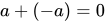
In mathematics, an identity is an equality relating one mathematical expression A to another mathematical expression B, such that A and B (which might contain some variables) produce the same value for all values of the variables within a certain domain of discourse. In other words, A = B is an identity if A and B define the same functions, and an identity is an equality between functions that are differently defined. For example, and are identities. Identities are sometimes indicated by the triple bar symbol ≡ instead of =, the equals sign. Formally, an identity is a universally quantified equality.


Certain identities, such as and , form the basis of algebra, while other identities, such as and , can be useful in simplifying algebraic expressions and expanding them.


Geometrically, trigonometric identities are identities involving certain functions of one or more angles. They are distinct from triangle identities, which are identities involving both angles and side lengths of a triangle. Only the former are covered in this article.
These identities are useful whenever expressions involving trigonometric functions need to be simplified. Another important application is the integration of non-trigonometric functions: a common technique which involves first using the substitution rule with a trigonometric function, and then simplifying the resulting integral with a trigonometric identity.
One of the most prominent examples of trigonometric identities involves the equation which is true for all real values of . On the other hand, the equation


is only true for certain values of , not all. For example, this equation is true when but false when .


Another group of trigonometric identities concerns the so-called addition/subtraction formulas (e.g. the double-angle identity , the addition formula for ), which can be used to break down expressions of larger angles into those with smaller constituents.


The following identities hold for all integer exponents, provided that the base is non-zero:
Hub AI
Identity (mathematics) AI simulator
(@Identity (mathematics)_simulator)
Identity (mathematics)
In mathematics, an identity is an equality relating one mathematical expression A to another mathematical expression B, such that A and B (which might contain some variables) produce the same value for all values of the variables within a certain domain of discourse. In other words, A = B is an identity if A and B define the same functions, and an identity is an equality between functions that are differently defined. For example, and are identities. Identities are sometimes indicated by the triple bar symbol ≡ instead of =, the equals sign. Formally, an identity is a universally quantified equality.
Certain identities, such as and , form the basis of algebra, while other identities, such as and , can be useful in simplifying algebraic expressions and expanding them.
Geometrically, trigonometric identities are identities involving certain functions of one or more angles. They are distinct from triangle identities, which are identities involving both angles and side lengths of a triangle. Only the former are covered in this article.
These identities are useful whenever expressions involving trigonometric functions need to be simplified. Another important application is the integration of non-trigonometric functions: a common technique which involves first using the substitution rule with a trigonometric function, and then simplifying the resulting integral with a trigonometric identity.
One of the most prominent examples of trigonometric identities involves the equation which is true for all real values of . On the other hand, the equation
is only true for certain values of , not all. For example, this equation is true when but false when .
Another group of trigonometric identities concerns the so-called addition/subtraction formulas (e.g. the double-angle identity , the addition formula for ), which can be used to break down expressions of larger angles into those with smaller constituents.
The following identities hold for all integer exponents, provided that the base is non-zero:
Recent media