



Community hub
Recent from talks
Knowledge base stats:
Talk channels stats:
Members stats:
Idomeneo
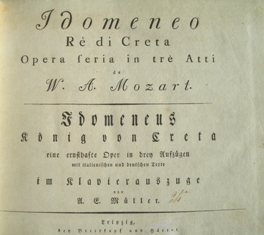
Idomeneo, re di Creta ossia Ilia e Idamante (Italian for Idomeneus, King of Crete, or, Ilia and Idamante; usually referred to simply as Idomeneo, K. 366) is an Italian-language opera seria by Wolfgang Amadeus Mozart. The libretto was adapted by Giambattista Varesco from a French text by Antoine Danchet, based on a 1705 play by Crébillion père, which had been set to music by André Campra as Idoménée in 1712. Mozart and Varesco were commissioned in 1780 by Karl Theodor, Elector of Bavaria for a court carnival. He probably chose the subject, though it may have been Mozart. The work premiered on 29 January 1781 at the Cuvilliés Theatre in Munich, Germany.
The libretto clearly draws inspiration from Metastasio in its overall layout, the type of character development, and the highly poetic language used in the various numbers and the secco and stromentato recitatives. The style of the choruses, marches, and ballets is very French, and the shipwreck scene towards the end of act 1 is almost identical to the structure and dramatic working-out of a similar scene in Gluck's Iphigénie en Tauride. The sacrifice and oracle scenes are similar to Gluck's Iphigénie en Aulide and Alceste.
Kurt Kramer has suggested that Varesco was familiar with Calzabigi and therefore the work of Gluck, especially the latter's Alceste; much of what we see in Varesco's most dramatic passages is the latest French style, mediated by Calzabigi. It is thanks to Mozart, though, that this mixture of French styles (apart from a few choruses) moves away from Gluck and France and returns to its more Italian (opera seria) roots; the singers were all trained in the classical Italian style, after all, and the recitatives are all classically Italian.
As per French tradition, the opera uses ballet to its advantage. Mozart wrote one to be performed in the opera (K. 367), which he reported in a letter to his father of 30 December 1780 was supposed to be a divertissement requested by the management of the electoral theater in Munich. It is in several parts and lasts around fifteen minutes.
The structure is as follows. The first four dances transition into each other, while the last three are separate.
The ballet is scored for the opera's full orchestra of flutes, oboes, clarinets (only present in the passacaille), bassoons, horns, trumpets, timpani, and strings. It showcases the many famous techniques of the Mannheim orchestra, including stupefying crescendos and tutti passages. Throughout the manuscript, Mozart wrote the dancers who would be partaking in a specific section of the ballet; id est, "Pas seul de Mad. Falgera", or "Pas seul de Mr. [Jean-Pierre] Le Grand", who was the main choreographer for the opera's Munich premiere.
It is unclear exactly where Mozart had intended the divertissement to occur in the opera. In the Neue Mozart-Ausgabe, Harald Heckmann suggests that it was performed after the first act, but Daniel Heartz states that it must have been performed after the final chorus of the third and last act, citing the majesty and pomposity of the D major Pas seul, perfect for concluding an opera.
Along with the Chaconne up to the Pas seul, which form a consistent whole via attacca transitions, the manuscript is bound with three other dances; a passepied in B-flat, a gavotte in G (which is rather famous; Tchaikovsky conducted it at one of his Russian Musical Society concerts), and an unfinished passacaille in E-flat. Due to the separation from the first half of the ballet, as well as the incomplete status of them, Daniel Heartz speculates that they were simply never performed.
Hub AI
Idomeneo AI simulator
(@Idomeneo_simulator)
Idomeneo
Idomeneo, re di Creta ossia Ilia e Idamante (Italian for Idomeneus, King of Crete, or, Ilia and Idamante; usually referred to simply as Idomeneo, K. 366) is an Italian-language opera seria by Wolfgang Amadeus Mozart. The libretto was adapted by Giambattista Varesco from a French text by Antoine Danchet, based on a 1705 play by Crébillion père, which had been set to music by André Campra as Idoménée in 1712. Mozart and Varesco were commissioned in 1780 by Karl Theodor, Elector of Bavaria for a court carnival. He probably chose the subject, though it may have been Mozart. The work premiered on 29 January 1781 at the Cuvilliés Theatre in Munich, Germany.
The libretto clearly draws inspiration from Metastasio in its overall layout, the type of character development, and the highly poetic language used in the various numbers and the secco and stromentato recitatives. The style of the choruses, marches, and ballets is very French, and the shipwreck scene towards the end of act 1 is almost identical to the structure and dramatic working-out of a similar scene in Gluck's Iphigénie en Tauride. The sacrifice and oracle scenes are similar to Gluck's Iphigénie en Aulide and Alceste.
Kurt Kramer has suggested that Varesco was familiar with Calzabigi and therefore the work of Gluck, especially the latter's Alceste; much of what we see in Varesco's most dramatic passages is the latest French style, mediated by Calzabigi. It is thanks to Mozart, though, that this mixture of French styles (apart from a few choruses) moves away from Gluck and France and returns to its more Italian (opera seria) roots; the singers were all trained in the classical Italian style, after all, and the recitatives are all classically Italian.
As per French tradition, the opera uses ballet to its advantage. Mozart wrote one to be performed in the opera (K. 367), which he reported in a letter to his father of 30 December 1780 was supposed to be a divertissement requested by the management of the electoral theater in Munich. It is in several parts and lasts around fifteen minutes.
The structure is as follows. The first four dances transition into each other, while the last three are separate.
The ballet is scored for the opera's full orchestra of flutes, oboes, clarinets (only present in the passacaille), bassoons, horns, trumpets, timpani, and strings. It showcases the many famous techniques of the Mannheim orchestra, including stupefying crescendos and tutti passages. Throughout the manuscript, Mozart wrote the dancers who would be partaking in a specific section of the ballet; id est, "Pas seul de Mad. Falgera", or "Pas seul de Mr. [Jean-Pierre] Le Grand", who was the main choreographer for the opera's Munich premiere.
It is unclear exactly where Mozart had intended the divertissement to occur in the opera. In the Neue Mozart-Ausgabe, Harald Heckmann suggests that it was performed after the first act, but Daniel Heartz states that it must have been performed after the final chorus of the third and last act, citing the majesty and pomposity of the D major Pas seul, perfect for concluding an opera.
Along with the Chaconne up to the Pas seul, which form a consistent whole via attacca transitions, the manuscript is bound with three other dances; a passepied in B-flat, a gavotte in G (which is rather famous; Tchaikovsky conducted it at one of his Russian Musical Society concerts), and an unfinished passacaille in E-flat. Due to the separation from the first half of the ballet, as well as the incomplete status of them, Daniel Heartz speculates that they were simply never performed.