


Community hub
Recent from talks
Contribute something to knowledge base
Content stats: 0 posts, 0 articles, 1 media, 0 notes
Members stats: 0 subscribers, 0 contributors, 0 moderators, 0 supporters
Subscribers
Supporters
Contributors
Moderators
Hub AI
Idukki Dam AI simulator
(@Idukki Dam_simulator)
Hub AI
Idukki Dam AI simulator
(@Idukki Dam_simulator)
Idukki Dam
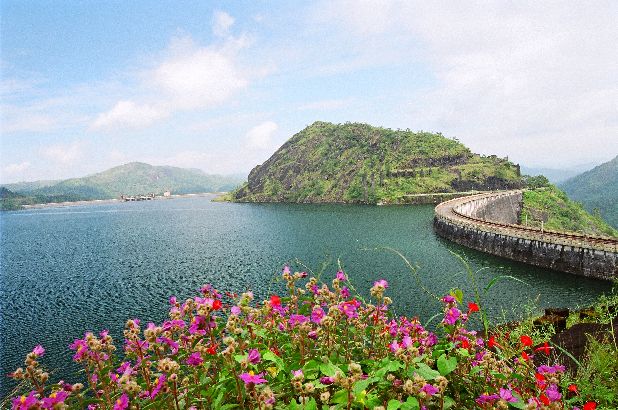
The Idukki Dam is a double-curvature thin arch dam constructed across the Periyar River in a narrow gorge between two granite hills locally known as Kuravan and Kurathi, in Idukki district, in the state of Kerala, India. It is constructed and owned by the Kerala State Electricity Board. It supports a 780 MW hydroelectric power station in Moolamattom, which started generating power on 4 October 1975. At 168.91 metres (554.2 ft), it is one of the highest arch dams in Asia. The Indo-Canadian project was inaugurated by Prime Minister Indira Gandhi on February 17, 1976.
This dam was constructed along with two other dams at Cheruthoni and Kulamavu. Together, the three dams and Two saddle dams, Kulamavu Saddle Dam (Near Junction) and Kulamavu Saddle Dam (Right Bank) have created an artificial lake that is 60 km2 (23 sq mi) in area. The stored water is used to produce electricity at the Moolamattom Power house, which is located inside nearby rocky caves.
Narakakkanam, Azhutha, Vazhikkadavu, Vadakkepuzha and Kuttiar diversion schemes were later added to augment the Idukki reservoir.
The idea of constructing a dam for power generation was first conceived in 1919 in a report submitted by Italian engineer Jacob to the Travancore government, which was rejected. As per history, Shri Chemban Karuvellayan Kolumban, the head of 'Oorali' tribe during 1922, showed the way to the Malankara Estate Superintendent W.J.John and his friend AC Thomas Edattu, who were on hunting trip to forests near the present Arch Dam. Upon hearing the legend of Kuravan and Kurathi Hills, Thomas impressed by the sight of water flow between the mountains; suggested the spot suitable for an Arch dam. In 1932, W.J.John submitted a report to the Government of Travancore on the possibility of constructing a dam at Idukki for Power Generation. In 1935, assembly member Shri.K.A.Narayana Pillai brought the Idukki project to the attention of Government of Travancore. Italian engineers Angelo Omedayo and Clantheyo Masele conducted a study in 1937 but things didn't go forward.
In 1947, a preliminary investigation report was prepared and submitted by Sri. P. Joseph John, then The Chief Electrical Engineer to the Government of Travancore. It was during 1956 that the Central Water Commission conducted a detailed investigation based on the Government's request. The project report was prepared in 1961 and the Planning Commission accorded sanction for implementing the scheme in 1963. In 1964, under the leadership of Sri. E.U.Philipose, Superintending Engineer, preliminary works of the project were started.[citation needed]
The construction of this dam commenced on 30 April 1969. The project led by Dr.D.Babu Paul IAS, who was appointed as Project Coordinator, Idukki Hydel Project & District Collector with several engineers like Sri. C.V Mathews and Sri. M. Ramachandran, (Retired Chief Engineers, Kerala State Electricity Board). The Government of Canada aided the Project with long-term loans and grants. SNC-Lavalin, Canada, a well-known firm of Consulting Engineers were advising and assisting Project Engineers under Canadian aid, while Hindustan Construction Company (a.k.a. HCC) of Walchand group won the bid for construction.
Storage of water in Idukki reservoir commenced in February, 1973. The inauguration of trial run of the first machine was celebrated on 4 October 1975. Commercial operation of the Power Station was Commissioned on 12 February 1976 by the then Prime Minister Smt. Indira Gandhi.
The Idukki Dam is 168.91 m (554.2 ft) tall, constructed between two mountains, Kuravanmala (839 m (2,753 ft)) and Kurathimala (925 m (3,035 ft)). The length of the dam on its top is 365.85 m (1,200.3 ft). It has a width of 7.62 m (25.0 ft) at the top and 19.81 m (65.0 ft) at the bottom. The gross storage capacity of the dam is 1.996 cubic kms (70.50 tmc ft). About 464,000 m3 (16,400,000 cu ft) of concrete was used in the construction of the dam. This project is situated in Idukki District and its underground power house is located at Moolamattom which is about 43 km (27 mi) from the dam. It is notable that the Idukki arch dam does not have any shutters. The reservoir water level is maintained by the shutters in the Cheruthoni dam.
Idukki Dam
The Idukki Dam is a double-curvature thin arch dam constructed across the Periyar River in a narrow gorge between two granite hills locally known as Kuravan and Kurathi, in Idukki district, in the state of Kerala, India. It is constructed and owned by the Kerala State Electricity Board. It supports a 780 MW hydroelectric power station in Moolamattom, which started generating power on 4 October 1975. At 168.91 metres (554.2 ft), it is one of the highest arch dams in Asia. The Indo-Canadian project was inaugurated by Prime Minister Indira Gandhi on February 17, 1976.
This dam was constructed along with two other dams at Cheruthoni and Kulamavu. Together, the three dams and Two saddle dams, Kulamavu Saddle Dam (Near Junction) and Kulamavu Saddle Dam (Right Bank) have created an artificial lake that is 60 km2 (23 sq mi) in area. The stored water is used to produce electricity at the Moolamattom Power house, which is located inside nearby rocky caves.
Narakakkanam, Azhutha, Vazhikkadavu, Vadakkepuzha and Kuttiar diversion schemes were later added to augment the Idukki reservoir.
The idea of constructing a dam for power generation was first conceived in 1919 in a report submitted by Italian engineer Jacob to the Travancore government, which was rejected. As per history, Shri Chemban Karuvellayan Kolumban, the head of 'Oorali' tribe during 1922, showed the way to the Malankara Estate Superintendent W.J.John and his friend AC Thomas Edattu, who were on hunting trip to forests near the present Arch Dam. Upon hearing the legend of Kuravan and Kurathi Hills, Thomas impressed by the sight of water flow between the mountains; suggested the spot suitable for an Arch dam. In 1932, W.J.John submitted a report to the Government of Travancore on the possibility of constructing a dam at Idukki for Power Generation. In 1935, assembly member Shri.K.A.Narayana Pillai brought the Idukki project to the attention of Government of Travancore. Italian engineers Angelo Omedayo and Clantheyo Masele conducted a study in 1937 but things didn't go forward.
In 1947, a preliminary investigation report was prepared and submitted by Sri. P. Joseph John, then The Chief Electrical Engineer to the Government of Travancore. It was during 1956 that the Central Water Commission conducted a detailed investigation based on the Government's request. The project report was prepared in 1961 and the Planning Commission accorded sanction for implementing the scheme in 1963. In 1964, under the leadership of Sri. E.U.Philipose, Superintending Engineer, preliminary works of the project were started.[citation needed]
The construction of this dam commenced on 30 April 1969. The project led by Dr.D.Babu Paul IAS, who was appointed as Project Coordinator, Idukki Hydel Project & District Collector with several engineers like Sri. C.V Mathews and Sri. M. Ramachandran, (Retired Chief Engineers, Kerala State Electricity Board). The Government of Canada aided the Project with long-term loans and grants. SNC-Lavalin, Canada, a well-known firm of Consulting Engineers were advising and assisting Project Engineers under Canadian aid, while Hindustan Construction Company (a.k.a. HCC) of Walchand group won the bid for construction.
Storage of water in Idukki reservoir commenced in February, 1973. The inauguration of trial run of the first machine was celebrated on 4 October 1975. Commercial operation of the Power Station was Commissioned on 12 February 1976 by the then Prime Minister Smt. Indira Gandhi.
The Idukki Dam is 168.91 m (554.2 ft) tall, constructed between two mountains, Kuravanmala (839 m (2,753 ft)) and Kurathimala (925 m (3,035 ft)). The length of the dam on its top is 365.85 m (1,200.3 ft). It has a width of 7.62 m (25.0 ft) at the top and 19.81 m (65.0 ft) at the bottom. The gross storage capacity of the dam is 1.996 cubic kms (70.50 tmc ft). About 464,000 m3 (16,400,000 cu ft) of concrete was used in the construction of the dam. This project is situated in Idukki District and its underground power house is located at Moolamattom which is about 43 km (27 mi) from the dam. It is notable that the Idukki arch dam does not have any shutters. The reservoir water level is maintained by the shutters in the Cheruthoni dam.
Recent media
Recent media