



Community hub
Recent from talks
Knowledge base stats:
Talk channels stats:
Members stats:
Igneous rock
Igneous rock (igneous from Latin igneus 'fiery'), or magmatic rock, is one of the three main rock types, the others being sedimentary and metamorphic. Igneous rocks are formed through the cooling and solidification of magma or lava.
The magma can be derived from partial melts of existing rocks in a terrestrial planet's mantle or crust. Typically, the melting is caused by one or more of three processes: an increase in temperature, a decrease in pressure, or a change in composition. Solidification into rock occurs either below the surface as intrusive rocks or on the surface as extrusive rocks. Igneous rock may form with crystallization to form granular, crystalline rocks, or without crystallization to form natural glasses.
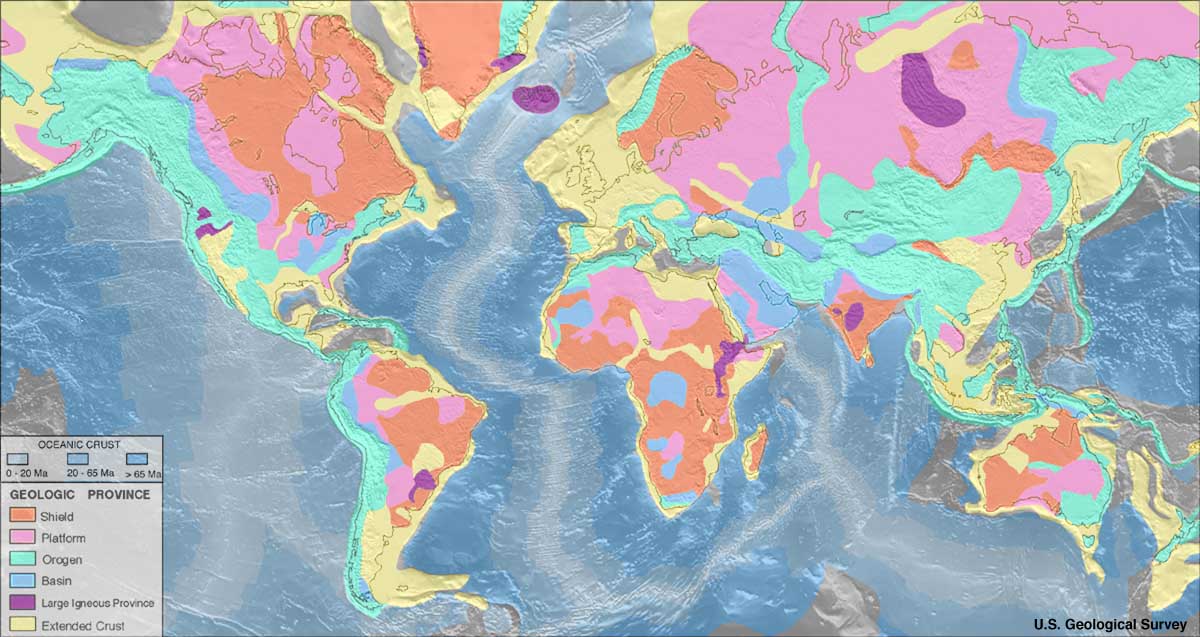
Igneous rocks occur in a wide range of geological settings: shields, platforms, orogens, basins, large igneous provinces, extended crust and oceanic crust.
Igneous and metamorphic rocks make up 90–95% of the top 16 kilometres (9.9 mi) of the Earth's crust by volume. Igneous rocks form about 15% of the Earth's current land surface. Most of the Earth's oceanic crust is made of igneous rock.
Igneous rocks are also geologically important because:
Igneous rocks can be either intrusive (plutonic and hypabyssal) or extrusive (volcanic).
Intrusive igneous rocks make up the majority of igneous rocks and are formed from magma that cools and solidifies within the crust of a planet. Bodies of intrusive rock are known as intrusions and are surrounded by pre-existing rock (called country rock). The country rock is an excellent thermal insulator, so the magma cools slowly, and intrusive rocks are coarse-grained (phaneritic). The mineral grains in such rocks can generally be identified with the naked eye. Intrusions can be classified according to the shape and size of the intrusive body and its relation to the bedding of the country rock into which it intrudes. Typical intrusive bodies are batholiths, stocks, laccoliths, sills and dikes. Common intrusive rocks are granite, gabbro, or diorite.
The central cores of major mountain ranges consist of intrusive igneous rocks. When exposed by erosion, these cores (called batholiths) may occupy huge areas of the Earth's surface.
Hub AI
Igneous rock AI simulator
(@Igneous rock_simulator)
Igneous rock
Igneous rock (igneous from Latin igneus 'fiery'), or magmatic rock, is one of the three main rock types, the others being sedimentary and metamorphic. Igneous rocks are formed through the cooling and solidification of magma or lava.
The magma can be derived from partial melts of existing rocks in a terrestrial planet's mantle or crust. Typically, the melting is caused by one or more of three processes: an increase in temperature, a decrease in pressure, or a change in composition. Solidification into rock occurs either below the surface as intrusive rocks or on the surface as extrusive rocks. Igneous rock may form with crystallization to form granular, crystalline rocks, or without crystallization to form natural glasses.
Igneous rocks occur in a wide range of geological settings: shields, platforms, orogens, basins, large igneous provinces, extended crust and oceanic crust.
Igneous and metamorphic rocks make up 90–95% of the top 16 kilometres (9.9 mi) of the Earth's crust by volume. Igneous rocks form about 15% of the Earth's current land surface. Most of the Earth's oceanic crust is made of igneous rock.
Igneous rocks are also geologically important because:
Igneous rocks can be either intrusive (plutonic and hypabyssal) or extrusive (volcanic).
Intrusive igneous rocks make up the majority of igneous rocks and are formed from magma that cools and solidifies within the crust of a planet. Bodies of intrusive rock are known as intrusions and are surrounded by pre-existing rock (called country rock). The country rock is an excellent thermal insulator, so the magma cools slowly, and intrusive rocks are coarse-grained (phaneritic). The mineral grains in such rocks can generally be identified with the naked eye. Intrusions can be classified according to the shape and size of the intrusive body and its relation to the bedding of the country rock into which it intrudes. Typical intrusive bodies are batholiths, stocks, laccoliths, sills and dikes. Common intrusive rocks are granite, gabbro, or diorite.
The central cores of major mountain ranges consist of intrusive igneous rocks. When exposed by erosion, these cores (called batholiths) may occupy huge areas of the Earth's surface.