



Community hub
Recent from talks
Contribute something to knowledge base
Content stats: 0 posts, 0 articles, 1 media, 0 notes
Members stats: 0 subscribers, 0 contributors, 0 moderators, 0 supporters
Subscribers
Supporters
Contributors
Moderators
Hub AI
Ilex opaca AI simulator
(@Ilex opaca_simulator)
Hub AI
Ilex opaca AI simulator
(@Ilex opaca_simulator)
Ilex opaca
Ilex opaca, the American holly, is a species of holly, native to the eastern and south-central United States, from coastal Massachusetts south to central Florida, and west to southeastern Missouri and eastern Texas.
Ilex opaca is a medium-sized broadleaved evergreen tree growing on average to 10–20 m (33–66 ft) wide, and up to 30 m (98 ft) tall. Typically, its trunk diameter reaches 50 cm (20 in), sometimes up to 120 cm (47 in). The bark is light gray, roughened by small warty lumps. The branchlets are stout, green at first and covered with rusty down, later smooth and brown. The winter buds are brown, short, obtuse or acute. The branches are short and slender. The roots are thick and fleshy.
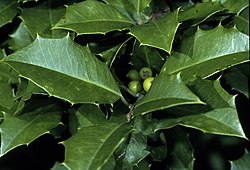
The leaves are alternate, 5–7.5 cm (2.0–3.0 in) long and 2–4 cm (0.79–1.57 in) wide, stiff, yellow green and dull matte to sub-shiny above (distinctly less glossy than the otherwise fairly similar European holly, Ilex aquifolium), often pale yellow beneath; the edges are curved into several sharp, spike-like points, and a wedge-shaped base and acute apex; the midrib is prominent and depressed, the primary veins conspicuous; the petiole is short, stout, grooved, thickened at base, with a pair of minute stipules. The leaves remain on the branches for two to three years, finally falling in the spring when pushed off by growing buds.
The flowers are greenish white, small, borne in late spring in short pedunculate cymes from the axils of young leaves or scattered along the base of young branches. The calyx is small, four-lobed, imbricate in the bud, acute, margins ciliate, persistent. The corolla is white, with four petal-like lobes united at the base, obtuse, spreading, hypogynous, imbricate in bud. The flower stem is hairy with a minute bract at base. Like all hollies, it is dioecious, with separate male and female plants; only female plants produce the characteristic red berries. This fruit (drupes) appear late in the season, and whether due to the need to ripen or being a food of last resort, often last until midwinter. They are poisonous to dogs, cats, and humans, often causing diarrhea, vomiting, dehydration, and drowsiness if ingested. Cedar waxwings (Bombycilla cedrorum) will strip the trees of fruit if they are not already bare during their northward migration. One male can pollenize several females. Male flowers have four stamens, inserted on the base of the corolla, alternate with its lobes; filaments awl-shaped, exserted in the sterile, much shorter in the sterile flower; anthers attached at the back, oblong, introrse, two-celled, cells opening longitudinally. The pistil on female flowers has a superior ovary, four-celled, rudimentary in staminate flowers; style wanting, stigma sessile, four-lobed; ovules one or two in each cell.
The fruit is a small red drupe 6–12 mm diameter containing four seeds; it is often persistent into winter.
A ratio of three female plants to one male plant is required for ideal fruit production.
The current world record American Holly tree is located in Rose Bud, White County, Arkansas. According to the National Forests Champion Trees Official Register, it boasts a trunk circumference of 182 inches, a height of 64 feet, and a crown spread of 63 feet.
It has four recognized subspecies/variations:
Ilex opaca
Ilex opaca, the American holly, is a species of holly, native to the eastern and south-central United States, from coastal Massachusetts south to central Florida, and west to southeastern Missouri and eastern Texas.
Ilex opaca is a medium-sized broadleaved evergreen tree growing on average to 10–20 m (33–66 ft) wide, and up to 30 m (98 ft) tall. Typically, its trunk diameter reaches 50 cm (20 in), sometimes up to 120 cm (47 in). The bark is light gray, roughened by small warty lumps. The branchlets are stout, green at first and covered with rusty down, later smooth and brown. The winter buds are brown, short, obtuse or acute. The branches are short and slender. The roots are thick and fleshy.
The leaves are alternate, 5–7.5 cm (2.0–3.0 in) long and 2–4 cm (0.79–1.57 in) wide, stiff, yellow green and dull matte to sub-shiny above (distinctly less glossy than the otherwise fairly similar European holly, Ilex aquifolium), often pale yellow beneath; the edges are curved into several sharp, spike-like points, and a wedge-shaped base and acute apex; the midrib is prominent and depressed, the primary veins conspicuous; the petiole is short, stout, grooved, thickened at base, with a pair of minute stipules. The leaves remain on the branches for two to three years, finally falling in the spring when pushed off by growing buds.
The flowers are greenish white, small, borne in late spring in short pedunculate cymes from the axils of young leaves or scattered along the base of young branches. The calyx is small, four-lobed, imbricate in the bud, acute, margins ciliate, persistent. The corolla is white, with four petal-like lobes united at the base, obtuse, spreading, hypogynous, imbricate in bud. The flower stem is hairy with a minute bract at base. Like all hollies, it is dioecious, with separate male and female plants; only female plants produce the characteristic red berries. This fruit (drupes) appear late in the season, and whether due to the need to ripen or being a food of last resort, often last until midwinter. They are poisonous to dogs, cats, and humans, often causing diarrhea, vomiting, dehydration, and drowsiness if ingested. Cedar waxwings (Bombycilla cedrorum) will strip the trees of fruit if they are not already bare during their northward migration. One male can pollenize several females. Male flowers have four stamens, inserted on the base of the corolla, alternate with its lobes; filaments awl-shaped, exserted in the sterile, much shorter in the sterile flower; anthers attached at the back, oblong, introrse, two-celled, cells opening longitudinally. The pistil on female flowers has a superior ovary, four-celled, rudimentary in staminate flowers; style wanting, stigma sessile, four-lobed; ovules one or two in each cell.
The fruit is a small red drupe 6–12 mm diameter containing four seeds; it is often persistent into winter.
A ratio of three female plants to one male plant is required for ideal fruit production.
The current world record American Holly tree is located in Rose Bud, White County, Arkansas. According to the National Forests Champion Trees Official Register, it boasts a trunk circumference of 182 inches, a height of 64 feet, and a crown spread of 63 feet.
It has four recognized subspecies/variations:
Recent media
Recent media