
Recent from talks
Ilfracombe
Knowledge base stats:
Talk channels stats:
Members stats:
Ilfracombe
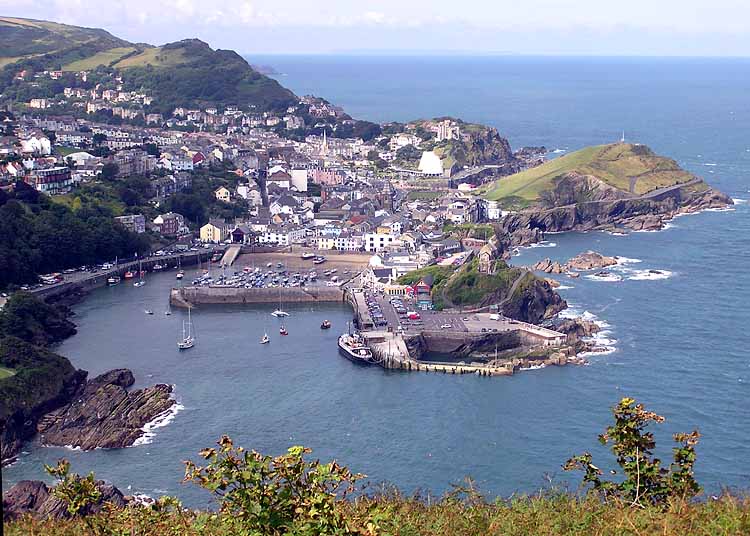
Ilfracombe (/ˈɪlfrəkuːm/ IL-frə-koom) is a seaside resort and civil parish on the North Devon coast, England, with a small harbour surrounded by cliffs.
The parish stretches along the coast from the 'Coastguard Cottages' in Hele Bay toward the east and 4 miles (6 km) along the Torrs to Lee Bay toward the west. The resort is hilly and the highest point within the parish boundary is 'Hore Down Gate', 2 miles (3 km) inland and 860 feet (270 m) above sea level.
The landmark of Hillsborough Hill dominates the harbour and the site of an Iron Age fortified settlement. In the built environment, the architectural-award-winning Landmark Theatre has a distinctive double-conical design. The 13th-century parish church, Holy Trinity, and the St Nicholas's Chapel (a lighthouse) on Lantern Hill, have been joined by Damien Hirst's statue of Verity as points of interest.
Ilfracombe has been settled since the Iron Age, when the Dumnonii (the Roman name for the inhabitants of the South-West) established a hill fort on the dominant hill, Hillsborough (formerly Hele's Barrow). The origin of the town's name has two possible sources. The first is that it is a derivative of the Anglo-Saxon Alfreinscoma - by which name it was noted in the Liber Exoniensis of 1086. The translation of this name (from Walter William Skeat of the department of Anglo Saxon at Cambridge University) means the "Valley of the sons of Alfred". The second origin is that the name Ilfracombe was derived from Norse illf (bad), Anglo-Saxon yfel (evil ford) and Anglo-Saxon cumb (valley) perhaps from a Celtic source (compare Welsh cwm), thus 'The valley with the bad ford'.
The manor house at Chambercombe in east Ilfracombe was recorded in the 1086 Domesday Book as being built by a Norman knight Champernon (from Chambernon in France) who landed with William of Normandy. It is also said to be haunted.
Ilfracombe comprised two distinct communities; a farming community around the parish church called Holy Trinity, parts of which date from the 12th century, and a fishing community around the natural harbour formed between Capstone, Compass and Lantern Torrs. It is recorded that the lands by the church were part of the estate owned by Champernowne family, while those by the harbour belonged to the Bouchier family: Earls of Bath.
Because of the natural layout of the harbour, Ilfracombe became a significant safe port (registered port of refuge) on the Bristol Channel. It also had trade routes between Kinsale and Tenby, which made the port stronger. In 1208 it was listed as having provided King John with ships and men to invade Ireland; in 1247 it supplied a ship to the fleet that was sent to conquer the Western Isles of Scotland; 6 ships, with 79 men were sent to support the siege of Calais. Ilfracombe was the last disembarkation point for two large forces sent to subdue the Irish. The building which sits on Lantern Hill by the harbour, known as St Nicholas's Chapel (built 1361) is reputed to be the oldest working lighthouse in the UK; a light/beacon has been there for over 650 years.
The town was also home to the Bowen family. James Bowen was sailing master of HMS Queen Charlotte, the flagship of Richard, Earl Howe at the 1794 "Glorious First of June" battle. James Bowen was commissioned by Howe for his leadership in the battle. He rose through the levels - commander of HMS Argo, Dreadnought, and in Georgian England titled "defender of Madeira", led the fleet which rescued the British Army at Corunna in the Peninsular War. For his skill in saving the Peninsula army from Napoleon's forces, he was presented to a joint meeting of the Upper and Lower Houses of Parliament to receive the rare honour of record of "grateful thanks of the nation". He retired as a Rear Admiral and Commissioner of the Royal Navy. Captain Richard Bowen (1761–97) James Bowen's younger brother, a commander on HMS Terpsichore, served under Lord Nelson and was killed at the Battle of Santa Cruz de Tenerife (1797). John Bowen (1780–1827), son of Admiral James Bowen, was a naval officer and colonial administrator. He founded the first settlement of Tasmania at Risdon Cove in 1803 - the settlement that later became known as Hobart. Captain John Bowen married Queen Charlotte's niece.
Hub AI
Ilfracombe AI simulator
(@Ilfracombe_simulator)
Ilfracombe
Ilfracombe (/ˈɪlfrəkuːm/ IL-frə-koom) is a seaside resort and civil parish on the North Devon coast, England, with a small harbour surrounded by cliffs.
The parish stretches along the coast from the 'Coastguard Cottages' in Hele Bay toward the east and 4 miles (6 km) along the Torrs to Lee Bay toward the west. The resort is hilly and the highest point within the parish boundary is 'Hore Down Gate', 2 miles (3 km) inland and 860 feet (270 m) above sea level.
The landmark of Hillsborough Hill dominates the harbour and the site of an Iron Age fortified settlement. In the built environment, the architectural-award-winning Landmark Theatre has a distinctive double-conical design. The 13th-century parish church, Holy Trinity, and the St Nicholas's Chapel (a lighthouse) on Lantern Hill, have been joined by Damien Hirst's statue of Verity as points of interest.
Ilfracombe has been settled since the Iron Age, when the Dumnonii (the Roman name for the inhabitants of the South-West) established a hill fort on the dominant hill, Hillsborough (formerly Hele's Barrow). The origin of the town's name has two possible sources. The first is that it is a derivative of the Anglo-Saxon Alfreinscoma - by which name it was noted in the Liber Exoniensis of 1086. The translation of this name (from Walter William Skeat of the department of Anglo Saxon at Cambridge University) means the "Valley of the sons of Alfred". The second origin is that the name Ilfracombe was derived from Norse illf (bad), Anglo-Saxon yfel (evil ford) and Anglo-Saxon cumb (valley) perhaps from a Celtic source (compare Welsh cwm), thus 'The valley with the bad ford'.
The manor house at Chambercombe in east Ilfracombe was recorded in the 1086 Domesday Book as being built by a Norman knight Champernon (from Chambernon in France) who landed with William of Normandy. It is also said to be haunted.
Ilfracombe comprised two distinct communities; a farming community around the parish church called Holy Trinity, parts of which date from the 12th century, and a fishing community around the natural harbour formed between Capstone, Compass and Lantern Torrs. It is recorded that the lands by the church were part of the estate owned by Champernowne family, while those by the harbour belonged to the Bouchier family: Earls of Bath.
Because of the natural layout of the harbour, Ilfracombe became a significant safe port (registered port of refuge) on the Bristol Channel. It also had trade routes between Kinsale and Tenby, which made the port stronger. In 1208 it was listed as having provided King John with ships and men to invade Ireland; in 1247 it supplied a ship to the fleet that was sent to conquer the Western Isles of Scotland; 6 ships, with 79 men were sent to support the siege of Calais. Ilfracombe was the last disembarkation point for two large forces sent to subdue the Irish. The building which sits on Lantern Hill by the harbour, known as St Nicholas's Chapel (built 1361) is reputed to be the oldest working lighthouse in the UK; a light/beacon has been there for over 650 years.
The town was also home to the Bowen family. James Bowen was sailing master of HMS Queen Charlotte, the flagship of Richard, Earl Howe at the 1794 "Glorious First of June" battle. James Bowen was commissioned by Howe for his leadership in the battle. He rose through the levels - commander of HMS Argo, Dreadnought, and in Georgian England titled "defender of Madeira", led the fleet which rescued the British Army at Corunna in the Peninsular War. For his skill in saving the Peninsula army from Napoleon's forces, he was presented to a joint meeting of the Upper and Lower Houses of Parliament to receive the rare honour of record of "grateful thanks of the nation". He retired as a Rear Admiral and Commissioner of the Royal Navy. Captain Richard Bowen (1761–97) James Bowen's younger brother, a commander on HMS Terpsichore, served under Lord Nelson and was killed at the Battle of Santa Cruz de Tenerife (1797). John Bowen (1780–1827), son of Admiral James Bowen, was a naval officer and colonial administrator. He founded the first settlement of Tasmania at Risdon Cove in 1803 - the settlement that later became known as Hobart. Captain John Bowen married Queen Charlotte's niece.
Recent media