



Community hub
Recent from talks
Contribute something to knowledge base
Content stats: 0 posts, 0 articles, 1 media, 0 notes
Members stats: 0 subscribers, 0 contributors, 0 moderators, 0 supporters
Subscribers
Supporters
Contributors
Moderators
Hub AI
Ilha Grande AI simulator
(@Ilha Grande_simulator)
Hub AI
Ilha Grande AI simulator
(@Ilha Grande_simulator)
Ilha Grande
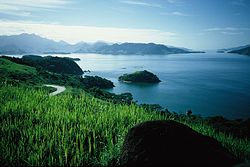
Ilha Grande (Portuguese pronunciation: [ˈiʎɐ ˈɡɾɐ̃dʒi]), or "big island", is a 193 km2 (75 sq mi) forested island located around 12 km (7.5 mi) off of the Atlantic coast of Angra dos Reis, Rio de Janeiro, Brazil, and about 243 km (151 mi) from São Paulo. The highest point on Ilha Grande is the 1,031 m (3,383 ft) tall Pico da Pedra D'Água.
For almost a century, the Brazilian government declared the island off-limits, banning unauthorized entry, as it had contained an immigration quarantine station and, later, a maximum-security prison (Colônia Penal de Dois Rios, later known as Instituto Penal Cândido Mendes). The Cândido Mendes Penal Colony, which housed some of the most dangerous offenders in Brazil, was closed in 1994.
On 1 January 2010, devastating mudslides killed at least 19 people on the island.
On 5 July 2019, Ilha Grande and Paraty were inscribed as a UNESCO World Heritage Site.
Ilha Grande and Paraty are contained within the 12,400 hectares (31,000 acres) of Tamoios Environmental Protection Area (APA), created in 1982. The main island (and APA) contains the Aventureiro Sustainable Development Reserve, created in 2014 from the former Aventureiro Marine State Park, which was integrated with the Praia do Sul Biological Reserve. 62.5% of the island is covered by the Ilha Grande State Park, giving a total of 87% of the island protected status.
Ilha Grande is one of the most pristine examples of Brazil's endangered Atlantic rainforest habitat, containing a multitude of species of plants and animals. A hotspot for biodiversity and conservation, Ilha Grande is home to at least 110 resident and migratory avian species, including Magellanic penguins and red-ruffed fruitcrows. The island has been designated an Important Bird Area (IBA) by BirdLife International because it supports significant populations of solitary tinamous, white-necked hawks, red-browed amazons, unicolored antwrens, cinnamon-vented pihas, bare-throated bellbirds, and azure-shouldered and black-backed tanagers.
There are at least 20 species of mammals, from capybara and coatimundi to primates, such as common and black-tufted marmosets and brown howler monkeys. Smaller animals, such as rodents and carnivores, include gray slender and big-eared opossums, Brazilian squirrel, crab-eating fox and raccoon, red-rumped agouti and the hairy dwarf porcupine. Several species of bat also inhabit caves on the island, mainly from the Artibeus, Molossus and Saccopteryx genera, emerging at sunset to feed on swarms of flying insects.
At least 40-50 species of reptiles and amphibians can be found on the island, including the Argentine black-and-white tegu, Brazilian torrent frog, Bocaina tree frog, broad-snouted caiman, chicken snakes, Chironius, Dipsas and Echinanthera snakes, garden tree boa, geckos, Imantodes snakes, Jackson's and Brazilian fathead anoles, lava lizards, mabuya, painted coralsnake, smallhead worm lizards and the venomous Yarará lancehead. Invertebrates and arthropods number in the hundreds, with at least 400-500 species identified on Ilha Grande.
Ilha Grande
Ilha Grande (Portuguese pronunciation: [ˈiʎɐ ˈɡɾɐ̃dʒi]), or "big island", is a 193 km2 (75 sq mi) forested island located around 12 km (7.5 mi) off of the Atlantic coast of Angra dos Reis, Rio de Janeiro, Brazil, and about 243 km (151 mi) from São Paulo. The highest point on Ilha Grande is the 1,031 m (3,383 ft) tall Pico da Pedra D'Água.
For almost a century, the Brazilian government declared the island off-limits, banning unauthorized entry, as it had contained an immigration quarantine station and, later, a maximum-security prison (Colônia Penal de Dois Rios, later known as Instituto Penal Cândido Mendes). The Cândido Mendes Penal Colony, which housed some of the most dangerous offenders in Brazil, was closed in 1994.
On 1 January 2010, devastating mudslides killed at least 19 people on the island.
On 5 July 2019, Ilha Grande and Paraty were inscribed as a UNESCO World Heritage Site.
Ilha Grande and Paraty are contained within the 12,400 hectares (31,000 acres) of Tamoios Environmental Protection Area (APA), created in 1982. The main island (and APA) contains the Aventureiro Sustainable Development Reserve, created in 2014 from the former Aventureiro Marine State Park, which was integrated with the Praia do Sul Biological Reserve. 62.5% of the island is covered by the Ilha Grande State Park, giving a total of 87% of the island protected status.
Ilha Grande is one of the most pristine examples of Brazil's endangered Atlantic rainforest habitat, containing a multitude of species of plants and animals. A hotspot for biodiversity and conservation, Ilha Grande is home to at least 110 resident and migratory avian species, including Magellanic penguins and red-ruffed fruitcrows. The island has been designated an Important Bird Area (IBA) by BirdLife International because it supports significant populations of solitary tinamous, white-necked hawks, red-browed amazons, unicolored antwrens, cinnamon-vented pihas, bare-throated bellbirds, and azure-shouldered and black-backed tanagers.
There are at least 20 species of mammals, from capybara and coatimundi to primates, such as common and black-tufted marmosets and brown howler monkeys. Smaller animals, such as rodents and carnivores, include gray slender and big-eared opossums, Brazilian squirrel, crab-eating fox and raccoon, red-rumped agouti and the hairy dwarf porcupine. Several species of bat also inhabit caves on the island, mainly from the Artibeus, Molossus and Saccopteryx genera, emerging at sunset to feed on swarms of flying insects.
At least 40-50 species of reptiles and amphibians can be found on the island, including the Argentine black-and-white tegu, Brazilian torrent frog, Bocaina tree frog, broad-snouted caiman, chicken snakes, Chironius, Dipsas and Echinanthera snakes, garden tree boa, geckos, Imantodes snakes, Jackson's and Brazilian fathead anoles, lava lizards, mabuya, painted coralsnake, smallhead worm lizards and the venomous Yarará lancehead. Invertebrates and arthropods number in the hundreds, with at least 400-500 species identified on Ilha Grande.
Recent media
Recent media