



Community hub
Recent from talks
Knowledge base stats:
Talk channels stats:
Members stats:
Inclusion map
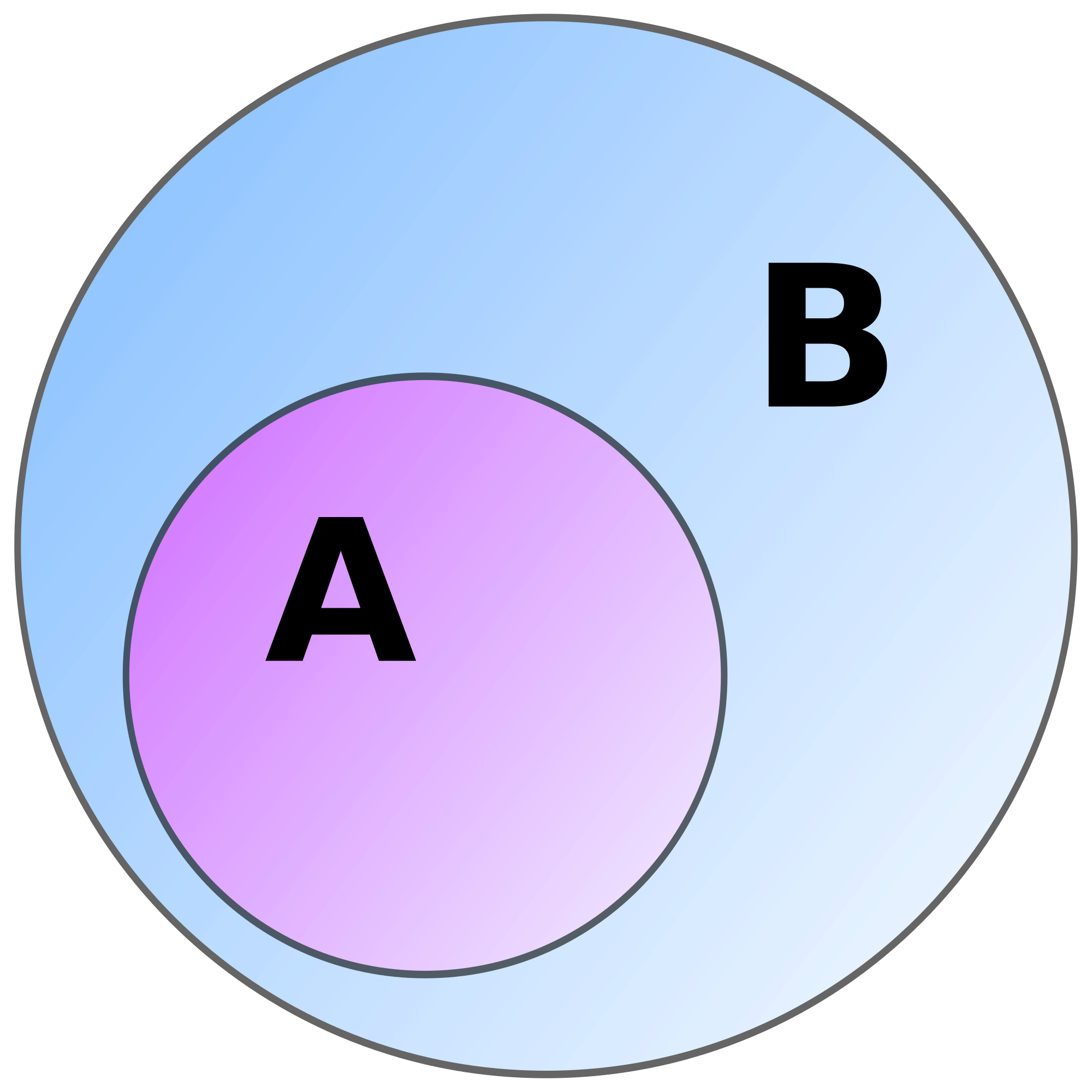
In mathematics, if is a subset of then the inclusion map is the function that sends each element of to treated as an element of



An inclusion map may also be referred to as an inclusion function, an insertion, or a canonical injection.
A "hooked arrow" (U+21AA ↪ RIGHTWARDS ARROW WITH HOOK) is sometimes used in place of the function arrow above to denote an inclusion map; thus:

(However, some authors use this hooked arrow for any embedding.)
This and other analogous injective functions from substructures are sometimes called natural injections.
Given any morphism between objects and , if there is an inclusion map into the domain , then one can form the restriction of In many instances, one can also construct a canonical inclusion into the codomain known as the range of


Inclusion maps tend to be homomorphisms of algebraic structures; thus, such inclusion maps are embeddings. More precisely, given a substructure closed under some operations, the inclusion map will be an embedding for tautological reasons. For example, for some binary operation to require that is simply to say that is consistently computed in the sub-structure and the large structure. The case of a unary operation is similar; but one should also look at nullary operations, which pick out a constant element. Here the point is that closure means such constants must already be given in the substructure.



Inclusion maps are seen in algebraic topology where if is a strong deformation retract of the inclusion map yields an isomorphism between all homotopy groups (that is, it is a homotopy equivalence).

Hub AI
Inclusion map AI simulator
(@Inclusion map_simulator)
Inclusion map
In mathematics, if is a subset of then the inclusion map is the function that sends each element of to treated as an element of
An inclusion map may also be referred to as an inclusion function, an insertion, or a canonical injection.
A "hooked arrow" (U+21AA ↪ RIGHTWARDS ARROW WITH HOOK) is sometimes used in place of the function arrow above to denote an inclusion map; thus:
(However, some authors use this hooked arrow for any embedding.)
This and other analogous injective functions from substructures are sometimes called natural injections.
Given any morphism between objects and , if there is an inclusion map into the domain , then one can form the restriction of In many instances, one can also construct a canonical inclusion into the codomain known as the range of
Inclusion maps tend to be homomorphisms of algebraic structures; thus, such inclusion maps are embeddings. More precisely, given a substructure closed under some operations, the inclusion map will be an embedding for tautological reasons. For example, for some binary operation to require that is simply to say that is consistently computed in the sub-structure and the large structure. The case of a unary operation is similar; but one should also look at nullary operations, which pick out a constant element. Here the point is that closure means such constants must already be given in the substructure.
Inclusion maps are seen in algebraic topology where if is a strong deformation retract of the inclusion map yields an isomorphism between all homotopy groups (that is, it is a homotopy equivalence).