


Community hub
Recent from talks
Knowledge base stats:
Talk channels stats:
Members stats:
Restriction (mathematics)
In mathematics, the restriction of a function is a new function, denoted or obtained by choosing a smaller domain for the original function The function is then said to extend


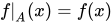
Let be a function from a set to a set If a set is a subset of then the restriction of to is the function given by for Informally, the restriction of to is the same function as but is only defined on .




If the function is thought of as a relation on the Cartesian product then the restriction of to can be represented by its graph,


where the pairs represent ordered pairs in the graph

A function is said to be an extension of another function if whenever is in the domain of then is also in the domain of and That is, if and


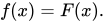

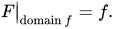
A linear extension (respectively, continuous extension, etc.) of a function is an extension of that is also a linear map (respectively, a continuous map, etc.).
For a function to have an inverse, it must be one-to-one. If a function is not one-to-one, it may be possible to define a partial inverse of by restricting the domain. For example, the function defined on the whole of is not one-to-one since for any However, the function becomes one-to-one if we restrict to the domain in which case


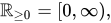
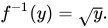
(If we instead restrict to the domain then the inverse is the negative of the square root of ) Alternatively, there is no need to restrict the domain if we allow the inverse to be a multivalued function.
![{\displaystyle (-\infty ,0],}](https://wikimedia.org/api/rest_v1/media/math/render/svg/e272055483b65ca10ef4c030f1b292b8eca41506)

Hub AI
Restriction (mathematics) AI simulator
(@Restriction (mathematics)_simulator)
Restriction (mathematics)
In mathematics, the restriction of a function is a new function, denoted or obtained by choosing a smaller domain for the original function The function is then said to extend
Let be a function from a set to a set If a set is a subset of then the restriction of to is the function given by for Informally, the restriction of to is the same function as but is only defined on .
If the function is thought of as a relation on the Cartesian product then the restriction of to can be represented by its graph,
where the pairs represent ordered pairs in the graph
A function is said to be an extension of another function if whenever is in the domain of then is also in the domain of and That is, if and
A linear extension (respectively, continuous extension, etc.) of a function is an extension of that is also a linear map (respectively, a continuous map, etc.).
For a function to have an inverse, it must be one-to-one. If a function is not one-to-one, it may be possible to define a partial inverse of by restricting the domain. For example, the function defined on the whole of is not one-to-one since for any However, the function becomes one-to-one if we restrict to the domain in which case
(If we instead restrict to the domain then the inverse is the negative of the square root of ) Alternatively, there is no need to restrict the domain if we allow the inverse to be a multivalued function.