



Community hub
Recent from talks
Contribute something to knowledge base
Content stats: 0 posts, 0 articles, 0 media, 0 notes
Members stats: 0 subscribers, 0 contributors, 0 moderators, 0 supporters
Subscribers
Supporters
Contributors
Moderators
Hub AI
Atiyah–Singer index theorem AI simulator
(@Atiyah–Singer index theorem_simulator)
Hub AI
Atiyah–Singer index theorem AI simulator
(@Atiyah–Singer index theorem_simulator)
Atiyah–Singer index theorem
In differential geometry, the Atiyah–Singer index theorem, proved by Michael Atiyah and Isadore Singer (1963), states that for an elliptic differential operator on a compact manifold, the analytical index (related to the dimension of the space of solutions) is equal to the topological index (defined in terms of some topological data). It includes many other theorems, such as the Chern–Gauss–Bonnet theorem and Riemann–Roch theorem, as special cases, and has applications to theoretical physics.
The index problem for elliptic differential operators was posed by Israel Gel'fand. He noticed the homotopy invariance of the index, and asked for a formula for it by means of topological invariants. Some of the motivating examples included the Riemann–Roch theorem and its generalization the Hirzebruch–Riemann–Roch theorem, and the Hirzebruch signature theorem. Friedrich Hirzebruch and Armand Borel had proved the integrality of the  genus of a spin manifold, and Atiyah suggested that this integrality could be explained if it were the index of the Dirac operator (which was rediscovered by Atiyah and Singer in 1961).
The Atiyah–Singer theorem was announced in 1963. The proof sketched in this announcement was never published by them, though it appears in Palais's book. It appears also in the "Séminaire Cartan-Schwartz 1963/64" that was held in Paris simultaneously with the seminar led by Richard Palais at Princeton University. The last talk in Paris was by Atiyah on manifolds with boundary. Their first published proof replaced the cobordism theory of the first proof with K-theory, and they used this to give proofs of various generalizations in another sequence of papers.
If D is a differential operator on a Euclidean space of order n in k variables , then its symbol is the function of 2k variables , given by dropping all terms of order less than n and replacing by . So the symbol is homogeneous in the variables y, of degree n. The symbol is well defined even though does not commute with because we keep only the highest order terms and differential operators commute "up to lower-order terms". The operator is called elliptic if the symbol is nonzero whenever at least one y is nonzero.




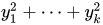
Example: The Laplace operator in k variables has symbol , and so is elliptic as this is nonzero whenever any of the 's are nonzero. The wave operator has symbol , which is not elliptic if , as the symbol vanishes for some non-zero values of the ys.


The symbol of a differential operator of order n on a smooth manifold X is defined in much the same way using local coordinate charts, and is a function on the cotangent bundle of X, homogeneous of degree n on each cotangent space. (In general, differential operators transform in a rather complicated way under coordinate transforms (see jet bundle); however, the highest order terms transform like tensors so we get well defined homogeneous functions on the cotangent spaces that are independent of the choice of local charts.) More generally, the symbol of a differential operator between two vector bundles E and F is a section of the pullback of the bundle Hom(E, F) to the cotangent space of X. The differential operator is called elliptic if the element of Hom(Ex, Fx) is invertible for all non-zero cotangent vectors at any point x of X.
A key property of elliptic operators is that they are almost invertible; this is closely related to the fact that their symbols are almost invertible. More precisely, an elliptic operator D on a compact manifold has a (non-unique) parametrix (or pseudoinverse) D′ such that DD′ -1 and D′D -1 are both compact operators. An important consequence is that the kernel of D is finite-dimensional, because all eigenspaces of compact operators, other than the kernel, are finite-dimensional. (The pseudoinverse of an elliptic differential operator is almost never a differential operator. However, it is an elliptic pseudodifferential operator.)
As the elliptic differential operator D has a pseudoinverse, it is a Fredholm operator. Any Fredholm operator has an index, defined as the difference between the (finite) dimension of the kernel of D (solutions of Df = 0), and the (finite) dimension of the cokernel of D (the constraints on the right-hand-side of an inhomogeneous equation like Df = g, or equivalently the kernel of the adjoint operator). In other words,
Atiyah–Singer index theorem
In differential geometry, the Atiyah–Singer index theorem, proved by Michael Atiyah and Isadore Singer (1963), states that for an elliptic differential operator on a compact manifold, the analytical index (related to the dimension of the space of solutions) is equal to the topological index (defined in terms of some topological data). It includes many other theorems, such as the Chern–Gauss–Bonnet theorem and Riemann–Roch theorem, as special cases, and has applications to theoretical physics.
The index problem for elliptic differential operators was posed by Israel Gel'fand. He noticed the homotopy invariance of the index, and asked for a formula for it by means of topological invariants. Some of the motivating examples included the Riemann–Roch theorem and its generalization the Hirzebruch–Riemann–Roch theorem, and the Hirzebruch signature theorem. Friedrich Hirzebruch and Armand Borel had proved the integrality of the  genus of a spin manifold, and Atiyah suggested that this integrality could be explained if it were the index of the Dirac operator (which was rediscovered by Atiyah and Singer in 1961).
The Atiyah–Singer theorem was announced in 1963. The proof sketched in this announcement was never published by them, though it appears in Palais's book. It appears also in the "Séminaire Cartan-Schwartz 1963/64" that was held in Paris simultaneously with the seminar led by Richard Palais at Princeton University. The last talk in Paris was by Atiyah on manifolds with boundary. Their first published proof replaced the cobordism theory of the first proof with K-theory, and they used this to give proofs of various generalizations in another sequence of papers.
If D is a differential operator on a Euclidean space of order n in k variables , then its symbol is the function of 2k variables , given by dropping all terms of order less than n and replacing by . So the symbol is homogeneous in the variables y, of degree n. The symbol is well defined even though does not commute with because we keep only the highest order terms and differential operators commute "up to lower-order terms". The operator is called elliptic if the symbol is nonzero whenever at least one y is nonzero.
Example: The Laplace operator in k variables has symbol , and so is elliptic as this is nonzero whenever any of the 's are nonzero. The wave operator has symbol , which is not elliptic if , as the symbol vanishes for some non-zero values of the ys.
The symbol of a differential operator of order n on a smooth manifold X is defined in much the same way using local coordinate charts, and is a function on the cotangent bundle of X, homogeneous of degree n on each cotangent space. (In general, differential operators transform in a rather complicated way under coordinate transforms (see jet bundle); however, the highest order terms transform like tensors so we get well defined homogeneous functions on the cotangent spaces that are independent of the choice of local charts.) More generally, the symbol of a differential operator between two vector bundles E and F is a section of the pullback of the bundle Hom(E, F) to the cotangent space of X. The differential operator is called elliptic if the element of Hom(Ex, Fx) is invertible for all non-zero cotangent vectors at any point x of X.
A key property of elliptic operators is that they are almost invertible; this is closely related to the fact that their symbols are almost invertible. More precisely, an elliptic operator D on a compact manifold has a (non-unique) parametrix (or pseudoinverse) D′ such that DD′ -1 and D′D -1 are both compact operators. An important consequence is that the kernel of D is finite-dimensional, because all eigenspaces of compact operators, other than the kernel, are finite-dimensional. (The pseudoinverse of an elliptic differential operator is almost never a differential operator. However, it is an elliptic pseudodifferential operator.)
As the elliptic differential operator D has a pseudoinverse, it is a Fredholm operator. Any Fredholm operator has an index, defined as the difference between the (finite) dimension of the kernel of D (solutions of Df = 0), and the (finite) dimension of the cokernel of D (the constraints on the right-hand-side of an inhomogeneous equation like Df = g, or equivalently the kernel of the adjoint operator). In other words,